The ‘Civilian’ French Truck That Quietly Carried France’s Most Sensitive Cold War Cargo D
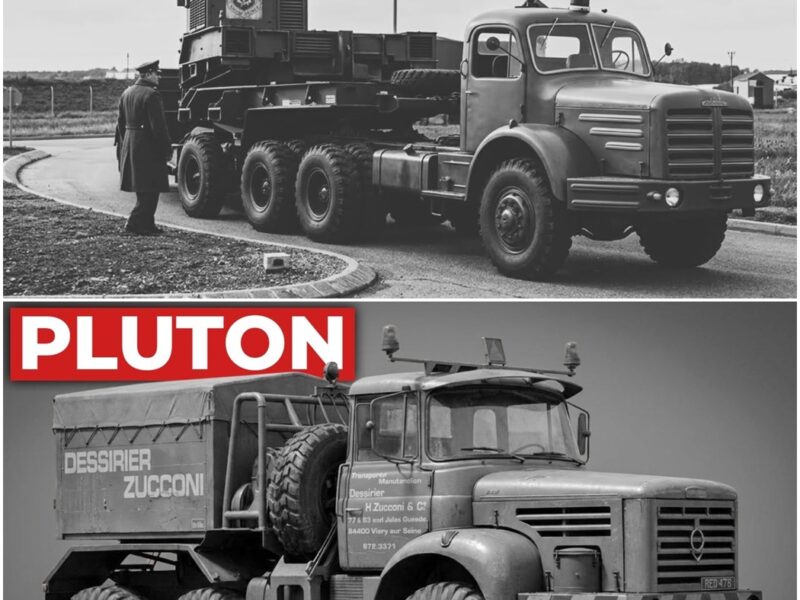
December 1967, the Berliet factory at Lyon Monplaisir in the industrial heart of Rhône-Alpes, a new heavy tractor rolls out of the assembly hall on 16-in military tires, bonneted cab, long flat hood, a single inline six diesel hammering under a steel grill. It looks like every other French heavy truck of the decade, civilian, quotidian, boring.
It looked unremarkable. It looked industrial. The cab was the same one fitted to bridge haulers and oil field tractors crossing the Sahara for Shell. There was no armor, no central tire inflation, no automatic transmission. The seats were leather, the springs were leaves.
It was a 15-L commercial truck wearing olive paint. Over the next 25 years, vehicles exactly like this one would haul French main battle tanks across two continents, support every regiment of France’s tactical nuclear deterrent, deploy with the Division Daguet through Saudi Arabian sand, roll under United Nations white into the wreckage of Sarajevo, and quietly carry the heaviest equipment of an army that had walked out of NATO’s integrated command to deter the world in any direction.
Five Pluton missile regiments depended on it. 24 nuclear warheads moved within its convoy ecosystem. Gendarmes from a special branch of the French National Police controlled every kilometer it traveled. Its full designation was the Berliet TBO 15M 36 by 4 HC 320 horsepower, and it was the most strategically important industrial truck France ever built.
To understand why the TBO 15 existed, you need to understand the problem France faced in the late 1960s. On March 7, 1966, President Charles de Gaulle withdrew France from NATO’s integrated military command. American logistical support evaporated. American nuclear release authority over the Honest John rockets stationed with French forces in West Germany was withdrawn the following year.
France would now deter the entire world by herself. In December 1967, General Charles Ailleret, Chief of the Defense Staff, published his doctrine in the Revue de Défense Nationale. He called it tous azimuts, defense in every direction. The French nuclear deterrent would be aimed at any compass bearing, any threat, any enemy.
To execute that doctrine, France needed road-mobile tactical nuclear missiles able to redeploy across French territory and West Germany on short notice. Those missiles would ride on tracked launchers. The launchers would ride on heavy trucks. The heavy trucks would have to be French. The man building them was Paul Berliet, son of the founder Marius Berliet, a Lyon hat band weaver’s son who had built his first car in a garden shed in 1894.
The family business had survived collaboration trials after the Second World War, near bankruptcy, and the rebuilding of the French commercial vehicle industry. Paul Berliet had launched the legendary T100 Saharan hauler in January 1957. Four trucks each powered by a 600 horsepower Cummins V12 of nearly 30 liters.
He had launched the GBC 8KT Gazelle in 1961, of which more than 30,000 would be built. By 1967, he was ready for the truck that would quietly carry the heaviest loads of the French Cold War. The TBO 15M3 was not a new design. It was a hardened, militarized military escort version of a civilian heavy tractor that had already crossed the Algerian desert hauling oil drilling rigs.
The chassis was a 6×4, three axles, steered front, powered rear tandem on hub reduction final drives. The engine was the Berliet MS640 Magic, an inline six diesel of 14,760 cubic centimeters, bore 140 millimeters, stroke 160 millimeters, turbocharged, 320 horsepower SAE. The Magic name was no marketing slogan.
It came from a licensed MAN spherical combustion chamber, direct injection system that allowed the engine to start cold without preheating. In a Champagne winter at minus 15 degrees Celsius, that meant the truck started first turn while every other diesel on the parade ground was still glowing.
The transmission was a five-speed manual non-synchronized gearbox with a pneumatic range doubler giving 20 effective ratios. The cab was a steel three-seat bonneted unit shared with civilian Berliet heavy haulers. Two bonnier winches sat behind the cab under a protective arch. Suspension was leaf springs throughout. Curb weight, around 12 tons.
Solo gross weight, 23 tons. Coupled to a Coder or Majored low loader semi-trailer, total combined weight on the road, 95 tons. That 95-ton figure is the number that matters. It meant the TBO 15 could legally haul an AMX 30 main battle tank weighing 36 tons, an AMX 30 D armored recovery vehicle, an AMX 30 AUF 1 self-propelled 155 mm gun weighing 42 tons, an Engin Blindé du Génie Combat Engineer Vehicle on AMX 30 chassis weighing 38 tons, a Leopard 1 armored recovery vehicle, and any of the heavy engineering plant in service with the French Army of the ’70s. The HC in the designation stood for “hors code”, outside the standard French highway code, wider than the legal 2 and 1/2 m limit. Every movement required a convoy exceptional permit and a gendarmerie escort. It was 320 horsepower hauling 95 tons. By the standards of every NATO ally, it was underpowered. By the standards of
what France actually needed to do, it was exactly enough. Now, before we get into the combat record and the nuclear missions this truck quietly supported, if you’re enjoying this deep dive into French Cold War and the strategic logistics behind the Force de Frappe, hit subscribe.
It takes a second, costs nothing, and helps the channel grow. The first TBO 15 M3 units entered service with the French Army train regiments in 1968. The early operators were the 503rd Train Regiment at La Rochelle, the 515th, the 516th at Tulle Crouve at Quartier Favie, and the 519th. The 503rd would later move to Martinique, then to Nîmes-Garons.
The trucks worked alongside the École d’Application du Train at Tours and the Compagnie Légère de Réparation du Matériel à Mourmelon. They moved tanks. They moved engineering plant. They moved bridge sections. Then in May 1974, everything changed. On May 1, 1974, the Pluton tactical nuclear missile entered French Army service with the 3rd Artillery Regiment at Mailly-le-Camp in the Aube department.
The Pluton was a short-range ballistic missile mounted on an AMX 30 tracked launcher. Range 17 to 120 km. Warhead, the AN-51 nuclear device in two yields, 15 kilotons or 25 kilotons. Five French regiments would eventually field the Pluton. The 3rd at Mailly, the 4th at Laon-Couvron, the 15th at Suippes, the 32nd at Oberhoffen-sur-Moder, replacing the Honest John in November 1976, the 74th at Bourogne near Belfort.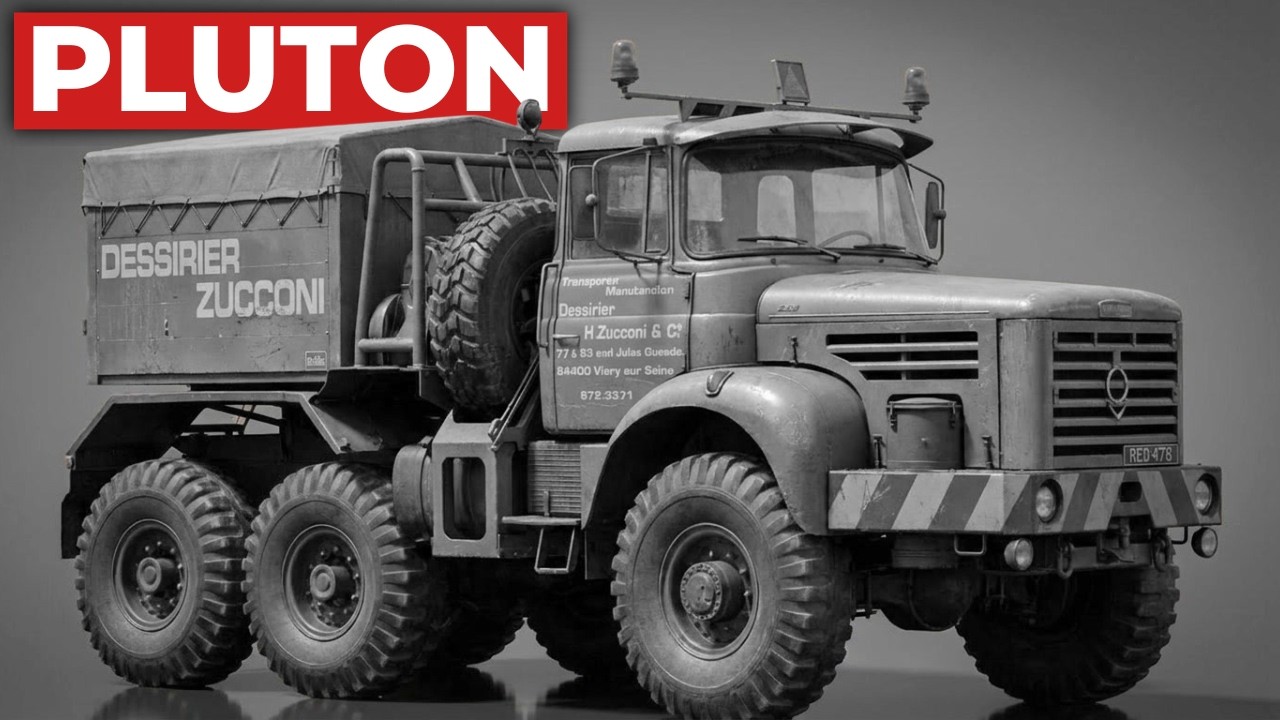
40 operational launchers. 24 warheads. Eight launchers per regiment. Six operational, two reserve. The dedicated tank carrier for the Pluton launcher itself was officially the Berliet TRH 350, but the entire ecosystem around the launcher rode on TBO 15 and three trucks. The recovery vehicles attached to each battery of security and nuclear transport, the engineering plant that prepared firing positions, the heavy equipment that supported every Pluton deployment, the truck that you saw at the back of the convoy painted standard French Army green, looking like a routine logistics tractor, was carrying the steel that made tactical nuclear deterrence physically possible. The convoys were controlled by the Groupement de Sécurité et de Sûreté, created by the Defense Council on February 4, 1964. In 1993, this organization was renamed the Gendarmerie de la Sécurité des Armements Nucléaires. Their doctrine, formalized by decree on February 7, 1990, required prior governmental authorization for any movement of nuclear cores outside their
depot atelier de munitions speciale. Continuous tracking of every warhead, surveillance during the three critical moments, transport on national territory, storage on bases, mating with launch systems. The Pluton was a night-firing weapon. It was also a night-moving weapon. The TBO 15 rolled in darkness behind gendarmerie outriders along the A4 from Paris to Metz to Strasbourg, the A5 from Sens to Langres, the A26 from Calais to Reims to Troyes, and the routes national 4, 44, and 19 across Champagne. A driver who served at the Mourmelon repair company in 1974 and 1975 left a testimony preserved by French military archivists. He recalled, in his own words, hauling a Leopard 1 armored recovery vehicle on a Maduro trailer behind a TBO 15 M3 to recover bogged AMX 30 tanks from forest tracks after exercises. The same year the Pluton went operational 70 km down the road at Mailly. Routine work, quiet work, the kind of work no one writes
books about. The truck deployed beyond France. Forces Françaises en Allemagne kept 50,000 French personnel in West Germany under the bilateral Franco-German agreement of December 21, 1966. The first armored division at Baden-Baden garrisons at Trier, Mulheim, Sigmaringen, Idar-Oberstein, Wittlich, Koblenz-Pfaffendorf at Quartier Jeanne d’Arc, Friedrichshafen, Saarburg, Donaueschingen.
The train military Forces Françaises à Berlin ran the only NATO era French armored rail movement permitted across East Germany. TBU 15 recovery variants of the same family loaded AMX 30 tanks of the 5th Cuirassiers at the Berlin-Tegel rail head on June 19 and July 6, 1982. In 1990, the truck went to war. The Division Daguet deployed to Saudi Arabia for the Gulf War.
TBO 15 M3 units painted in the distinctive two-tone sand and brown French desert camouflage hauled AMX 30 B2 main battle tanks and AMX 30 D recovery vehicles across the Saudi desert. The The definitive photograph appeared in Charge Utile magazine special issue 58, page 25. In the mid-1990s, the truck went to the Balkans.
Its TBU-15 recovery cousin, painted in United Nations white, was photographed with battle damage near the PTT building in Sarajevo, supporting UNPROFOR, then IFOR, then SFOR operations. The same chassis lineage that had quietly carried France’s nuclear deterrent now quietly carried French peacekeeping logistics through a war that was supposed to never happen on European soil again.
On paper, every NATO and Warsaw Pact rival looked superior. The West German Faun SLT 50 Elephant, introduced in April 1976, was an 8×8 monster powered by a 730 horsepower twin turbo Daimler-Benz 58, hauling 52-ton Leopard tanks. 324 were built. The American Oshkosh M911 CHET entered service in 1977 with 450 horsepower and a 60-ton payload.
Its successor, the M1070, climbed to 700 horsepower and could haul a 70-ton Abrams. The British Scammell Commander, introduced March 30, 1984, fielded a 26.7 L Rolls-Royce CV12 diesel of 625 horsepower. The Soviet MAZ-537, built in over 10,000 units from July 30, 1962, used a 525 horsepower 38-L V12 derived from the T-34 tank engine.
By every published metric, the TBO-15 was outclassed. Half the horsepower of the Scammell Commander, less than half the power of the Elephant or the M1070, six-wheel drive instead of eight, no NBC protection, no automatic transmission, a civilian cab, leaf springs. So, why did France keep it for 30 years? Five reasons.
First, French industrial policy locked brands out of major army contracts until the mid-1980s. Berliet, and after the October 1978 merger that created Renault Vehicules Industriels, had a near monopoly. Second, the TBO 15 was a free byproduct. Its R&D was already amortized through civilian and Saharan sales. Building a purpose-built heavy equipment transporter for a few hundred units would have cost a fortune.
Third, the mission profile fit. The AMX 30 weighed 36 tons. That was 20 tons lighter than the Leopard II, the Chieftain, the Challenger, or the M1 Abrams. 320 horsepower and a 50-ton trailer rating were genuinely sufficient for the heaviest vehicle France actually fielded. Fourth, Gaullist sovereignty. The same logic that demanded the Force de Frappe demanded that French tanks roll on French wheels behind French diesels. Fifth, cross-amortization.
The same chassis served petroleum work in Algeria, heavy haulage in metropolitan France, and Spanish hydroelectric construction. Closest peer of the TBO 15 was not the Elephant or the Commander. It was the Oshkosh M911, a commercial-derived design, modestly powered, road-oriented, good enough. The replacement finally arrived.
In September 1993, after a 6-year European tender involving 16 industrials including Faun, Mercedes, and Iveco, the French army selected the Renault TRM 700-100. 179 units were ordered. First deliveries reached the 515th, 516th, and 517th train regiments in January 1995.
700 horsepower, 6-wheel drive, 60-ton payload. The age of the bonneted civilian cab on a French army porteur was over. December 1967, Lyon-Monplaisir. A bonneted heavy truck rolled out of the assembly hall looking like every other commercial tractor of its decade. It was underpowered. It was civilian-derived.
It was 6-wheel drive when its rivals were eight. It had no armor, no central tire inflation, no automatic transmission, no NBC protection, no air transportability, and yet it worked. It worked on the autoroute from Mailly-le-Camp to Oberhoffen carrying the support fleet of five Pluton regiments. It worked at Mourmelon dragging Leopard recovery vehicles up to bogged AMX 30 tanks in Champagne forest tracks.
It worked in the Saudi desert behind the Division Daguet. It worked on the Berlin railhead loading cuirassier tanks for the only NATO armored rail movement allowed across East Germany. It worked under United Nations white in the wreckage of Sarajevo. 320 horsepower, 95 ton combined weight, 15 liter magic engine, 3,500 kilometers of French and West German autoroute, 24 nuclear warheads moving in the convoy ecosystem it supported, 30 years of service, five Pluton regiments depended on it, two armored divisions deployed behind it, one Gulf War rolled on it. The dissuasion nucléaire of the Fifth Republic moved on its leaf springs. That is not luck. That is what French industrial sovereignty looks like at the ton per horsepower scale. The Berliet TBO 15 M3 was not powerful. It was not glamorous. It was not exported in great numbers. It was French and it carried what mattered when it mattered exactly as long as France needed it to.