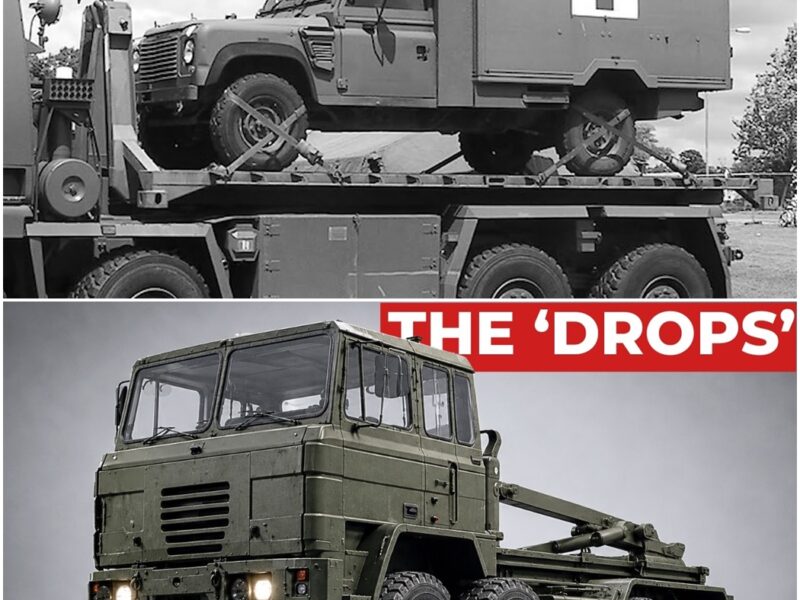
The ‘Crane-Less’ British Truck That Loaded 15 Tons By Itself In Every War Since The Gulf D
January 1991, the Saudi desert. A British convoy halts beside an empty patch of sand. A single eight-wheeled truck reverses into position. No crane arrives, no forklift, no second vehicle. The driver stays in his cab. A hydraulic arm rises behind the cabin like a mechanical spine. It hooks onto a 15-ton flat rack already waiting on the ground. The arm rotates.
The load slides forward on guide rollers. Locks engage. The truck pulls away with 15,000 kg of 155-mm artillery shells on its back. The whole process took seconds. American observers watching nearby had nothing like it. Not yet. Their own version was still 2 years from entering service. The vehicle was called DROPS, the demountable rack offload and pickup system, and it had just rewritten the rules of battlefield logistics.
To understand why Britain built it, you have to go back to the 1970s. The British Army of the Rhine ran two studies that terrified its planners. The Battle Attrition Study and the Review of Ammunition Rates and Scales both pointed at the same Soviet shadow advancing across the North German Plain. The Warsaw Pact had new tanks, T-72s, T-80s, armor that 105-mm British guns could no longer reliably defeat.
The entire divisional artillery had to be rebarreled to 155-mm. The shells were no longer 18 lb, they were 96 lb. Add the massive stockpile of L9 bar mines for the core barrier plan, and the math collapsed. According to the work study a man SWS project 226, British trucks were managing one round trip a day. Doctrine demanded two or three.
The Rhine railheads were too few, too fragile, too far. If the Soviets ever rolled west, the British Army would run out of shells before it ran out of barrels. The solution had to be radical. In 1981, the Ministry of Defense agreed a concept that did not yet exist in any front-line army on Earth.
A truck that loaded itself, no crane, no forklift, no external equipment of any kind. In August 1982, two staff targets went out to industry. GST 3920 for the vehicle. GST 3921 for the material handling equipment. Industry was told to tender a complete system. Chassis, hydraulics, flat racks, trailers, all of it. A year-long trial ran in 1986.
In February 1987, Leyland won the first contract. 1,522 vehicles based on the S26 8×6 chassis. By 1990, the Royal Corps of Transport had them in service. A higher mobility variant followed. The improved medium mobility load carrier, the Foden version, built in Sandbach, Cheshire. Production began January 1994.
Around 400 were delivered. Now, here is the part that matters for the historical record. The United States Army did not award its prototype contracts for the palletized load system until January 1989. The Oshkosh M1074 did not enter American service until 1993. By that date, British drops trucks had already been operational for 3 years. Britain was first.
The documentary trail is clean. The Foden improved medium mobility load carrier was a serious piece of engineering. Eight wheels, six driven. A Perkins Eagle 350 MX engine. 12.7 L, turbocharged, 350 horsepower at 2,100 rpm. Torque of 1,184 lb ft at just 1,100 rpm. Behind the engine sat a ZF 6HP 600 Ecomat automatic transmission.
Six speeds. Fully automatic in an era when most military trucks still demanded a clutch foot and a sense of timing. GKN axles with hub reduction. A 10-ton steering bogie at the front. A 20-ton double drive bogie at the rear. Michelin 20.5 and 25 high flotation tires. The vehicle measured 9.
5 m long, 2.9 m wide, 3.4 m tall. Gross weight 32,960 kg. Payload 15,000 kg exactly. The fuel tank held 272 L, range around 500 km, but the specifications are not the story. The story is the device bolted to the chassis behind the cab, the hook loader. The mechanism that turned an ordinary truck into a self-contained logistics platform.
And here is where honest history requires a careful note. The hook loader itself was not British. It was Finnish. Three brothers, Mikko, Mauno, and Martti Terho, bought a surplus American GMC truck in Raisio, Finland in 1949. They were timber haulers. They hated how long loading took. So, they invented the world’s first mechanical demountable platform.
They founded Multilift Oy that same year. The British achievement was not inventing the hook loader. The British achievement was militarizing it, standardizing every flat rack to the ISO 20-ft footprint, writing the world’s first single tender procurement specification for a complete demountable logistics system, and putting it into frontline combat before anyone else.
That is a different kind of brilliance, systems engineering brilliance. The Multilift Mark IV worked through pure hydraulic geometry. The flat rack carried a standardized lifting bar at a fixed height on its front bulkhead. The driver reversed up to the rack until the hook engaged the bar.
Hydraulic cylinders rotated the arm upward and rearward. The flat rack tilted, then slid forward on guide rollers built into the chassis. Locks engaged. The driver had not left his seat. To unload, the cycle reversed. Hook lifts the rack, rotates it backward, deposits it on the ground, disengages.
The British Army’s own description of the cycle is, quote, in seconds. The mechanically similar American palletized load system is officially documented at {quote} less than 1 minute. The two figures are consistent. Any popular claim of an exact loading time under 60 seconds should be treated as enthusiast folklore, not as a Ministry of Defense figure.
The flat racks themselves were built by Marshall of Cambridge. Two trailer types, the King and the Queen, could carry an identical second flat rack behind the truck. A container handling unit accessory let the system pick up a bare 20-ft ISO container directly. Side rail transfer equipment allowed direct loading from railway wagons.
The doctrine was simple. The flat rack is just a very large pallet. The truck never waits for ground handling equipment because it brings its own. Now, before we get to the combat record, if you are enjoying this deep dive into British logistics engineering, a quick subscribe genuinely helps the channel reach more people who care about this kind of history.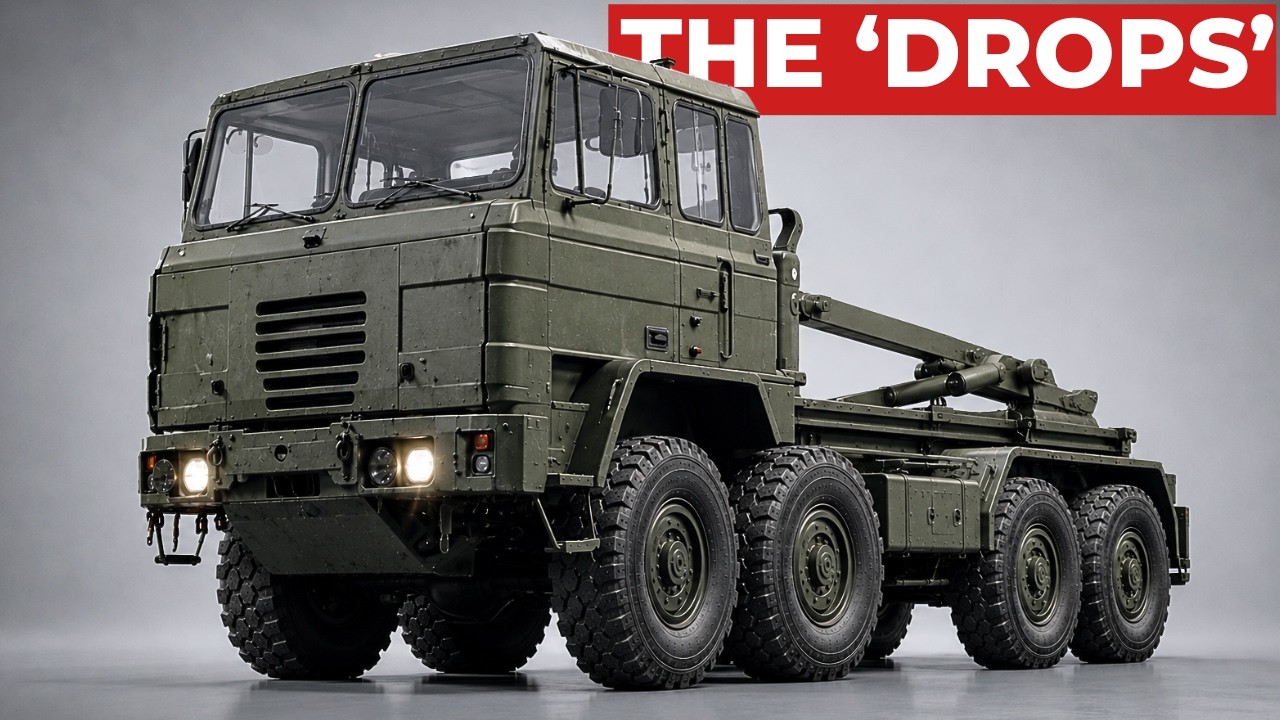
Costs nothing, takes a second. Right. Let us see what this truck actually did when the shooting started. January 1991, Operation Granby. The Leyland version of DROPS had been in service for only months when Saddam Hussein invaded Kuwait. The trucks had not been designed for the desert. The Treasury had restricted procurement to NATO European climate.
The cabs were left-hand drive only, and then they were ordered to the Persian Gulf anyway. The desert found the weak point fast. Sand ingress through the air intake. Multiple sources record engine failures during the deployment until an emergency modification raised the intake position. The fix worked. The trucks kept moving.
According to figures released by the Ministry of Defense, the Op Granby logistics effort moved 46,000 personnel and 46,000 tons of freight by air, by sea, 14,700 vehicles, 87,000 tons of ammunition and loose freight, 7,000 containers. A separate Army Benevolent Fund commemoration records 400,000 tons of total freight, 146 cargo ships, 12,000 airlift sorties.
DROPS was a critical link in the 4,000 mile supply chain that fed Challenger 1 tanks and M109 and FH70 artillery batteries. The Balkans followed. December 1995, United States National Archives photographs show 21 Squadron Royal Logistic Corps Leyland DROPS unloading from a Russian roll-on/roll-off ship at the port of Split, Croatia.
The deployment was Operation Joint Endeavor, the IFOR intervention in Bosnia. DROPS became the routine workhorse of British SFOR logistics, then KFOR in Kosovo from 1999 onward. March 2003, Operation Telic, 102 Logistics Brigade, relieved in May by 101 Logistic Brigade, ran the DROPS-based ammunition resupply for the British 1st Armoured Division during the invasion of Iraq.
The National Audit Office recorded 9,100 ISO containers and 15,000 vehicles deployed in 10 weeks. Half the time the 1991 effort had taken. DROPS sat at the heart of the in-theater distribution feeding Challenger 2 tanks, the 32 AS90 self-propelled guns of 3rd Regiment Royal Horse Artillery and 16 Air Assault Brigade, but the truck became legend in Afghanistan, Helmand Province, 2006 to 2014, Operation Herrick.
The combat logistic patrols of 19 Combat Service Support Battalion Royal Logistic Corps ran a standing convoy operation that has no easy equivalent in modern military history. A typical patrol was 70 plus vehicles, mostly eight-wheeled DROPS, 250 km round trips from Camp Bastion to forward bases like Sangin, three days on the road, 500 tons of food, water, fuel, ammunition, building materials, engineering supplies and the post from home.
Major Rob Tasker, officer commanding 10 close support squadron, told Ministry of Defence media in 2009, “quote The logistics patrols are so big and so well armed that they achieve more than a traditional convoy. They can pick up intelligence about enemy forces and dominate the battlefield, denying the enemy freedom of movement.
The terrain imposes a huge strain on our crews and their vehicles, but we are fortunate in having extremely capable men and women. end quote” By 2011, a separate Ministry of Defence released recorded Helmand combat logistic patrols, sometimes exceeding 18 km in length. The largest exceeded 240 vehicles.
A single armored snake of British logistics moving through the most heavily mined country on Earth carrying everything an army needs to fight and survive. The driver still loaded by himself. The hook still rose behind the cab. The flat rack still came up off the desert floor without ground equipment.
The same mechanism that had been demonstrated at Sandback a decade earlier was now feeding a war 8,000 km from home. How does it compare to the American answer? The Oshkosh M1074 palletized load system is the closest equivalent and the comparison is honest. The Americans went bigger, 10 wheels instead of eight.
A Detroit Diesel 8V-92 TA engine making 500 horsepower against the Foden’s 350. Payload 16.5 short tons, around 15 metric tons. Essentially identical to DROPS in metric terms. Gross weight 39,278 kg, around 6 tons heavier than the Foden. The Americans also bought more. By December 2009, the United States Army had received 6,288 PLS trucks.
Britain bought roughly 1,800 DROPS across the Leyland and Foden contracts combined. America scaled up. Britain scaled smart. The mechanically critical point is this. The American PLS uses a Multilift Mark 5 hook loader licensed from the same Finnish company that supplied the British Mark 4, the two systems are mechanical siblings separated by 3 years of development and one license agreement.
Britain saw the concept first, Britain bought it first, Britain fought with it first. The Americans went bigger and went later. The German Bundeswehr fields a closely related demountable rack system called multi, the Mechanisierte Umschlaglager und Transportintegration, for the same ammunition resupply role. The French, the Dutch, the Australians all eventually followed.
Every Western military hook loader fleet in service today traces its operational doctrine back to a British procurement specification written in August 1982. The Foden improved medium mobility load carrier left front-line British service in early 2020. Its replacement is the enhanced palletized load system built on the MAN HX 77 8 by 8 chassis.
382 were converted under a 72 million pound contract with Babcock and MAN Truck and Bus at Manchester between 2018 and 2021. Total British EPLS fleet now stands at 559 vehicles. The new trucks carry armored cabs the old drops never had. The civilian world noticed, too. In 2018, Hiab launched the Multilift Commander, a direct commercial descendant of the British military requirement.
In December 2022, the Finnish Defense Forces placed an order for 135 Multilift Ultima hook lifts with an option for 127 more. The technology has gone full circle back to the country where the Terho brothers invented it. What the British did with drops was not invent the hook loader. The Finns did that in 1949. What the British did was see what it could become, a complete combat logistics system standardized to a single container footprint, autonomous at the load and offload point, fielded in front-line service before any other army on Earth had even awarded a development contract. January 1991, a truck reverses across the Saudi sand. A hook rises behind the cab. 15 tons of artillery shells slide forward and lock down. The driver never leaves his seat. The truck pulls away. Three years before the Americans had anything that could do the same thing. Three decades before the system would finally retire. And every modern Western army still carries supplies on a vehicle
that traces its lineage back to that moment. That hook. And that piece of British engineering that saw a finished timber loading invention and understood, before anyone else did, what it could mean for the future of war. The hook still rises. The flat rack still moves. The doctrine still holds.
British engineering did not invent the mechanism. British engineering invented the war it would fight.