The desert war, July 1942 D
This video uses historical air war events from the book: “A History of the Mediterranean Air War”, by Christopher Shores and Giovani Massimello along with RAF Operations Records. It’s intended to give an idea of what air combat was like in North Africa based on the morning of the 16th of July 1942. Voices in the video are based on pilot interviews in the book.
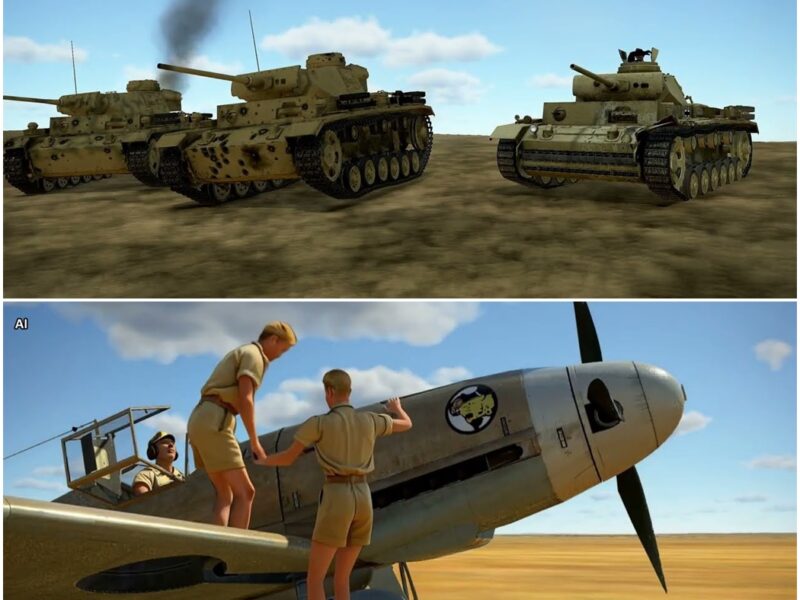
With the Afrika Korps advancing towards El Alamein, the three Gruppen of JG 27 transitioned from airfield to airfield going eastward along the coast. The First Gruppe had been at Turbiya, Egypt for only the past nine days. Werner Schröer of the Third Gruppe describes what life was like in the desert: “It was difficult because of the heat, the flies, salt water, too few aircraft, no protection in open desert, and the numerical superiority of the enemy. Early warning (Freya and Kiebitz) was good. The old hand pilots were better shots. Some younger pilots: Stahlschmidt, von Liers and Remmer, were excellent. Because of the low number of aircraft, old hares flew more often. We flew freie jagd against enemy fighters. Jochen Marseille had established himself as the leading desert ace with 100 victory claims awarded by Jun 17. He was on two month leave in Germany
to accept the Knights Cross with oak leaves and swords. He didn’t return until the 23rd of August. In his absence, Stahlschmidt had the highest rate of scoring for the First Gruppe during July. From James “Stocky” Edwards, who flew Kittyhawks: We Leapfrogged airfields to keep up with troop advances. We leveled the desert for runways. The airstrip was obvious.
The desert showed no signs of life. The original airfields were built along the coast. Bombers would form up form up over their own field then fly over the escort’s field at 2 to 3 Kft. When the bombers were seen, all engines were started up. From Friedrich Körner, 2./JG 27: Ju 87s were used for Tobruk harbor, convoys, and frontline Close Air Support.
The Ju 87s needed escorts. They were scattered over a wide area after a dive so were hard to protect. German pilots dwelt in tents like the older groundcrew. That fostered comradeship as there was no special treatment for the pilots. German pilots were respectful and sympathetic to British pilots.
Many could speak English better than any other foreign language. From Körner: There was a discrepancy between German pilot victories due to strong individualists. Newcomers had a hard time. Germans flew mostly freie jagd with one schwarm and on rare occasions
with two schwarme and a covering rotte. Rare because there weren’t enough aircraft. From James Edwards: Enemy troop concentrations were seen along coastal roads. Navigation direction was by sun and shadow. From Jun to Nov 1942, Allied supply lines were short with Cairo and Alexandria nearby From Rudolph Sinner, staffelkapitän of 6.
/JG 27: Experts did well, wingmen not so much. Surprise attacks were made, sparrow-like. No dogfights. Rarely were there more than six to eight 109s in the air at a time. From Körner: Often we met groups of 20-30 British fighters whirling about in a confused fashion.
When attacked, they formed 1 to 3 defensive circles but generally lost one aircraft before they could form these. The Germans broke into pairs at the start of combat. From 127 Sqn Operations Reports: Eight Hurricanes, led by F/Lt Marples, were again scrambled to patrol the forward area [Alamein box], as top cover to No. 80 Sqn. From John Waddy, an Australian who flew Tomahawks, Kittyhawks and Spitfires: We looked up to find 109s.
I did not on many occasions meet up with the Macchis. We saw mainly 109s and Ju 87s. From Neville Duke: The British tactics were weaving and defensive circles. The Germans – dive and climb. Continuing with 127 Sqn’s report: On reaching the patrol line, 8+ ME109Fs were sighted, 2-3 Kft above and in the sun.
The enemy aircraft made persistent diving attacks, in pairs, on our formation. From Schröer: The British introduced the defensive circle during Tobruk convoy attacks with no high cover. Marseille would dive down near a circle, pull up and zoom into it from below, just before stalling, shooting down a Tommy, then spin to sea level, where he pulled up at the last second.
This was repeated until the circle broke up. We spent most of our time trying to attack the circle, then the bombers were gone.” I learned to attack RAF defensive circles from Marseille. Wingtip waving goodbye was fairy tales. From Körner: I never experienced German fighters being pursued after breaking away. F/O Grot, the first attacked, carried out evasive
actions and became detached from our formation. He was then ordered home. F/Sgt Benedict, at the rear of the defensive circle, was the next quarry to be picked out by two 109Fs. He pulled up but his machine was hit. Lt Gray’s aircraft was also damaged in the same attack but he was able to continue.
From Shores: Eight Bf 109s of I./JG 27 on Stuka escort reported combat with 20 fighter-bombers and Hurricanes. Lt Stahlschmidt claiming one of the latter and a second damaged. He [F/Sgt Benedict] bailed out, burnt on arms and legs. From Rudolph Sinner: Two, four or six 109s would attack 12 to 20 RAF fighters.
In the desert, if two German pilots shot at an aircraft, and both saw an aircraft burning on the desert floor, both claimed it. During bombing attacks, Ju 87s and 88s would break formation, then fly line abreast in a 1 km-wide line. That made them easy targets – too scattered for German fighters to protect them. From James Edwards: Whole battles were engulfed in dust and haze up to 12,000 ft.
From Körner: Medium bombers almost always had escorts. The Germans fought the escorts. From Sinner: RAF bombers held tight formations, with concentrated fire. From Schröer: We didn’t like bomber tail gunners. From Neville Duke who flew Kittyhawks: We didn’t see large numbers of Ju 88s. Only threes and fours. Lots of Ju 87s. It was nearly always clear, blue sky, and bright sunshine.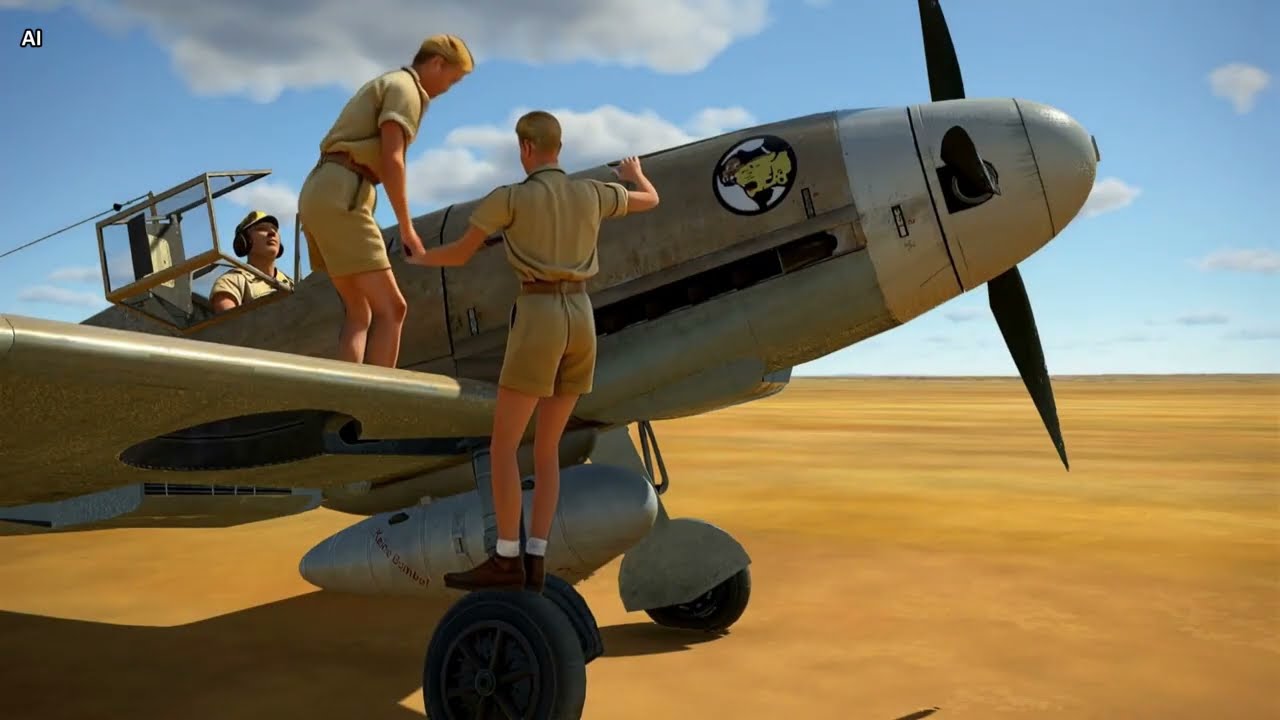
On the 14th of July, Rommel rushed German troops to the Ruweisat Ridge which was under attack. Genlt Walther Nehring launched a counter-attack. The 5th Indian Infantry Brigade pushed them back. When the attack resumed late in the afternoon of the 16th, it was repulsed. After the battle, the Indians counted 24 knocked out tanks, as well as armored cars and numerous anti-tank guns left on the battlefield.
From Shores: A dozen Hurricanes of 213 Squadron took off on a sweep. A dozen more from 33 Squadron were supposed to provide top cover, together with four Spitfires of 601 Squadron. No 33, 601, and 213 Squadrons were on the same airfield, Landing Ground 154 (SW of Alexandria), along with: 145, and 238 Squadrons.
That’s maybe 60 aircraft compared to the 23 I./JG 27 had on their airfield. The RAF outnumbered the Germans in terms of aircraft. From John Edwards: Top cover took off first, 12 aircraft line abreast. Then medium cover took off from their dispersal, then close cover squadron. We landed quickly to avoid 109 attacks with our gear down.
Eventually there were three Spitfire squadrons, making the 109s look up for the first time. From Neville Duke: During formation P-40 takeoff, our windscreens were covered in sand. 109Fs replaced the 109Es in the desert at the end of 1941. The 109F could fly higher than the Hurricanes and the P-40s which assumed the top cover role although Hurricanes were providing top cover for this Hurricane squadron.
601 Sqn [UF] Summary of Events: Four Spitfires took off to give top cover to 33 and 213 Squadrons. On taking off, 33 Squadron took off crosswind and collided with a Spitfire of this unit [601 Sqn] piloted by Sgt Dipersio. 213 Sqn [AK] Summary of Events Just as 33 Sqn was taking off at 1110, a Spitfire ran right across their path and collided with a Hurricane.
Presumably for this reason, both formations were recalled and ours went out without top cover of any kind. 601 Sqn: Both pilots were killed and the plane of this unit [601 Sqn] was burnt out. From 213 Sqn: there was no top cover of any kind. Consequently the 12 aircraft of 213 Squadron were bounced by one MC.202 and one Bf 109.
Luftwaffe pilots in constant action for 18 months had built up considerable skills and confidence. From Shores: RAF pilots were inadequately trained, inexperienced and provided with aircraft of inferior performance. They posed little threat and were easy pickings for their Axis opponents. From 213 Sqn: We were jumped by one Macchi 202 and an M.E. 109.
Sgt Ballantyne did not return, and an M.E. 109 was seen sitting right on his tail and firing at him from dead astern until he went in. Op Records: 274 Squadron (1110-1215) Weather1/10 cumulus cloud over the sea at 2000 ft. visi poor, Hazy. The squadron consisting of eight bombers and four fighters were airborne at 1110. The target was a fair amount of enemy M.T. at P.P. [Passage Point] 864280 [?] 2/5 miles W. of our track.
Sqn came in on target from North at 7500 ft and bombed from 3000 ft. At least six direct hits were scored, one causing a violent explosion, and eight near misses. A box of intense Breda at 3/4000 ft was put up by the enemy and also some heavy at 7000 ft. When leaving the target [sounds like after just one pass from north to south at ~3500 ft]
one of our aircraft was seen to be on fire and crashed at P.P. 870281[?] (approx). The pilot, Sgt. Presland was not seen to bale out. A second machine was seen to be streaming glycol and landed approx. 6 [?] miles W. of P.P. 870281[?]. Sgt. Harrington, the pilot, was seen to get out and run away from his machine. It was later learned that he walked back to our lines.
Our casualties – Sgt. Presland, missing, presumed killed, 2 aircraft (Category 3) and destroyed. From James Edwards: We converted from Hurricanes to Kittyhawks on 1 February 1942. We started flying Finger Four formations, line abreast, on 16 February 42. Early P-40 versions were unstable and difficult to fly.
Our Kittyhawks carried 500 lb bombs during escort and dropped them before going home. From Neville Duke: The Tomahawk was heavy and not maneuverable, slow climbing. The Tomahawk had two fifties in the nose and four .303s in the wing. The Kittyhawk had six fifties. Sometimes two were removed to save weight. The Kittyhawk could catch up to a 109 in a sustained dive.
From Massimello: According to Italian records, eleven MC.202s of 10° Gruppo, led by Cap Franco Lucchini (an ace with 22 victory credits) took off [from Fuka Sud, Egypt] at 1035 to escort CR.42s. With their mission carried out, they intercepted ten Hurribombers over Deir el Qattara (38 km SW El Alamein) flying at 1,500 feet, covered by ten P-40s at 6,000 ft, 15 P-40s at 16,000 ft and six Spitfires at 20,000 ft.
A 20-minute running fight followed, during which the Italian pilots claimed four P-40s shot down, … . In a possibly unrelated event that took place in the same area and same time … From Operations Records: 1145 – 1240 (and there might be a one hour time difference between Allied and Axis time zones): Bombing El Alamein. Interception by MC.202s. Bombs jettisoned.
Eight aircraft sent to bomb at 875277. The [bottom four] were jumped by four 202s but gave a good account of ourselves. P/O Taylor turned promptly and “got in a squirt” and as the 202s dived below our bottom four, one was hotly pursued by F/Lt Marshall, Sgt Cormack and Sgt Cairns. Then as Sgt Cairns gained height, he saw another 202 above, gave him a good burst and saw tracer enter enemy aircraft near radiator.
It continued without evasive action, in a shallow dive, is believed to have hit the ground (where a fire was seen) and is claimed destroyed. Sgt Cairns was attacked again five miles east of the bomb line. P/O Collier was attacked and shot up. From Neville Duke: Sometimes the better 109 pilots would turn with us. The Italian pilots were more inclined to engage in dogfights. They had more maneuverable aircraft.
F/Lt Marshall especially pumped lead into him, but without result (guns improperly harmonized). From Neville Duke: The Italians couldn’t communicate with each other so they were easier to bounce. From Schröer: The Macchis flew higher and were sometimes confused with Spitfires. From Sinner: I was not impressed by the Italians.
From Massimello: Lucchini’s aircraft was hit and he crash-landed near Qotafiya but managed to return to Fuka in the afternoon in a car. Baroni was hit and forced to land near El Daba: Berti and Bignami returned with slight damage to their Macchis. Four of the Italian pilots, including Lucchini, shared a claim for one P-40 and five others, including Baroni, shared a claim for a second.
I was hoping to see and hear some gunfire from the various Hurricane models but that didn’t fit the storyline. Here they are anyway. The Mk IIb, the Mk IIc, and the Mk IId tank buster. That’s it for the desert life.