The ‘Doorless’ American Jeep The SAS Drove Onto A German Airfield And Destroyed 37 Aircraft S
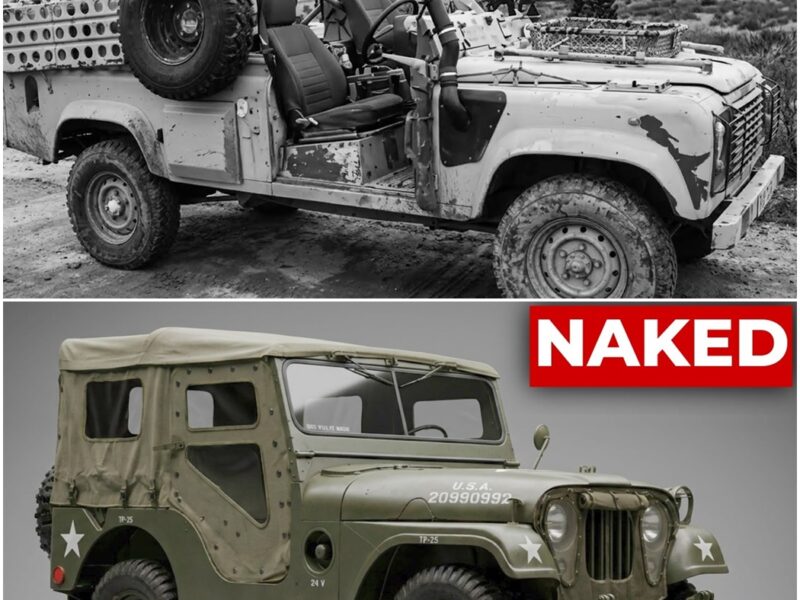
Night of the 26th of July, 1942. The Libyan desert, 235 mi west-northwest of Cairo. 18 American-made Willys jeeps sit in a loose column behind a ridge of sand, engines ticking in the dark. Each one stripped of its doors, its windscreen, its canvas roof, stripped of everything that might slow it down or make it heavier than it needs to be.
What has been added is far more interesting. Twin Vickers K aircraft machine guns are bolted to the front passenger frame. A Browning 50-caliber heavy machine gun sits on a post behind the driver. In one of the lead vehicles, a tall, impossibly calm Scots Guards officer called David Stirling raises a Very pistol and fires a single green flare into the sky. 18 engines roar.
The jeeps surge forward in a V formation, headlights off, and drive straight onto the runway of Sidi Haneish airfield, a Luftwaffe base packed with Junkers 87 Stukas, Junkers 52 transports, and Messerschmitt 109s, all parked wingtip to wingtip. Every gun on every jeep opens fire simultaneously. Tracer rounds walk across the parked aircraft in overlapping streams of white and orange.
Fuel tanks rupture, wings collapse. Within minutes, 37 German aircraft are burning. The only Allied soldier killed in the assault is 21-year-old Lance Bombardier John Robson. By dawn, the jeeps are gone, vanished back into the desert that birthed them, leaving nothing behind but a column of black smoke and a question the German garrison cannot answer.
Where did they come from, and why were they driving vehicles with no armor at all? That question, why no armor, has followed Britain’s Special Air Service for more than 80 years now. Every army in the world wraps its soldiers in steel. The heavier the vehicle, the safer the crew. That is the logic that built the Warrior infantry fighting vehicle at 25 tons, the Mastiff mine-resistant patrol truck at 24 tons, and every armored personnel carrier in between.
The SAS looked at that logic, studied it carefully, and rejected it entirely. From Stirling’s jeeps in 1942 to the Supercat Jackal rolling through Helmand Province in 2008, the most elite soldiers in the British Army have consistently chosen to ride into battle in vehicles that offer almost no physical protection whatsoever.
Not because they are reckless, because they believe armor will get them killed faster than speed. To understand why the SAS made that choice, you need to understand what the regiment was actually built to do. The SAS does not hold ground. It does not advance in formation. It does not fight prolonged engagements against a dug-in enemy.
It strikes targets deep behind enemy lines, airfields, communication nodes, supply depots, missile launchers, and then disappears before the enemy can respond. The entire operational philosophy rests on four principles: range, speed, concealment, and disproportionate firepower. Every ounce of armor plate works against all four.
Steel adds weight. Weight destroys range. Reduced range means you cannot penetrate deep enough behind enemy lines to find the targets worth hitting. Reduced speed means you cannot break contact go wrong. And a heavy, slow, road-bound vehicle is not hidden. It is a target.
The SAS made a calculated bet that has held for eight decades. It is safer to never be found than to survive being hit. The first vehicle to prove that bet was the Willys Jeep at City Hanisch. But the machine that defined the philosophy for the Cold War era was something far stranger. In 1968, the Ministry of Defense purchased 72 Land Rover Series 2A long wheelbase trucks and sent them to Marshalls of Cambridge for conversion into something the official paperwork called the Truck Utility Light F F R SAS. The soldiers who drove them called them the Pink Panthers. The name was not a joke. The vehicles were painted pink. A soft, muted mauve pink that looked absurd in a motor pool, but turned out to be one of the most effective desert camouflage colors ever tested. The Long Range Desert Group had discovered during the Second World War that pink and mauve tones disappear into sand and rock at dawn and dusk, the two periods when desert patrols are most vulnerable. One widely repeated story claims a crashed aircraft painted pink for visibility
proved nearly impossible to spot from the air. Whether that particular tale is apocryphal or not, the principle was real. Pink worked, and the SAS committed to it fully. The Pink Panther itself was a masterpiece of stripped-down engineering. Doors removed, windscreen removed, roof removed.
In their place, four fuel tanks holding roughly 100 gallons, enough for an unsupported range of over 1,000 mi, heavy-duty suspension, sand tires, a sun compass for navigating when magnetic compasses became unreliable, smoke discharges for breaking contact, and weapons. A general-purpose machine gun on the commander’s mount, a Browning .
50 caliber heavy machine gun, and depending on the mission, a Milan anti-tank guided missile, a Carl Gustaf 84-mm recoilless rifle, or a 66-mm LAW rocket. A crew of three, driver, commander, and gunner-signaler, could drive a thousand miles into the desert, destroy a target, and drive back without ever seeing a friendly resupply convoy.
That was the point. The Pink Panther did not need the army behind it. It was the army. These vehicles served everywhere Britain’s desert interests demanded. Oman, Yemen, Jordan, Kenya, Belize. From 1968 until the mid-1980s, when the SAS transitioned to the Land Rover 110 desert patrol vehicle, a coil-sprung V8-powered successor that traded some of the Pink Panther’s legendary range for a smoother ride and better cross-country speed.
The newer trucks, still called Pinkies despite their beige paint, carried an even wider array of weapons, GPMGs, .50 caliber machine guns, Mark 19 40-mm grenade launchers, and in some configurations, a 20-mm cannon or a 7.62-mm minigun. They could fit inside a Chinook helicopter. Up to four could load into a C-130 transport aircraft.
They were in every sense weapons platforms that happened to have wheels. And it was in these vehicles, not tanks, not armored cars, not infantry fighting vehicles, that the SAS fought one of its most celebrated campaigns. January 1991, the Gulf War. While the famous failure of the conflict was Bravo Two Zero, an eight-man foot patrol inserted without vehicles that ended in death, capture, and a punishing march through the Iraqi winter.
The vehicle-mounted fighting columns of A and D squadrons were doing exactly what the SAS was designed to do. Columns of armed Land Rover 110s, supported by Unimog logistics trucks and motorcycle outriders, drove deep into Western Iraq’s Scud Alley. Moving by night, lying up under camouflage nets by day, hunting mobile Scud missile launchers that were threatening to drag Israel into the war and fracture the coalition.
They cut fiber optic communication cables. They raided the Victor Two communications facility. They called in air strikes on launcher sites they could not reach themselves. Four SAS soldiers died during the campaign, but the vehicle columns achieved their strategic objective. The Scuds were suppressed, Israel stayed out of the war, and the coalition held.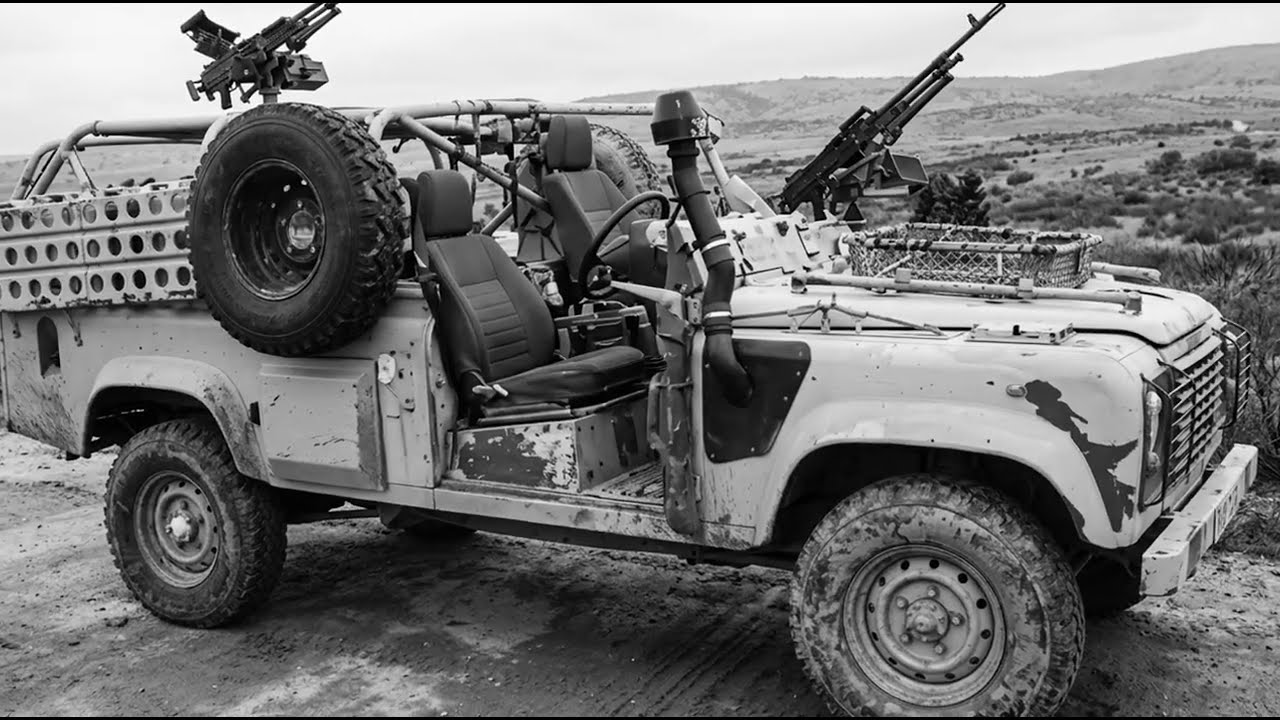
The lesson was unmistakable. The patrol that had vehicles survived and succeeded. The patrol that did not have vehicles became the most famous disaster in SAS history. If you are finding value in this journey through the machines that carry the world’s most dangerous soldiers, consider subscribing to the channel.
It is the single best way to ensure these stories keep being told, and it costs you nothing but a click. A decade later, the philosophy was tested again at an even larger scale. November 2001, Afghanistan. Operation Trent, the largest SAS ground assault since the Second World War. Roughly 120 men from A and G squadrons were flown into a desert landing strip by C-130, and drove 38 Land Rover Pinkies, eight Kawasaki dirt bikes, and two logistics trucks approximately 120 miles to a Sultan al-Qaeda linked opium storage facility near Kowi Malik. G Squadron formed a vehicle mounted fire support base with GPMGs, Milan missiles, 81 mm mortars, and 50 caliber Barrett sniper rifles while a squadron assaulted on foot. Roughly 50 million pounds worth of opium was destroyed and dozens of fighters killed reportedly for zero SAS dead. Five gallantry awards followed including a distinguished service order
and two conspicuous gallantry crosses. Then came Iraq again, March 2003. SAS desert patrol vehicles and Australian Special Air Service Regiment 6×6 long-range patrol vehicles seized the H2 and H3 airfields in Western Iraq. Then ranged east hunting scuds and military targets backed by RAF Harriers and Predator drones.
A deliberate replay of 1991. The SAS later captured the Alasad airbase with more than 50 aircraft on the ground. But the vehicle that carried the SAS through Afghanistan and Iraq was aging. The Land Rover Defender was approaching the end of its production life and the operational tempo of Helmand province was pushing the 110 DPV beyond its design limits.
Its replacement had already been quietly tested by UKSF under the code name Menacity. A vehicle built by a small Devon company called Supacat designated the HMT 400. The British Army version became the Jackal. It was everything the Pink Panther and the Pinky had been reborn for the 21st century. A Cummins 6.
7 L turbo diesel engine producing 182 horsepower, a gross weight of around 7 tons, barely a third of a warrior, a top speed of 80 mph on road and 55 cross country, height adjustable air suspension offering up to 380 mm of ground clearance, a range of over 600 miles, armament, a ring mounted 12.7 mm heavy machine gun or a 40 mm grenade machine gun plus a 7.
62 mm GPMG on a swing mount for the commander. And like every SAS vehicle before it, the top was deliberately left open. Not because the designers forgot to add a roof, because an open top gives the crew 360° visibility, faster target acquisition, and the ability to debut in seconds when the vehicle takes fire.
The roof was not missing, it was rejected. The Jackal entered service in November 2007 and debuted in Afghanistan the following April. It was by any measure a formidable machine, but it was not invulnerable, and the SAS had never claimed it would be. By August 2009, 13 British soldiers had been killed in Jackals, several in improvised explosive device strikes.
The open top that gave crews their situational awareness also left them exposed to blast. Critics called it a death trap. The Ministry of Defense called it protection through mobility, a vehicle designed to go off-road away from the predictable routes where IEDs were buried, fast enough and agile enough to avoid the threat entirely.
Both arguments contain truth, and both arguments were sharpened by the cautionary tale that haunted every vehicle decision the British military made after 2004, the Snatch Land Rover. The Snatch was a Defender 110 fitted with light armor originally designed for Northern Ireland patrols, where the threat was petrol bombs and small arms.
It was sent to Iraq and Afghanistan where the threat was buried explosively formed projectiles that could punch through the floor of a main battle tank. The Snatch occupied the worst possible middle ground, heavy enough to be slow, too heavy to go off-road effectively, but nowhere near armored enough to stop the weapons being used against it.
Between 2003 and 2014, 37 British personnel were killed in Snatch Land Rovers. Between July 2004 and July 2006 alone, 20 of the United Kingdom’s 44 hostile action fatalities, nearly half, were soldiers traveling in that single vehicle type. Troops called it the mobile coffin. The Chilcot Report later found the Ministry of Defense had known about its vulnerability for years.
The lesson could not have been clearer. If you are going to armor a vehicle, armor it properly. Build a Mastiff, a 24-ton mine-resistant truck with a V-shaped hull that can survive a buried charge. And if you’re not going to armor it properly, do not armor it at all. Build a Jackal.
Build something fast enough and agile enough to never be on the road where the bomb is buried. The one thing you must never do is split the difference. The SAS understood that lesson before anyone wrote it down. They understood it in 1942 when David Stirling bet the lives of his men on speed instead of steel and drove 18 unarmed jeeps onto a defended German airfield.
They understood it in 1991 when fighting columns of stripped-down Land Rovers ranged hundreds of miles behind Iraqi lines without a single millimeter of armor plate between their crews and the desert. They understood it in 2001 when 120 men drove open-topped trucks into an Al-Qaeda stronghold and came out alive. And they understand it now.
Night, the Libyan desert, 80 years later. Or Helmand. Or Western Iraq. Or wherever the next mission demands. A column of low, fast, open-topped vehicles moves without headlights across ground no armored convoy could reach. Carrying weapons no vehicle their size should be able to mount, crewed by soldiers who made a choice that most armies would consider suicidal.
No doors, no roof, no armor, and no intention of being anywhere near the enemy long enough to need any of it. The SAS do not refuse armor because they think they are invincible. They refuse it because they know exactly how vulnerable they are. And they have spent 80 years building a doctrine that turns that vulnerability into the most dangerous advantage on the battlefield.