The ‘Flimsy’ British Armoured Car With a Jaguar Engine That Nobody Wanted to Crew d
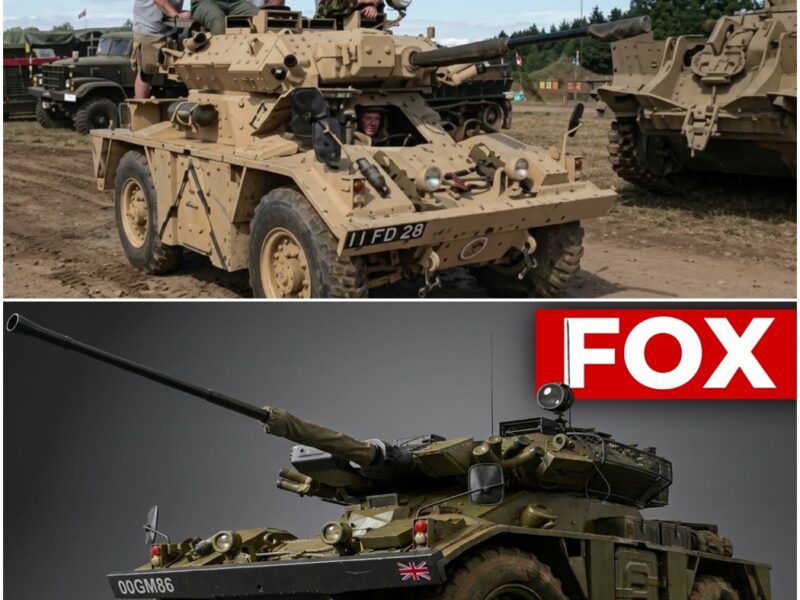
1973, the Royal Ordnance Factory, Leeds, West Yorkshire. A vehicle rolls off the production line that looks like nothing the British Army has ever fielded. It is low. It is compact. Four wheels, not tracks. A sharp angular turret sits high on an aluminum hull that weighs less than 7 tons fully loaded.
Bolted to the turret is a 30 mm cannon capable of destroying armored personnel carriers at over 1,000 m. Beneath the hull sits a Jaguar 4.2 L petrol engine, the same power plant found in one most elegant sports cars in the world. On a flat road, this machine can reach 65 mph. It can be loaded three at a time into a Hercules transport aircraft.
Two of them can be parachute dropped from altitude. It looks fast. It looks aggressive. It looks like it was designed by people who wanted to win a race, not fight a war. And that was the problem. Because for all its speed, for all its clever engineering, the Fox was too light to survive, too top-heavy to trust, too cramped to love, and too compromised to last.
It would serve the British Army for barely two decades, equip only three nations, and be quietly withdrawn without a direct replacement. Its turrets would be stripped from their hulls and bolted onto a tracked chassis just to keep the guns in service. Its name would fade from regimental memory within a generation.
Its designation was the FV721 Fox, combat vehicle reconnaissance wheeled, and it was the last purpose-built wheeled armored car that Britain ever fielded. To understand why the Fox existed, you need to understand what it was supposed to replace and why. By the early 1960s, the British Army’s reconnaissance fleet rested on two vehicles.
The Daimler Ferret, a small beloved four-wheeled scout car that had served since 1952, and the Alvis Saladin, a six-wheeled armored car armed with a 76 mm gun that had entered service in 1958. Both were products of the late 1940s design philosophy. Both were showing their age against the threat posed by Warsaw Pact forces massed along the inner German border.
The Ministry of Defense issued two parallel requirements. General Staff Requirement 3301 called for a new tracked reconnaissance vehicle, which would become the Scorpion family. The Combat Vehicle Reconnaissance Tracked General Staff Requirement 3358 called for its wheeled counterpart, a fast air-portable four-wheeled scout car with real firepower.
That vehicle would become the Fox. The Fighting Vehicles Research and Development Establishment led the design. In 1966, Daimler of Coventry, the firm that had built the Ferret, received a contract for 15 prototypes. The first was completed in November 1967. The last rolled out in April 1969. Trials followed.
The Fox was publicly announced in October 1969 and formally accepted for service in 1970. Then came the decision that ended a legacy. When the production contract went to competitive tender, Daimler, Alvis, and Jaguar had all been absorbed into British Leyland. The Royal Ordnance Factory at Leeds, subsidized by ongoing Chieftain tank production, underbid Daimler on price.
Leeds won the contract despite having no experience whatsoever with aluminum armor or wheeled armored vehicles. Daimler’s armored vehicle business, which stretched back to the Second World War, ceased entirely in 1971. The Fox was the vehicle that killed it. The production delay cost nearly two years.
Full manufacturing began in 1972, and the first production Fox was completed in May 1973. Turrets were built by Alvis at Coventry. The vehicle itself was a study in deliberate compromise. Three crew members, a driver seated centrally in the hull, and a commander and gunner in the two-man turret, operated in exceptionally tight quarters.
The hull was welded from 7039 series aluminum alloy. Frontal armor was roughly 33.5 mm of aluminum, with sides at around 41 mm, and the rear at 38. In steel equivalency, this stopped 7.62 mm rifle fire and shell splinters. It did not stop heavy machine gun rounds. It did not stop anything designed to kill armored vehicles.
The main armament was the 30-mm L21 Rarden cannon, a weapon whose name derived from the Royal Armament Research and Development Establishment and the Royal Small Arms Factory at Enfield. Its principal designer was Norman Trevor Brint, a man who had originally trained as a carpenter before moving into gun design because, as one source recorded, there was no money in carpentry.
The Rarden was deliberately slow-firing, roughly 90 rounds per minute, fed by three-round clips six-round ready magazine. What it lacked in volume it made up for in precision. Groups of 1 m at 1,000 m were achieved on a regular basis. 99 rounds of 30-mm ammunition were carried alongside 2,600 rounds of 7.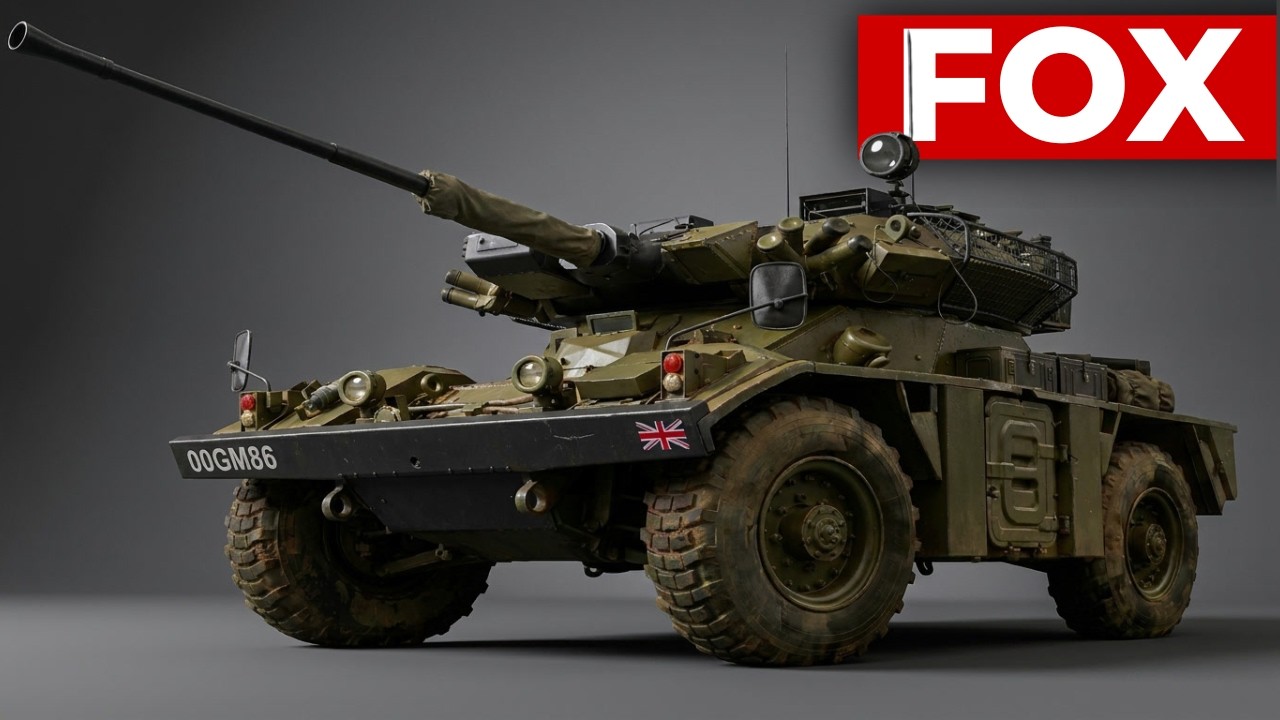
62-mm for the coaxial machine gun. A collapsible flotation screen was fitted around the hull, theoretically allowing the Fox to swim across rivers propelled by its wheels at roughly 5 km/h. In practice, the capability was near useless. Most British vehicles had their screens removed early in service. The Fox also lacked any form of nuclear, biological, and chemical protection, a serious deficiency for a vehicle expected to operate on a Cold War battlefield saturated with the threat of chemical warfare. Now, before we get into where the Fox actually served and why its crews grew to distrust it, if you are enjoying this deep dive into Cold War British armor, hit subscribe. It costs nothing, takes a second, and helps the channel grow. The Fox entered frontline service in 1975 with B Squadron, 1st Royal Tank Regiment, based at Alrewas Barracks, Tidworth. From there it was distributed across the British Army of the Rhine, equipping the reconnaissance elements of the Royal Yeomanry and the Queen’s Own Yeomanry, the brigade reconnaissance regiments
assigned to 2nd Division, the formation responsible for the rear area of the British sector in West Germany. A typical Fox squadron fielded four troops of four vehicles each. Two additional Fox squadrons were stationed at Armagh in Northern Ireland for medium reconnaissance duties, but the Fox’s greatest enemy was not the Soviet Union.
It was physics. Within months of entering widespread service, a pattern of serious accidents emerged that threatened the vehicle’s entire operational credibility. The Fox was dangerously top-heavy. Its high-mounted turret combined with a relatively narrow four-wheeled base and a combat weight under 7 tons created a center of gravity that punished aggressive driving.
At speed, the Fox exhibited severe oversteer. Drivers who instinctively found the vehicle snapping the other way. Rollovers occurred with alarming frequency in the early years. Unlike the Ferret, where the crew could brace and ride out a roll, the Fox’s turret crew had no easy escape positions.
A rolled Fox was a potentially fatal Fox. The army’s response was not to redesign the vehicle. It was to redesign the training. Specialized driver instruction was introduced that taught Fox crews to manage the oversteer rather than fight it. The accident rate declined, but the reputation never recovered.
Crews who known the Ferret, a forgiving, almost affectionate little vehicle that did what you asked without trying to kill you, found the Fox an entirely different proposition. One former Fox crewman, a veteran of the 1980s, described the experience in terms that became widely shared among reconnaissance soldiers.
“Fox looks good,” he said, “very often sounds good, but when we wanted to have fun, it was a Ferret every time. Fox is hard work and no fun to crew.” A former Royal Electrical and Mechanical Engineers Workshops fitter who serviced the vehicles recalled that they arrived from the factory with roughly two dozen modifications still outstanding.
“Not a good sign,” as he put it, “since some of these things should have been sorted on trials.” The same fitter described removing multiple engines with smashed cylinder blocks where connecting rods had punched through the side of the casing. The Fox never saw major combat in British hands.
It patrolled the inner German border. It watched for Soviet armor that never came. It sat in hides in the North German plain. Its Jaguar engine ticking in the cold. Its crew scanning the tree lines through a passive night sight. In Northern Ireland, it provided mobile reconnaissance in a theater where its speed was useful, but its armor was irrelevant against the threat of improvised explosive devices and heavy caliber sniper rifles.
Abroad, the story was different but equally modest. Approximately 145 Foxes were exported. Nigeria received the largest share and according to available records, still operated around 50 vehicles as recently as 2024. Malawi purchased 20 Foxes from Britain in 1981 and all were reported operational as of the same year.
No confirmed accounts of Fox vehicles in sustained foreign combat have emerged in open-source records, though Nigerian Foxes are likely to have seen internal security deployments. Total production reached approximately 325 vehicles at Royal Ordnance Factory Leeds, 180 for Britain, 145 for export. For a vehicle intended to replace the Ferret, which had been built in numbers exceeding 4,000, the Fox was produced in almost negligible quantity.
On paper, the Fox’s rivals made it look outclassed. The French AMX-10RC, a 6×6 wheeled reconnaissance vehicle entering service in 1981, carried a 105-mm gun capable of destroying main battle tanks. The Panhard ERC-90 Sagaie mounted a 90-mm cannon firing armor-piercing fin-stabilized discarding sabot rounds.
Both were heavier, both were far more powerfully armed, and both could fight the vehicles they were sent to find. The Soviet BRDM-2, the Fox’s most direct conceptual counterpart, took the opposite approach. It carried only a 14.5-mm heavy machine gun, far less firepower than the Fox’s 30-mm cannon. But it was fully amphibious with water jet propulsion, carried nuclear, biological, and chemical protection as standard, and was produced in quantities exceeding 7,200 vehicles.
The Fox could kill a BRDM-2, but the Soviets could afford to lose them. The Fox’s own stablemate proved to be its most damaging competitor, the Scimitar, the tracked member of the combat vehicle reconnaissance family, carried the same Rarden cannon, the same Jaguar engine, and offered superior cross-country mobility on a tracked platform with a lower center of gravity.
The Scimitar went to the Falklands in 1982. The Scimitar went to the Gulf in 1991. The Fox went to neither. When commanders needed reconnaissance vehicles for real operations, they chose tracks over wheels every time. The Fox was withdrawn from British service between 1993 and 1994. No wheeled replacement was procured.
Its role was absorbed by the Scimitar. But 136 Fox turrets were given a second life. In 1995, they were mated to FV101 Scorpion hulls to create the Sabre, a hybrid reconnaissance vehicle that served armored and mechanized infantry battalions until 2004. The Fox’s gun outlived its body by a decade. Today, preserved Foxes survive in small numbers.
The Tank Museum at Bovington holds the FV722 Vixen prototype, an unarmed liaison variant that never entered production. Eden Camp Modern History Museum in North Yorkshire maintains a running Daimler built prototype, the ninth of the original 15, affectionately known as Lilly. The Norfolk Tank Museum holds another. A handful exist in private collections across Britain, the United States, and Australia.
1973, the Royal Ordnance Factory, Leeds, a vehicle rolls off the line that is faster than almost anything else on four wheels in any army in the world. It carries a cannon accurate enough to place every round inside a 1-m circle at 1,000 m. It is light enough to fly, small enough to hide, and quick enough to outrun almost anything it cannot outfight.
It is also too top-heavy to corner safely, too thinly armored to survive the battlefield it was designed for, too cramped for its crews to operate in comfort, too fragile to deploy to the wars that actually came. It has no nuclear, biological, or chemical protection, no stabilized gunnery, no room to grow, and yet it served.
It watched the inner German border for nearly 20 years. It patrolled the streets of Northern Ireland. It equipped armies in West Africa that are still operating it more than four decades after delivery. Its cannon went on to arm the Warrior infantry fighting vehicle, the Scimitar, and the Sabre with total Rhaden production exceeding 1,600 guns.
The Fox was not a failure. It was a lesson. Britain learned that in reconnaissance, the vehicle that survives to report is worth more than the vehicle that arrives first. Speed without protection is a promise the battlefield does not honor. The Fox was the fastest armored car Britain ever built. It was also the last.
That is not a coincidence.