The ‘Genius’ British Tank That Built Bridges In 30 Seconds While Germans D
1943 a workshop somewhere in southern England. British engineers have just stripped the turret off a perfectly good Churchill tank. Every gun, every weapon, gone. In its place, they have bolted two enormous steel ramps and a set of timber trackways. The thing looks like a broken bridge glued to a tank hull.
Officers watching the demonstration are baffled. One asks the obvious question, “What exactly is it supposed to do?” The answer is simple. It drives into a ditch, drops the ramps, and stays there while 40-ton tanks drive directly over it. The crew remains inside. This is the Churchill ARK, the armored ramp carrier.
It carries no weapons, it fires no rounds, it cannot fight, and it will prove more valuable than most of the guns in the British arsenal. To understand why British engineers deliberately destroyed a good tank to build a mobile ramp, you have to go back to one of the worst days in Allied military history.
August 19, 1942, Dieppe, France. Operation Jubilee sent over 6,000 troops, predominantly Canada’s second infantry division, against the fortified port. The 14th Canadian Army Tank Regiment brought Churchill tanks ashore for the first time in combat. Of 58 tanks allocated, only 29 reached the beach. Two sank during offloading.
Of the remaining 27, 12 were immobilized the moment their tracks touched the shore. The beach at Dieppe was covered in church shingle, rounded stones between 1 and 6 in across, resting at a 15 to 20° angle. These stones jammed between drive sprockets and track links, snapping track pins and shedding tracks entirely.
British intelligence had assessed the beach by examining holiday photographs. It was a catastrophic failure of reconnaissance. 15 tanks did manage to claw over the low seawall. But every street exit from the esplanade into the town was sealed with concrete anti-tank roadblocks covered by machine guns, 37-mm guns, and 75-mm guns firing from pillboxes.
Not a single Churchill entered Dieppe. Royal Canadian engineers carrying demolition charges to blast the road blocks were cut down by fire before reaching them. Unprotected soldiers simply could not clear obstacles under direct enemy fire. According to Canadian military records, total casualties reached 3,623 out of 6,086 landed.
Nearly 60% Canadian losses alone amounted to roughly 900 killed and 1,900 captured. All 27 tanks that reached the beach were destroyed or abandoned. Remarkably, the Churchill’s armor proved so effective that very few crewmen died inside their tanks. The vast majority were killed trying to escape or surrender. Captain Dennis Whitaker of the Royal Hamilton Light Infantry recalled the killing ground.
“The place is in the shape of a saucer,” he said. “They were firing at us from behind as well as the front and both sides.” The official post-raid analysis was devastating. Dieppe proved three things that shaped every specialized armored vehicle Britain would build for D-Day. Seawalls, shingle beaches, and concrete obstacles could neutralize an entire armored force.
Engineers needed armored protection to do their work, and standard tanks needed help crossing vertical barriers that tracks alone could not climb. Lieutenant J. J. Donovan, a Canadian engineer who survived Dieppe, proposed mounting demolition weapons directly onto armored vehicles so that engineers would never again approach obstacles on foot under fire.
His concept became the Churchill AVRE. The seawall problem, specifically the need to get tanks up and over vertical concrete barriers without stopping, drove a separate line of development. That line led directly to the ARK. The man who turned Dieppe’s lessons into battlefield reality was Major General Percy Hobart.
Born in 1885, Hobart was one of the most brilliant and most difficult officers in the British Army. He had formed the mobile force in Egypt in 1938, which became the legendary 7th Armoured Division, the Desert Rats. But his abrasive personality earned powerful enemies. His superior, Lieutenant General Wilson, accused him of tactical ideas based on the invincibility of the tank to the exclusion of other arms.
In 1940, General Wavell dismissed him into retirement. What followed was extraordinary. Hobart enlisted in the Home Guard as a Lance Corporal. Military theorist Basil Liddell Hart published a newspaper article that caught Winston Churchill’s attention. The Prime Minister summoned the retired general to lunch at Chequers.
Churchill then wrote one of his most forceful memos to the Chief of the Imperial General Staff. “We are at war, fighting for our lives,” he argued. “We cannot afford to confine army appointments to officers who’ve excited no hostile comment in their career. This is a time to try men of force and vision.” Hobart was restored to active duty, and in March 1943 received command of the 79th Armoured Division.
A crucial personal connection helped. Hobart’s sister, Betty, had married Bernard Montgomery in 1927. She died tragically in 1937. But the family bond remained, and after El Alamein, Montgomery threw his considerable prestige behind his former brother-in-law’s work. From headquarters at Hurts Hall in Saxmundham, Suffolk, with a training center code-named Crushen, where German beach defenses were replicated at full scale, Hobart transformed the division into a military innovation laboratory.
His first directive set the tone. “Suggestions from all ranks for improvements in equipment are to be encouraged.” The result was a menagerie of specialized armored vehicles that the army nicknamed Hobart’s Funnies. Swimming tanks, flail mine clearers, flame thrower tanks, assault engineering vehicles, carpet layers, fascine carriers, and the ARK.
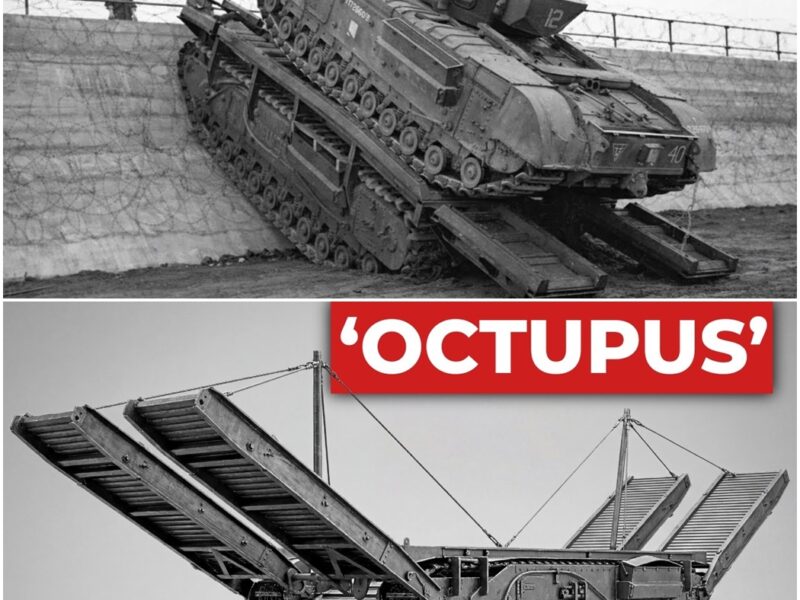
The Churchill ARK was built on the hull of the Churchill infantry tank, the A22. The most dramatic modification was the complete removal of the turret. The turret ring was sealed with a blanking plate. All armament was stripped. The ARK was entirely unarmed. The ramp mechanism was purely mechanical with no hydraulics.
On the Mark I version, full-length timber and metal trackways were installed over the hull above the tracks. Each trackway was 2-ft wide with regular crossmembers for grip. The configuration was deliberately asymmetric. A short front ramp was designed to drop onto the top of a seawall.
A longer rear ramp extended back to the beach below. A ratchet attachment under the front ramps allowed the tracks to bounce the ramps against the seawall for a secure fit. The ramps were hinged, folded upward for travel, and released by a quick mechanism operated from inside. Deployment took under a minute. The Bedford twin-six petrol engine produced 350 brake horsepower.
Maximum road speed was 27 km/h. Operational range was 144 km. Hull armor was retained since it was structural with up to 102 mm on the frontal plate. None of this was about fighting. It was about surviving long enough to reach the obstacle. According to wartime trials records, the ARK could bear a class 40 load, meaning a full 40-ton Churchill tank could drive over it.
For deeper obstacles, two ARKs could be stacked one atop the other. 50 Mark I ARKs were produced by February 1944, manufactured by REME workshops using conversion kits from TC Jones & Company. Meanwhile, in Italy, army workshops independently developed their own version. Approximately 47 Churchill Mark III tanks were converted into what they called the Octopus.
These used American Treadway ramps at each end and had no separate trackways. Vehicles drove directly on the Churchill’s own tracks. After D-Day, all surviving Mark I vehicles were upgraded to the Mark II standard with longer ramps at both ends and the left-hand trackway widened from 2 ft to 4 ft to accommodate wheeled supply vehicles.
One experimental variant pushed the concept to its extreme. The Churchill Great Eastern used rocket-deployed ramps designed to span 60 ft and climb a 12-ft wall. At its first live trial, the rockets were so powerful they lifted the entire tank chassis off the ground. 10 were built.
Only two reached France and none saw combat before Germany surrendered. Now, before we get into the combat record, if you are finding this deep dive into British engineering interesting, hit subscribe. It takes a second and helps the channel grow. Now, let us see what happened when the ARK met the enemy. Here is one of the most surprising findings from the research.
Despite 50 Mark I being available, the ARK played little or no role in the initial D-Day landings. Specialist historians Richard Anderson and Richard Doherty make scant mention of ARKs in the Normandy assault. The seawalls at Gold, Juno, and Sword were handled by other funnies, specifically the AVRE blowing holes in concrete with its Petard mortar, the scenes filling ditches, and SBG bridges spanning gaps.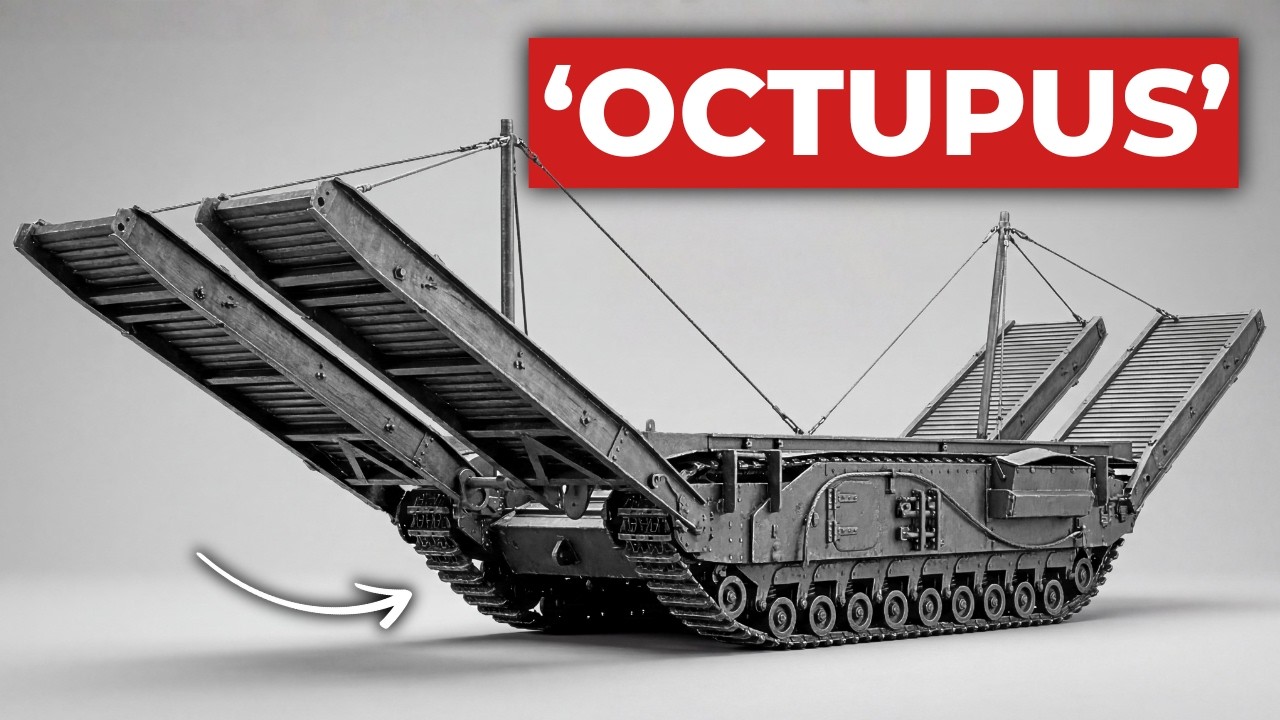
The ARK was designed for the problem, but its sibling solved it first. Italy gave the ARK its combat debut and its finest hour. According to photographs held by the Imperial War Museum, the Italian Patton Octopus first saw action on the Gothic Line from September 1944. Units operating ARKs in Italy included the 25th Tank Brigade with the 51st Royal Tank Regiment and the North Irish Horse, as well as the 21st Army Tank Brigade and the 93rd Anti-Tank Regiment.
Each formation typically maintained 18 ARKS alongside AVREs and Sherman bulldozers. On October 24th, 1944, an ARK was driven directly into the River Savio to form a crossing point. An Imperial War Museum photograph shows an Achilles 17-pounder tank destroyer of the 93rd Anti-Tank Regiment driving over it.
On November 9, ARKs and AVREs were photographed advancing through the liberated city of Forlì. The greatest showcase came during Operation Grapeshot on April 10, 1945 at the River Senio. The river banks rose at least 20 ft above the surrounding plain. The solution was audacious. Two Churchill ARKs were stacked one on top of the other to bridge the deep river bed.
Churchill tanks of the North Irish Horse and Sexton 25-pounder self-propelled guns drove across the double-decker bridge. It remains one of the most extraordinary images of World War II military engineering. In northwest Europe, the ARK Mark II supported the 79th Armoured Division’s advance through France, the Low Countries, and into Germany.
The 1st Assault Brigade Royal Engineers, comprising the 5th, 6th, and 42nd Assault Regiments, provided ARK support during the clearing of Channel ports including Le Havre and Walcheren. They were there for Operation Veritable in February 1945, the assault through the Reichswald Forest where flooding had turned the landscape into a swamp.
They were there again for Operation Plunder in March 1945, the Rhine crossings, when the 79th was at its greatest wartime strength. Each assault regiment maintained an establishment of roughly 18 ARKs alongside 18 AVREs and 18 Sherman bulldozers. The crew of a standard ARK faced a unique psychological burden.
Direct quotes from Churchill ARK crews are extremely rare in public sources, a consequence of fewer than 100 vehicles ever being built and crews drawn from small Royal Engineer Assault Squadrons. But the experience can be reconstructed. Once the ramps dropped, the crew was committed.
There was no quick exit, no ability to reverse out, no weapons to defend themselves. The vehicle was explicitly expendable, driven into position and left there for the duration. Sapper Ian Easley of 16 Assault Squadron Royal Engineers, who served alongside ARK operators and Churchill AVREs using the same hull, later recalled the experience.
“Sitting in a tin box,” he said, “one does not have much idea of what is going on around one. The noise was indescribable. The interior was bitterly cold most of the time and leaked through the hatches whenever it rained.” His overriding memory was the feeling of tremendous fatigue. Nigel Duncan captured the spirit of the men who crewed these strange machines in the official history of the 79th.
“Inspired by its divisional commander,” he wrote, “the division pursued its way with gaiety tempered with the resolution to be defeated by no difficulty, whether of nature’s or man’s creation.” Now consider what the Germans and Americans had for comparison. Germany developed bridge-laying tanks, but abandoned the program.
The Brückenleger IV, based on a Panzer IV chassis, was their most serious attempt. 20 vehicles were converted carrying a 9-m bridge with a 28-ton capacity. According to German production records, they were issued to the 1st, 2nd, 3rd, 5th, and 10th Panzer divisions for the 1940 French campaign. But the bridge proved too heavy for the chassis.
All 20 were converted back to gun tanks by May 1941. Germany developed nothing comparable to Hobart’s integrated suite of specialized armor. The Americans relied on Treadway bridges and Bailey bridges, a British invention, placed by engineering teams under fire. They did not deploy a widely standardized armored bridge laying vehicle in operational numbers during the war, despite experimental Sherman-based concepts reaching the prototype stage.
The popular narrative that American generals arrogantly refused Hobart’s Funnies and paid for it at Omaha Beach is more complicated than usually told. On January 27 and February 11, 1944, Hobart demonstrated his full arsenal to Eisenhower and Bradley. Eisenhower was deeply impressed, but left the decision to Bradley.
Bradley explained that since the Funnies used Churchill chassis, accepting them would require retraining operators and a separate supply chain for spare parts. However, according to recently examined correspondence, Bradley actually requested 25 flail tanks and 100 Churchill crocodiles just 5 days after the demonstration.
The British War Office agreed to supply them. The problem was production capacity. There were not enough converted vehicles to meet both Anglo-Canadian and American requirements before June. Time ran out. The casualty comparison remains sobering, though multiple factors beyond the Funnies explain Omaha’s carnage.
The beach was defended by the experienced 352nd Infantry Division at full strength, not just weak garrison units. The steep bluffs created a natural killing ground. Aerial bombing missed entirely, dropping ordnance 5 km inland. At Omaha Beach, where the Americans had only DD swimming tanks, and most of those sank in rough seas after being launched 5,000 yd offshore, casualties reached between 2,400 and 3,600.
At Gold Beach, where British forces landed with the full suite of Funnies, casualties were roughly 1,100. The 79th Division’s own final report stated that it was the overwhelming mass of specialized armor in the leading waves, coming as a complete surprise, which overwhelmed the defending troops and contributed to comparatively light casualties.
By war’s end, the 79th Armoured Division fielded nearly 7,000 vehicles. It suffered 379 tank losses and approximately 1,500 personnel casualties across Northwest Europe. Liddell Hart offered the ultimate assessment. “To have molded the best two British Armoured Divisions of the war was an outstanding achievement,” he wrote.
But Hobart made it a hat-trick by his subsequent training of the specialized 79th, the decisive factor on D-Day. The division was unique in military history. It never fought as a single formation. Instead, it parceled its specialist teams out to support every major operation in Northwest Europe.
It was disbanded on August 20, 1945, yet the concept the ARK pioneered outlived them all. The term AVLB, Armoured Vehicle Launched Bridge, formally replaced ARK in military vocabulary, but the lineage was unbroken. In the 1960s, the Centurion ARK became the most advanced version ever built with an 80-ton capacity and a 75-ft span.
It was the last vehicle to carry the ARK designation. Only four survive, with the finest example at the Royal Engineers Museum in Kent. The Chieftain AVLB replaced it from 1974, seeing combat in the 1991 Gulf War with the 32nd Engineering Regiment. Today, the British Army fields the Titan, based on the Challenger 2 hull, capable of deploying an 85-ft bridge in 2 minutes.
The Americans developed the M60 AVLB in 1963, over 400 built, serving in Vietnam and both Gulf Wars. Some were even sent to Ukraine in 2023. Their current Joint Assault Bridge runs on the M1 Abrams chassis. The Soviets fielded the MT-55A, with over 1,700 produced. Every major army now fields an armored bridge-laying capability.
The concept strongly influenced the post-war development of modern AVLB systems worldwide and traces back to the simple idea British engineers had in 1943. Strip the turret, bolt on ramps, drive into the gap. Think back to that workshop in southern England. Engineers staring at a turretless Churchill tank bolted to a pair of ramps. It looked wrong.
It looked ridiculous. It carried no weapons and could not fight. Its crew would drive it into ditches and rivers and stay inside while 40-ton machines rolled over their heads. At the River Senio, two of these strange machines stacked one on top of the other allowed an entire armored column to cross a 20-ft riverbed that would have stopped any conventional force.
No other army in the world could have done that in 1945. The Germans tried bridge-laying tanks and gave up. The Americans never fielded one in operational numbers. The British built the Ark, used it in combat, stacked two together when one was not enough, and helped establish the modern armored assault bridging doctrine that every post-war army eventually adopted.
That is not luck.