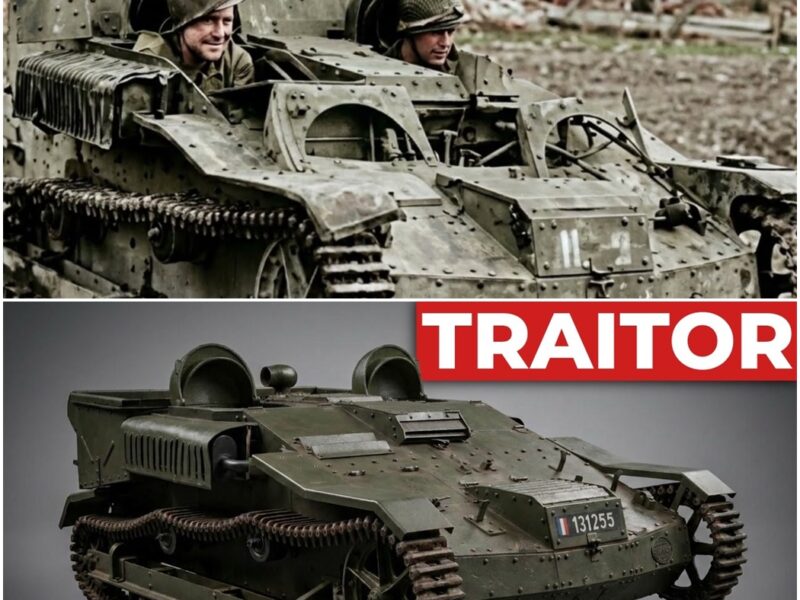
The ‘Harmless’ French Tractor Germany Captured In Thousands And Used Against Its Makers D
June 1940, a factory floor in Issy-les-Moulineaux, just outside Paris. German engineers in gray overalls move along a production line that was 6 weeks ago still French. They are inspecting row upon row of small tracked vehicles, each one barely a meter and a quarter tall.
Each one light enough that two men could almost lift one end. No guns, no turret, a tipping cargo bin at the rear, two cramped cupolas at the front, and rubber road wheels no larger than a farm cart’s. It looked like a toy. It looked like something a child might imagine when told to draw a tank. The crew sat knee to knee inside an open-topped steel box with nothing but a thin hemispherical hood to slide over each man’s head in combat.
The armor was 9 mm thick. A heavy rifle round could perforate it at close range. The Germans cataloged it without ceremony, stenciled a black cross onto the hull, and put it back to work. 3,000 of them. Captured almost without a shot fired because the French infantry units they belonged to had been enveloped and surrendered whole.
3,000 vehicles built in France at French expense, on French production lines, by the company of Louis Renault himself. Now pressed into service against every nation that had ever been France’s ally. They would roll under German colors through the Balkans, across the plains of Russia, into Sicily, and onto the beaches of Normandy, where some of them faced the very free French soldiers who had trained on their predecessors 4 years before.
Its designation was the Chenillette Renault UE, and it was the most produced French armored vehicle of the interwar period. Not a tank, not a fighter, a supply tractor, and it served more armies, fought in more countries, and launched more rockets than anyone who designed it ever intended. To understand why the Renault UE existed, you need to understand the problem France faced in 1930.
The French infantry had watched the Great War reduce its best divisions to walking ammunition parties. Men staggering forward under fire carrying mortar rounds in sandbags, artillery shells in bare hands. The lesson seemed obvious, mechanize the supply chain, give every infantry regiment a small armored tracked vehicle that could push forward under shrapnel, deliver ammunition, tow a light anti-tank gun, and get back.
Fast, reliable, cheap enough to build in thousands. The Commission de Vincennes issued its requirements in 1930. Several companies submitted prototypes. Louis Renault personally oversaw the Renault design bureau’s answer, and he patented the suspension himself, a double track guide leaf spring system clearly derived from British Vickers and Carden Loyd engineering, adapted and refined until French lawyers were satisfied it was sufficiently original.
The commission endorsed the Renault submission in December An initial order for 50 vehicles followed. Mass production began in earnest by 1934. The production variant weighed 2.64 metric tons. Its four-cylinder water-cooled petrol engine produced 35 horsepower, enough to push the vehicle to 30 km/h on a hard road, or roughly 12 km/h with the standard supply trailer hitch behind.
That trailer, designated the UK, could carry 600 kg. The cargo bin on the hull itself held 350 kg more, and it could be tipped from the driver’s seat, dropping its load without anyone dismounting under fire. Range was approximately 100 km on a full tank. Armor, as noted, was 9 mm where it mattered most, 6 mm elsewhere, riveted, not welded. There was no radio.
The two crew communicated through a system of colored interior lights. There was no armament either. The infantry had insisted on this. They feared that any weapon mounted on the UE would tempt commanders to misuse it as a light tank, rather than preserve it for its correct role as a supply vehicle. Louis Renault disagreed.
He had designed the hull with a turretless tank chassis profile precisely because he hoped the military would eventually fit a turret. The infantry refused. The design went into production naked of any gun, and it stayed that way. By June 1940, 4,977 had been delivered to the French Army. Every infantry division had 30 of them.
Mechanized infantry divisions had 66. They towed 25 mm anti-tank guns. They carried mortar bombs. They supplied the forward companies that could not be reached by trucks. Then Germany broke through at Sedan and the supply vehicles found themselves inside a collapsing pocket with nowhere to go.
The UEs were not destroyed. They were captured intact by the thousands because the men who crewed them surrendered with their parent units. Unlike tanks that burned or artillery pieces that were demolished, small supply tractors were simply left where they sat. German logistical officers moved through the abandoned French lines and counted what they had.
The consensus figure across the French language literature is approximately 3,000 vehicles still mechanically serviceable, stockpiled at depots across northern France. The Wehrmacht could not ignore 3,000 ready-made tracked vehicles. They were returned to the AMX works at Issy-les-Moulineaux, the same factory that had built them, now operating under German MAN company supervision.
They were overhauled, repainted Dunkelgrau, stamped with the Balkenkreuz, and entered into the Waffenamt inventory under the designation Infanterieschlepper UE 630f, the f standing for französisch, French. Then the conversions began. Now before we get into exactly what Germany did with 3,000 captured French supply tractors and where those vehicles ended up fighting, if you are enjoying this deep dive into the stranger second career any military vehicle has ever had, hit subscribe.
It takes a second, costs nothing, and helps this channel keep going. The most direct conversion was the anti-tank variant. Around 700 Renault UEs were fitted with the 37 mm PaK 36 anti-tank gun bolted just in front of the cargo bin on an improvised ring mount. The crew stood exposed behind the gun to serve it.
There was no shield worthy of the name, but the PaK 36 could penetrate the armor of most Soviet light tanks and armored cars at combat ranges, and the result was a self-propelled anti-tank platform cheap enough to equip every Panzerjäger company in an infantry division without drawing on Germany’s strained production of purpose-built tank destroyers.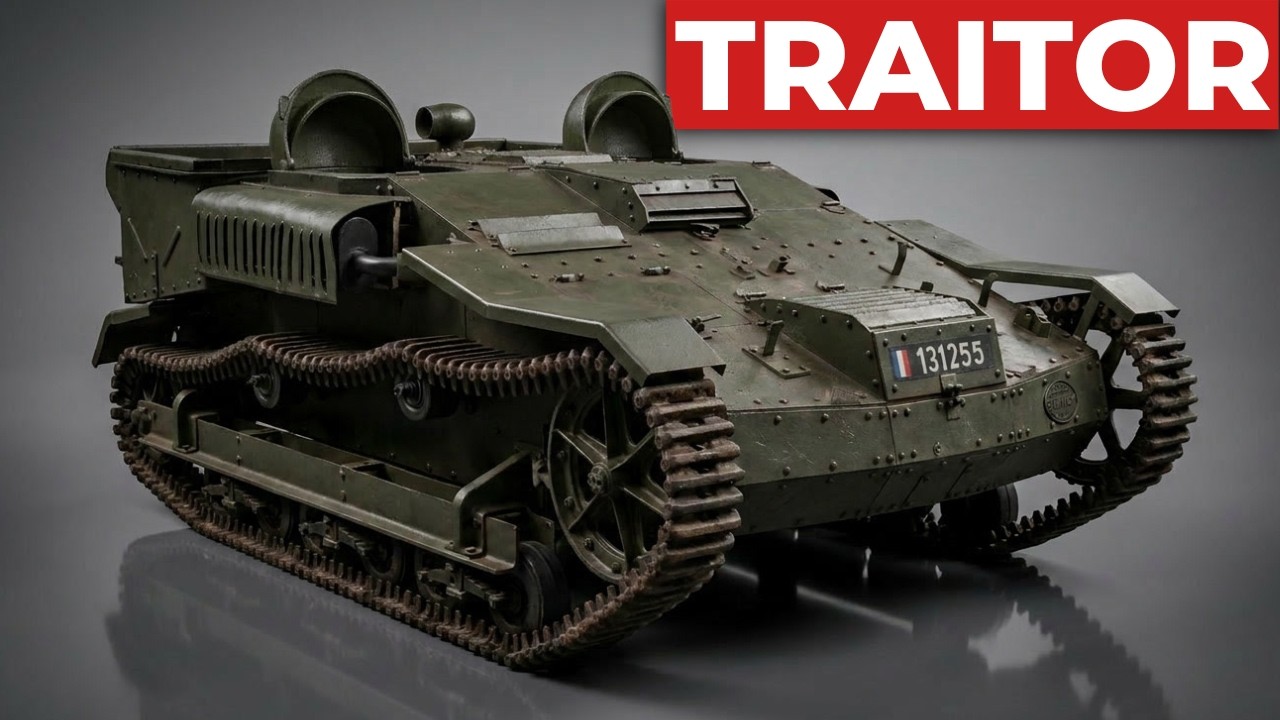
These vehicles went east in the summer of 1941, equipping units attached to infantry divisions pressing into the Baltic states, the Ukraine, and toward Leningrad. They were ugly, they were exposed, and they worked. The rocket variant was stranger. 40 Renault UE were fitted with Wurfrahmen 40 launch frames for the 28-cm high explosive and 32-cm incendiary Stuka zu Fuß rockets, the same rockets fired from purpose-built half-tracks.
The tiny French tractor, weighing less than 3 tons, became a rocket artillery platform. Some had the frames mounted on the hull sides, others received a four-rack platform that replaced the cargo bin entirely. They fired, relocated, and fired again. They appear in the records of fighting at Kursk in the summer of 1943.
The other conversions filled every gap Germany’s stretched economy could not meet through dedicated production. 40 vehicles were rebuilt as radio and artillery observation carriers by an engineer named Major Alfred Becker, who ran a conversion workshop called Baukommando Becker out of the captured Hotchkiss plant near Paris.
Becker was a reserve artillery officer and a trained mechanical engineer. He had recognized early in the occupation that Germany’s tank production could never meet the Wehrmacht’s needs and that the answer lay in the captured vehicle parks of northern France. He converted Lorraine tractors into howitzer carriers, Hotchkiss tanks into anti-tank guns, and Renault UE into command vehicles.
According to records of his output, Becker’s unit delivered over 550 armored vehicles to the Wehrmacht, more than 400 of them going to a single formation, the 21st Panzer Division reformed in Normandy for the defense of France in 1943. General Edgar Feuchtinger, commanding the 21st Panzer Division, had been explicitly forbidden by German High Command from drawing on any standard German equipment.
He was given the scrap of occupied France instead. Feuchtinger turned to Becker. The 40 Renault UE based observation and command vehicles that Becker delivered became the division’s eyes on the battlefield. When the Allies landed on June 6th, 1944, those French built German converted Normandy crude supply tractors were among the first tracked vehicles to move against the beachhead.
The regiment commanded by Major Hans von Luck, Panzergrenadier Regiment 125, fought through the bocage that week with Becker’s vehicles directing fire onto Allied positions. On July 18th, during Operation Goodwood, Becker himself commanded his Sturmgeschütz Battalion through the largest British armored assault of the Normandy campaign.
He was eventually captured in Alsace in December 1944. The irony of the 21st Panzer Division’s armor does not end at Normandy. Among the Allied forces pressing into the bocage that summer were units of Free France. Soldiers of the First French Army and the French Second Armored Division, men who had trained on Renault US in 1938 and 1939 before the fall.
They were now advancing against Normandy positions defended partly by the same model of vehicle, wearing the wrong uniform. This was not the first time it had happened. In June and July of 1941, during the Syria-Lebanon Campaign, Free French forces under de Gaulle fought Vichy units equipped with Renault US in the Levant.
Australian newsreel crews filmed the moment Allied troops drove captured Vichy Chenillettes out of Damascus positions. Frenchmen using French vehicles against other Frenchmen. The Australian War Memorial holds that footage today. The strangest conversion of all was never fired in anger. The Panzerkampfwagen attrape of UE was a Renault UE fitted with a plywood superstructure shaped to resemble a Soviet T-34.
The smallest French tracked supply vehicle in service, dressed as the most feared Soviet tank in production, driven by Germans on training ranges in occupied France to teach recognition and gunnery. It is difficult to think of a more complete summary of 1940s consequences than that image. Outside Germany, the Renault UE served in Romanian hands alongside license-built copies manufactured by the Malaxa works in Bucharest.
126 Romanian-built Chenillette Malaxa Tiple UE rolled off that line between 1939 and March 1941, when French parts dried up after the armistice. The Romanians used them to tow 47-mm anti-tank guns on the Eastern Front in the Crimea and beyond. 10 export UEs ordered by China in 1936 were intercepted by Vichy colonial authorities in Indochina in 1940 and never reached their intended operator.
Thailand captured a small number during the Franco-Thai war of 1940-41. 17 UEs that had been earmarked for the Polish Independent Highland Brigade wound up in Scotland after the fall of France, used by Polish tankers as driver training vehicles, learning to operate British armor on a French chassis while the country that built it was occupied.
On paper, the Renault UE was inferior to its rivals in almost every measurable category. The British Universal Carrier was faster, heavier, better protected, and carried a Bren gun as standard. Britain eventually built over it the most produced armored fighting vehicle in history. The Renault UE could carry more payload than the Kettenkrad, but was slower and shorter range than the German half-track motorcycle.
Against its French rival, the Lorraine 37L, it was underpowered, lighter, and could carry less. On every chart, the Chenillette looked like a compromise. What the charts did not show was that no other supply vehicle in the world was captured in enough quantity to be turned into an entire secondary army. Return to that factory floor in Issy-les-Moulineaux. June 1940.
A machine that looked too small to matter, parked in rows under German fluorescent lights, no gun, minimal armor, a tipping bin and two cramped seats, and a colored light signal system instead of a radio. It had been built to carry ammunition in a war that lasted six weeks. It went on to fire rockets in Russia, command armor in Normandy, tow anti-tank guns in the Crimea, and stand in for a Soviet medium tank on a French training range.
Survivors of the type sat in Syrian army depots into the 1950s. More than 40 examples survive in museums across at least 20 countries today, from the Wheels of Liberation Collection in Pennsylvania to the Cavalry Center at Saraburi in Thailand. It was not a weapon. It was never meant to be. That is precisely what made it indispensable.
France built it for one war. Germany inherited it for another. And the vehicles that were designed to keep French soldiers alive ended up fighting them on three continents. That is not accident. That is what happens when you build something well enough to be worth stealing.