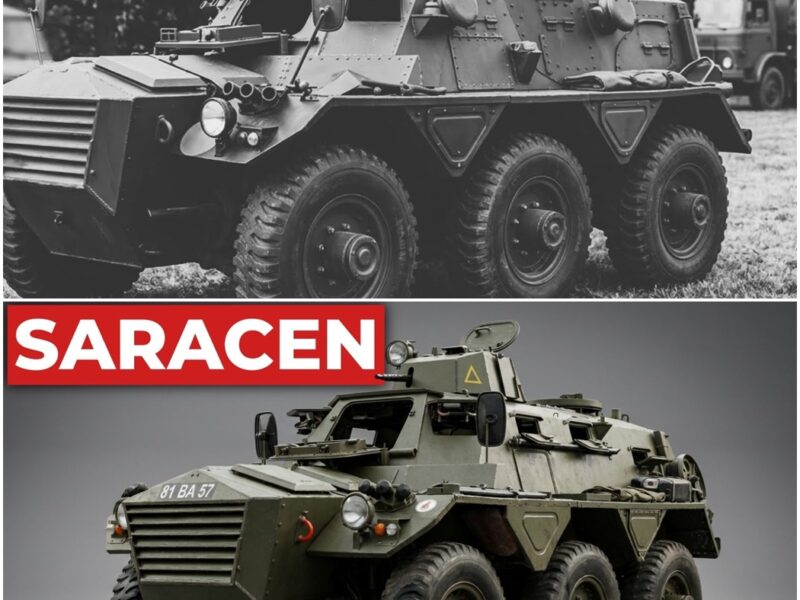
The ‘Hated’ British APC That Saved More Lives In Malaya Than Any Tank Britain Ever Built D
June, 1948. A jungle road south of Kuala Lumpur, Federation of Malaya. A Bedford 3-ton lorry moves through the trees. Soft canvas sides, open top, eight soldiers inside, rifles across their knees, watching the tree line on both sides of the road. The engine noise fills the silence under the canopy. Nothing else moves.
They never see the men who killed them. This was the ambush problem. This was the problem that cost the British Army more soldiers per mile than any other hazard in the opening years of the Malayan Emergency. Soft-skinned vehicles on jungle roads carrying infantry with nothing between them and the darkness under the trees except canvas and optimism.
Every convoy on every trunk road through Pahang and Perak was a question the Malayan Communist guerrillas answered with a burst of fire and a shower of grenades. Soldiers who survived the first volley had nowhere to go. The lorry could not fight back. It could not protect them while they dismounted. It could not accelerate out of the killing ground at any speed that mattered.
It looked like a simple problem. It was not. It would take a vehicle that looked ridiculous, weighed 11 tons, ran on six wheels, and was condemned by critics before it fired a shot to solve it. That vehicle went on to serve on four continents. 18 nations bought it. 1,838 were built over two decades of continuous production.
Its own crews cursed it in Belfast a generation later. Governments debated it in Parliament. A rock band put it in a song. And not a single successor has managed to replace everything it offered in a single hull at a single price across four decades of continuous war. Its designation was FV603. Its name was the Saracen.
And it was the most underestimated armored vehicle Britain ever built. To understand why the Saracen existed, you need to understand the problem Britain faced in 1947. The Second World War had ended with a British Army equipped for a conventional European campaign that was now over. What Britain actually faced was an empire still stretching from West Africa to Hong Kong with insurgencies, emergencies, and colonial confrontations that none of the war’s hardware had been designed to handle. A Centurion tank was no answer to a jungle ambush. A field artillery regiment was no answer to a gorilla hiding in rubber trees. What the army needed was protected mobility, the ability to move 10 soldiers through a contested road in a steel box, absorb the opening burst of any ambush, and either fight back or drive away, depending on the circumstances. In 1947, the Fighting Vehicles Research and Development Establishment at Chertsey commissioned a family of standardized 6×6 armored vehicles. The contract was awarded to the Alvis
Car and Engineering Company on Holyhead Road in Coventry, an automotive mark founded in 1919 that was now increasingly committed to military work. The family, designated the FV600 series, would share a common chassis, independent torsion bar suspension, and an H drive system that distributed power to all six wheels simultaneously.
The plan called for an armored car first, a personnel carrier second, then Malaya forced a change. By 1950, the ambushes on the Malayan Trunk Road had reached a rate the colonial government could not sustain. The guerrilla campaign was not losing. The decision was taken to hand the armored car contract to a separate manufacturer and throw every Alvis engineer at the personnel carrier.
The result was startling even by peacetime standards, and extraordinary by the standards of a nation at war. Two prototypes were completed and shipped directly to Malaya for field trials in June 1951. Tested in the exact terrain in which they would fight. By December 1952, production vehicles were rolling out of Holyhead Road.
The Saracen had beaten the Saladin armored car, the vehicle it was supposed to follow into service by six full years. A personnel carrier had been rushed into production ahead of the gun platform it was based on. Britain had built the taxi before the patrol car because the taxi was killing people.
The vehicle itself rewarded that urgency. The hull was clad in rolled steel armor up to 16 mm thick at the front, 8 mm on the sides and roof. That meant it was proof against every small arms round in the MNLA arsenal, proof against shell fragments, and impervious to the standard infantry weapons the enemy could bring to a jungle ambush.
A manually traversed one-man turret mounted a 7.62 mm Browning machine gun with full 360° rotation. A second machine gun sat at a ring mount over the rear hatch. Six smoke grenade dischargers flanked the hull, three to each side. Troops in the rear compartment could fire personal weapons through ports in the hull sides without exposing themselves to the outside.
The engine was a Rolls-Royce B80, an eight-cylinder petrol unit developing 160 brake horsepower. It sat in the nose of the hull, which put a wall of metal and engine between the driver and anything coming from ahead. The gearbox was a five-speed preselector unit with fluid coupling, and here was one of the Saracen’s least discussed advantages.
Every gear available in the forward direction was also available in reverse. A driver caught in an ambush who floored the accelerator in reverse could extract a 9-m vehicle at a speed that surprised the ambushing party as much as it surprised the passengers. The Saracen could reach 72 km/h on a road surface and sustain 400 km on a single load of fuel.
It could carry 10 soldiers fully armed in a hull that was completely closed against fire from every angle. Its American contemporary, the tracked M75, offered heavier armor and a heavier weapon, but it cost three times as much per vehicle, wore its crews and running gear down on long patrols, and could not fit inside the transport aircraft the British Army relied on to get armored vehicles to emergencies on the far side of the world at short notice.
The Soviet BTR-152 offered a 6×6 wheeled layout similar to the Saracen’s, but carried its infantry in an open-topped body with no overhead protection. A single grenade dropped from a bridge ended a BTR-152’s patrol. It did not end a Saracen’s. Now, before the combat record, if you are finding this history worth your time, hit subscribe.
This channel covers British military engineering with the depth these machines deserve. It costs nothing. It helps the channel grow. The first regiment to take the Saracen into combat was the 11th Hussars, Prince Albert’s Own. They arrived in Johor Bahru in July 1953 and over 3 years of convoy escort, road domination patrols, and jungle edge troop insertion covered nearly 4 million miles of Malayan road.
They returned to Britain in March 1956 with negligible vehicle losses to enemy action. The 15th and 19th King’s Royal Hussars followed from June 1954 with regimental headquarters at Ipoh and squadrons at Taiping and Raub. In every engagement on those roads, the calculus was the same. Where a Bedford lorry had delivered dead soldiers, a Saracen delivered living ones.
Where an open vehicle had left its crew exposed to the follow-up attack after the ambushers first volley, the Saracen absorbed the fire and drove through it. 4 million miles, minimal losses. That is not luck. That is engineering answering a problem correctly. When the Cyprus emergency opened on the 1st of April 1955 and EOKA’s campaign of bombings and assassinations began killing British personnel across Nicosia and Limassol, Saracens went to Cyprus.
They ran cordon operations through the Troodos foothills. They secured checkpoints and escorted military convoys across the island through the worst of the bombing campaign and they remained on station with the Cyprus armored squadron into the 1980s, one of the last postings in the British Army still routinely equipped with the type.
Aden was the Saracen’s most cinematic deployment. By 1963, armored car regiments rotating through the South Arabian Protectorate operated Saracens and Saladins and Ferret Scout Cars in the close terrain of the Crater District, a densely built neighborhood of narrow streets and high buildings that was ideally suited to ambush and entirely unsuited to conventional armored operations.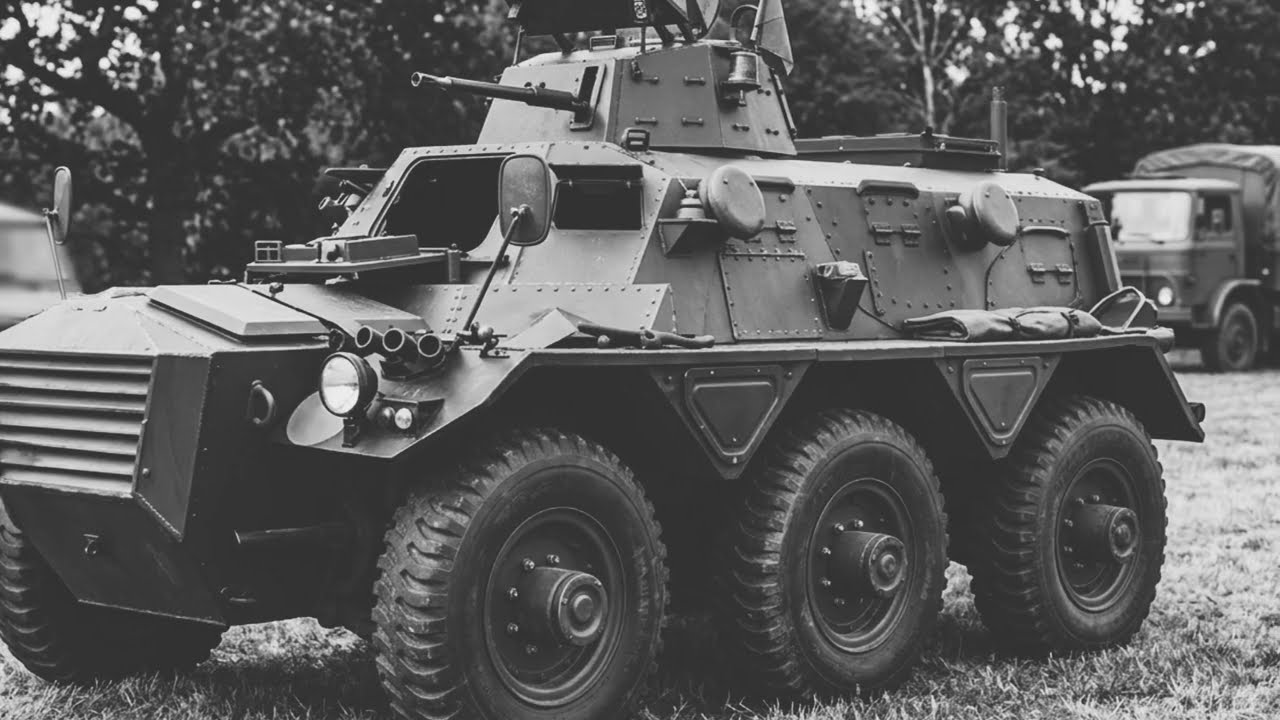
On the evening of the 3rd of July 1967, Lieutenant Colonel Colin Campbell Mitchell, commanding the 1st Battalion of the Argyll and Sutherland Highlanders, launched Operation Sterling Castle. B Company, under Major Palmer, advanced from Marine Drive into Crater in darkness, with Saracens and Saladins of a squadron, Queen’s Own Dragoon Guards, alongside the leading platoons.
Pipe Major Robson sounded the regimental charge as the advance moved into the district. When enemy machine guns opened fire from positions near the Sultan of Lahej’s Palace, the armored car crews returned fire immediately, silencing both positions. The Argylls held Crater for the final 5 months of British rule in Aden.
The Saracen was at the center of every patrol that made that possible. Then came Northern Ireland, and everything the Saracen was good at became a liability. When British troops deployed to Belfast and Londonderry on the 14th of August, 1969, the Saracen went with them, and it became, within weeks, the most recognizable military vehicle in British public life.
It also became the most hated. Its vision blocks were too narrow for patrolling the back streets and alleyways of a city built before the motor car. Its flat-bottomed hull offered almost no protection against the culvert bombs the Provisional IRA’s South Armagh Brigade was perfecting with each passing year.
The front-mounted petrol engine radiated heat into the crew compartment through a Belfast summer, until the vehicle became, in the words of veterans recorded after the campaign, a steel oven. The Saracen was 11 tons of colonial emergency vehicle operating in a political and physical environment it had not been designed for, against an enemy who studied its limitations with a patience the jungle guerrilla had never shown.
The British Army understood the problem and modified what it could. The Mark 5 and Mark 6 variants added applique armor, four-point harnesses for the passengers, internal padding, and high-pressure water dispensers for crowd control. The retrofits saved lives. Regimental accounts note at least one incident in which a Saracen of the 1st Royal Tank Regiment was destroyed by a culvert bomb after the Mark 6 upgrade program.
The commander and driver suffered minor cuts. The soldiers strapped in the rear compartment walked away. Not everyone was so fortunate. On the 19th of May, 1981, two Saracens of a British Army patrol drove along Chancellor’s Road near the townland of Altnaveigh, west of Newry. As the second vehicle crossed a culvert, the South Armagh Brigade detonated a 1,000 lb landmine by radio remote control.
The explosion threw the 11-ton hull over the Belfast to Dublin railway line and opened a 25-ft crater in the road. Five soldiers were killed outright. Lance Corporal Grenville Winston of the Royal Green Jackets, aged 27. Privates Paul Bulman, Michael Bagshaw, Andrew Gavin, and John King. None survived.
After Altnaveigh, the British Army began lifting South Armagh patrols by helicopter rather than road. The vehicle that had saved soldiers in Malaya was losing them in County Armagh. The geography was different. The enemy was different. The mine was a thousand times heavier than anything the Malayan guerrilla had planted.
The Saracen had not failed. The war had changed beyond what any 1952 design brief could have anticipated. 18 nations ultimately bought the Saracen. Jordan took 120 and deployed them in the Black September operations of 1970 and on the Golan front in 1973. South Africa took 280 and their employment against anti-apartheid demonstrators from the 1960s onward became a source of such acute political controversy in Westminster that the British government let spare parts supply lapse in 1968.
The vehicles kept running anyway. Nigeria operated Saracens throughout the civil war of 1967 to 1970. Indonesia’s army used them in Jakarta during the 1965 coup and was still operating upgraded examples fitted with Perkins diesel engines in place of the original Rolls-Royce petrol units during the Aussie offensive of 2003.
Nearly half a century of frontline service in a vehicle whose first prototype had rolled off a Coventry production line in 1951. On paper, every vehicle that replaced the Saracen should have improved on every one of its qualities. The FV432 tracked APC took over its role in the BAOR mechanized force from 1963, offering heavier armor and the tracked cross-country mobility of a battle tank.
The Saxon wheeled APC took over the Northern Ireland patrol role in the late 1980s, faster on roads and simpler to maintain. The Warrior infantry vehicle, which entered service from 1988, is a far more capable combat system in every measurable dimension. None of them did everything the Saracen did.
The FV432 was built for a conventional European war and had a road range and strategic mobility that made it expensive and slow to deploy across the empire. The Saxon had four wheels rather than six, less mine redundancy, and was regarded by veterans as ungainly in the precise confined spaces where the Saracen had imperfectly and at great cost still managed to function.
The Warrior exists in far smaller numbers, costs far more, and carries fewer soldiers in a correspondingly heavier and narrower hull. No single vehicle in the British inventory after 1983 combined the Saracen’s air transportability, its six-wheel mine damage tolerance, its 400 km range, and its capacity for 10 fully equipped infantrymen in an enclosed armored hull at a price that allowed 1,838 of them to be built.
Preserved examples survive at the Tank Museum at Bovington, the South African Armor Museum, the Israeli Armored Corps Collection at Latrun, the National War Museum in Malta, and private collections across Britain, Australia, and the United States. Running examples sell for as little as 8,000 lb in Britain.
More than 70 years after the first prototype crossed a Malayan jungle road, the Saracen is one of the most widely surviving Cold War armored vehicles on Earth. Return to June 1948. Return to the jungle road. Return to the soldiers in the lorry with nothing between them and the trees. The Saracen had no night vision system.
It had no nuclear, biological, or chemical protection. Its petrol engine was in the wrong place for the crew and thirsty for fuel. Its 16 mm armor would not stop a heavy machine gun at close range. In Northern Ireland, it cooked its crews in summer, blinded its drivers in the backstreets, and was outpaced eventually by the IRA’s engineers.
In South Armagh, it was defeated. And yet, in 4 million miles of Malayan road patrol, it delivered its soldiers alive. In the alleys of Aden, it silenced the machine guns and held the district. In Cyprus, and Borneo, and Jordan, and Nigeria, and on five continents across 40 years of continuous service, it did the one thing an armored personnel carrier must do above every other.
It kept its men alive long enough to matter. That is not an accident of design. That is what happens when engineers are handed a real problem, given a real deadline, and told to solve it without the luxury of getting it wrong. 18 nations bought it. Some were still using it 50 years later.
The Bedford lorries it replaced are dust. The Saracen is still running. That is not sentiment. That is British operational engineering. And that is what the Saracen was.