The ‘Hated’ British Army Truck That Every Soldier Complained About But Absolutely Refused To Die D
1983 Telford, England. A factory floor owned by GKN Sanki, an engineering company that had been building things out of steel for the British military since the Boore War. A vehicle rolled out of those gates that no one had asked for. No doctrine had demanded it. No general had drawn up a requirement and waited years for it to be built.
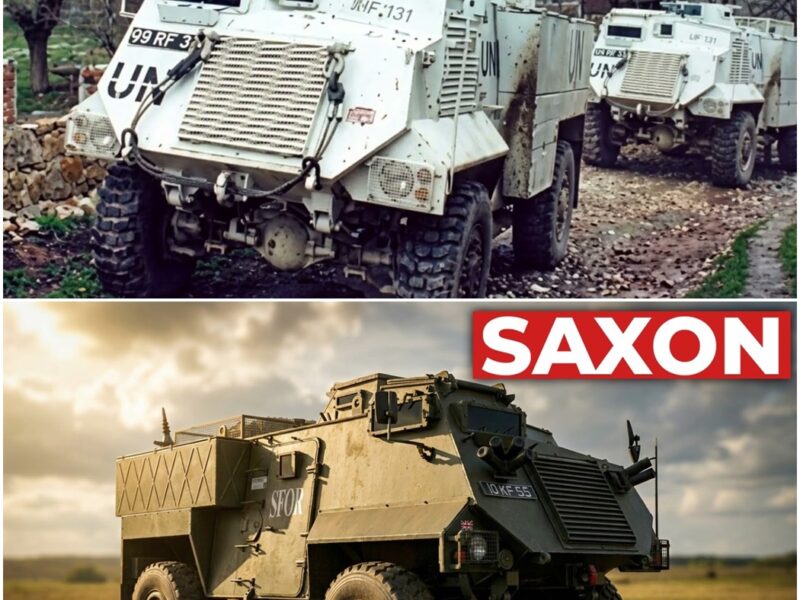
It had been designed privately, shopped around the world, rejected by most who saw it, and eventually bought by the British army out of a shortage of alternatives rather than any genuine enthusiasm. It looked like a delivery van that had survived a factory accident. Square, boxy, mounted on the running gear of a Bedford lorry.
No turret, no tracks, no aggressive angle to its hull. The men who first climbed inside called it a tin box, a 4 tunner with ambitions, and several things considerably less polite. Its top speed was 60 mph on a good road. It could not cross a field without bogging. It had no air conditioning. The men sitting in the rear could not see out.
In every theater it was ever deployed, British soldiers complained about it with a consistency and creativity that would have impressed a barrista. And yet it served on two continents, fought alongside British infantry through the streets of Belfast, the mountains of Bosnia and the alleyways of Bazra, was sold to the armies of more than 11 nations, and never in British service lost a crew to a mine strike.
Its designation was the AT105 Saxon and it was the most hated vehicle in the British Army that soldiers could not stop relying on. To understand why the Saxon existed, you need to understand the problem the British army faced in the 1970s. NATO’s strategy in Western Europe rested on the assumption that Soviet forces would punch through the inner German border at speed, with weight, and in enormous numbers.
The British Army of the Rine, stationed in West Germany, would be the first line of resistance. But the British Army of the Rine was only part of the story. A significant portion of the infantry, the reserve battalions, the follow-on forces were stationed back in the United Kingdom, earmarked to cross the channel and race to the Rine the moment the alert went out.
The problem was simple and embarrassing. Those reinforcing battalions had no protection whatsoever. They would make the crossing from British ports to the inner German border, sitting in unarmored Bedford Forton lorries. In the event of a Soviet attack, they would be driving softskinned trucks through a battlefield.
It was by any measure an unacceptable situation. The Ministry of Defense needed a solution. It needed one cheaply, quickly, and without the complications of an entirely new tracked vehicle program. GKN Sanki, already deep in British military contracting, and the company that had built the hull for the FV432 tracked armored personnel carrier, had been quietly developing an answer on their own budget since 1976.
They took the running gear, the engine, and the gearbox of the Bedford TM4x4, an 8-tonon logistics truck already in widespread British military service, and built an armored box around it. The design was not elegant. It was not supposed to be. It was a lorry chassis wearing a steel coat.
The hull was welded steel, rated to defeat 7.62 mm armor-piercing rounds at point blank range and shell fragments from a 155 mm artillery round detonating 10 m away. Beneath the floor, the hull angled into a V-shape, designed to deflect the blast of a mine outward rather than straight up through the crew compartment.
The axles sat deliberately outside the armor envelope. A wheel station could be blown off entirely without breaching the box where the soldiers sat. That detail was not an accident. It was the entire philosophy of the vehicle expressed in a single engineering decision. The engine was a Bedford 500 six-cylinder diesel producing 164 horsepower.
It pushed the Saxon to a road speed of 60 mph and gave it a range of approximately 510 km on a full tank. Later production variants received a cumin six-cylinder turbo diesel for improved reliability and easier maintenance. The crew was two, a driver and a commander with eight soldiers in the rear compartment. A single 7.
62mm generalpurpose machine gun sat on a pintle mount above the roof. The vehicle ran on large commercial tires with run flat capability. In February 1983, the Ministry of Defense placed an initial order for 47 vehicles. A larger order of 247 followed in 1985, with the total British fleet reaching approximately 577 vehicles by the end of the decade.
Total production across all export customers reached approximately 850 units by 1995. Every single nation that bought it would have the same fundamental complaint, and every single nation would keep using it anyway. Before we get into where this vehicle actually fought and what happened when it did, if you are enjoying this deep dive into British military engineering, hit subscribe.
It takes a second, costs nothing, and helps this channel grow. The Saxon was designed for one war and fought an entirely different one. The war in Western Europe never came. The Cold War ended without the reinforcing battalions ever loading their sections into Saxons and racing for the Rine.
Instead, the British Army found itself committed to a conflict it had been fighting since 1969 on its own territory in the streets of Northern Ireland. The Humber Pig, the cramped armored personnel carrier that had served British infantry in Belfast and Londereerry through the worst years of the troubles, was wearing out.
By the early 1990s, it was exhausted, and its successes needed something better. From late 1992, Saxon patrol variants began arriving in Northern Ireland. These were substantially modified internal security versions. Cumins engine, extendable riot wings, barricade rams, wire cutters, additional roof hatches, and Kevlar interior liners bolted to the inside of the steel walls.
By 1993, second battalion, the parachute regiment was operating Saxons in West Belfast, running patrols around the Woodborne Royal Olter Constabularary Station and the Poleglass Estates. The complaints began immediately. The noise inside the vehicle drowned out radio nets. The rear compartment had no external visibility for the dismounts, meaning eight trained soldiers sat blind in a steel box while moving through one of the most dangerous urban environments in the world.
In a city defined by tight streets and culvert bombs, the Saxon’s bulk made it an obvious target. Easily channeled into a killing ground, the IRA found it harder to kill than the pig. The V-shaped hull and reinforced floor proved their value repeatedly against the undervehicle devices that had destroyed pigs throughout the 1970s and 80s.
No Saxon crew in Northern Ireland was killed by a mine strike during the vehicle’s service in the province. The vehicle was genuinely despised. It genuinely worked. In March 1994, the Saxon was sent somewhere nobody had anticipated. The first battalion of the Duke of Wellington’s regiment, 900 soldiers strong, was rushed to central Bosnia as part of the United Nations Protection Force, deploying around Bodnau, Vitz, Travnik, and the besieged enclave of Gaj.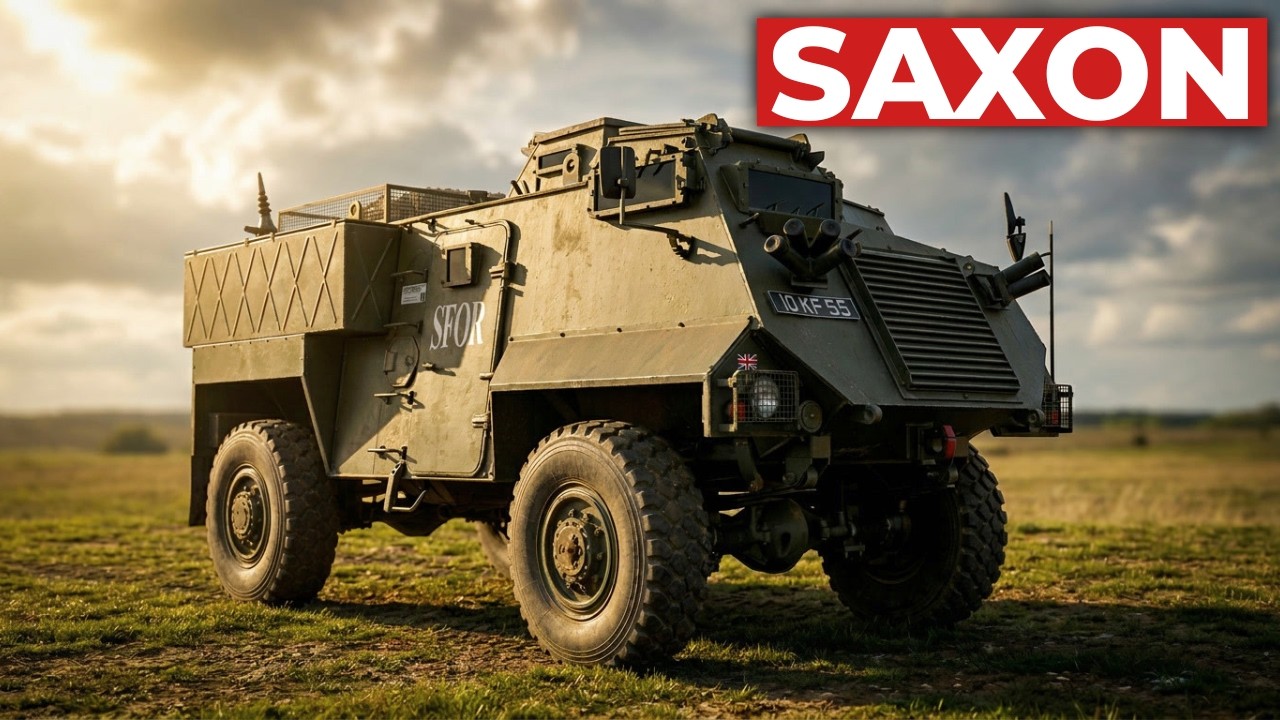
The Bosnian hills exposed every weakness the Saxon possessed. The leaf spring suspension and commercial tires that served so well on European motorways were brutally ills suited to mountain tracks with adverse camber and no crash barriers. When surplus turrets from the FV 432 were bolted to Saxon rooftops for anti-niper protection, the vehicles became dangerously topheavy.
Rollovers occurred on Bosnian gradients. In 1996, a national newspaper published an article blaming the vehicle for troops deaths. And the Saxon’s public reputation crystallized into a single verdict. Unsafe, inadequate, and overdue for replacement. What that verdict could not erase was what happened near Rama Lake in 1994.
A Saxon from the Duke of Wellington’s regiment drove over a TMA3 anti-tank mine. The TMA3 was a weapon designed to destroy armored vehicles. The explosion demolished the wheel station and the forward section of the vehicle. The V-shaped hole floor did exactly what GK and Sanki’s engineers had specified in 1976.
It deflected the blast outward and downward. The crew compartment held. The soldiers inside walked away. Corporal Wayne Mills of the same regiment operating in the Gashi area during this period was awarded the conspicuous gallantry cross gazetted in May 1995 for extracting his patrol under direct fire. He was the first recipient of that decoration to be gazetted.
The citation recorded his actions while mounted in a Saxon, the vehicle that soldiers called a tin box had carried him to a firefight and carried his men out of it. Through Operation 1 FOR from December 1995 and FOR from December 1996, Saxons remained in the Balkans in progressively reduced roles, handling medical evacuation, command, and rear area transport.
While warriors and scimitars held the forward positions, the Saxon had been designed for roads, Bosnia had no roads worth the name. The vehicle continued regardless. From 2003, Saxons appeared in southern Iraq on Operation Telk. British units in Bazra found the vehicle no more beloved there than it had been in Belfast and considerably hotter.
In 2005, General Sir Richard Danut, then commander and chief land command, ordered the Saxon withdrawn from frontline British service, judging it completely unsuitable for the threat environment in Iraq and Afghanistan. No Saxon crew in Iraq was killed in the vehicle. The withdrawal was precautionary, not the consequence of catastrophic loss.
On paper, the vehicle the Saxon was meant to supplement, the FV432 tracked armored personnel carrier was superior in almost every measurable respect, the FV432 was fully tracked, able to keep pace with Chieftain main battle tanks across country. More heavily armored and better protected against mine blast.
In practice, the FV432 cost approximately three times as much as a Saxon to procure, required far more maintenance, and was not designed to self-deploy at 60 mph along a motorway for 1,000 km. The Saxon and the FE 432 were not competing for the same role. One was a battle vehicle, the other was a battle taxi. The British Army needed both.
In the 1980s, it could only afford one of each type. The warrior infantry fighting vehicle entering British service in 1987 with a 30 mm roden cannon and the ability to operate alongside Challenger tanks made the Saxon look even more modest by comparison. Nobody compared the Saxon to the Warrior.
The Saxon was compared by the men who rode in it to nothing at all because there was nothing else available in its role. By the time the Saxon was formally retired from British frontline service, approximately 147 vehicles were held in storage against a possible future internal security commitment. The remainder passed to commercial dealers.
In December 2013, a contract was agreed for 75 surplus British Saxons to be transferred to Ukraine at a total purchase price of approximately $3.8 million. Delivery came in two shipments in 2015. The Ukrainian National Guard tested the armor against armor-piercing ammunition and found it held.
Some vehicles received heavy caliber machine guns and additional generalpurpose machine gun positions. The 81st and 95th Airmobile brigades received early allocations. From June 2015, they were in action in the Donbass. From February 2022, after Russia’s full-scale invasion, British-built Saxons designed in 1976 to stop a Soviet advance into Western Europe were finally being driven against Russian forces.
General Sir Richard Danut, who had called the sale immoral, and the vehicles quite useless. Semi-armored lorries that should be nowhere near anyone’s front line, was contradicted by a Ukrainian airmobile soldier speaking to a camera in 2015. “The armor is good,” that soldier said. for evacuating personnel. It is great.
1983 Telford, a box-shaped vehicle on a lorry chassis rolled out of the GKN Sanki factory and into an army that did not particularly want it. It had no turret, no tracks, no prestige. The soldiers who rode in it said it was cramped, blind, deafening, and too slow off-road to keep pace with anything it was supposed to support.
They were right on every count. The Saxon was underpowered, topheavy when modified, poorly suited to mountains, and built to a budget that showed in every corner of its interior. British soldiers complained about it in Belfast in 1993, in Bosnia in 1994, and in Basra in 2004. No British crew was ever killed inside one in the streets of West Belfast on the mountain tracks above Gaj in the roads south of Basra in eastern Ukraine against the enemy it had been designed to face 50 years earlier.
The Saxon was not fast. It was not elegant. It was not loved. It was a Bedford lorry wearing a steel box. But the engineers who built that steel box understood one thing above everything else. The soldiers inside it had to come home. They did. That is not luck. That is British engineering at its most unglamorous and its most honest.