The ‘Improvised’ British Missile Truck Built In A Weekend To Kill Russia’s Best Tanks In Ukraine D
April 2022, a request arrives in London from Kyiv. Russian heavy armor is rolling through Eastern Ukraine. Russian T-90M and T-80BVM tanks, the most modern in Putin’s arsenal, fitted with reactive armor designed specifically to defeat Western anti-tank missiles. Ukraine needs something to stop them. Something with reach.
Something British engineers can build right now. A small team at the Ministry of Defense gathers over a single weekend. According to officials briefing reporters at Wellington Barracks the following year, they grab an office laptop, commandeer a truck, and walk into a B&Q hardware store to buy a power generator.
They take a precision missile designed to be fired from a fast jet at 30,000 ft, and they bolt it to the back of a flatbed. 6 weeks later, footage emerges of the system destroying Russian armored vehicles inside occupied territory. The operator never saw the targets. The launcher fired, then drove away before Russian artillery could find it.
The system was called Wolfram, and it would change how Ukraine hunted Russian tanks. The Russian armor problem in spring 2022 was specific and severe. The T-90M Proryv was Russia’s flagship tank. A 48-ton machine carrying composite frontal armor, a 125-mm smoothbore gun, and Relikt explosive reactive armor.
Relikt was designed to defeat tandem charge warheads, the very weapons Western nations had built to kill Russian tanks. Vladimir Putin called it the best tank in the world. The T-80BVM was the gas turbine cousin, lighter, faster, equally well armored, equally deadly. Together, these formed the spear tip of Russia’s mechanized forces.
Ukraine had Javelin missiles, thousands of them, supplied by the United States. The Javelin used an imaging infrared seeker and a top attack profile that climbed above the tank before diving onto its thin roof armor. It worked. By spring 2022, the Pentagon had credited the first 112 Javelins fired in Ukraine with 100 verified hits.
But, the Javelin had a problem. Its maximum range was 4 km. The operator had to physically see the target to lock the seeker before firing. That meant a Ukrainian soldier with a Javelin had to be within 4 km of a Russian tank and looking directly at it. The Russian Kornet anti-tank guided missile reached 5 and 1/2 km in its base version, 8 km in the upgraded Kornet EM variant.
The American TOW reached 4 and 1/2. None of these weapons could engage a target the operator could not see. That was the gap. Russia was massing armor beyond visual range. Ukrainian crews were dying to reach firing positions. And the existing anti-tank arsenal could not engage what could not be seen. Ukraine asked Britain for something with longer reach.
Specifically, they asked for Brimstone. On April 25, 2022, British Defense Secretary Ben Wallace told Parliament that Britain would look to provide Brimstone for the land using stock that was already held. The next day, Armed Forces Minister James Heappey gave the Commons a more specific commitment.
Such was the speed of the work, he said, that Brimstone would be in Ukrainian hands within weeks. The Brimstone was not designed for the ground. It was an air-launched precision missile fired from Royal Air Force Tornadoes and Typhoons. Originally designed to kill armored columns from beyond their air defenses.
It weighed 50 kg. It measured 1.8 m long. It carried a 6.3 kg tandem shaped charge warhead. A two-stage explosive penetrator built specifically to defeat reactive armor like the Relikt fitted to the T-90M. The defining feature was the seeker. Brimstone used an active radar operating at 94 GHz in what engineers call the W band. The wavelength was 3.
2 mm, short enough to generate radar imagery sharp enough to recognize vehicle types. The missile could be launched into a designated kill box, scan autonomously for targets matching pre-loaded radar signatures, prioritize the most valuable, and strike. All without operator input after launch. The operator did not need to see the target.
The operator did not need to be near the target. The operator could fire from defilade, behind a hill, from inside a tree line, and the missile would find its own way to a tank 25 km away. That was the capability Ukraine wanted. The problem was that no ground launcher existed.
This is where the Wolfram legend begins. According to the Independent, citing Ministry of Defense officials at a Wellington Barracks briefing in July 2023, a team of British technicians spent a single weekend solving the integration problem. They used an office laptop. They commandeered a truck. They bought a power generator from B&Q.
Sky News, reporting the same briefing, called the truck a Toyota and described what it called some cunning computer code. Defense specialists have noted that MBDA, the British missile manufacturer, had been working on surface-launched Brimstone variants since at least 2019, including a Polish anti-tank vehicle concept and a maritime version.
The weekend team almost certainly ported existing MBDA fire control software onto an improvised launcher, rather than writing it from scratch. The achievement was speed of integration, not invention from zero. By early May 2022, the missiles were flowing. Russian troops recovered debris from a Brimstone manufactured in September 2001, evidence that Britain had pulled stock straight off Royal Air Force shelves.
On May 12th, 2022, the first video emerged of a ground-launched Brimstone fired from a flatbed truck inside Ukraine. Five days later, on May 17th, 2022, the Ukrainian Ministry of Defense released footage of the first claimed combat use. Two Russian armored vehicles struck behind enemy lines. The system that emerged was unglamorous.
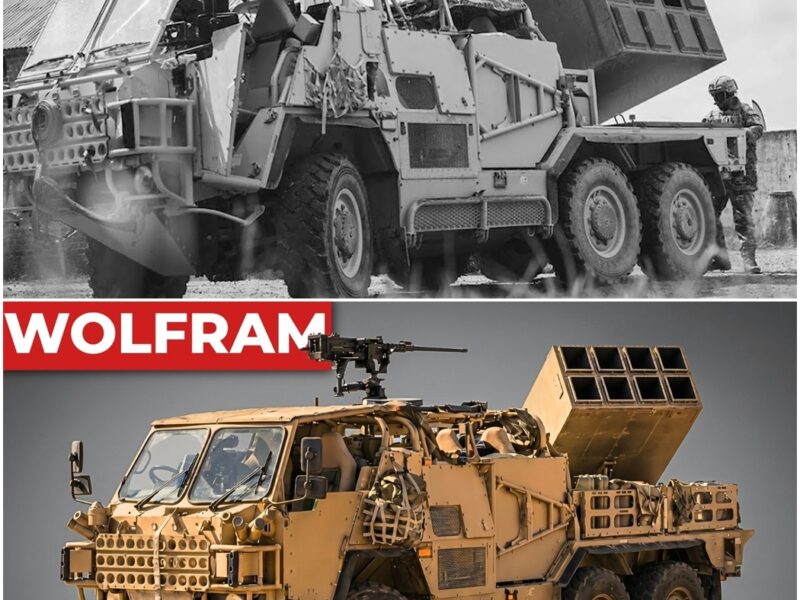
Iveco daily delivery vans, Mercedes Sprinters, Toyota commercial trucks, a Cobham triple rail launcher bolted to the cargo bed, an operator inside the cab with the laptop. The whole rig could be assembled in hours, fired in minutes, and driven away before Russian counter-battery radar found it. Britain later developed a formal version, the MBDA Supercat HMT 600, a 6×6 all-terrain platform shown publicly at defense vehicles display events in 2022 and 2024.
According to Joint Forces News and The War Zone, this formal Wolfram has not been independently confirmed in Ukrainian service. The vehicles fighting in Ukraine remain primarily the improvised commercial trucks. Now, before we get into how Wolfram has actually performed in combat, if you are enjoying this deep dive into British engineering, hit subscribe.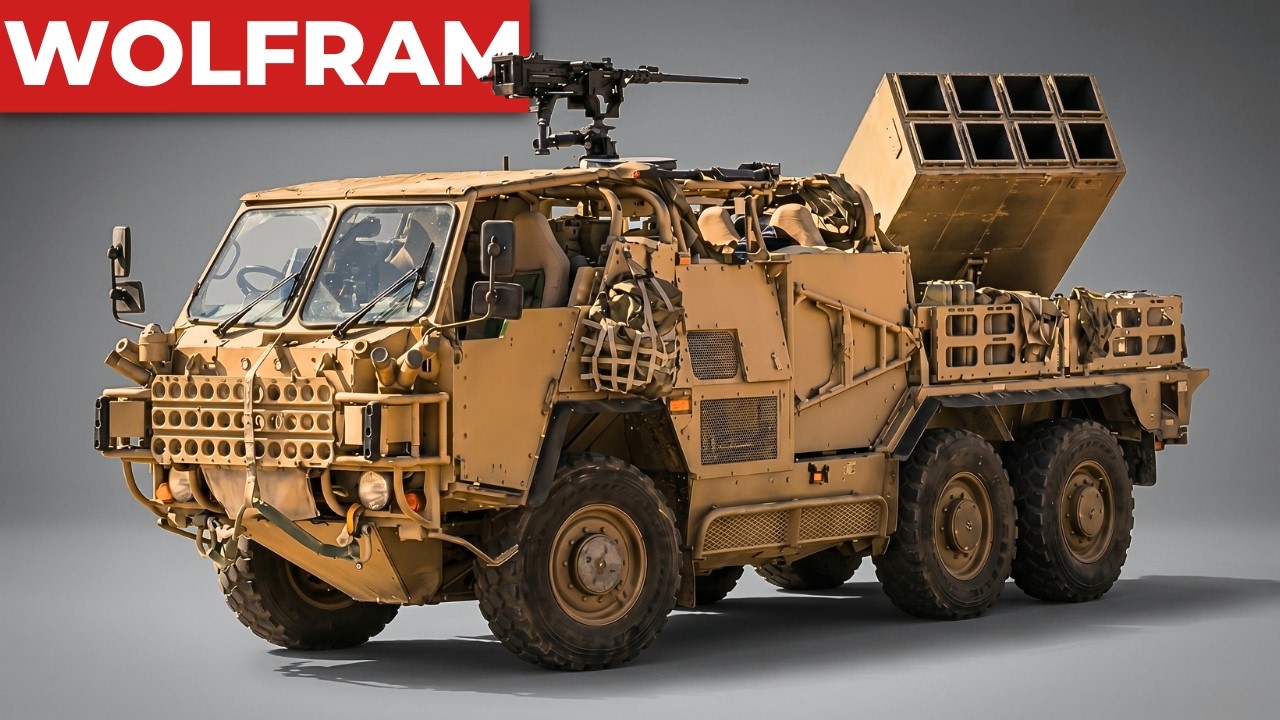
It takes a second, costs nothing, and helps the channel grow. All right, let us get into the combat record. The first verified ground launch in Ukraine occurred in mid-May 2022. The footage showed a missile leaving its launcher, climbing, then diving onto a target the camera operator could not see. Ukrainian Special Operations Forces officer Pavlo Kashchuk later told Ukrainian media that tanks were getting their turrets torn down even from the rear.
There were rumors, he said, about new ghost planes from NATO, but these were just good old Brimstones in the skillful hands of Special Operations Forces operators. That last detail matters. The Special Operations Forces took ownership of the Wolfram launchers. The pattern reported by Defense Express was daytime reconnaissance, nighttime launches, then immediate relocation.
The teams operated independently, often deep in zones Russia considered secure. The kill record requires careful handling. Ukrainian compilation videos show Brimstone strikes against Russian armor throughout 2022, 2023, and 2024. New launch footage circulated as recently as January 31, 2025. Ukrainian forces claim the system has destroyed T-90 M and T-80 BVM tanks, Russia’s most modern armor.
But, here is the honest accounting. Open-source intelligence trackers like Oryx document destroyed Russian vehicles by photographic evidence. They do not always identify the specific weapon used in each kill. As of mid-2025, Oryx had visually confirmed at least 134 T-90 variants destroyed, damaged, abandoned, or captured.
T-80 losses had passed 1,274, but the share of those kills attributable specifically to Brimstone is not publicly itemized in verifiable form. What is verified is the scale of British supply. Britain has provided more than 1,300 Brimstone missiles to Ukraine across at least four announced packages. An initial 600 Brimstone 1 missiles in 2022, an undisclosed Brimstone 2 batch from November 2022.
600 more announced in January 2023. 200 pledged by Defense Secretary Grant Shapps in February 2024. Roughly 100 more pledged by Defense Secretary John Healey during a visit to Odessa on July 7, 2024. Several dozen Wolfram launch vehicles have been delivered, according to reporting by Oryx and The Independent.
The comparison with Russian Kornet teams illuminates why the system matters. A Kornet operator targeting a Ukrainian armored vehicle at maximum 8 km range must hold the optical crosshair on the target throughout the missile’s entire flight, roughly 20 seconds at the missile’s subsonic The launcher cannot move. The operator cannot blink.
Anyone with a counter-sniper rifle, a mortar, or a drone can engage the launch position. A Wolfram operator firing at a Russian tank 25 km away does not see the target at any point. The missile launches, climbs to cruise altitude, navigates by inertial guidance to the kill box, switches on its millimetric wave radar, scans the area, identifies an armored vehicle, and strikes.
The launcher relocates within minutes. Russian counter-battery artillery, typically the 2S19 Msta-S self-propelled howitzer with a maximum range of 24.7 km, cannot reach the launch position even if it locates it. That is the gap. A Wolfram operator engages tanks from roughly five times the range of a Cornet team, and six times the range of a Javelin gunner, and does so without ever exposing the launcher to direct line of sight from the target.
The cost mathematics favor Ukraine heavily. A Brimstone missile costs somewhere between 100,000 and 175,000 pounds, depending on the variant. A T-90M tank, depending on whose numbers you trust, costs between $1.6 million at Russia’s actual 2017 procurement contract price, and $4.5 million at Western export estimates. Each successful Brimstone strike on a T-90M therefore exchanges British engineering for Russian armor at a ratio somewhere between 14:1 and 20:1 in Ukraine’s favor.
Brimstone salvo mode, in which multiple missiles distribute targets among themselves to prevent duplication, makes the ratio worse for Russia when an entire armored column is engaged at once. Russian forces have struggled to adapt. The T-90M was supposed to carry the Arena-M hard-kill active protection system, which intercepts incoming missiles before they hit.
According to Army Recognition Reporting, only a small minority of fielded T-90M tanks actually carry Arena-M. Most retain the older Shtora-1 soft-kill suite, often without its iconic infrared jammers, which Russia judged obsolete. MBDA’s own data sheet for the Brimstone surface launcher states that the missile defeats all known active protection systems.
Whether the Arena-M is the exception remains classified. The strategic impact of Wolfram is asymmetric. Several dozen launch vehicles and roughly 1,500 missiles is a a contribution against an opponent that started the war with thousands of tanks. Compared to the more than 10,000 Javelins or the equivalent number of NLAW rockets supplied to Ukraine, Wolfram is a niche capability, but its tactical effect punches far above its numerical weight.
Russian armored tactics in Ukraine have shifted measurably since 2022. Tank columns no longer assemble in the open at 20 km from contact. Russian units pull back further, move at night, disperse more aggressively. Some of that is drones, some is artillery. Some is Wolfram. The cumulative effect is that the Russian armored fist has been broken into smaller, more cautious fragments.
MBDA’s Paul Mincly told European Security and Defense at the Defense Vehicles Display in 2024 that the surface-launched Brimstone would provide the army with a capability for defeating armor that they had not had for the last decade. The British Army has now decided to procure the SuperCat-based Wolfram for its own service under the Battle Group Organic Anti-Armor program.
Germany has ordered 3,266 Brimstone 3 missiles for the Luftwaffe, the largest single order in the missile’s history, which has prompted MBDA to open a second production line at Schrobenhausen. Return to that weekend in April 2022. A laptop on a desk, a truck pulled in from somewhere, a generator from a hardware store. Within 40 days, those parts had become a system that destroyed tanks the operator could not see at distances no other anti-tank weapon in Ukraine could match.
The B&Q generator may be myth, embellishment, or precise truth. The capability is documented, the combat use is verified, and the lesson for British engineering is the lesson it has always been. The numbers prove it, the documents confirm it. The work was done in a weekend.