The ‘Invisible’ West German Scout Car That Found Soviet Tanks In Total Darkness D
1968, a test track outside Trier, West Germany. A large eight-wheeled vehicle rolls out of a hangar and onto a road running parallel to the Iron Curtain. It moves without drama, no roar, no clatter of tracks, just the low hiss of wide tires on asphalt. A sound so faint that soldiers standing 20 m away cannot tell whether the engine is running.
The vehicle carries a 20 mm cannon on a low turret. It has two drivers, one facing forward and one facing backward. It weighs 19 and 1/2 tons and it can reach 90 km per hour in both directions, forward and reverse, the same top speed. Because the men who built it understood something about the war they expected to fight.
It looked too big, too expensive, too slow to be a scout car and too lightly armed to be a tank. Army officers who watched the trials questioned whether something this size and this cost could ever justify itself on a Cold War battlefield where everything was expected to move fast and die young. The vehicle’s job, after all, was simply to look, to whisper back what it found, and then disappear.
Generals wondered whether they were buying the most sophisticated thing they had ever seen or the most complicated thing they could not afford to lose. They were buying both and they were right on both counts. This vehicle would go on to serve the Bundeswehr for 34 years. It would deploy to Bosnia and Kosovo after the Cold War it was designed for never came.
It would be so quiet during exercises that the German army had to designate safe sleeping zones for soldiers on its patrol routes and it would prove, beyond any reasonable argument, that a wheeled scout vehicle could outperform tracked alternatives in the role that mattered most. Finding the enemy before the enemy found you and surviving long enough to say something about it.
Its designation was Bapanzer 2 Luchs, the Lynx. And it was the most sophisticated wheeled reconnaissance vehicle any NATO army ever fielded. To understand why the Luchs existed, you need to understand the problem West Germany faced in the late 1960s. The inner-German border stretched 1,393 km. On the western side stood the Bundeswehr and NATO.
On the eastern side stood the group of Soviet forces in Germany, roughly 340,000 troops in 24 divisions with approximately 4,200 tanks, 8,200 armored vehicles, and 3,600 artillery pieces. The 8th Guards Combined Arms Army, a unit that had fought at Stalingrad under General Vasily Chuikov, and then captured Berlin, sat 5 km from the West German border near Weimar.
Its four divisions fielded T-80 main battle tanks. Behind them, the 1st Guards Tank Army waited as an exploitation force with five additional divisions, ready to pour through the breach the 8th Guards created. The distance from that border to the Rhine through the Fulda Gap was barely 100 km. Bonn’s doctrine demanded forward defense.
There would be no planned retreat because every kilometer surrendered meant abandoning German citizens to Soviet occupation. NATO’s flexible response framework required conventional forces capable of calibrated resistance before nuclear escalation. Someone had to find those Soviet divisions first, classify their strength and direction, and transmit that intelligence fast enough for commanders to make decisions that would determine whether the war was won or lost in the first 48 hours.
The vehicles available for that mission were not equal to it. The American M41 Walker Bulldog light tank was loud, tracked, maintenance-intensive, and its 76 mm gun could no longer penetrate modern Soviet armor. The French-designed Hotchkiss carrier used by the Bundeswehr as a scout vehicle reached only 58 km per hour, had no reverse driving capability, could not cross rivers under its own power, and had insufficient range at 390 km.
Neither vehicle was quiet enough to avoid detection. Neither was survivable on a nuclear-contaminated battlefield. The Bundeswehr needed something designed from the ground up for a single purpose, see without being seen, then return alive. In the mid-1960s, the German Ministry of Defense drafted specifications for a new eight-wheeled armored reconnaissance vehicle.
The requirements were demanding in every dimension. It had to be amphibious. It had to operate in full nuclear, biological, and chemical contamination. It had to carry day and night observation systems capable of identifying Soviet armor at long range. It had to be fast and it had to be so quiet that an alert crew in a forward position would not hear it approaching until it was too late to react.
The inspiration for the reverse driving requirement came directly from the Second World War. German engineers studied the Sd.Kfz 234 family of eight-wheeled armored cars, which had included rear-facing driver positions allowing escape from contact without turning around on narrow roads. On the forest tracks and suburban streets of central European terrain, executing a three-point turn in a 7 and 3/4 m vehicle under enemy fire was a death sentence.
The answer was a second complete set of driving controls at the rear of the hull facing backward with its own clutch, accelerator, and steering wheel. Two competing designs were submitted in 1968. Daimler-Benz, with engineering support from Porsche, submitted one design. A five-company consortium submitted another. Nine prototypes of each were built and subjected to extreme testing in Norwegian winter, Italian summer, and mountainous terrain.
The first Daimler-Benz prototypes revealed serious shortcomings and had to be substantially revised before a second evaluation round. By the time a winner was selected in January 1971, the surviving Daimler-Benz prototypes had accumulated approximately 200,000 km of testing, the equivalent of circling the earth five times.
In December 1973, Rheinmetall Wehrtechnik received the production contract for 408 vehicles at 300 million Deutsche marks. The first production vehicle rolled off the Kassel assembly line in May 1975. Formal delivery to the Bundeswehr began in September of that year. Production concluded in early 1978. The vehicle that emerged from this process was a masterpiece of Cold War engineering.
The heart of the Luchs was its Daimler-Benz OM 403A engine, a 10-cylinder 90° V configuration turbocharged power plant producing 390 horsepower on diesel fuel. A ZF 4 PW 95 H automatic transmission with four forward and four reverse gears drove all eight wheels. The result was a top speed of 90 km per hour in both directions.
On road, the Luchs was faster in reverse than many contemporary military vehicles were going forward. All eight wheels were steerable. Below approximately 50 km per hour, all four axles turned together, giving a turning circle of just 12 m, remarkable for a vehicle nearly 8 m long. Large low-pressure run-flat tires minimized road noise and continued functioning after punctures.
The operational range reached 730 km on 500 L of fuel. A crew could drive from Hamburg to Munich and have fuel to spare. The sound insulation was extraordinary. The engine compartment was separated from the crew by gas-tight welded bulkheads. Exhaust gases were mixed with ambient air to reduce both noise and thermal signature.
According to sources from the Bundeswehr’s own Panzeraufklärungstruppe veterans, exercises required soldiers to sleep only in designated safe zones because the Luchs operating at night was virtually inaudible. This was not a side effect of good engineering. It was the central design requirement pursued as aggressively as speed or protection.
In its original configuration, the vehicle was fully amphibious. Two steerable propellers beneath the rear hull drove it through water at 10 km per hour. The preparation required was minimal. Raise the hydraulic trim vane at the bow, activate three bilge pumps, drive in. No separate preparation time, no engineer support.
The Luchs could cross any river it reached on its own. The armament was deliberately constrained. The Rheinmetall MK 20 RH 202 auto cannon in the TS 7 turret fired 20 by 139 mm NATO standard ammunition at 880 to 1,000 rounds per minute with an effective range of 2,000 m and an elevation angle reaching 69°. High enough for anti-aircraft use.
The A1 upgrade variant added a dual-belt ammunition feed allowing instant switching between armor-piercing and high-explosive incendiary rounds. 475 rounds were carried in total. A roof-mounted 7.62 mm machine gun and eight 76 mm smoke grenade launchers completed the fit. The 20 mm cannon could destroy armored personnel carriers. It could engage helicopters.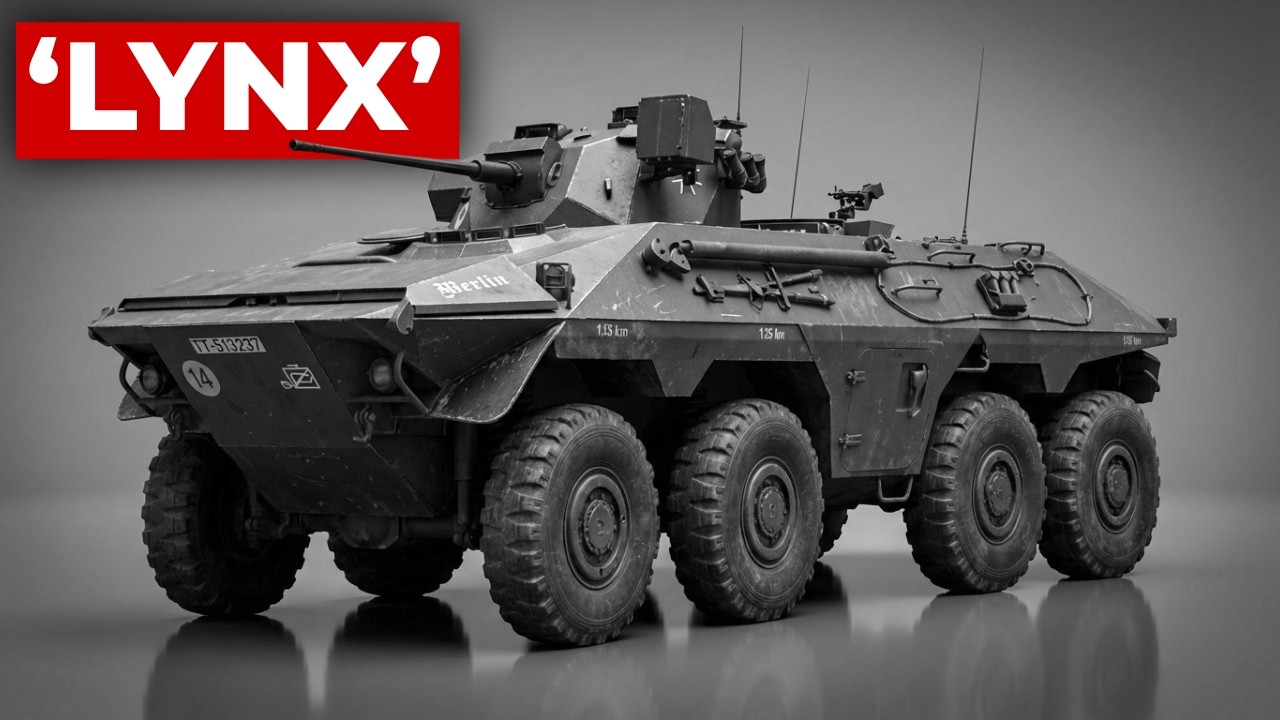
It could not threaten a main battle tank. This was correct. A scout car that fights tanks is a dead scout car. Now, before the combat record of the Luchs, if you’re finding this deep dive into Cold War military design valuable, hit subscribe. It takes seconds and it helps this channel continue producing this kind of content.
The Luchs served in the Bundeswehr’s Panzeraufklärungsbataillon, one battalion per division, organized into two vehicle patrols led by experienced non-commissioned officers. The doctrine was called Spähaufklärung, scout reconnaissance, and it drew a sharp distinction from Gefechtsaufklärung, combat reconnaissance.
In combat reconnaissance, a commander forces the enemy to reveal himself through fire. In scout reconnaissance, a commander sends vehicles that are quiet enough, fast enough, and skilled enough to observe the enemy without triggering a response. Dead scouts send no reports. Through the Cold War, Luchs vehicles of the Panzeraufklärungsbataillone patrolled the border zone, watching East German territory through their optics, staring across at Soviet BRDM-2s that stared back.
They trained in Norwegian winter. They exercised across Central Europe. They crossed rivers. They sat in hides for hours, engines off, observing through their Carl Zeiss sights with the patience the mission required. The war they were built for never came. When the Berlin Wall fell in November 1989, and the Cold War ended without a shot being fired along the inner-German border, the Luchs found a second career for which it had not been designed and proved equal to it.
In December 1995, Luchs vehicles from Panzeraufklärungsbataillon 5 deployed to Bosnia-Herzegovina with the Implementation Force following the Dayton Agreement. The terrain was mountainous, the roads were narrow, and the threat was mines rather than Soviet armor. On April 21st, 1996, a German Luchs became the first vehicle to cross the rebuilt bridge at Visoko, a crossing that had been destroyed during the war and reconstructed by German and Romanian engineers after extensive mine clearance. It was a symbolic moment.
The vehicle that had spent its career watching a border that history had dissolved was now crossing bridges that peace was rebuilding. The Luchs continued serving with the stabilization force from 1996 to 2004. It deployed to Kosovo with the Kosovo Force from 1999 onward. On Balkan mountain where heavier vehicles struggled or could not pass, the Luchs performed patrol and convoy escort with the agility its designers had intended for a very different landscape.
The Panzer Museum Munster later assessed that the vehicle had proved itself in the mountainous Balkan terrain while acknowledging it was, as a Cold War system, no longer fully suited to the peacekeeping mission specific demands. It lacked mine protection. Its electronics were outdated by the early 2000s.
No combat losses have been publicly documented from Balkan service. It was not deployed to Afghanistan. By the time the Bundeswehr committed forces to International Security Assistance Force operations, its replacement had already entered service. On paper, the Luchs’s competitors appear to have compelling advantages.
The British Fox Combat Vehicle Reconnaissance weighed just 6.75 tons, reached 104 km/h on road, and carried a 30-mm Rheinmetall cannon with greater penetration than the 20-mm Rh 202. In practice, the Fox’s aluminum armor could not stop .50 caliber rounds. It had no nuclear, biological, and chemical protection at all.
A significant gap for any vehicle expected to operate on a Cold War European battlefield. Its range was 434 km to the Luchs’s 730. And the Fox suffered dangerous stability problems from its top-heavy design that caused serious accidents in early service. The Soviet BRDM-2 weighed 7 tons, less than half the Luchs. Its 14.5-mm heavy machine gun was outclassed by the 20-mm auto cannon at all combat ranges.
Its armor stopped small arms fire and little else. Its advantages were production numbers and cost. More than 7,200 were built against 408 Luchs. Some BRDM variants carried Sagger or Spandrel anti-tank missiles, giving them a tank-killing capability the Luchs never possessed and was never intended to possess.
The Soviets built vehicles to observe and, if necessary, to kill tanks. The Germans built the Luchs to observe and escape. The American M114 stands as the clearest demonstration of what happens when a reconnaissance vehicle is designed without these priorities. General Creighton Abrams called it a failure in 1973.
In Vietnam, mines that would damage an M113 would destroy an M114 entirely. It could not ford streams. It was mechanically unreliable. It was withdrawn from Vietnam by late 1964, yet continued issuing to units in Europe until the late 1970s. The Luchs was everything the M114 failed to be: fast, reliable, amphibious, quiet, survivable.
The French AMX-10RC represented the opposite philosophical extreme from the Luchs. Its 105-mm rifled gun could destroy main battle tanks, making it a tank destroyer wearing a reconnaissance uniform. But its ammunition storage proved catastrophically vulnerable in combat conditions decades later.
Ukraine received AMX-10RC vehicles from France in 2023. Fragments from 152-mm artillery pierced the hull, detonated stored ammunition, and killed the crew. The AMX-10RC was being replaced from 2021 onward. The Luchs was not exported. Its unit cost, roughly 735,000 Deutsche Marks, approximately $293,000 at 1975 exchange rates, made it uncompetitive in the export market.
All 408 produced served exclusively with the Bundeswehr. Two major upgrade programs extended its service life. The A1 variant from 1980 to 1983 added the dual-belt ammunition feed. The A2 from 1985 replaced the original image-intensified night vision with the WBGX thermal imaging system capable of detecting vehicles at 3 to 5 km, and upgraded the radio suite to encrypted digital communications.
The added weight permanently ended amphibious capability. This loss was confirmed on July 18th, 1986, when a Luchs sank during an exercise in the Danube near Eining in Bavaria. All four crew members evacuated safely. Amphibious operations were suspended permanently afterward. By 2009, only 68 Luchs remained in service.
They were decommissioned that year. The Fennek 4×4 light scout vehicle, a German-Dutch joint design weighing 10 and 1/2 tons, took over the reconnaissance mission. The Bundeswehr had spent the 1960s choosing eight wheels over four, and returned to four wheels after 34 years. Two Luchs vehicles survive at the Deutsches Panzer Museum Munster, including one pre-series prototype, and one is held at the Tank Museum in Bovington, England.
In 2024, Germany ordered 274 new vehicles under the designation Luchs 2. A Piranha-based 6×6 from General Dynamics European Land Systems at a cost of approximately 3.5 billion euros with deliveries planned from 2029. The name endured. 1968, a test track outside Trier, a vehicle moves through the darkness so quietly that soldiers standing 20 m away cannot confirm it is running.
No thermal bloom visible at combat distances. No track signature. No engine sound that carries to an alert enemy post. A rear driver waiting hands-on controls ready to accelerate to 90 km/h in the direction it came from. It was, on paper, too expensive, too heavy for a scout, too lightly armed for a fight.
It never swam another river after 1986. Its thermal imaging was outdated by the time it reached Bosnia. It was not fast enough for the Balkan roads where heavier vehicles got stuck and lighter ones got blown apart. And yet it worked in the training areas of northern Germany where it watched the border for 30 years without ever seeing what it was sent to find.
On the bridges of Bosnia where it crossed water that tanks could not reach. On the mountain passes of Kosovo where its quiet engine and small profile meant it arrived and departed without announcement. The Soviets built reconnaissance vehicles to observe contact and survive it. The Germans built the Luchs on a different premise entirely.
The best reconnaissance vehicle is the one the enemy never knows was there. 408 were built. None were ever destroyed in combat. That is not luck. That is doctrine made steel.