The ‘Isherman’ American Tank That Israel Sent Against Soviet T-55s 2 Decades After WW2 D
October 7, 1973. Just past sunset, the southern escarpment of the Golan Heights, 1 km west of Kibbutz El Al, a Syrian mechanized brigade is rolling downhill in the dust. 40 T-55s in column, fresh from the depots near Damascus. Their 100-mm guns swinging west toward the lights of the Hula Valley.
Below them, the road into Israel proper is open. The Barak Brigade is broken. The northern Golan is burning. What stops them is not a Centurion. It is not a Patton. It is an American tank from 1943. A flat-sided hull with a long, vicious-looking gun, and a great cast bustle hanging off the back of the turret. Welded patches on the glasses.
A xenon searchlight bolted above the mantlet. Diesel exhaust climbing straight out of the rear deck in a black plume. The men in the turret are reservists. Their uniform still smell of civilian laundry. Some of them are 40 years old. They call this tank the Isherman. The Syrians who are about to die under its gun do not know that name.
They do not know that the hull beneath the welded patches rolled out of a Detroit factory before most of their crewmen were born. They do not know that the cannon is French. They do not know that the engine is from a truck plant in Indiana. They’re about to learn all three things in the next 90 seconds. This is the story of how a battalion of these tanks, the 377th of the 9th Oded Brigade, stopped a Syrian armored thrust cold on the night of October the 7th, 1973, and destroyed 17 T-55s at point-blank range with a weapon the Pentagon had stopped building 28 years earlier. They called it the Isherman. And it was the most improvised killing machine of the Cold War. 1959. A windowless office in the Israeli Ordnance Corps headquarters. A small group of officers is staring at the photographs of a tank. The tank in the photographs is the Soviet T-54. It has been arriving in Egypt by the trainload. Cairo’s tank parks are filling up with them. Damascus has them, too. And the Israeli answer,
on paper, is a fleet of World War II American Shermans rebuilt with a French 75-mm gun. That weapon, designed for the AMX-13 light tank, can no longer reliably defeat the T-54’s front. Three doors have already closed. The United States rejected an Israeli request for M47 Pattons in 1953.
The British will not sell Centurions for another 4 months. A clandestine West German deal for 150 M48s has been leaked to the press and is collapsing. Only about 40 Pattons will arrive before the contract dies. What Israel has, it must rebuild. The Ordnance Corps reaches for the same arsenal that gave them the 75-mm gun 3 years earlier, the Atelier de Bourges in central France.
The same workshop where the cannon for the new French AMX-30 main battle tank is being designed. The cannon is called the It is a 51-caliber rifled gun firing a strange spin-compensated shaped charge round called the Obus G, developed at the Franco-German Institute at Saint Louis.
The round defeats armor by chemistry, not by speed. Its penetration is the same at 100 m and at 3,000. The Israelis order a shortened version, designation D1508. New muzzle brake, larger recoil stroke cut down to fit a turret 30 years older than the gun. Its designation was the Sherman M-51. And it was a French gun, a Detroit hull, and an Indiana engine married by an Israeli Ordnance Corps that could not buy what it needed and refused to wait.
The first prototype is built on a French-supplied M4A1 cast hull. They mount a near-stock AMX-30 cannon to it. The recoil tears at the turret ring. The gun is rejected. The second prototype uses the shortened D1508 with the oversized double baffle muzzle brake, and this one holds. In July 1962, the first M-51s enter service.
By summer 1964, 90 conversions are complete. By 1965, all of them have been re-engined with the Cummins VTA460 diesel, a 15 and 1/2 L turbocharged American truck engine producing 460 horsepower. The gasoline Continental radial that powered the Sherman from Normandy to Iwo Jima is gone. With it goes the nickname the Germans gave the Sherman in 1944, the Ronson, “Lights first time, every time.
” The diesel is cooler, quieter, and longer ranged. The Ordnance Corps cuts a hole in the rear deck and roots the exhaust straight up out of the top of the engine bay because the standard exhaust path is melting the engine compartment in Negev heat. That single vertical stack becomes the visual signature of every Israeli Sherman thereafter.
The suspension is replaced with the wider HVSS type. The turret gains a cast iron counterweight on the back of the bustle to balance the cannon. Weight settles at 38 metric tons. Speed, 42 km/h. Crew of five at first, four by Yom Kippur. By 1965, 180 conversions stand complete, but none of this modernization touches the armor.
The glacis is still 51 mm. The turret front is still 76. A T-54’s 100-mm gun will punch through the M-51 from any aspect, at any range, on any day. A T-62’s 115-mm smoothbore will treat that armor as if it were not there. The men crewing it understand this. Their training compensates. In March 1964, Major General Israel Tal personally takes a handpicked Sherman crew to the Headwaters Diversion Site on the Syrian border.
In 2 minutes, firing 10 rounds, they destroy five of eight Syrian construction tractors at 2,000 m. Tal’s gunnery program will become the doctrinal spine of the Israeli Armored Corps. The Sherman is its instrument. What the IDF did not yet know on the morning of June 5, 1967, was that the Sherman crews who had mattered most that summer were not the famous ones in Sinai.
They were a column of M51s grinding up the Golan Escarpment in single file. But first, if you are enjoying this deep dive, hit subscribe. It helps the channel grow. Now, the escarpment. June 9, 1967, afternoon. Givat HaEm on the western face of the Golan Heights, the 8th Armored Brigade of Colonel Avraham Mandler is climbing toward the Syrian fortified line at Kaala.
33 M50 and M51 Shermans in column. Five of their eight engineering bulldozers have already broken down. Concrete dragon’s teeth and Syrian 130-mm artillery rake the climb. The road bends and bends again. The tanks cannot deploy. They can only push. A Syrian shell shears the radio antenna off a turret.
The tank commander, Lieutenant Horowitz, keeps fighting from the cupola without a radio, wounded, directing his platoon by hand signals. His subordinate called Ilan takes a hit and burns out on the slope. By 1800 hours, only three Shermans and a handful of half-tracks reach the top of Kaala. Horowitz’s crew swarms a Syrian trench from the turret, dropping grenades over the side onto the men inside.
This is not how the manuals say a Sherman should fight. There is no manual for any of this. Two nights earlier, in a different war on a different front, a platoon of M51s of the 45th Brigade had been pushing through the olive groves around Burkin Hill in pitch darkness. A platoon leader flipped on his xenon searchlight at roughly 50 m and found himself nose-to-nose with a Jordanian M47 Patton, gun bore sighted on his hull.
Both tanks fired. Both missed. The Sherman reloaded first. The M47 went up in a fireball that lit the entire ridge. Six Shermans then swept up the hill, strobing their searchlights on and off, blinding everything ahead of them. A Jordanian ammunition truck exploded. An entire company of M47s was destroyed in minutes for the cost of one Sherman lightly damaged.
The crews were not aces. They had a 40-year-old hull, a French cannon, and a doctrine that said the first shot kills. In the Sinai the same week, Lieutenant Colonel Mordechai Zipori’s 14th Brigade Shermans were converging on Abu Ageila in support of Major General Ariel Sharon’s set piece night assault. On June 5 at 2200 hours, six artillery battalions fired 6,000 shells into the Egyptian fortified box in 20 minutes.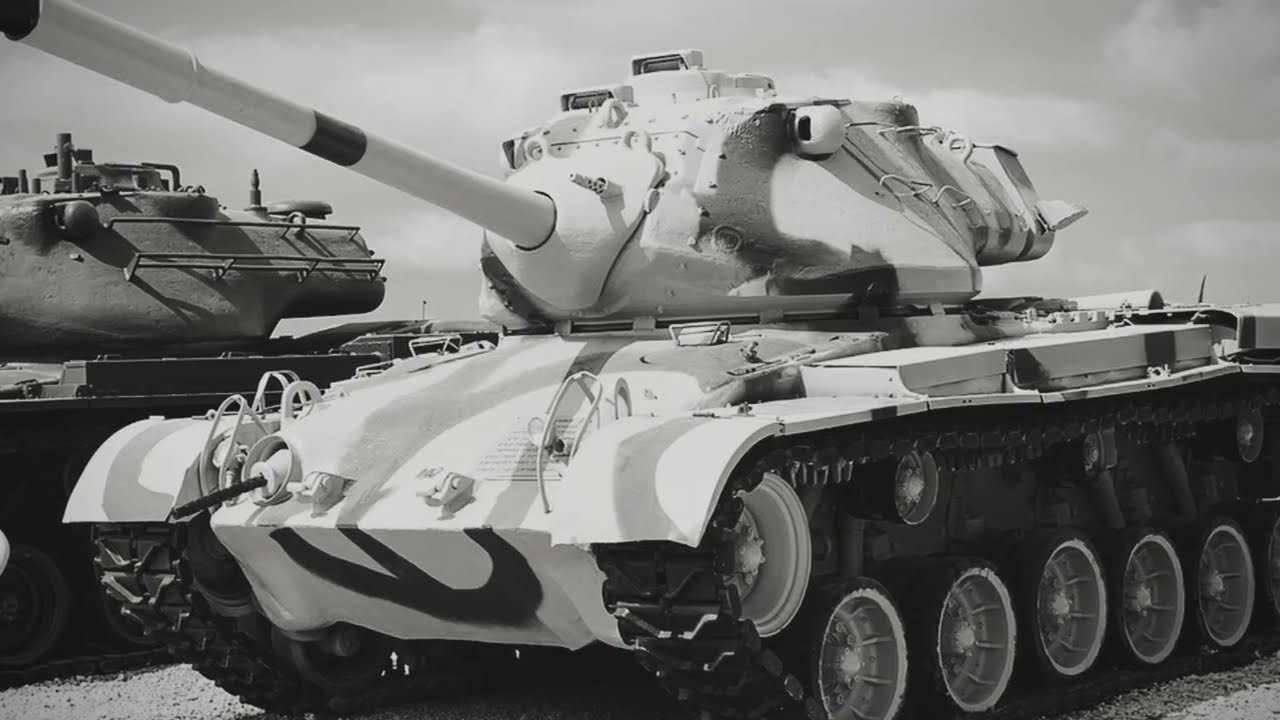
At 2300 paratroopers were lifted by helicopter onto the Egyptian guns. By midnight, reservists of the 99th Brigade were breaking into the Um Katef trenches under Sherman searchlight illumination. By dawn, Zipori’s Shermans and Lieutenant Colonel Natke Nir’s independent Centurion battalion had collided in dust over the Egyptian armored reserve at Ruafa Dam so chaotically that Zipori had to order his crews to cease fire on the Centurions.
40 Egyptian tanks were destroyed in 3 hours. A photograph survives taken from the column M51 registration 810239. A loader with a shaved head passing a 105 mm round to a crewmate mid-battle. The Six-Day War ended in 6 days. The M51 had earned its place not as a wonder weapon, but as a tank that could be aimed extremely well from positions chosen extremely carefully by men who knew what its armor could not stop and what its gun could.
Six years later, that knowledge would be tested by an enemy that had learned its own lessons. On the eve of Yom Kippur, October 1973, the IDF Sherman fleet stood at roughly 374 M50 and M51 tanks. They were concentrated in reserve and mechanized brigades, displaced from the front line by Centurions and Pattons.
The men who had crewed them on October 6th had been farmers, teachers, and bus drivers the week before. In the Sinai, the 164th Brigade of Colonel Avraham Baram had three M-51 battalions. On the Golan, the ninth Oded mechanized Brigade had one M-51 battalion, identified by Tom Gannon’s research as the 377th Tank Battalion.
The Egyptians crossed the canal at 1400 hours on October 6th. The Syrians crossed the Purple Line on the Golan at the same moment. By the night of October 7th, a Syrian mechanized Brigade had broken through the southern Golan and was descending toward Kibbutz El Al. Below them lay the road to Israel proper. Major General Moshe Peled’s 146th Reserve Division had been ordered into the southern sector.
At its core was the ninth Oded Brigade, its M-51 battalion under Lieutenant Colonel Ben Zion Padan. They reached the escarpment in the last hour of light. The Syrian column came down the road in echelon, 40 T-55s. The lead tanks were no more than 400 m away when the Shermans opened fire from defilade. The Obus G round arced through the dusk at slightly under 900 m per second.
Time of flight, 1 and 1/2 seconds. At that range, with hull-down M-51s, the 17 T-55s that died never saw the muzzle flashes that killed them. A shaped charge does not care about velocity. The 400-mm penetration at point of impact was identical to the figure on the test stand at Bourges 7 years earlier.
The Syrian advance halted. The History Net account of the action records the moment in a single line. A Syrian mechanized Brigade ran into a small IDF force of Super Shermans, losing 17 T-55s. A halt was called. Five days later, on October 12th and 13th, Major General Dan Laner’s 240th Reserve Division set a horseshoe ambush near Tel Shams.
An Iraqi armored column drove into it at dawn. Roughly 80 Iraqi T-55s were destroyed for negligible Israeli loss. One of Laner’s brigades was M-51 equipped. The Sherman crews were not killing T-55s by outshooting them. They were killing them by reaching the trigger first from positions the Syrians and Iraqis had not seen at ranges chosen for the slow shell. The asymmetry was physical.
Soviet 100 mm armor-piercing rounds lost velocity with range. The Obus G did not. The price was paid in the Sinai. The thin Sherman armor that had been a manageable risk in 1967 was a death sentence against the Egyptian Sagger antitank missile in 1973. The wire-guided rocket arrived from positions a kilometer away.
It punched through everything. The M-51s of the 164th Brigade took disproportionate losses in the canal crossings. Total EDF tank casualties for the war reached roughly 400 destroyed and 600 damaged. The M-51 had finished the work it was built to do, the work of buying time until something better arrived. On paper, the T-54 and T-55 looked superior to the Sherman in every measurable category.
110 mm of glacis armor at 60°. A 100 mm D-10T gun firing armor-piercing rounds at 1,400 m/s. A 36-ton hull, a low silhouette, and a snorkel for river crossings. In practice, the M-51 offered three advantages the Soviet design did not. First, gun depression of -10° against the T-55’s -4. The Sherman could fight hull down from a reverse slope that the Soviet tank physically could not match.
Second, a five-man crew with dedicated loader capable of sustaining six aimed rounds a minute under stress against a T-55 crew of four where the commander loaded the gun himself in a hot turret. Third, the Obus G round whose penetration was indifferent to range. Against the NATO benchmark, the comparison was unkind.
The British Centurion mounted the L7 105-mm rifled gun. The West German Leopard 1 the same weapon. Both fired full velocity APDS rounds at 1,500 m per second. Both had ballistic computers. The M-51 had a stadi-reticle and a gunner’s memory. The Israeli answer was the fourth comparison layer. The American baseline M4A1 Sherman, as it had left Detroit in 1943, mounted a 75-mm gun firing armor-piercing rounds capable of penetrating roughly 90 mm at 500 m.
The Israeli M-51, on the same hull, killed third-generation Soviet armor at 400 mm of penetration at any range. The chassis did not change. The doctrine did. The replacement, when it came, was the Merkava Mark 1, Tal’s life’s work, the first Israeli-designed main battle tank fielded in 1979. The same year, Israel began selling its M-51 fleet to Chile, where 118 of them were shipped between 1980 and 1981.
And rebuilt with Detroit Diesel turbo diesels in the 1990s, the Chilean army fielded the M-51 as a front-line tank until roughly 2002, and in reserve service until 2006, when Leopard 2A4 deliveries finally retired them, 41 years after the first conversion left the Ashkelon workshop. The last M-51 in operational service stood on a parade ground in the Atacama Desert.
The Pentagon had built it. The world had rebuilt it. Surviving examples remain at Yad La Shiryon at Latrun, the Har-El Brigade Memorial at Har Adar, the Musée de Tank at Équip, the US Army Armor Collection at Fort Benning, and the National Museum of Military Vehicles in Dubois, Wyoming, October 7, 1973.
The escarpment above El Alamein. The plume of diesel exhaust still rising from the engine deck. The M-51 had no rangefinder, no ballistic computer, no infrared optics on most hulls. Its armor was 40 years out of date. Its gun could not fire kinetic ammunition. Its time of flight at 1 km was twice that of a modern APDS round.
Its crew was older than its tank and under another flag with another gun on a hull two decades past its design life, it became something its designers in Detroit never imagined. It stopped a Syrian armored brigade at point-blank range on a road into Israel. It cleared a Jordanian Patton company off Burkin Hill in the dark.
It climbed the Golan Escarpment under fire without engineering support. It outlasted its replacement. It outlived its retirement. It fought in the Andes into the third millennium. The Pentagon built it for Europe. It fought everywhere except Europe. Detroit designed it. Bourge armed it. Cummins powered it. The Israelis aimed it.
And somewhere in a desert warehouse in Arica behind a chain-link fence, the last of them is still there, still pointing east.