The M15/42 – Italy’s Last WWII ‘M’ Tank D
As World War II raged on, Italy’s armored forces found themselves increasingly outmatched on the battlefield. Early war designs like the Kadamato M1139, M1340 and M1441 had shown promise in North Africa, but their thin armor, unreliable engines, and outdated guns quickly became liabilities against newer Allied tanks and anti-tank weapons.
Mechanical breakdowns, poor speed, and limited crew protection left Italian crews at a constant disadvantage. By the early 1940s, it was clear that Italy needed something more. Faster, better armed, and built to meet the escalating demands of modern warfare. As the war advanced, Italy’s M series tanks struggled to keep up until their final iteration, the M1542, something of a stop gap solution until the heavier Kadawamato P40, could be built.
But was this new design a meaningful step forward, or simply a desperate attempt to salvage a failing armored program? Today we take a close look at the M1542, the last of Italy’s wartime medium tanks, and ask, was it evolution or constraint? The story of Italy’s M series tanks begins with the Calamato M1139, the country’s first attempt at a modern medium tank.
Influenced by the British Vic 6 ton, the M1139 carried its main gun in the hull and a small machine gun turret above. an awkward layout that limited flexibility in combat. Its 37mm cannon was already underpowered by the time it entered service, and its thin armor offered little protection against even light anti-tank weapons.
The M1340 soon followed as a major redesign. This model moved the main 47mm gun to a turret, improved armor, and gave the vehicle a more conventional and balanced structure. But beneath these upgrades, Italy’s design philosophy, shaped by the expectation of fighting in the rugged mountains of northern Italy, kept weight and size low.
These tanks were never built for the wide deserts or open plains where Italy would actually fight. The result was a vehicle that, though better armed, remained underpowered, lightly armored, prone to engine trouble, and mechanically unreliable. Wenuses laid bare during the 194041 campaign in Greece and later in North Africa.
The follow-up M1441 offered only marginal improvement with a slightly stronger engine and minor armor adjustments. By the time it reached the front, it was already obsolete, outmatched by Allied tanks in armor, firepower, and reliability. Wor still, Italy’s production numbers of the M1340 and later M1441 models lagged far behind demand, leaving Italian armored units thinly equipped.
In an attempt to compensate, Italy turned to captured French tanks supplied by Germany in 1941, including Renault R35s, Samurua S35s, and a handful of Shi one bis heavy tanks. None of these provided a real solution, mainly due to a lack of spare parts and available ammunition. The R35s were used for the defense of Sicily.
The Samoa S35s were reduced to a training tank and the Shelby Wombis only arrived in very small numbers, likely as little as two with the turrets missing. In June 1941, Italy even asked Germany for help, exploring a license to produce the Panza 3, but negotiations broke down over Germany’s insistence that key parts and materials come from German suppliers.
Italy also investigated the Shodda T-21, a promising Czechoslovak design, but it never advanced beyond study. Despite these setbacks, Fatanelo remained favored by the Italian army. The company pressed forward with two projects. One, the long delayed Kalawamato P40, a heavy tank.
The other lighter designs such as the Komedio Kalani and later the Chilei Salaniano developed for use in desert conditions. All showed promise, but progress was slow and delays continued as the war turned against Italy. In early 1942, Germany again offered a production license, this time for the Panza 4, but Italy once more declined, determined to pursue domestic designs.
The final decision was pragmatic. Upgrade what already existed. The M1340 line evolved into the M1441. And by late 1942, Italian engineers began work on a new model featuring a more powerful petrol engine and a longerbarreled 47mm gun with improved armorpiercing ability. The idea was to provide the Italian army with a stop cap solution and persuade the Rejo Sashito to stop evaluating foreign vehicles and continue with Fiat Analo for the production of tanks.
Development moved quickly and between late 1942 and March 1943, the prototype was completed and tested successfully. Production was soon authorized and thus the M1542 was born. Italy’s last and most refined medium tank of the war. The M1542 represented the final and most refined evolution of Italy’s medium tank line during the war.
And the first major visual difference from earlier models was immediately apparent in the hull. The engineers extended it in length, adding roughly 14 cm to the rear of the vehicle to make room for more powerful gasoline engine. This change brought new, larger inspection hatches to the engine compartment, extra armor plates, and expanded cooling grills.
The rear grills in particular were significantly enlarged to handle the greater heat output. Despite these external revisions, the internal configuration stayed familiar. It remained a crew of four with driver, machine gunner, who was also radio operator, commander who was also the gunner, and finally the loader.
The driver remained seated on the left side with the vision slot and hyperscope above. To his right, the superructure stretched forward slightly to accommodate a ball mount for twin machine guns operated by the whole gunner positioned just behind them. Many of the tanks external fittings carried over from earlier models.
Tools were mounted between the rear inspection hatches. Long mud fenders covered the length of the tracks. And on each fender, a storage box sat toward the rear just ahead of the exhaust muffler. At the very back, the designers placed two spare road wheels as well as a towing ring and hooks for recovery operations. For close defense, pistol ports were cut into the sides of the fighting compartment.
Armor protection saw modest but welcome improvement. The front transmission cover was 30 mm thick while the main hall front reached 42 mm. The whole sides and rear were 25 mm and the turret offered up to 50 mm on the mantlet and 45 mm frontally thinning to 25 mm on the sides and rear.
The roof was protected by 50 mm of plate and the whole floor by 6 mm. The turret was the same twoman design seen on previous M series tanks, complete with a small turret basket suspended over the central transmission shaft where a circular platform stood. Inside the commander and loader sat on folding seats.
The 47mm main gun’s breach block occupied the center with the San Giorgio sighting optics mounted to the right and the manual elevation crank positioned below it. The breach was semi-automatic, disposing of spent casings automatically, but the loader having to manually load the rounds. The machine gun and ammunition racks sat to the left, while an additional rack for 47 mm rounds occupied the rear of the turret, though it was thinly protected.
The turret machine gun and main armament was fired using foot pedals. On the turret roof, two hyperscopes provided better visibility and a raised bulge improved gun depression. Gun elevation was 20° and gun depression was 10°. There was a small rectangular hatch split by two doors that opened outwards on the roof, allowing the commander to pop out either for observation or to communicate orders to messengers and other tank commanders or to operate a machine gun during anti-aircraft engagement.
Mechanically, the tank retained the leaf spring suspension of its predecessors. However, because the hull was lengthened, the rear suspension unit was repositioned slightly farther back by a few inches. The track tensioning device connected to the rear idle wheel was also modified. Internally, the front transmission and braking system were compactly installed just ahead of the crew compartment.
The driver’s position featured steering tillers, a handbrake, gear lever, and a simple dashboard with space behind it for machine gun ammunition stowage. To his right sat the machine gunner with the twin guns mounted slightly forward of his seat and the vehicle’s radio to his right, located a little further back.
The main transmission shaft ran along the center line, linking the frontal gearbox to the engine at the rear. Additional 47 mm ammunition racks occupied space on the bottom of the hull to the left side. Finally, at the back of the fighting compartment were the cylindrical air filters and the coolant tank feeding the new larger engine.
The M1542’s engine marked a major step forward from the earlier medium tanks of the Italian army. While it inherited its basic design from the preceding Karaomati M series, the new power plant featured an enlarged displacement and several refinements that brought noticeable improvements in both reliability and performance.
This engine designated the Fiat Spark T15B represented a key shift in philosophy. Unlike the diesel engines used in some earlier models, the T-15B ran on petrol, a necessity born from Italy’s wartime shortage of diesel fuel reserves. The switch allowed more responsiveness and acceleration, even if it meant sacrificing some fuel efficiency.
However, a petrol engine is more susceptible to fire and explosion risk. Because the new engine was larger, engineers lengthen the rear of the hull to accommodate it, creating a roomier engine compartment. This redesign not only improved cooling through larger grills and better air flow, but also made space for expanded fuel tanks, giving the tank an operational range of roughly 220 km, an important boost for field endurance.
The T-15B produced more power than its predecessor, and combined with the modest weight of the M1542, it raised the tank’s powertoweight ratio to about 13 horsepower per ton. On level ground, the tank could now reach a top speed of nearly 38 km per hour, a respectable figure for Italian armor of the period, but still behind contemporary tanks of other nations.
Mechanical improvements didn’t stop at the engine. The transmission system was upgraded as well, offering an additional forward gear. This extra ratio gave the driver finer control over speed and torque, enhancing maneuverability both on the road and across rough terrain. The M1542’s main armament was the culmination of Italy’s long work with the 47mm tank gun, refined to keep pace with the increasingly wellarmored enemy vehicles it faced.
Originally derived from the Canon de 4732 pero M13, which had been adapted as a tank weapon, the piece was modified with a longer barrel to create the Canon 4740. This new gun gave the tank a more potent punch while retaining the compact layout of earlier Italian mediums. To reach this improved performance, Italian designers had already experimented with the gun on the Chel Sarano project and even tested it on the M1441 tank.
Those trials showed that a longer barrel and a more powerful cartridge could be managed within the small tank turret, provided the internal layout was carefully reworked for the M1542. The brereech block itself had to be enlarged to accept a longer, higher capacity shell casing. This allowed the 4740 to generate greater muzzle velocity, which translated into better armor penetration, a flatter trajectory, and improved accuracy at range.
Muzzle velocity when firing a standard AP round was around 900 m/s, much better than the 630 m/s on the previous 4732 gun. rate of fire was around 8 to 10 rounds per minute, which was helped by the semi-automatic breach. In service, the gun offered a respectable effective anti-tank range of up to 1,500 m, enough to threaten some Midwall Allied tanks under favorable conditions.
However, this depended significantly on ammunition type. The 4740 was supplied with a useful variety of ammunition types to give the crew flexibility in combat. High explosive rounds were used against infantry. Gun positions and soft targets where fragmentation and blast were more important than penetration. Armor-piercing solid shot formed the primary anti-tank round relying on velocity and mass to punch through enemy armor.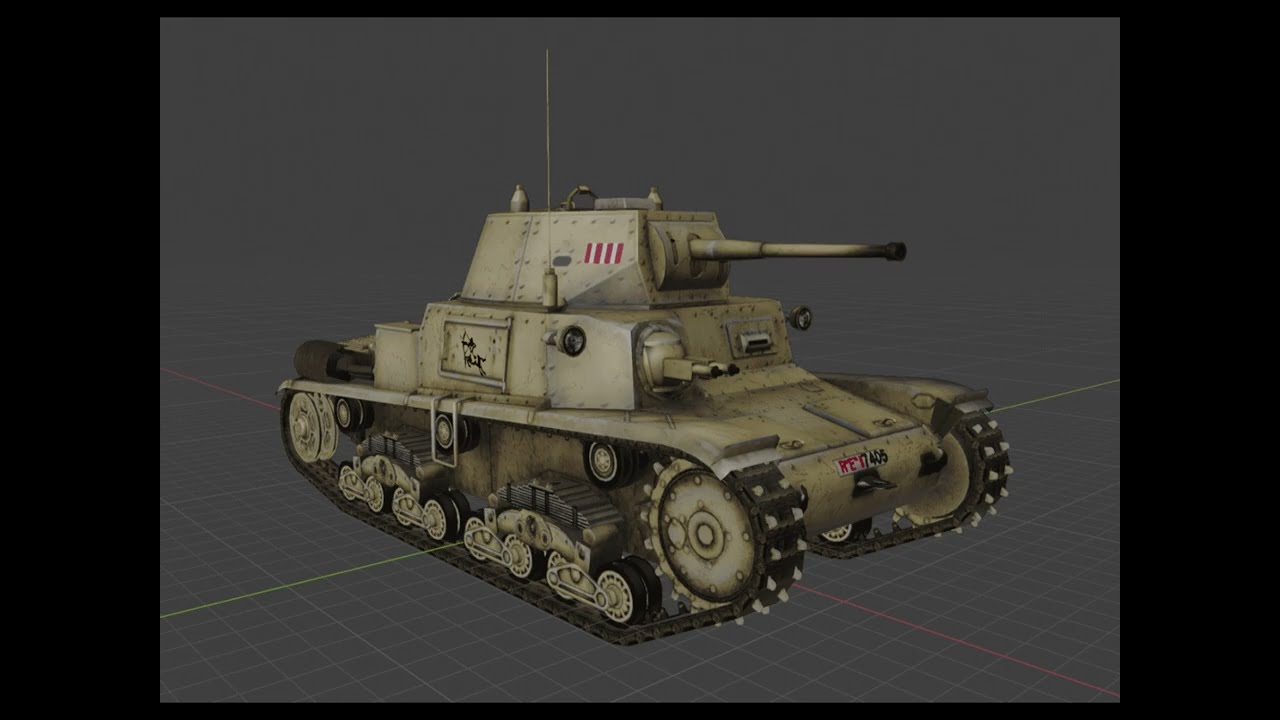
The most sophisticated option was the EP aetto bronto round, a heat type shell that used a shaped charge to burn through armor largely independent of range. In practice, the AP shell could penetrate thicker armor plates than the previous 4732 cannons rounds at typical battle distances, while the EP round was capable of defeating thicker armor than the AP at longer ranges, where kinetic penetration fell off.
Penetration figures for the Aphetto Pronto type shell are 112 mm at 100 m, dropping to 43 mm at 1,000 m. The AP shell was significantly weaker with a drop off of about 30 mm of penetration at 1,000 m. Despite the improvement in firepower, it would still be a struggle for an M1542 to do any significant damage to a typical Allied medium tank of the time, the M4 Sherman, without getting in close range and firing the EP round or somehow flanking the tank.
Inside the tank, ammunition stowage was generous, but came with a serious drawback. The M1542 carried a total of 111 rounds for the 47 mm gun distributed in racks around the lower fighting compartment and in the turret. However, these racks were only lightly protected. In particular, the rack at the rear of the turret was vulnerable.
A hit in this area could ignite or detonate stored shells, leading to a rapid ammunition cookoff and the complete destruction of the vehicle. This vulnerability was a common problem in many World War II designs, but it was especially acute in Italian tanks where internal armor shielding for ammunition was minimal.
The M1542 secondary arament centered on the Braa Medel 38 machine gun, a tank and vehicle version of the widely used Italian Brada M37 heavy machine gun. In the hole, a twin mount of Brada 38s was installed in a ball mount on the right front of the superructure operated by the machine gunner.
In the turret, a coaxial braider 38 was mounted alongside the 47mm cannon to allow the commander to engage infantry and soft targets without expending main gun ammunition. On the turret roof, a further braided 38 could be mounted on a pintle for anti-aircraft defense or high angle fire against exposed targets. To feed all of these weapons, the tank carried a substantial supply of 8 mm ammunition in smaller racks in the crew compartment and turret, ensuring that the crew could sustain prolonged suppressive fire even when the main gun was not required. Radios would be installed in the tank, and it is likely that the tanks were fitted with the same Manetelli RF1CA radio while in Italian use. Production of the M1542 reflected both Italy’s attempts to modernize its armored forces and the limits of its industry and doctrine in the final phase of the war. The production of the
earlier M1441 medium tank was cancelled in the closing months of 1942 and assembly lines were redirected to the new M1542 with an initial order for 280 vehicles. This program was never intended as a long-term answer. Italian planners already understood that the design lagged behind contemporary Allied and German tanks in both protection and firepower and saw it more as a stop gap to keep units supplied while more powerful types were readed.
In early 1943, priorities shifted again. The Reio Ezito decided to concentrate resources on the new heavy tank, the Kadawamato P40, and on a fresh generation of some self-propelled guns, which offered thicker armor and heavier armament. As a result, the M1542 order was cut from 280 to 220 tanks.
This decision reflected a clear recognition that only vehicles with substantially better armor and anti-tank capability could hope to meet the standards set by rival nations, mediums, and heavies, and that the M1542 could not be more than an interim solution. Production of the M1542 began in the autumn of 1942 and continued up to the armistice of September 1943 when Italian industry was thrown into chaos.
Exact totals vary by source, but one cited figure is around 167 tanks completed with 139 vehicles built before the armistice and a further batch quoted as roughly 28 vehicles finished under German control afterwards. Some estimates suggest that the total production, including German orders, may have been as much as around 60 higher, illustrating how fragmentaryary records from this period can be.
The tank is popularly known as the M1542 today, but its real designation was M42. In 1942, designation for vehicles changed and the weight figure 15 tons for this model was dropped. Designation now only included weight classification and year of adoption. The basic M1542 chassis and hull also served as the basis for several important variants.
A CO Central radio command tank version was produced fitted with enhanced radio equipment in place of some ammunition stowage to service a battlefield command vehicle and it had the turret removed. The front ball-mounted machine guns were sometimes replaced with a heavier armament, the Bradello 31 heavy machine gun firing 30 mm ammunition.
45 of these variants were built for the Italian army with a further 40 built for the Veract after the September 1943 armistice. The same M42 hole underpinned updated Seavventa self-propelled gun models, notably the Seavventa M427518 and the improved M42M7534, which mounted more effective 75mm guns in low Casemate superructures and were considered more viable fighting vehicles than the original tank itself.
In addition, an anti-aircraft self-propelled variants, the M42 Contriaro or anti-air was developed using the same basic chassis to provide mobile air defense. Taken together, these production decisions and derivatives underlined how the M1542 was never the centerpiece of Italian armored doctrine, but rather a transitional platform.
Its real legacy layers is much in the vehicles built from its hull rather than the medium tank that originally carried the M42 designation. The M1542’s operational history was as limited as it was symbolic, reflecting both Italy’s late attempt to modernize its armor and the confused final phase of its war.
From the outset, it saw only restricted frontline service under the Reu Zashito and notably was never committed to repel the Allied landings in Sicily or on the Italian mainland. Instead, at the time of the Allied invasion, many of these tanks were still being used primarily for training, underlining how the Italian army had not fully embraced them as a decisive battlefield asset.
The main combat actions of the M1542 came not against the Allies directly, but during the chaotic days following the armistice of September 1943 when German forces moved to occupy key Italian cities. The tanks were deployed in the defense of Rome and in the fierce fighting around Bombino, where Italian units, often poorly coordinated and politically divided, tried to resist German advances.
Within this turmoil, the M1542 equipped the 135th Alietta 2 division formed earlier that year, while the better equipped 136th Armor Division, Chantaro fielded a mix of more capable German tanks such as Panza 3es, Panza 4s, and Stug 3s. Parts of Chentaro were strongly loyal to Mussolini and the fascist cores rather than to the king and the new government, which further complicated the command situation and unity of effort.
In Rome, the most dramatic moments for the M1542 came during the clashes around Porto S. Paulo, where Italian troops, tanks, and civilians confronted advancing German forces. Here, the M1542 crews faced the sobering reality of confronting superior German armor, including Tiger 1 heavy tanks, a mismatch that starkly exposed the limitations of Italy’s medium design.
In the confused street fighting and withdrawals that followed, many M1542s were captured intact by the Germans, while others were deliberately sabotaged or disabled by their crews to prevent their use by the former ally turned occupier. After seizing these vehicles, the Germans pressed the M1542 into their own service.
The Vermacht ordered Italian factories now under German control to continue production of the type and the tank also appeared in the forces of the Italian Social Republic RSI though only in small numbers. Under German command, the M1542 was generally relegated to secondary fronts where its modest firepower and armor were more acceptable.
It saw use mainly in the Balkans for policing, security, and antipartisan duties, roles where it could dominate lightly armed opponents despite its obsolescence. German workshops also made some minor modifications such as adding a storage box on the rear of the turret, giving it a more elongated profile and repainting the tanks in two-tone camouflage schemes more in line with German practice.
The turbulent conditions in the Balkans meant that some of these tanks eventually fell into the hands of local resistance forces. Yuguslav partisans managed to capture a small number of M1542s and employed them against Axis units, turning the Italians and Germans own machines back on their former owners.
At least one particularly unusual field modification is known, an M1542 hull fitted with a Panza 38T turret likely carried out under German or Axis collaborators. This hybrid vehicle may have served with Croatian forces and it stands as a striking visual example of the improvisation and scarcity that characterized late war armored operations in the region.
A few M1542 tanks remained in service for the Italian army following the war, but mainly used as a reserve tank and for public events before removal from service in the early 1950s. In combat terms, the M1542 offered only a marginal improvement over Italy’s earlier M series tanks, and by the time it reached the field, it was already outclassed.
Its slightly better gun, modestly increased armor, and improved engine and transmission could not compensate for the gap that had opened between Italian designs and the Allied and German standards of the Midwar period. Against American Shermans and German Panzer falls, the M1542 was simply outmatched in protection and overall battlefield survivability.
Firepower may have been adequate at the time of entering service if firing the Ato bronto shell, but the Italian army suffered with its logistics, including availability of ammunition. The AP round may have been the more widely available ammunition type for anti-tank purpose, but would reduce the firepower of the 47mm L40 cannon.
As a result, the tank became less a weapon of decision and more a symbol. It reflected Italy’s industrial limits, shortages of fuel, materials, and production capacity, and the fragmented logistics that hampered any attempt at large-scale modernization. The M1542 embodied a late earnest effort to update Italy’s armored forces, and at the same time, it revealed just how constrained that effort was by the realities of war and politics.
Today only a small number of M1542s survive preserved as museum pieces rather than as remembered battlefield icons. Around 13 examples are known with roughly 10 held in collections across Italy. One in the Muzia de Blendes at Samir in France, one in Belgrade and another in San Marino. Each of these vehicles now serves as a physical reminder of a design that arrived too late and with too little impact to alter Italy’s fortunes in armored warfare.
For Italy, the M1542 stands as both a final attempt at modernization and a testament to how far behind its armored doctrine had fallen by 1943.