The Man Who Decided Which Royals Were Allowed to Fall in Love D
In 1929, a 41-year-old courtier walked into a room in the most powerful household on Earth and resigned. Not because he had failed, but because he had decided that the man he served, the future king of England, wasn’t fit to be king. The prince was Edward. The courtier was Alan Lascelles, and everyone who knew him called him Tommy.
7 years later, when that same prince threw away the throne, Lascelles was back inside the palace steadying the brother who had to take his place. He served George V, Edward VIII, George VI, and the young Elizabeth. Four sovereigns in one career, and across all of it, he held a power that no crown sat on and no election conferred.
He decided which letters the monarch saw. He decided which men were suitable. And in 1953, when a princess fell in love with a divorced war hero, the man who moved first and had already decided the outcome was the quiet figure at the private secretary’s desk. This is the story of the most powerful man in the royal family.
He was never in it. Most people first encountered him through The Crown on Netflix, where actor Pip Torrens plays him across the first three seasons, appearing in the opening episode, Wolferton Splash, and running through to Margaretology. Torrens’ Lascelles is cold, rigid, and power-hungry.
A figure viewers describe as appearing to think he is the king. That portrayal made him recognizable. It also got him wrong. The Crown gave audiences a martinet. His published diaries reveal something more unsettling. A man of formidable intellect, dry wit, and complete institutional conviction whose power was real and whose motives went well beyond a bureaucrat’s cold contempt.
Duff Hart Davis, who edited the diaries and published them in 2006 under the title King’s Counselor, described Lascelles as having a brilliant mind and an astute sense of humor. Readers who compared the diaries with the show described the real Lascelles as thoughtful, sensitive, a good judge of character, and with a timely sense of humor.
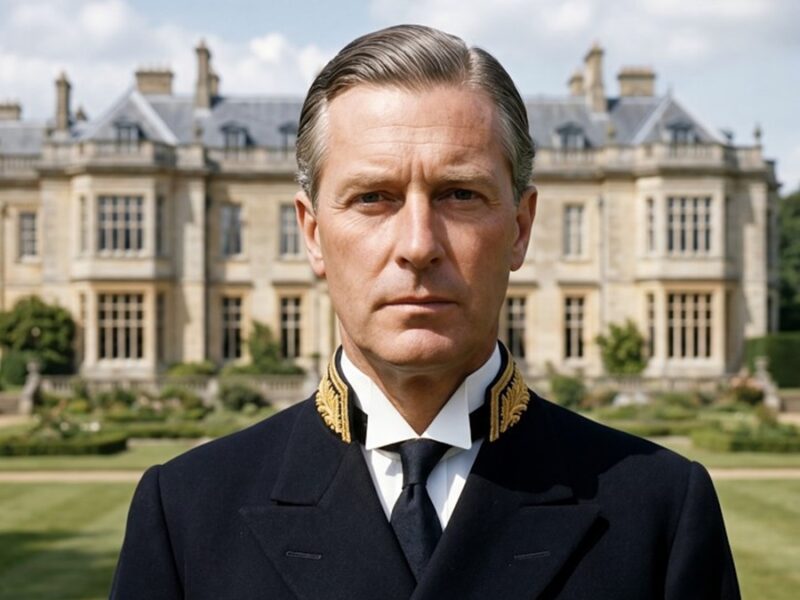
The show gave audiences the silhouette. The diaries give you the man. The best-known photograph of Lascelles in his full authority dates from 1943, the year he was appointed Principal Private Secretary to King George VI. He is in formal court dress, composed, entirely still. He looks like what he was, a man who had spent 23 years learning to be invisible while controlling almost everything.
Alan Frederick Lascelles was born on the 11th April 1887 at Sutton Waldron House in Dorset, the sixth and youngest child of Commander Frederick Canning Lascelles and the grandson of Henry Lascelles, the fourth Earl of Harewood. He was upper British aristocracy, close enough to the royal family to understand its world from the inside, distant enough to judge it without sentiment.
He was educated at Marlborough College, then read classics at Trinity College, Oxford, graduating in 1908 with a second-class degree. He failed the Foreign Office entrance examination twice. That failure, which should have been the natural destination for a man of his class and formation, helps explain the route he took instead.
After brief periods in journalism and stock broking, he joined the Rifle Brigade in 1914. The First World War followed. He served on the Western Front, was mentioned in dispatches, and received the Military Cross. After the armistice, he briefly became aide-de-camp to his brother-in-law, Lord Lloyd, the governor of Bombay.
He returned to England in 1920, a married man, and in that same year was appointed assistant private secretary to Edward, Prince of Wales. His first assessment of Edward was uncomplicated admiration. That lasted approximately 7 years. Through the early 1920s, Lascelles accompanied Edward on royal tours across Canada, Australia, and Africa.
He was an exceptional organizer, a stylish writer, a man of exceptional memory, fluent in the register of the court. He was also watching. Year by year, what he observed was a prince for whom duty was a performance to get through before the real business of the day, the women, the jazz, the cocktails, could begin.
By 1927, on a royal tour of Canada, the accumulation had reached a breaking point. In his own recorded words, Lascelles sought out Prime Minister Stanley Baldwin and told him plainly that the heir apparent, in his unbridled pursuit of wine and women, and of whatever selfish whim occupied him at the moment, was going rapidly to the devil and would soon become no fit wearer of the British Crown.
That conversation took place 9 years before Edward became king and 9 years before the abdication. Lascelles was recording a judgment reached through sustained observation. He had also noted that words like decency, honesty, duty, dignity, and so on, meant absolutely nothing to the prince. Edward himself had once said to Lascelles, with what may have been self-awareness or simple self-pity.
I’m quite the wrong sort of person to be Prince of Wales. Lascelles agreed and filed the remark away. In 1929, he resigned. He resigned despite being a married man with a young family and no immediate employment secured. The public formulation was differences with the Prince. The private reality was moral disgust.
George V, who had awarded Lascelles an MVO for his service to Edward, received the news. Lascelles later reflected that the decoration had been the most grimly earned honor of his career. A remark that says something about the Western Front and everything about the Prince of Wales.
He had, as he put it, wasted the best years of his life. From 1931 to 1935, Lascelles served as secretary to the Governor-General of Canada, Vere Ponsonby, the ninth Earl of Bessborough, a dignified exile. Then, in the latter months of 1935, he was persuaded to return to British royal service as assistant private secretary to King George V. V.
He accepted on assurances that the king was in reasonable health. George V died in January 1936. Lascelles was back inside the palace and now serving the man from whom he had resigned six years earlier, who was now King Edward VIII. He never saw the king during this period.
Edward retreated from Thursday to Tuesday at Fort Belvedere, his country house on the Windsor estate. Press photographs from the mid-1930s show elegant gardens and the man apparently determined to inhabit as little of the sovereign’s role as possible. From his desk at Buckingham Palace, Lascelles watched an institution he respected being navigated by a man he had already judged.
His diary’s assessment of the public position was precise and cold. The vast majority of the king’s subjects wouldn’t tolerate their monarch taking as his wife and their queen a shop-soiled American with two living husbands and a voice like a rusty saw. That is the real Lascelles, a man making a clinical assessment of political reality and recording it with the accuracy of a barrister taking notes.
One correction belongs here. During the abdication crisis of November and December 1936, the senior court official was Sir Alec Hardinge, the principal private secretary. Lascelles served below him as assistant private secretary. The constitutional communications between the palace and the government during those weeks ran through Hardinge’s office.
Lascelles was inside the machinery doing significant work watching events he had privately predicted for nearly a decade. Hardinge ran the crisis. When Edward signed the instrument of abdication on 10 December 1936, Lascelles was, by his diary’s account, deeply shocked. Despite having told Baldwin 9 years earlier it would happen.
That evening, he went out and walked three times round St. James’s Park in the darkness thinking of James II, George VI, the reluctant replacement, the younger brother who had never wanted the throne, now needed a private office capable of steadying a monarchy that had just endured its worst public crisis in centuries.
The new king had for years been managing his stammer with the help of Lionel Logue, an Australian speech and language therapist who had first worked with him in 1926. Logue’s was a therapeutic relationship, private and medical. Lascelles’ role was administrative, advisory, and constitutional. Logue treated the king’s voice.
Lascelles managed the institutional machinery around it. Press photographs from official engagements in the late 1930s and early 1940s show Lascelles positioned correctly at the king’s shoulder. Always present, always composed, always just outside the frame center. Across all accounts, the relationship between the two men was warm and mutually respectful in ways the relationship with Edward had never been.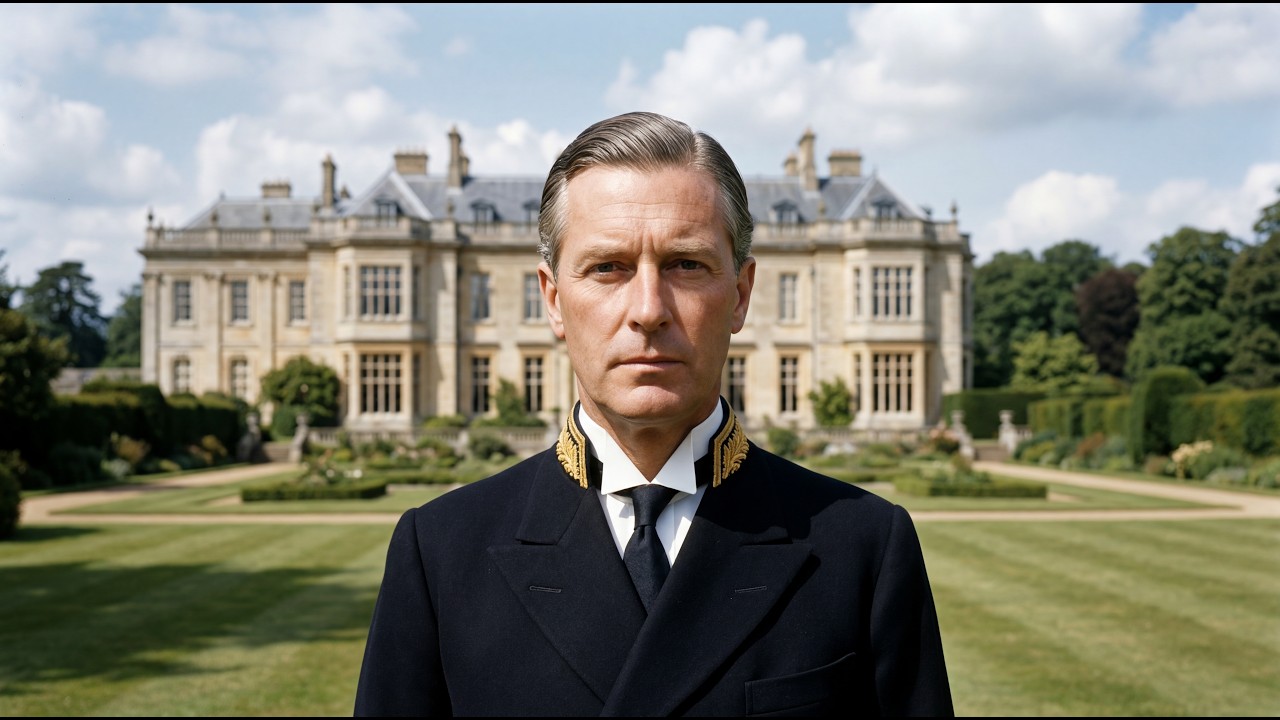
One account records that the king was especially grateful for Lascelles’ encouraging attitude. George the VI came to regard him as indispensable. In July 1943, Hardinge resigned on health grounds. Lascelles replaced him as principal private secretary to King George the VI. He was sworn on the Privy Council the same year and appointed Keeper of the Royal Archives at Windsor Castle.
He was 56 years old and at last in the senior position the institution needed him to occupy. The formal scope of the principal private secretary’s office was extraordinary. Every piece of official correspondence between the monarch and the government passed through it. Audiences were scheduled from that desk.
The constitutional advice on which the sovereign relied, on elections, on the appointment of prime ministers, on the exercise of royal prerogative, came first from the private secretary. As Lascelles recorded, “I get as much illumination on the drear fog of war as anybody in this country.” He was privy to all cabinet papers during the Second World War.
He knew about the atomic bomb 6 months before it was dropped on Japan. His relationship with Churchill was characteristically unsentimental. Historian Andrew Roberts, writing in Eminent Churchillians, records that both Hardinge and Lascelles despised him. The institutional picture is consistent with this.
Lascelles’ loyalties ran to the crown and to constitutional propriety, rather than to the personality of whichever politician occupied Downing Street. He served the institution. He wasn’t always charmed by its temporary servants. In 1950, writing in The Times under the pen name Senex, Latin for the old man, he published a letter that became one of the most cited documents in British constitutional law.
It set out the three circumstances in which a sovereign might legitimately refuse a Prime Minister’s request for a dissolution of Parliament. If the existing Parliament remained capable of governing, if an election would damage the national economy, and if another Prime Minister could form a working majority without one.
Precise, brief, and published anonymously. His name on the letter would have been institutionally inappropriate. A private secretary publicly holding his own constitutional views was the wrong kind of visible. Everyone who needed to know knew. By 1952, he had served three kings and was now private secretary to a 25-year-old queen.
George VI died on 6th of February, 1952. The transition was managed from the same desk by the same man. Lascelles served Elizabeth II for approximately 1 year, overseeing coronation preparations. Official photographs from the coronation on 2nd of June, 1953, show Elizabeth in Westminster Abbey in her embroidered gown, the Tudor rose, the Scots thistle, the Welsh leek, the Commonwealth’s floral emblems worked into the silk by Norman Hartnell.
Lascelles is in formal attendance. He is 66 years old. He is roughly 6 months from retirement, and just outside Westminster Abbey that morning, the event that would define the final chapter of his career was already unfolding. A courtier named Peter Townsend was standing near Princess Margaret. He was a group captain in the Royal Air Force, a Battle of Britain ace with nine confirmed victories, the Distinguished Service Order, the Distinguished Flying Cross and Bar, and a decade of royal household service. He had been equerry to George the VI, and then extra equerry to the new queen. He was 16 years older than Margaret, the father of two sons, and since November 1952, a man filing for divorce from his first wife. Margaret reached up and brushed a fleck of fluff from Townsend’s uniform. A gesture of 2 seconds. Photographers noticed it.
Within days, the British press had identified the relationship. The palace had known about it before the coronation. There had been a private proposal in April 1953, which Margaret had accepted. Press photographs of Townsend from this period, including his wartime RAF portrait, and images taken at official engagements, show a lean, decorated officer in his late 30s.
Photographs of Margaret from the same years show a young woman at the height of her public glamour, dark-eyed, photographed at every official occasion. The gap between those press images and what was happening in the private secretary’s office, the constitutional assessments, the institutional advice, the coordinated response, is exactly the gap this story exists to name.
The constitutional position was this. Margaret was 22 years old in June 1953. Under the Royal Marriages Act 1772, she required the sovereign’s formal consent to marry. Parliament had no formal veto role at that stage. That provision only activated once a royal turned 25 and gave 12 months notice to the Privy Council.
The Queen’s consent was the entire legal bar. Behind it stood several others. The Church of England, of which the Queen was supreme governor, didn’t permit the remarriage of divorced persons while a former spouse lived. Townsend’s first wife was alive. The cabinet, under Prime Minister Churchill, indicated it was unlikely to approve the match.
The architecture of objection was institutional, multi-layered, and solid. Lascelles was at the center of it. As principal private secretary to the sovereign, the central administrative role in palace government communications, he was the figure through whom all of this machinery ran. His diaries show that he played what the Literary Review described, reviewing King’s Counselor on publication, as a significant part in the Townsend crisis.
More specifically, the reviewer noted the diaries contradict the later versions of Princess Margaret and Townsend and prove that both were perfectly well briefed about their options. The record is that Lascelles communicated precisely what was possible and what wasn’t. He was a man who left people fully informed about consequences.
When Townsend declared his intention to marry Margaret, Lascelles reportedly told him he must be either mad or bad, possibly both. The exact wording isn’t confirmed by a primary document in the available record, but the substance is consistent across sources and entirely consistent with the man’s documented approach to uncomfortable information.
Townsend wrote in his 1978 autobiography, Time and Chance, that his posting to Brussels came as an unnatural move to an obsolescent post in which his RAF career was to end. He was appointed air attaché to the British Embassy in Brussels in the summer of 1953 and served there from 1953 to 1956. The formal order for the posting was an Air Ministry and Foreign Office Act.
Lascelles held no authority over RAF postings. What the available record supports is that he advocated for the separation, coordinated the institutional response, and saw it executed. The formal machinery delivered what the palace required. Power of this kind rarely leaves a direct signature.
Margaret turned 25 on 21 August 1955. At that point, the Royal Marriages Act shifted its mechanism. She no longer required the Queen’s direct consent, but she would need to notify the Privy Council and wait 12 calendar months, during which Parliament retained the power to block the marriage by address. Townsend returned from Brussels in October 1955.
The Eden government, Churchill had resigned in April 1955, had privately prepared a plan confirmed by documents declassified in 2004, under which Margaret could contract a civil marriage if she renounced her succession rights, while retaining her royal display and civil list income. The plan existed as one available option.
The church’s position was unchanged. The political cost was made transparent. On 31 October 1955, Buckingham Palace released a statement in Margaret’s name. Townsend himself had drafted it. It was then approved through official channels. It read, “I would like it to be known that I have decided not to marry Group Captain Peter Townsend.
I’ve been aware that, subject to my renouncing my rights of succession, it might have been possible for me to contract a civil marriage, but mindful of the church’s teaching that Christian marriage is indissoluble, and conscious of my duty to the Commonwealth, I have decided to put these considerations before any others.
” The BBC interrupted its scheduled radio program to broadcast it. The statement was written in the first person. The decision, in its final expression, was Margaret’s. What surrounded that decision, the institutional pressure, the carefully constructed set of unattractive options, the constitutional walls constructed across two years, is a separate matter.
She later told friends that Lascelles had ruined her life by his involvement. His diaries, in their account of the same events, show a man who believed he had told both parties exactly what they needed to know. By the time the statement was issued, Lascelles had been retired for nearly two years.
He had left royal service at the end of 1953, shortly after the coronation. His successor as Principal Private Secretary was Sir Michael Adeane. He was offered a hereditary peerage and refused it. He accepted instead the Knight Grand Cross of the Order of the Bath. For the last 30 years of his life, he lived in the old stable block at Kensington Palace, a grace and favor home that kept him inside the institution’s perimeter without requiring anything further from it or of it.
He died there on 10 August 1981, aged 94. The diarist Kenneth Rose recorded that Lascelles used to say there were three sexes, male, female, and royalty. It captures the register in which he operated, amused, exact, maintaining distance even from the room directly adjacent to the throne. His papers are held at the Churchill Archives Centre at Cambridge.
His diaries run to three volumes. King’s Councillor, the last, published in 2006, covers the abdication through Elizabeth’s coronation. The Country Life reviewer called it impossible to put down, observed that the diaries proved both Margaret and Townsend were perfectly well briefed about their options, and noted, pointedly, that Lascelles was on the question of the 1943 handover with Hardinge rather more proactive in forcing Hardinge’s hand than he was prepared to admit.
The role he occupied, Principal Private Secretary to the Sovereign, sits at a constitutional choke point through which virtually every consequential act of the modern monarchy must pass. Royal assent, appointments, audiences, the flow of state papers between palace and cabinet, the monarch’s correspondence with heads of government worldwide, all of it moves through that desk.
No election confers it, no statute defines it fully. It operates, in the words of one constitutional scholar, as the vital link between the Crown and the Cabinet. And it has functioned that way through regimes, abdications, and wars for more than a century. The current holder of that position, serving King Charles III, is a former diplomat.
He works from the same institutional choke point. He won’t appear in a documentary. He won’t be interviewed about his judgments. No one will make a television series depicting his assessments of character or his management of the institution’s private decisions. He will leave no signature on the most consequential things he does.
That is the design. Tommy Lascelles served four kings and queens across three decades of royal service, and the most important things he ever did left no signature. He didn’t wear the crown. He didn’t make the laws. He simply decided, quietly, at a desk just out of the photograph, which letters a monarch read and which loves a royal was allowed to keep.
He was right about Edward. He was ruthless about Townsend. And when people watch the palace today and wonder who is really steering it, they aren’t asking about a king. They are asking, without knowing his name, for another Tommy Lascelles. Subscribe for more stories like this.