The ‘Monstrous’ Soviet Truck That Carried Nuclear Missiles Across Red Square To Terrify The West D
1958, the Minsk Automobile Plant, Partisan Avenue, Soviet Byelorussia. Inside a sealed experimental workshop designated TSOP, behind doors that do not appear on any public factory plan, a vehicle rolls forward under its own power for the first time. It weighs over 19 tons empty.
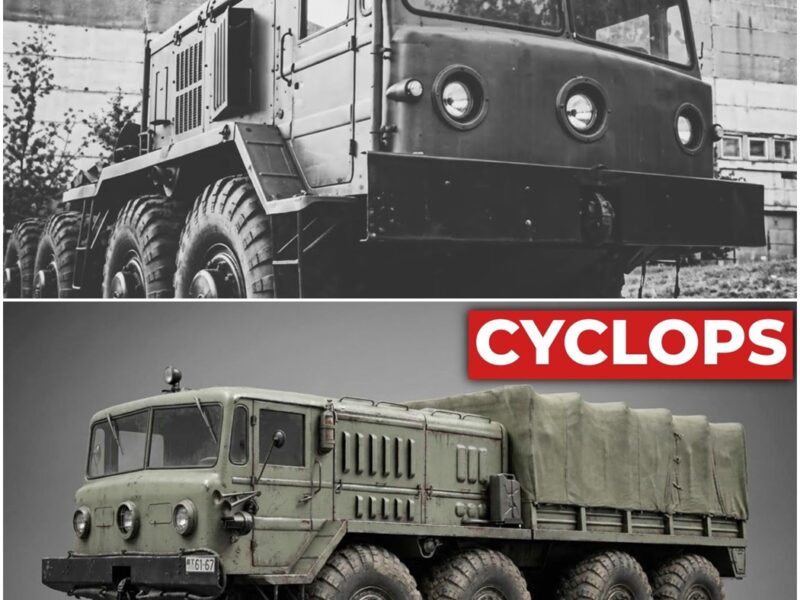
It has eight wheels, each one taller than a man’s waist, driven by a 38 L V12 diesel engine originally built for tanks. Its cab seats four, crouched low behind armored glass, and mounted above the front axle is a single infrared headlight that earns it an immediate nickname among the test drivers, Cyclops.
It looked absurd, a truck too heavy for most Soviet roads, too wide for standard rail transport, too thirsty on fuel to be practical, and too complex for conscript mechanics to maintain. Soviet generals who saw the first prototype reportedly asked what purpose such an enormous machine could possibly serve.
The answer was classified. This vehicle would carry the most terrifying weapons ever built, intercontinental ballistic missiles, through the forests of western Russia, and across the cobblestones of Red Square. It would parade plywood mock-ups of nuclear warheads past western military attachés to project a strength the Soviet arsenal did not yet possess.
It would help create the single most dangerous misconception of the 20th century, the missile gap, and it would do so carrying weapons that could not fly. Loaded onto trailers behind a truck the west had never seen. Its designation was the MAZ 535, and it was the vehicle that helped bluff the entire western world during the most dangerous decade of the Cold War.
To understand why the MAZ 535 existed, you need to understand the problem the Soviet Union faced in 1954. The Strategic Rocket Forces did not yet formally exist. They would not be established until December 1959. But the Soviet ballistic missile program was already accelerating beyond the capacity of existing military transport.
The R-5M, the R-12, the R-14, and the enormous R-16 were all under development. Each required road transport between rail heads, storage depots, and launch positions. Existing Soviet trucks, the YAZ-210 and the MAZ-200, were two and three axle machines designed for conventional cargo. They could not haul a 60-ft ballistic missile on a specialized trailer across unpaved roads, through mud, or over bridges rated for half the required load.
Tracked artillery tractors could manage the weight, but they were slow, short-ranged, and destroyed every road surface they touched. The Soviet leadership knew what a wheeled heavy tractor could do. During the war, 190 REO and 295 Diamond T tractors had arrived under Lend-Lease, American 6×4 machines.
They had hauled tanks and heavy equipment across the Soviet rear with a speed and reliability that tracked vehicles could not match, but the Americans had built nothing with eight driven wheels, nothing with a hydromechanical transmission, and nothing designed from the ground up to carry nuclear weapons through forests in winter.
On June 25th, 1954, the Soviet Council of Ministers issued decree number 1258. It ordered the creation of special design bureaus inside Soviet automobile plants to build a new generation of heavy military tractors. At Minsk, the corresponding bureau, SKB-1, was created by secret director’s order on July 23 and placed under a single man, chief designer Boris Lvovich Shaposhnik.
Shaposhnik was already 52 years old, a veteran of the ZiS factory in Moscow. He had served as chief designer at the Ulyanovsk plant during the wartime evacuation. He understood heavy machinery, and he understood deadlines imposed by the Kremlin. Within 2 years, his team of fewer than 30 engineers, including D. Katsnelson, A. M. Pechenev, and B. M.
Rabinovich, completed two working prototypes of the MAZ-535. The first test revealed frame failures. The riveted ladder chassis cracked under load. Shaposhnik redesigned the frame entirely, switching to a welded trough profile that would become the structural template for every Minsk heavy vehicle built over the next six decades.
The production MAZ 535A that emerged from these corrections was a machine unlike anything else on wheels. The D12A engine, a liquid-cooled V12 diesel producing 375 horsepower at 1650 revolutions per minute, was built at the Barnaul Transmash Plant and derived directly from the V2 engine that had powered the T-34 tank.
The drivetrain was staggering in its complexity. A single-stage torque converter fed into a three-speed planetary gearbox, which fed into a two-speed transfer case, which distributed power through seven self-locking differentials and 16 cardan shafts to eight planetary hub reductions, one at each wheel. There was no clutch pedal, only throttle and brake.
Test drivers at the 21st Research Institute in Bronnitsy described their first encounter with the controls as terrifying. The vehicle weighed 19.4 tons empty, stretched nearly 9 m in length, and consumed roughly 75 L of diesel per 100 km. Its central tire inflation system could adjust pressure on all eight wheels simultaneously from the cab, allowing the driver to lower pressure for soft ground and raise it again on pavement without stopping.
Top speed on a paved road was 60 km/h. Range was approximately 700 km on two 380 L fuel tanks. It could ford 1.3 m of water and climb a 30° gradient. Every specification served one purpose, moving ballistic missiles across terrain that would stop any other wheeled vehicle on Earth. Now, before we get into where the MAZ 535 actually operated and what it carried, if you are enjoying this deep dive into Cold War military engineering, hit subscribe.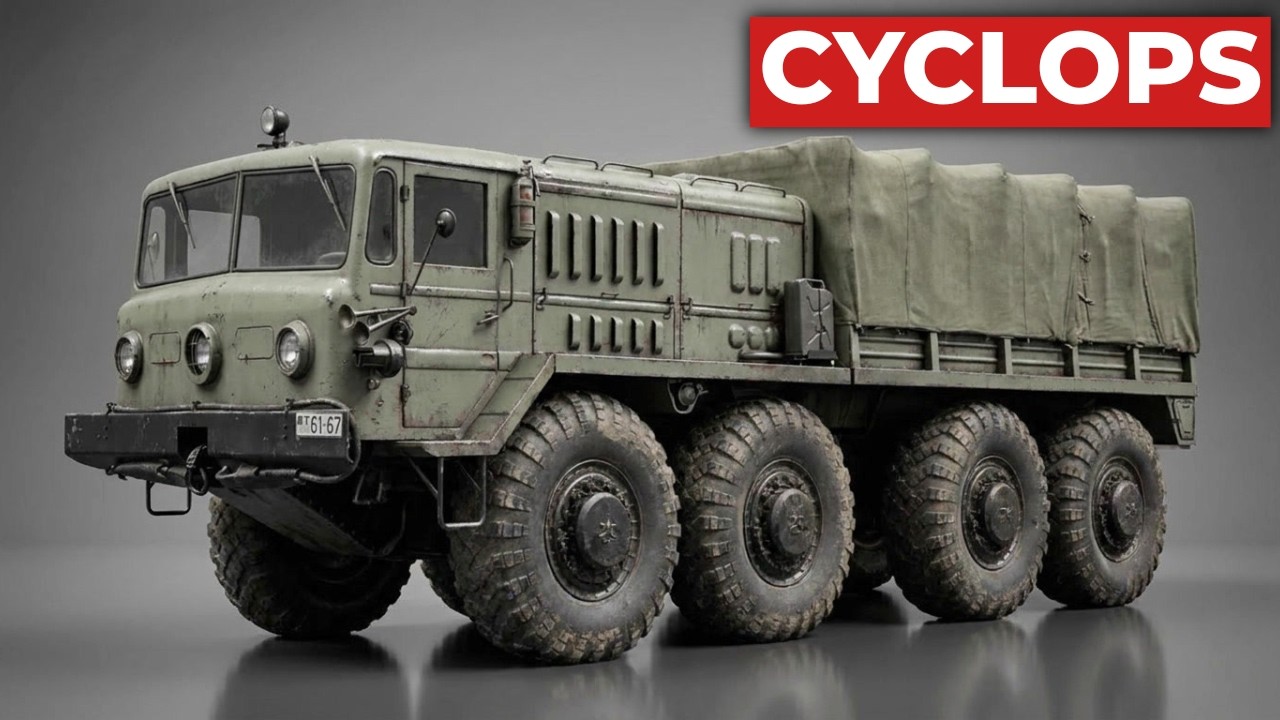
It takes a second, costs nothing, and helps this channel grow. The MAZ 535A entered limited production at Minsk in 1958 with output later transferred to the Kurgan Wheel Tractor Plant. Roughly 200 units were built in 1961 and 150 in 1962. Total production across the entire 535 family is estimated in the low hundreds, a tiny number by Soviet standards.
Because these vehicles were never intended for general military use, they belonged to the Strategic Rocket Forces. Their primary mission was hauling specialized missile trailers. The 8T115 single-axle trailer carried carried the R-12, the medium-range ballistic missile that would sit at the center of the Cuban Missile Crisis in October 1962.
The heavier 8T139 two-axle trailer carried the R-14 and the R-16, weapons capable of striking targets across Western Europe and, in the case of the R-16, across the Atlantic. The MAZ 535 did not launch these missiles. It moved them from rail depots to forest clearings, from storage bunkers to concrete launch pads, and most consequentially, from military staging areas to Red Square.
The Soviet practice of parading new weapons through Red Square on May Day and on the anniversary of the October Revolution was not merely ceremonial. It was strategic communication. Since 1957, it had become tradition to display missile systems publicly during these parades and Western military attachés stationed in Moscow knew it.
American, British, and French intelligence officers would position themselves along the parade route, on the rooftop of the National Hotel, and at other vantage points, photographing every vehicle and every weapon with telephoto lenses. The CIA’s National Photographic Interpretation Center, known as NPIC, produced dedicated reports analyzing the dimensions, propulsion type, and probable capability of each new system displayed.
According to the manufacturer’s own corporate history, the MAZ 535A made its first public Red Square appearance on November the 7th, 1961, towing a trailer bearing an R-14 missile. the sight was precisely calibrated to alarm. A massive eight-wheeled tractor, never before seen by Western observers, hauling what appeared to be a fully operational intermediate range ballistic missile through the heart of Moscow.
The scale of the vehicle alone suggested industrial capacity. If the Soviets could build a truck this large and this specialized, how many missiles must they have to justify its existence? The answer, had Western intelligence known it, was far fewer than the parade implied.
The most dramatic display came on May 9th, 1965, the 20th anniversary Victory Day parade. MAZ-535A tractors hauled AT-139 trailers bearing the GR-1, a weapon the Soviet leadership publicly called the global rocket. NPIC designated it SS-X-10 Scrag. Western analysts measured it, drew it, estimated its fuel type and range. The President’s daily brief for May 10, 1965, flagged the new missile as probably liquid-fueled and noted inconsistencies between its appearance and known Soviet launch vehicle families.
What Western intelligence could not know was that the GR-1 had been canceled in March 1964, more than a year before the parade. Its NK-9 engines had never worked reliably. The program was dead. The two objects hauled across Red Square behind MAZ-535A tractors that morning were completed airframes that had never flown and never would.
Former KGB Chairman Vladimir Semichastny later admitted in his memoirs that a number of the missiles displayed at Soviet parades were fakes, replicas made of plywood and aluminum, designed to look operational from a distance. He compared the practice to a Potemkin village. The deception operated against a backdrop that made it devastating.
In October 1960, Soviet Premier Nikita Khrushchev had told the United Nations General Assembly that Soviet missile production was now a matter of mass delivery, comparing the output to sausages from a machine. Senator John F. Kennedy had already coined the phrase missile gap in August 1958, warning that the Soviet Union was pulling ahead in the decisive weapons of war.
National Intelligence Estimate 11-5-58, published in August 1958, had projected that the Soviets could have as many as 500 operationally ICBMs by 1961 or 62. The reality was starkly different. By 1961, confirmed by Corona satellite reconnaissance and the revised National Intelligence Estimate 11-8-1-61, the Soviet Union possessed only four operational R-7 Semyorka ICBMs, four, not 500.
The missile gap was real, but it favored the United States by an enormous margin. President Eisenhower had known this, but refused to say so publicly because doing so would have revealed the existence of the U-2 and Corona programs. By the time the truth emerged, the MAZ-535 and its missile trailers had already shaped presidential election, accelerated American ICBM procurement, and pushed both superpowers deeper into the most dangerous arms race in human history.
No NATO army fielded a comparable vehicle during the MAZ-535’s operational years. The British army relied on the Thornycroft Antar, a 6×4 tractor powered by a Rolls-Royce Meteorite engine producing between 250 and 333 horsepower. It hauled Centurion tanks on flatbed trailers. The American military still operated wartime era M26 Dragon Wagons and was transitioning to the M123, a 6×6 tractor with a conventional drivetrain.
Neither driven wheels, neither had a hydromechanical transmission. Neither had centralized tire inflation. By any objective engineering comparison, the MAZ-535 was ahead of every Western equivalent in drivetrain technology, though its complexity, low production numbers, and enormous fuel consumption limited its practical utility.
The vehicle itself was never exported, unlike its successors, the MAZ-537 and the MAZ-543. The 535 served only within the Soviet Union, but its engineering legacy was immense. Shaposhnik’s design choices, one tank derived diesel driving a hydromechanical automatic transmission through independently suspended wheels with centralized tire control, became the template for every Minsk heavy military chassis that followed.
The MAZ-537 replaced it with 525 horsepower and greater payload capacity. The MAZ-543 became the chassis for the Scud B launcher, exported to Iraq, Syria, North Korea, and dozens of other nations. The MAZ-547 carried the SS-20 Pioneer, the MAZ-7912 and 7917 carried the Topol, and today the MZKT-79221, a 16-wheeled descendant of Shaposhnik’s original eight-wheel concept, carries the RS-24 Yars, Russia’s current road-mobile nuclear deterrent.
Shaposhnik received the State Prize in 1968 for the 535 and 537 family. He was named Hero of Socialist Labor in 1973 and awarded the Lenin Prize in 1976. He retired in March 1985 and died 6 months later. A handful of MAZ-535A units are believed to survive. The most reliably documented is displayed at the Sakharov Park Complex of the History of Technology in Tolyatti, 1958, the Minsk Automobile Plant, Partisan Avenue, Soviet Byelorussia.
A vehicle rolls forward under its own power, eight wheels, a tank engine. A single infrared eye mounted above the cab. It is too heavy, too wide, too thirsty on fuel, and too complex for the roads it is meant to travel. It had no armor. It carried no weapon of its own. It never fired a shot, never crossed a border under hostile conditions, and never engaged an enemy.
It was slow to build, difficult to maintain, and produced in numbers so small that most Soviet soldiers never saw one. And yet it changed the Cold War. It carried weapons that could not fly past analysts who could not look away. It projected power that did not exist onto a stage the entire world was watching.
It turned Red Square into the most effective theater of deception the nuclear age ever produced. The MAZ-535 was not elegant. It was not efficient. It was Soviet. And it convinced the West that the missiles were real when the missiles were made of wood. That is not engineering. That is the most dangerous bluff in the history of modern warfare.