The ‘Obsolete’ British Missile Truck That Made Russian Pilots Afraid To Fly Over Ukraine D
1991, the Alvis factory, Holyhead Road, Coventry. A low flat tracked vehicle rolls off the production line and onto the proving ground. It weighs 13 and 1/2 tons. Its aluminum hull is thin enough to stop rifle rounds and shrapnel, but nothing heavier. It carries no cannon, no heavy machine gun, no turret of any recognizable kind.
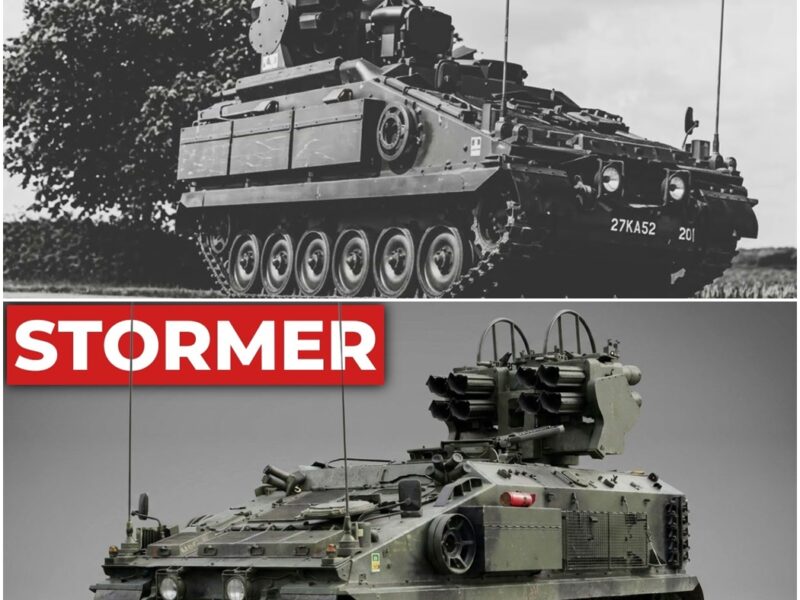
What sits on its roof is a rectangular launcher assembly holding eight cylindrical tubes angled slightly upward, and between them a small sensor pod that looks more like a security camera than weapon of war. It looked underwhelming. It looked like a spare parts carrier someone had bolted a science project onto.
Senior officers in the British Army had been waiting more than a decade for this vehicle, and what they received appeared to be a lightly armored box with a rack of drain pipes on top. That vehicle would go on to sit in storage for years without firing a shot in anger, survive repeated calls for its retirement, deploy to a war it was never designed for on a continent it was never meant to reach, destroy over 70 aircraft and drones in combat, and then in 2026 get pulled out of near retirement and flown to the Mediterranean to defend a British airbase against Iranian drone swarms during the largest Western military operation since the invasion of Iraq. Its designation was the Stormer HVM, armed with the Starstreak high velocity missile. It was the fastest short-range air defense system ever built, and for three decades almost nobody believed it would ever matter. To understand why the Stormer HVM existed, you need to understand the problem Britain faced in 1980. The British Army of the Rhine sat in West Germany as NATO’s front line against the Soviet
Union. The threat that kept air defense planners awake was not bombers flying at high altitude, it was attack helicopters. The Soviet MI-24 Hind could fly below the tree line, pop up, fire anti-tank missiles into a British armored column, and drop back behind cover in seconds. Existing British air defense weapons, the shoulder launched Blowpipe and later the Javelin, were too slow and too easy to decoy.
The Rapier provided area defense but could not keep pace with fast-moving armored formations. NATO needed something that could travel with the tanks, detect a helicopter the moment it appeared, and kill it before it fired. And it needed a missile so fast that no countermeasure on Earth could stop it.
In 1984, the Ministry of Defense awarded competing study contracts to two firms. Shorts Missile Systems in Belfast proposed a weapon called Starstreak, a missile that would accelerate past three times the speed of sound and then release three separate tungsten darts to strike the target simultaneously. British Aerospace proposed a rival design called Thunderbolt. Shorts won.
In 1986, the Ministry of Defense signed a contract worth approximately 225 million pounds for development and production across three variants. A shoulder-launched tube, a lightweight tripod launcher, and a self-propelled vehicle. That same year, the Alvis Stormer chassis, a stretched and modernized descendant of the CVR(T) Scorpion family, was selected as the carrier.
The vehicle itself was a masterpiece of practical engineering. The Perkins 6-liter turbocharged diesel produced 250 horsepower, enough to push the Stormer to 50 mph on roads and give it an operational range of 400 miles. Seven forward gears and seven reverse gears with full pivot turn capability meant the vehicle could reposition faster than any equivalent system in NATO or the Warsaw Pact.
The crew was three, a driver, a commander, and a gunner. Eight Starstreak missiles sat ready to fire on the roof launcher with additional reloads stowed inside the hull for a total of up to 20 rounds. Between the missile banks sat the air defense alerting device, a passive infrared scanner that could detect aircraft at 18 km, identify helicopter targets at 8 km, and automatically slew the weapon sight onto the threat.
Detection to launch took less than 5 seconds, but the missile was the real weapon. A two-stage solid propellant rocket motor launched the Starstreak from its tube. The first stage burned out before the missile even cleared the launcher, protecting the crew from backblast. Once the missile reached a safe distance, the second stage ignited and accelerated it past Mach 3.
5, roughly 4,500 km per hour. At burnout, the nose cone separated and released three tungsten alloy darts, each about 400 mm long and 22 mm in diameter, each carrying a delayed action explosive charge. The three darts flew in a tight formation, spreading to a radius of about 1 and 1/2 m, and struck the target at over 1,200 m per second.
Each dart hit with the kinetic energy of a Bofors 40 mm shell. The guidance method was what made Starstreak essentially unkillable. It used laser beam riding. The aiming unit projected two coded laser beams that formed a matrix in the air ahead of the target. The darts read their position within that matrix and steered themselves to stay centered on the operator’s aim point.
The missile did not chase a heat signature. It did not follow a radar reflection. It did not emit any signal at all. This meant that flares were useless. Chaff was useless. Infrared decoys, radar jamming, and electronic warfare, all useless. The launcher produced no radar emission, so the vehicle was invisible to any radar warning receiver on an enemy aircraft.
A pilot under attack by Starstreak would receive no warning. The first indication would be three tungsten darts arriving at more than a kilometer per second. By the time any human reflex could respond, the engagement was already over. Starstreak entered British Army service in September 1997 with 12 Regiment Royal Artillery and 47 Regiment Royal Artillery.
It had taken 17 years from the original requirement to reach the front line. The Cold War was over. The Soviet Hinds it was designed to kill had rusted in their hangars. The Stormer HVM deployed to Iraq in 2003 during Operation Telic. It did not fire for more than two decades. The fastest short-range air defense missile in the world sat in British armories, trained in Canada and Estonia, and waited for a war that never came.
Now, before we get into where this weapon finally proved itself in combat, if you are enjoying this deep dive into British defense engineering, hit subscribe. It takes a second, costs nothing, and helps this channel grow. On the 9th of March, 2022, British Defense Secretary Ben Wallace told the House of Commons that the government would explore donating Starstreak missiles to Ukraine.
One week later, on the 16th of March, he confirmed to the BBC that the missiles were already being supplied. On the 25th of April, Wallace announced the donation of the Stormer vehicles themselves, telling Parliament that armored vehicles fitted with launchers for those anti-air missiles would give Ukrainian forces enhanced short-range anti-air capability both day and night.
Six Stormer HVM systems arrived in Ukraine by July 2022, along with hundreds of Starstreak missiles. Ukrainian crews trained in Britain over roughly a month, and the vehicles were issued to the 1129th anti-aircraft missile regiment. The first Starstreak combat kill came before the Stormers even arrived.
On the 1st of April, 2022, footage from Luhansk Oblast showed a shoulder-launched Starstreak severing the tailboom of a Russian Mi-28 attack helicopter. The helicopter spun violently and crashed. According to UK Ministry of Defense sources, it was the first time a Starstreak missile had ever been fired in combat. Ukrainian paratroopers of the 95th Air Assault Brigade also downed a Ka-52 with a man-portable launcher in the same period.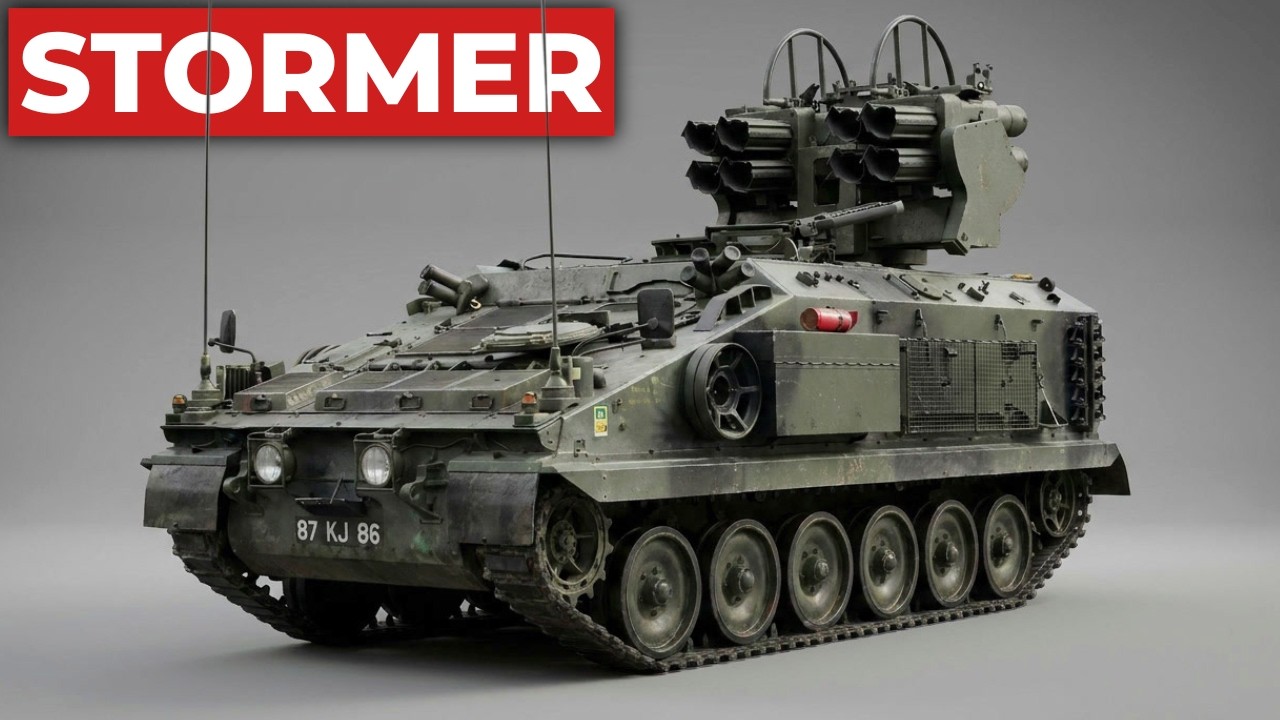
When the Stormer vehicles entered action in August 2022, they began destroying Russian reconnaissance drones almost immediately. Two Orlan-10 drones fell that month. By February 2023, footage showed a Stormer system engaging and destroying a Shahed series Iranian-made loitering munition. An operator from the 1129th regiment, identified only as Yaroslav, told the Ukrainian defense outlet Militarnyi that once a target was tracked by the missile, it could no longer escape, noting the speed of roughly a kilometer per second and stating that in 90% of cases the target would be hit. The regiment’s commander, identified as Ihor, praised the vehicle’s mobility and its passive operation, saying it could not be seen by enemy radar equipment and could find a target, strike it, and leave the firing position instantly. By August 2024, the 1129th Regiment reported approximately 70 aerial kills over 2 years, predominantly reconnaissance drones including ZALA, Supercam, Orlan-10, Orlan-30, and Merlin-VR types.
One individual Stormer system was credited with 20 kills. Another had destroyed 46 air targets in total. The system was not invincible. On the 11th of March 2023, a Russian Lancet 3 loitering munition struck and destroyed a Stormer HVM in Donetsk Oblast, the first confirmed loss. A second Lancet kill followed in May.
Ukrainian forces responded by building plywood Stormer decoys to draw Russian fire away from the real vehicles. Then, in February 2026, the system that was scheduled for retirement found itself needed again. Operation Epic Fury, the American code name for the joint United States and Israeli campaign against Iran, began on the 28th of February.
Iranian retaliation was massive. Waves of Shahed drones and ballistic missiles struck across the region. Around the 2nd of March, an Iranian-made Shahed drone hit the runway at RAF Akrotiri, the British sovereign base on Cyprus. The response was immediate. Within weeks, RAF C-17 Globemaster transports flew Stormer HVM vehicles into Cyprus to reinforce ground-based air defenses.
On the night of the 23rd to 24th of March, British forces intercepted 14 drones in a single engagement, the highest such count recorded by British troops in the region. Four RAF Regiment Gunners reached what the military informally calls ace status, each credited with five or more kills, Wing Commander Richard Morgan confirmed the milestone publicly.
The Stormer’s operated as part of a layered British defensive posture that included F-35 and Typhoon jets, Wildcat helicopters firing Martlet missiles, the Type 45 destroyer HMS Dragon, and the Sky Sabre medium-range system deployed later to Saudi Arabia. On paper, Russia’s Pantsir-S1 was the superior system. It combined twin 30-mm cannons with 12 missiles, a maximum range of 20 km, a ceiling of 15 km, and the ability to track roughly 20 targets simultaneously.
The Russian Tor-M1 offered 12 km range, 6 km ceiling, and Mach 2.8 missiles with active radar guidance. The German Gepard, also sent to Ukraine, carried twin 35-mm radar-directed cannons with a deep ammunition magazine ideal for shredding cheap drones at close range. The American Avenger mounted eight Stinger missiles on a Humvee, lighter and cheaper than any of them.
With a fire-and-forget infrared seeker that freed the operator after launch. In practice, every one of those systems had a weakness the Stormer did not share. The Pantsir’s radar made it visible. In Ukraine, Syria, and Libya, Pantsir systems were repeatedly destroyed by drones and anti-radiation missiles that homed on their emissions.
The Tor’s active radar created the same vulnerability. The Gepard’s guns were devastating against slow drones, but lacked the range and speed to catch fast-moving aircraft or helicopters beyond 2 or 3 km. The Avenger’s Stinger missiles could be defeated by simple flare dispensers, and at Mach 2.
5, they gave targets measurably more time to react than Starstreak at Mach 3.5. The Stormer emitted nothing. It hid, it waited, and it fired a missile too fast for any aircraft countermeasure system to defeat. The trade-off was real. The operator had to keep the laser aim point on the target until impact.
It was not fire-and-forget. The small dart warheads were less effective against very small drones than a proximity fused weapon, and the thin aluminum armor offered no protection against artillery or loitering munitions. But, as a mobile ambush weapon for defending armored formations or fixed bases against helicopters, jets, and medium-sized drones, nothing else in Western service matched it.
The Stormer HVM was scheduled to leave British Army service in 2026. Its replacement is the VAMTAC Rapid Ranger, a wheeled Spanish-built vehicle carrying four Starstreak or Martlet missiles on a lightweight launcher. Some analysts have criticized the replacement as a downgrade, trading tracked armored mobility and eight ready rounds for a lighter wheeled platform with half the missile capacity.
A longer-term solution based on the Boxer armored vehicle has been reported, but not yet ordered. Meanwhile, Thales Belfast has doubled its missile production output since the start of the Ukraine war and plans to double it again. Alex Cresswell, chief executive of Thales UK, confirmed in March 2024 that the Belfast factory was producing more missiles than at any point in living memory.
Export orders have followed from Portugal, India, and others. The Starstreak family, once considered a Cold War relic, is now at the center of allied counter-drone strategy across three continents. 1991, Holyhead Road, Coventry. A flat-tracked vehicle with a rack of tubes on its roof rolls onto the proving ground for the first time.
It is lightly armored. It carries no gun. It requires its operator to hold a laser on the target from launch to impact. It was designed for war against the Soviet Union that never came, and it sat in storage for a quarter of a century without firing a single shot in anger. And yet, it worked.
It worked in the fields of Eastern Ukraine against Russian reconnaissance drones. It worked against attack helicopters built by the same nation whose aircraft it was originally designed to kill. It worked on the Mediterranean coast of Cyprus against Iranian-made suicide drones during the largest Western air defense operation in a generation.
It worked because its missile was too fast to outrun, too quiet to detect, and too unconventional to decoy. 14 nations have bought the Starstreak system or expressed intent to acquire it. Thales Belfast is building them faster than at any point in the weapon’s history. The vehicle may retire, the missile will not. That is not obsolescence.
That is a 30-year bet on physics over electronics, and physics won.