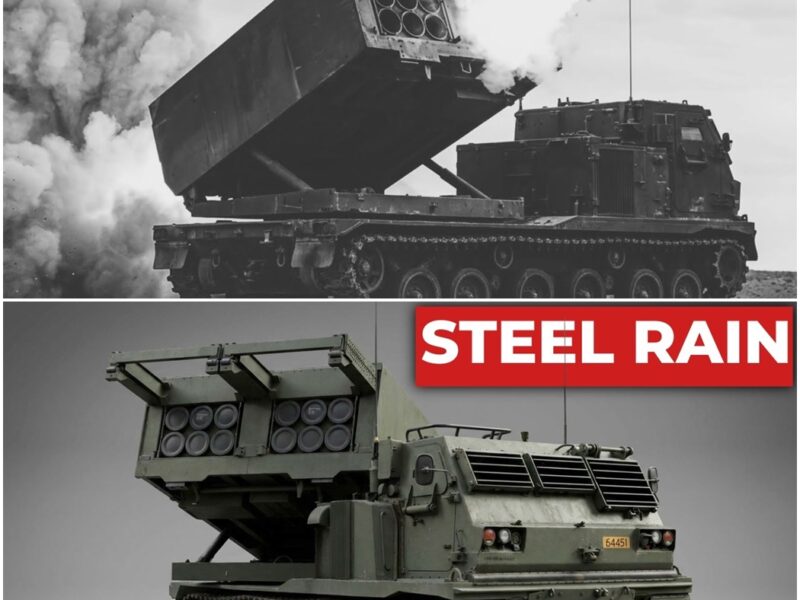
The ‘Obsolete’ British Rocket Launcher Iraq Called “Steel Rain” That Now Hunts Russians in Ukraine D
Summer 2022, Southern Ukraine, somewhere inside a tree line south of Kramatorsk. A crew of three Ukrainian gunners crouches beneath a canopy of cut pine branches and camouflage netting, mobile phones switched off, engine idling. The vehicle beneath all that foliage is enormous.
25 tons of tracked steel sitting on a stretched Bradley chassis. It’s twin launcher pods angled skyward like the spine of something prehistoric. A fire mission crackles through the encrypted radio. The commander punches coordinates into screen. The launcher slews, elevates, and in fewer than 60 seconds, 12 guided rockets scream out of their pods in rapid succession.
Each one riding a pillar of white flame that turns the forest floor orange. Before the last rocket has even reached its target, a Russian ammunition dump more than 70 kilometers away, the vehicle is already reversing out of position. Tracks grinding through the mud, disappearing into the dark. By the time the dump detonates in a chain of secondary explosions visible on satellite imagery, the launcher is 4 kilometers away and reloading.
The Ukrainians call this machine a gift from Britain. The Russians call it something worse. The rest of the world knows it by its designation, the M270 multiple launch rocket system. And the version Britain sent to Ukraine, the M270B1, is the most advanced variant of a weapon that was never supposed to fight this war, in this country, against this enemy.
It was built to stop Soviet tanks pouring through the Fulda Gap third world war that never came. Instead, it ended up doing exactly that, just 40 years late and 600 miles further east. To understand why this weapon exists, you need to understand the nightmare that haunted NATO planners throughout the 1970s.
The Soviet Union maintained thousands of truck-mounted Katyusha descendant rocket launchers, cheap, mobile, and devastating in volume. The BM-21 Grad alone could blanket an area the size of several football pitches in a single salvo. NATO had nothing equivalent. Western armies had invested in precision howitzers and air power, but a massed Soviet armored thrust across the North German plain, the scenario every Cold War exercise rehearsed, would overwhelm those assets before air support could respond.
The answer had to be fast, mobile, and capable of saturating a kill zone before Soviet columns could disperse. In December 1975, the United States Army Missile Command issued a request for proposals. By September 1977, two firms, Boeing Aerospace and Vought Aerospace, were building prototypes.
Vought won in May 1980. The system they delivered was designated the M270. Britain, West Germany, France, and Italy signed a memorandum of understanding in July 1979 to jointly produce it for European armies. The first American launchers reached the 1st Infantry Division in early 1983. British launchers arrived with 39 Heavy Regiment Royal Artillery in 1989.
The United Kingdom originally purchased 64 of them. The machine itself is deceptively simple in concept, but brutally effective in execution. The M270 rides on the M993 carrier, a lengthened derivative of the M2 Bradley’s hull, six road wheels per side, torsion bar suspension, aluminum armor protecting against small arms fire and shell splinters.
A Cummins VTA-903 turbocharged diesel pushes 500 horsepower through a hydromechanical transmission, giving the launcher a road speed of roughly 64 km/h and an operational range of nearly 500 km. The crew of three, driver, gunner, and section chief, sit in a sealed overpressure ventilated cab fitted with chemical, biological, and nuclear filtration.
Because in the Cold War scenario, you launched your rockets and then drove straight through the fallout. The business end is the M269 launcher loader module mounted on the vehicle’s back. It holds two interchangeable pods, each containing six rockets, 12 in total. The entire salvo can be fired in under 60 seconds.
Reload takes roughly 5 to 10 minutes depending on conditions using the vehicle’s own integrated winch and boom system. The launcher traverses 360° and elevates to 60°, meaning it can fire in virtually any direction without repositioning the hull. This is the shoot and scoot doctrine made physical. Arrive at a firing point, launch everything, and be gone before enemy counter-battery radar can calculate your position.
What transformed the M270 from a Cold War area saturation weapon into something far more dangerous was the ammunition it eventually learned to fire. The original M26 rocket was unguided, 227 mm in diameter, carrying 644 dual-purpose submunitions out to about 32 km. A single launcher’s 12-rocket salvo scattered 7,728 bomblets across a target area.
Three launchers firing together dropped over 23,000. That is where the nickname came from. Iraqi soldiers who survived it called it steel rain, but the submunitions had a dud rate of roughly 2%, which meant hundreds of unexploded bomblets littered every target area. A humanitarian disaster that eventually led Britain to destroy its entire M26 stockpile by 2013 under the Convention on Cluster Munitions.
The replacement was the M31 Guided Multiple Launch Rocket System round, GMLRS. Introduced around 2005, it uses GPS-aided inertial navigation and four nose-mounted canards to steer a single 90-kg unitary high-explosive warhead to within roughly 10 m of its target at ranges up to 84 km. One rocket, one warhead, one impact point accurate enough to hit a specific building.
British gunners in Afghanistan gave it a new nickname, the 70-km sniper. And the M270 can also carry a very different weapon, the ATACMS ballistic missile, a 610-mm munition so large that only one fits per pod, two per launcher. Range up to 300 km for the GPS-guided Block IA variant.
That means a single M270 can function as both a precision rocket battery and a short-range ballistic missile launcher, depending on what you load into it. If you have made it this far into the story of a weapon that started as a Cold War contingency, evolved into a precision assassin, and is now reshaping the battlefield in Ukraine, then you are exactly the kind of viewer this channel was built for.
Hit subscribe and turn on notifications. The War Foundry covers military hardware across all nations and all eras, and there is much more to come. The British variant, the M270B1, is essentially the American M270A1 upgrade with a distinctly British edition. The A1 brought the improved fire control system with GPS and inertial navigation, the improved launcher mechanical system that cut aiming time by about 70% and reload time by up to half, and full compatibility with guided GMLRS.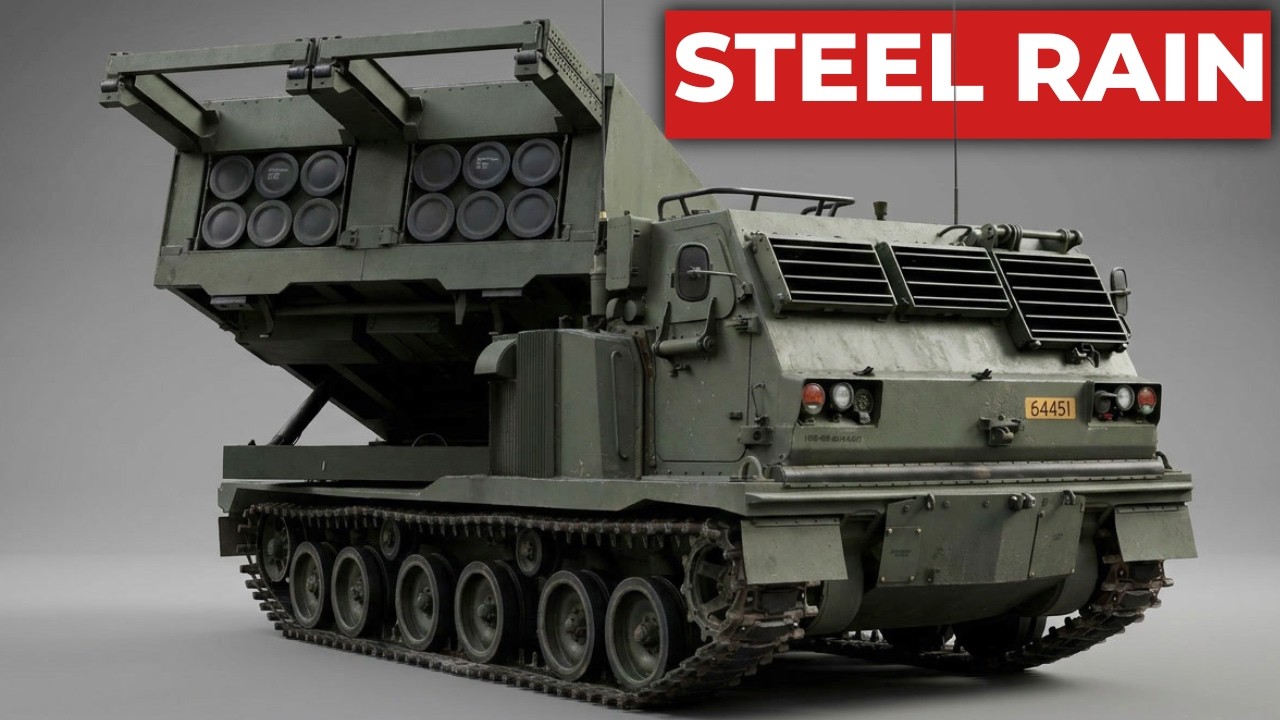
Britain then added an enhanced armor package specifically designed to protect the crew against improvised explosive devices, a direct and painful lesson from Iraq and Afghanistan, where dispersed launchers moving through hostile territory proved vulnerable to ambush. That armor upgrade is the B1 in the designation.
The M270’s combat debut came in the deserts of Kuwait and Iraq in January 1991. The United States deployed over 230 launchers. Britain sent 16 with the 1st Armoured Division. On the 18th of January, Battery A of the 6th Battalion, 27th Field Artillery, fired eight ATACMS missiles at Iraqi surface-to-air missile sites, the first shots of the ground campaign’s deep strike plan.
In one recorded engagement, three MLRS batteries fired 287 rockets at 24 separate targets in under 5 minutes. A cannon battalion would have needed over an hour to achieve the same effect. By the time the ground war launched on the 24th of February, Iraqi artillery crews had learned to stay in their bunkers the moment they heard the distinctive shriek of incoming rockets.
Surrendering prisoners raised their hands and begged their captors, “No more steel rain.” In Afghanistan, the weapon found a different role. In July 2007, 39 Regiment Royal Artillery fired the first British GMLRS rounds in combat from Helmand province. Precision strikes against Taliban fortifications at ranges that kept the launcher far beyond the reach of any insurgent weapon.
The 70-km sniper did not need to see its target. It just needed coordinates. Then came Ukraine. On the 6th of June 2022, British Defense Secretary Ben Wallace announced the donation of 3 M270 B1 launchers along with M31A1 guided rockets. By August, three more followed, six in total. Germany contributed its MARS 2 launchers.
France sent LRU systems. Combined with American HIMARS, these weapons gave Ukraine something it had never possessed, the ability to reach deep behind Russian lines and destroy the logistics chain that kept the invasion alive. The results were immediate and catastrophic for Russia. Within weeks, Ukrainian crews were methodically eliminating ammunition depots, fuel storage sites, command posts, and air defense batteries, each one worth millions of dollars, destroyed by a single rocket costing roughly 168,000.
Most famously, GMLRS strikes systematically hold the Antonivskyi Bridge across the Dnipro River, severing the supply line to Russian forces occupying Kherson and setting the conditions for the city’s liberation in November 2022. A Ukrainian rocket brigade commander who had previously operated the Soviet-era Smerch system told reporters the difference was like comparing a Zhiguli to a Lamborghini.
But the story does not end with triumph. From late 2023, Russian electronic warfare systems, units like the Pole-21 and R-330Z Zhitel, began aggressively jamming GPS signals across the front. GMLRS accuracy degraded. The related GPS guided Excalibur artillery shells saw its effectiveness reportedly collapse from 70% to just 6% within roughly 6 weeks.
According to testimony cited by the Hudson Institute’s Dr. Daniel Patt before the US House Armed Services Committee, drawing on research by RUSI’s Dr. Jack Watling, GMLRS retains an inertial backup that functions without GPS, but it is less precise. The 70 km sniper was still lethal, but it was no longer surgical.
Ukraine’s war had revealed the M270’s greatest modern vulnerability. Its precision depends on a satellite signal that an adaptive enemy can degrade. Against its rivals, the M270B1 holds a distinctive position. Russia’s BM-30 Smerch fires 12 300 mm rockets with warheads nearly three times heavier than GMLRS out to 90 km and can saturate 67 hectares in a single salvo, but it is unguided, unarmored, and takes 20 minutes to reload.
A lifetime on a modern battlefield where counter-battery radar can fix your position within seconds. China’s PHL-03 is essentially a reverse-engineered Smerch with longer range and BeiDou satellite navigation, but it has never been tested in combat and lacks the tracked armored mobility that lets the M270 keep pace with tank formations.
And then there is HIMARS, the M270’s own lighter sibling. Built on a wheeled 6×6 truck, HIMARS carries half the rockets, one pod of six versus the M270’s two pods of 12, but it is faster on roads, easier to maintain, and light enough to fit inside a C-130 transport aircraft. In Ukraine, HIMARS became the more famous system simply because there were more of them.
But the M270 carries double the firepower per vehicle, can launch two ATACMS simultaneously where HIMARS can only launch one, and its tracks allow it to operate in terrain where a wheeled vehicle would bog down. They are not competitors, they are complements. The heavy fist and the fast jab of the same doctrine. Britain is now rebuilding.
The fleet had shrunk through years of cuts and the donation of six launchers to Ukraine. Norway transferred three of its stored M270s as backfill with eight more pledged. The British Army’s current requirement stands at 76 launchers, all to be delivered by the end of 2029, upgraded to the latest M270A2 standard.
A 600 horsepower engine, new armored cab with energy absorbing seats, composite rubber tracks, and a common fire control system developed jointly with the United States, Italy, and Finland. The A2 will fire the extended range GMLRS out to 150 km and the precision strike missile beyond 500.
The first two British M270A2 launchers were received at Red River Army Depot in Texas on the 7th of October, 2025. The fleet is expected to serve until at least 2050. Somewhere in Eastern Ukraine tonight, under a canopy of cut branches and camouflage netting, an M270B1 with British markings painted over sits in a forest clearing with its engine idling.
The crew waits for a fire mission. When it comes, 12 rockets will leave those pods in under a minute and the launcher will vanish into the dark before the first one lands. It is the same drill that was rehearsed on the plains of West Germany in 1983 against an enemy that was supposed to come through the Fulda Gap.
That enemy never came, but the weapon built to stop them found its war anyway, 40 years late, 600 miles east, and still raining steel.