The ‘Obsolete’ Yugoslav Armored Vehicle That Fought Both Sides Of A Civil War After Its Nation Fell D
1991, the streets of Vukovar, eastern Croatia. A wheeled armored vehicle rolls through a ruined intersection. Four wheels, an open-topped turret, three cannon barrels pointing skyward at 83 degrees. It looks like an anti-aircraft gun bolted onto a truck chassis. It looks like something built to shoot down aircraft.
That is exactly what it was designed to do. It never shot down a single plane. What it did instead was something no weapons bureau had planned for and no doctrine manual had prepared for. It fought through the rubble of Vukovar. It fired into apartment blocks above Sarajevo. It was captured, repainted, and turned against the force that first deployed it.
It served in the armies of six successor states after the country that built it ceased to exist. And in the spring of 2024, more than four decades after its first prototype rolled out of a Slovenian factory, the last surviving examples were loaded onto flat cars and shipped east to fight a war in a country those Slovenian engineers had never imagined.
Its designation was the BOV 3. It was a weapon designed to protect a nation. The nation collapsed, the weapon kept going. To understand why the BOV 3 existed, you need to understand the problem Yugoslavia faced in the late 1970s. The Yugoslav People’s Army, known by its Serbo-Croatian initials as the JNA, answered to neither NATO nor the Warsaw Pact.
Marshal Josip Broz Tito had spent 30 years building an independent defense doctrine called Total National Defense, built on one absolute principle. Yugoslavia would arm itself, not from Moscow, not from Washington, from its own factories, with its own engineers, on its own terms. That independence had a price. Every vehicle, every gun, every armored car had to come from Yugoslav industry, or it did not come at all.
By 1978, the JNA’s wheeled vehicle fleet was aging rapidly. Soviet BTR-40s and BTR-152s, Romanian TAB-71s, a handful of older tracked vehicles. None of them were built for the narrow valley roads and steep mountain passes of the Yugoslav interior. None of them were domestically produced. The JNA needed a fast wheeled wholly Yugoslav platform that could carry troops, mount weapons, and cover ground quickly enough to matter.
The solution began at the Tovarna Avtomobilov Maribor factory in Slovenia in the summer of 1978. Engineers there took the standard JNA medium military truck, the TAM 110, and built a new armored family around its proven chassis and drive line. The Military Technical Institute in Belgrade provided the design authority. Three variants would emerge: an anti-tank missile carrier, an armored personnel carrier, and the one that concerns this story, the anti-aircraft gun vehicle.
The anti-aircraft variant mounted three Zastava M55 auto cannons in a single power operated open-topped turret. Each cannon fired 20 mm rounds. Each barrel cycled at roughly 750 rounds per minute. Three barrels firing together could produce close to 2,250 rounds per minute of combined fire. The turret elevated to 83° giving it the ability to engage low-flying aircraft, helicopters, and critically, targets on upper floors and rooftops that tank guns could not reach.
360° of traverse, 1,500 rounds carried in total, the vehicle weighed 9.1 tons. A Deutz six-cylinder air-cooled diesel producing 150 horsepower pushed it to 94 km/h on a sealed road. The hull armor was 8 mm of welded steel, enough to stop rifle bullets and shell fragments, not enough to stop much else. There was no radar, no night vision system, no nuclear, biological, and chemical protection.
The crew of four sat and stood in an open turret, fully exposed to everything above them. On paper, against the threat environment of the early 1980s, those limitations were acceptable. The BOV 3 was not built to absorb punishment. It was built to impose it from a distance, to discourage any enemy pilot from flying low enough to engage JNA columns on the move.
The gun was the deterrent, the vehicle was what moved it. Production began in earnest by 1987. Roughly 565 vehicles across the entire BOV family rolled out of Maribor before the factory went quiet in 1991. The country that ordered them had less than a year left to exist. Before we get into where the BOV-3 actually fought and who ended up fighting it, if you are finding this deep dive into Cold War armored vehicle history worthwhile, hit subscribe.
It takes 1 second, costs nothing, and helps the channel grow. June 25, 1991, Slovenia and Croatia declared independence on the same day. The JNA mobilized immediately. Armored columns rolled toward Ljubljana and toward the Croatian interior. BOV-3 vehicles moved with them as organic anti-aircraft protection for motorized brigades.
The 10-day war in Slovenia ended before a single BOV-3 turret tracked an enemy aircraft. There were no enemy aircraft to engage. Croatia was different, in scale, in duration, and in what the BOV-3 would be asked to do. Vukovar sits on the Danube in eastern Croatia. In the summer and autumn of 1991, it became the most fiercely contested urban ground in Europe since the Second World War.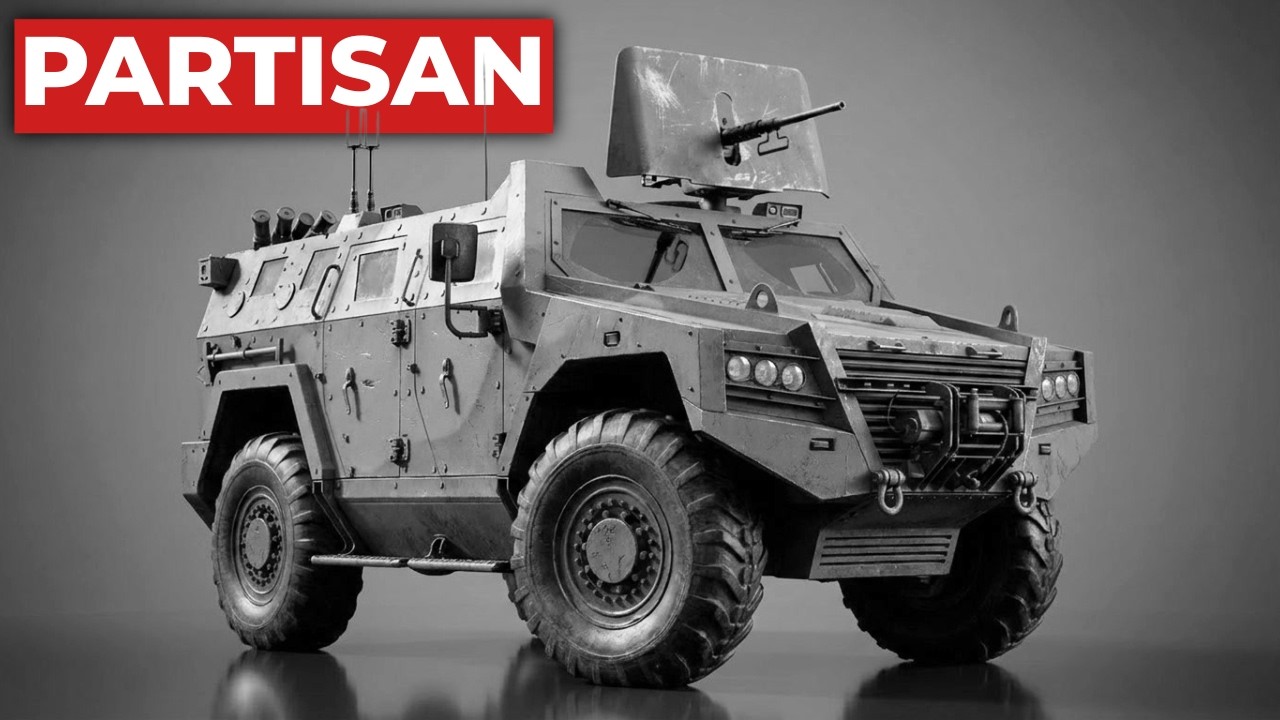
JNA armored columns pushed through its suburbs and into its center over 87 days. Croatian National Guard fighters and armed civilians held street by street, floor by floor. Snipers occupied attics. Machine gun nests held the upper stories of apartment blocks. Tank guns built for flat trajectory fire could not elevate high enough to engage them efficiently. The BOV-3 could.
Its 83-degree maximum elevation meant a crew could park in a rubble-strewn street and direct 320-mm cannons almost vertically into the top floors of a building. 120-mm round carries roughly 135 g of explosive. Three barrels firing simultaneously could strip a rooftop position in seconds.
The weapon that had entered the war as an anti-aircraft system became, in the ruins of Vukovar, a precision building clearance gun. It was not what the designers in Maribor had envisioned. It worked. Then, the country collapsed. And the BOV-3 became something else entirely. When the JNA formally withdrew from Bosnia and Herzegovina on May 12th, 1992, it left behind enormous quantities of equipment.
The Army of Republika Srpska inherited the bulk of it. The Army of the Republic of Bosnia and Herzegovina captured what it could from abandoned garrisons. Croatian Defense Council forces received transfers from Zagreb. All three forces ended up operating BOV-3 vehicles. The same gun, built in the same Slovenian factory, carried the markings of three belligerents simultaneously.
There were engagements in the hills above Sarajevo, where the distinctive silhouette of the triple-barreled turret appeared on both sides of the same ridgeline. The siege of Sarajevo lasted from April 5, 1992 to February 29, 1996. 1,425 days. Through that entire period, BOV-3 vehicles operated from positions above the city, elevated on the surrounding hills.
Their 20-mm rounds, originally rated to 2,000 m against low-flying aircraft, could reach targets across an urban valley at ranges their designers had never intended, with considerably more accuracy than anyone conducting a siege required. The weapon had traveled from anti-aircraft deterrent to urban clearance tool to siege gun in fewer than 18 months.
Bosnia settled into a frozen ceasefire after the Dayton Agreement of November 1995. The guns did not go away. Kosovo was next. In 1998 and 1999, Army of Yugoslavia and Serbian Ministry of Interior units deployed BOV-3 vehicles alongside T-55 tanks and M-80 infantry fighting vehicles against Kosovo Liberation Army fighters in the southern province.
The vehicle performed in exactly the same role it had occupied in Bosnia. Mobile direct fire support, high-angle engagement of fortified positions, convoy escort. Its 8-mm armor made it vulnerable to rocket-propelled grenades and heavy machine guns in open terrain, and accounts from the period indicate significant losses among BOV-3 crews.
Some sources have claimed that BOV-3 vehicles engaged and downed NATO aircraft during the 78-day NATO air campaign that began on March 24, 1999. That claim does not survive scrutiny. Both confirmed losses of manned NATO aircraft during that campaign the F-117A on March 27, 1999, and the F-16 on May 2, 1999 were attributed by United States Air Force historical records to surface-to-air missile engagements conducted by the 250th Air Defense Missile Brigade using S-125 missile systems.
A 20-mm cannon with no radar and an effective ceiling of 2,000 m against targets moving at combat altitude cannot be credited with those kills. The BOV-3’s ground war record across a decade of Balkan conflict was extraordinary. Its anti-aircraft record was not what the legend claims. The BOV-3 was not built in a vacuum.
In the same decade that Maribor was producing triple-20-mm gun vehicles for the JNA, other nations were pursuing the same requirement with very different answers. The American solution was the M163 VADS, a single 20-mm Vulcan rotary cannon mounted on an M113 tracked carrier. The rotary cannon could produce 3,000 rounds per minute from a single barrel and carried a ranging radar, impressive on paper.
But it demanded a tracked hull that consumed fuel at a rate incompatible with the JNA’s extensive road networks, and its single barrel produced far less suppressive area than three separate 20-mm cannons firing in parallel. In urban combat, spread of fire mattered more than cyclic rate.
The Soviet answer was the ZSU-23-4 Shilka, four 23-mm cannons, a fully enclosed armored turret, and an integrated radar capable of all-weather engagement at altitude. It weighed 19 tons. It cost several times what the BOV 3 cost. For a non-aligned country building its entire defense industry on a Balkan budget, the Shilka was simply unavailable.
The West German Gepard was the finest self-propelled anti-aircraft vehicle of its generation. Twin 35 mm Oerlikon cannons, dual independent radars, a Leopard 1 hull. It cost a sum that would have purchased an entire battalion of BOV 3s. The comparison reveals the BOV 3’s honest position. It was never the best. It was never supposed to be.
It was the weapon a resourceful independent country could build entirely for itself, with its own factories, its own steel, its own engineers. On that measure, it succeeded completely. That philosophy outlasted the country that produced it. When Slovenia donated its remaining BOV 3 vehicles to Ukraine in the spring of 2024, six vehicles with triple 20 mm turrets that had pointed at the skies above Vukovar in 1991 were pointing at Russian drones above Ukrainian in 2024.
The same open-topped crew position, the same 8 mm of welded steel between the gunner and whatever was incoming. Croatia still operates six BOV 3 vehicles in active service, demonstrating them at Exercise Shield 24 in Pula in June 2024, alongside United States, Polish, Slovenian, and French air defense units.
More than 30 years after the wars that destroyed the state that built them. 1991, a factory floor in Maribor, Slovenia. A wheeled armored vehicle with three 20 mm barrels elevated at the sky. It had no radar to find a modern jet. Its 8 mm of armor could not stop a heavy machine gun. It was designed for a threat environment that was already changing when it entered service.
Critics in the JNA’s own procurement bureaus questioned whether a gun vehicle with no fire control system and an open turret was worth building at all. And yet it worked in the rubble of Vukovar, in the siege lines above Sarajevo, in the valley roads of Kosovo. Under the skies of Ukraine four decades after its design was committed to paper in a country that no longer exists.
Six nations inherited it. Four fought with it in civil wars. One shipped it across a continent to a new war. Croatia put it in a NATO exercise in 2024. The engineers in Maribor did not design the BOV 3 for any of that. They designed it to protect a country. The country collapsed. The vehicle kept going.
That is not coincidence. That is engineering that outlived its nation.