The ‘Ordinary’ British Truck That Kept The Eighth Army Moving When Every Other Vehicle Failed D
1939, the Vauxhall Motors factory, Kimpton Road, Luton, Bedfordshire. A truck rolls off the production line. It has an open cab with no doors. A canvas apron serves in place of side panels. A flat timber cargo bed sits behind a bonnet wide enough to belong on a vehicle twice its size.
The driver sits fully exposed to wind, rain, and cold. There is no armor. There are no weapons. There is nothing to suggest this machine belongs on a battlefield at all. It looks exactly like a delivery lorry painted khaki. Nothing about it suggests the story that follows. It would be built 65,995 times at that single factory.
It would serve in France, in the Libyan desert, in East Africa, in Sicily, in Italy, in Normandy, at the Rhine, in Burma, and on the roads of the Soviet Union. It would keep armies moving through heat that cracked engine blocks and terrain that swallowed heavier machines whole. German mechanics would rebuild it from the wreckage of Dunkirk and send it east to fight on the Russian steppes using spare parts from their own trucks.
Because both vehicles shared the same corporate bloodline. And after the war, one example would carry the coffin of the founder of the Royal Air Force through the streets of London to Westminster Abbey. Its designation was the Bedford MW 15 hundredweight general service truck, and it was the most important vehicle the British Army ever issued that nobody has ever made a film about.
To understand why the Bedford MW existed, it is necessary to understand the problem Britain faced in the 1930s. The Army’s vehicle fleet was a logistical catastrophe waiting to happen. Worn-out survivors from the Great War sat alongside commandeered civilian lorries from nearly 30 different manufacturers.
Nothing was interchangeable. Nothing was purpose-designed for military service. Spare parts from one maker would not fit another. A single breakdown on a supply route could delay an entire column while mechanics searched for components that simply did not exist in the field. When the War Office began mechanizing the infantry in earnest after 1930, it needed one standard light truck, one engine family, one set of spare parts that every workshop in every theater could stock.
Something simple enough for a conscript mechanic to diagnose by torchlight, cheap enough to build in the tens of thousands, and robust enough to survive 6 years of continuous use on roads that were not roads at all. In 1933, the War Office issued a formal specification. The vehicle was to carry 760 kg of payload, fit within defined dimensional limits, clear off ground without four-wheel drive, and use a forward cab layout that let it carry a full rifle section.
Morris Commercial answered first, producing the CS8 in 1934. It was a serviceable vehicle. It was also powered by a 60 brake horsepower side-valve engine that strained under load, handled poorly when fitted with heavy signals bodies, and would be overtaken by events before the war was 2 years old.
Bedford Vehicles, a subsidiary of Vauxhall Motors in Luton, entered its own design in 1935. Vauxhall had been a General Motors subsidiary since 1925, and that American connection gave Bedford an industrial advantage no British competitor could match. The Luton plant covered 53 acres of factory floor, ran semi-flow production lines capable of turning out 150 chassis every single day, and drew on an engine design descended from the Chevrolet Stovebolt six-cylinder family, one of the most proven commercial petrol engines in the world at that time. Bedford failed the first round of War Office trials in Wales. The radiator overheated on long climbs. The tires were too narrow for soft ground. The ground clearance was insufficient. Bedford returned in 1936 with a larger radiator, wider tires, and raised suspension. By 1937, a dedicated prototype, the WD1, was performing strongly. The final 72 brake horsepower overhead valve engine was fitted in
1938. On the 2nd of May, 1939, the War Office accepted the Bedford MW for full production. By August, 2,000 units had been ordered. Within 6 years, more than 30 separate contracts would follow. The engine was the heart of everything. 72 brake horsepower from 3,519 cubic centimeters of displacement turning through a four-speed manual gearbox to the rear axle only.
No transfer case, no four-wheel drive. The vehicle could reach 53 mph ungoverned, though service examples were governed to 40 mph to reduce mechanical wear. Range on a full 91-liter fuel tank was approximately 430 km. Unladen weight was around 2,100 kg. The suspension was simple.
Live axles on semi-elliptical leaf springs front and rear, chosen for ease of field repair over any claim to comfort. Six variants left the Luton lines. The MWD was the standard cargo truck with a timber-paneled body and canvas tilt. The MWC was a water bowser carrying 910 liters in a fitted tank with suction hoses, filters, and field sterilizing equipment.
The MWR and MWV were signals and wireless variants with specialist fitted bodies for communications. There were gun portee variants mounting light anti-tank weapons. Each served a different function. All shared the same engine, the same gearbox, and the same basic chassis. One detail from the production history deserves particular attention.
The Bedford MW’s bonnet is noticeably wide, wider than the engine requires, wider than the firewall demands. The War Office specification had called for accommodation of a special oversized air filter to be fitted for desert service. That filter was never designed, never procured, never installed on a single production vehicle.
The wide bonnet remained throughout 6 years of war production, unchanged and unoccupied. Every Bedford MW ever built contained within its oversized bodywork a space designed for an object that did not exist. It is that kind of war. Now, before the Bedford MW goes to war, if this kind of deep dive into the machinery behind Britain’s campaigns is what brings you to this channel, hit subscribe. It costs nothing.
It takes 1 second, and it helps this channel keep going. September 1940. The beaches of Dunkirk are behind Britain now. In the chaos of the evacuation, the British Expeditionary Force had abandoned approximately 60,000 vehicles on French soil. Bedford MWs were among the heaviest losses. Retreating drivers had attempted sabotage, removing oil drain plugs and running engines until they seized.
The Germans, desperately short of transport for their overextended supply lines, assessed what could be salvaged. The answer surprised them. Vauxhall Motors and Adam Opel, the German arm of General Motors, were corporate siblings. The Bedford MW and the Opel Blitz shared engine design heritage traceable to the same American parent company.
Parts were interchangeable in ways that German mechanics had not expected. Captured Bedford MWs were shipped to specialist bodybuilders, fitted with standardized German military car bodies, and sent east during Operation Barbarossa. British trucks, rebuilt with German parts, driven by Wehrmacht drivers, rolling across Soviet roads toward Moscow.
That is the Bedford MW’s strangest combat record, and it was the enemy who wrote it. The main theater, however, was North Africa. By the summer of 1941, the Eighth Army in Libya depended on motor transport in a way no army in history ever had. The desert offered no railway lines, no navigable rivers, no supply depots carved into existing infrastructure.
Supply convoys were the Army’s bloodstream. Without them, the tanks stopped, the guns fell silent, and the men died of thirst before they were shot. The Bedford MW, in all its variants, was everywhere. A standard cruiser tank regiment’s war establishment included 18 15 hundredweight cargo trucks and four 15 hundredweight water bowsers.
The 22nd Armoured Brigade’s Royal Army Service Corps company, supporting the Seventh Armoured Division, drew Bedford MWs in Egypt in October 1941 ahead of Operation Crusader under the command of Major LS Bailey and workshop officer Captain JWA Wells. Each truck and its crew was responsible for a defined portion of the brigade’s supply chain.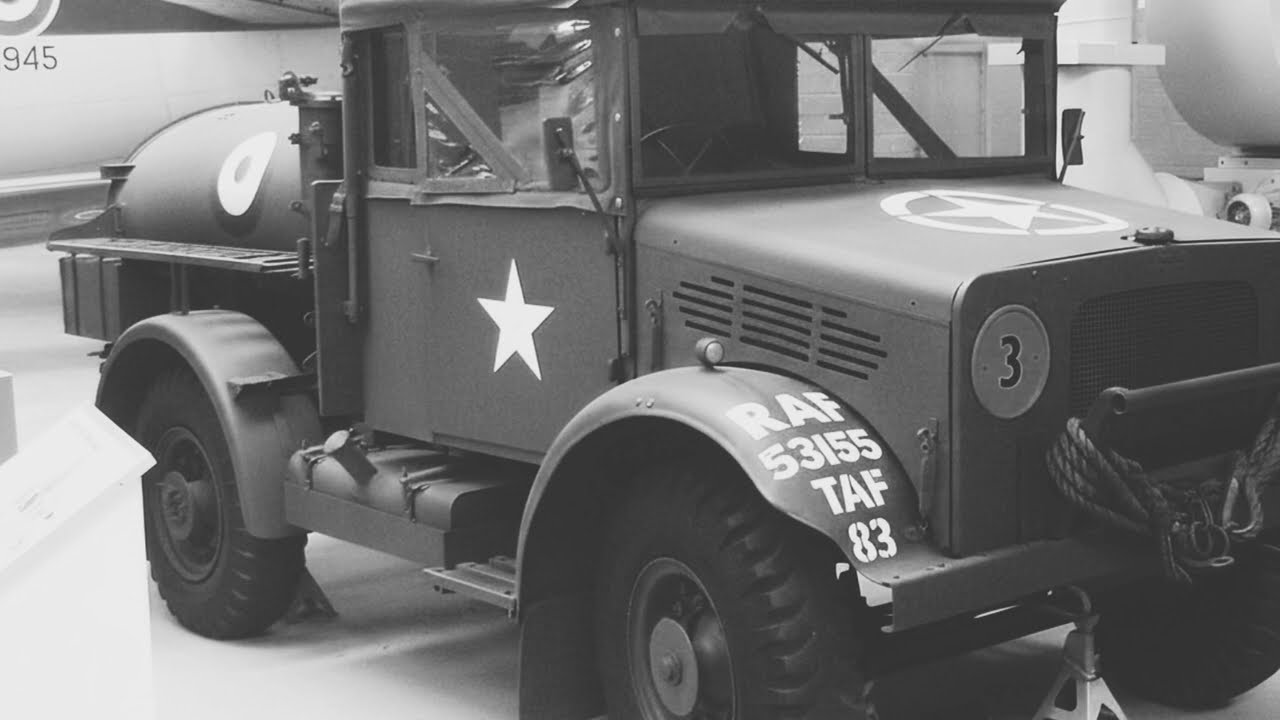
The margin for failure was zero. The MWC water bowser deserves its own moment. The Eighth Army required 350 tons of water every single day in heat exceeding 40° C with no shade and no natural water sources for hundreds of kilometers. That supply was not a logistical convenience. It was a survival equation written in liters.
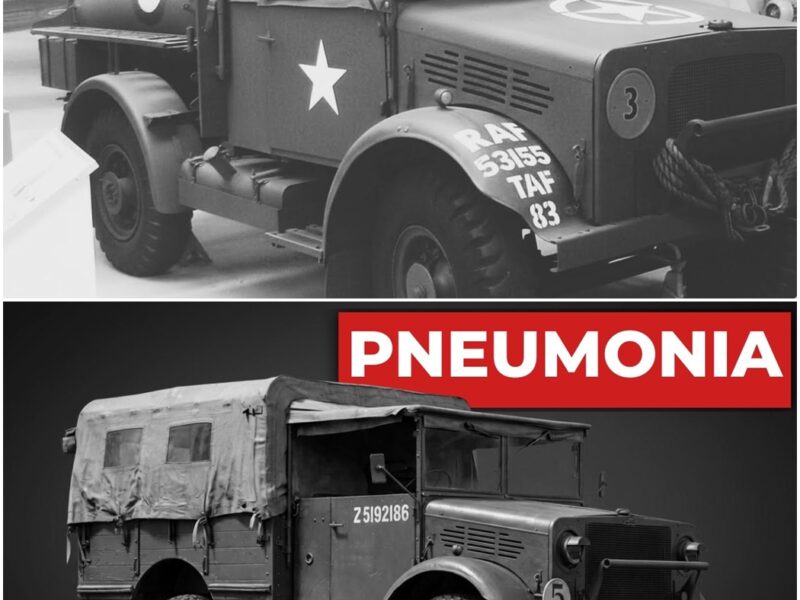
MWC crews operated under strict water rationing. Half a gallon per man per day for personal needs, half a gallon to the cookhouse, 1 gallon held in vehicle reserve. The driver of an MWC was not delivering a commodity. He was delivering the margin between a fighting force and a casualty list. The open cab, the so-called pneumonia wagon of British training camps, was not a hardship in the desert. It was a relief.
Crews drove with a windscreen folded flat, the canvas apron rolled back, the hot desert air moving through at 40 mph. Men who had cursed the design on Salisbury Plain thanked it at Tobruk. The same engineering decision that made the truck miserable in a Normandy winter made it tolerable in a Libyan summer. In February 1941, at the Battle of Beda Fomm, MWG portee variants mounting the 25 mm Hotchkiss anti-tank gun served with the 106th Royal Horse Artillery against the retreating Italian Tenth Army. The Italians lost more than 100 tanks and over 20,000 men taken prisoner. The portee trucks, stripped of armor and moving at speed across open ground, outmaneuvered heavier Italian armor by refusing to present a stationary target. The gun came with the truck. The truck came with the Army’s momentum. The Axis took what it could. A documented MWC water bowser, serial Z4176204, belonging to the Mobile Bath Unit of the
Second Support Group, was captured in Libya in February 1941, and later photographed towing a German anti-tank gun in service with a Fallschirmjäger unit. The enemy repaired it. The enemy used it. The same vehicle that had been delivering water to British soldiers was now supporting German operations in the same desert.
The Bedford MW served both sides of the same war without anyone at Luton ever intending it. After North Africa, the rest of the war. In Sicily from July 1943, MWs moved with the invasion force across stone roads and tracks in Italy through 1943 to 1945. Both open cab and later enclosed cab variants served in the grinding advance from the toe of the peninsula to the Alps.
In Normandy on the 12th of July 1944, late model MW D trucks with metal enclosed cabs and proper windscreens, produced from 1943 onwards to address the worst complaints of European theater crews, were photographed at 12th Corps forward water points in the bocage. In September 1944, Bedford MWs entered Valkenswaard with the Welsh Guards Armoured Division during Operation Market Garden.
In May 1945, one crossed into Copenhagen alongside the 179th Light Field Ambulance of the 11th Armoured Division on the day the war in Europe ended. In Burma, surplus vehicles from the Mediterranean were supplemented by fresh Luton production to support the 14th Army. Several thousand were delivered to the Soviet Union under Lend-Lease.
Final irony, British trucks with Chevrolet derived engines serving Soviet supply lines, while German rebuilt versions of the same vehicle served on the opposite side of the same front. On paper, the Bedford MW was never the strongest option available. The Fordson WOT2, produced in similar numbers, mounted an 85 brake horsepower Ford flathead V8, more powerful than the Bedford 72.
The Canadian Military Pattern trucks, the Chevrolet C15A and Ford F15A, arrived from 1941 onwards with genuine four-wheel drive capability the Bedford entirely lacked. Over 400,000 Canadian Military Pattern vehicles were built and where deep sand or jungle mud demanded cross-country traction, they did work the Bedford could not do.
The American Dodge 3/4 ton 4×4 was a more capable off-road vehicle in every measurable specification. None of them were built at Luton. None of them cost 268 pounds and 18 shillings and sixpence per unit. None of them could be produced at 150 chassis per day by a workforce that grew to over 12,000 people, more than a quarter of them women who had never worked in manufacturing before 1939.
The Bedford MW was not the best truck available. It was the truck that could be built in the numbers the army actually needed, maintained by the mechanics it actually had, and driven by the men it could actually train. The War Office eventually concluded that 15 hundredweight trucks represented poor value compared to three tonners, roughly the same production cost for half the payload, but that conclusion arrived too late to matter.
By then, 65,995 vehicles were already deployed. After the war, the truck stayed. The Bedford MW served in the British Army into the late 1950s, with some examples continuing in service east of Suez into the early 1960s. Denmark purchased vehicles in 1946 and 1947 and operated them until the late 1960s. A specific example, now held at the National Army Museum in London, manufactured around 1940, was still serving with the 72nd Independent Company of the Women’s Royal Army Corps Territorial Army as late as July 1961. Some entered civilian life, acquired by farmers, haulers, and country garages, fitted with commercial cabs, put to work moving timber and recovering breakdowns on rural roads. One found a ceremony, the MW C water bowser, now held at the Royal Air Force Museum Cosford, was modified for a single duty unlike any it had performed in wartime. On the 21st of February 1956,
it carried the coffin of Viscount Trenchard, founder of the Royal Air Force, through the streets of London to Westminster Abbey. A vehicle designed to supply drinking water to infantry in the Western Desert became the vehicle that bore Britain’s greatest air power commander to his burial. It was displayed at the Royal Air Force 50th Anniversary Review at Royal Air Force Abingdon in June 1968, then spent decades in storage before museum volunteers returned it to preservation.
The last significant public duty performed by a Bedford MW was a funeral. 1939, the Vauxhall Motors factory, Kimpton Road, Luton. A truck rolls off the line. It has no four-wheel drive. Its gearbox has no synchromesh and double declutching is required at every change. Its open cab offered no protection from rain, cold, or the desert sun.
Its oversized bonnet conceals nothing but empty air. It was rear-wheel drive only in a war fought partly across sand dunes and partly across the mud of northwest Europe. And yet it worked in the bocage of Normandy, in the dust of the Libyan Plateau, in the monsoon mud of Burma, in the rubble of Italian hill towns, on the grey roads leading into a defeated Germany.
It cost 268 pounds to build. It carried the water that kept men alive at El Alamein. It moved the signals equipment that coordinated the Normandy breakout. It was rebuilt by the enemy because even Germany could not justify scrapping something that functional. 65,995 were built, enough for every platoon, every battery, every supply company from the first day of the war to the last.
Generals plan battles, engineers build tanks, infantry take ground. Britain moved an army with a truck.