The ‘Pointless’ Canadian Tank That Never Fired Its Gun Yet Won Battles Across Europe D
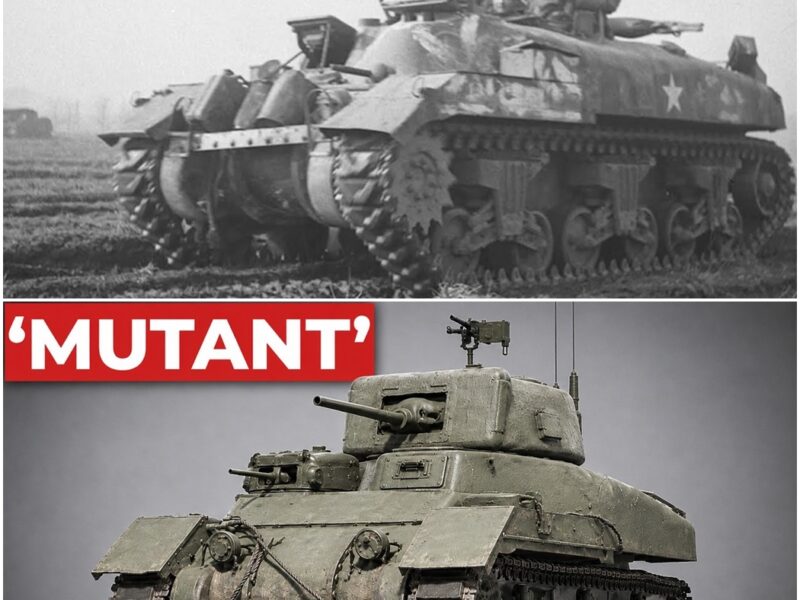
June 1941, Montreal Locomotive Works, Quebec. Canadian engineers unveil their country’s first homegrown tank. It has a cast hull, a fully traversing turret, and bolted to the left side of the glacis, a small rotating sub-turret housing a single machine gun. The thing looks like it grew an extra head.
Military observers from London stare at it and wonder what exactly Canada thinks it is doing. The tank is called the Ram. It will become the only Canadian-designed tank of the entire war. It will also never fire its main gun in combat, not once, not a single round. By the time it ships to England, the Sherman has made it obsolete.
Roughly 500 Rams will sit in British storage depots gathering rust, dismissed as monuments to wasted industry. The official Canadian military historian will compare them to the Ross rifle, the most notorious failed weapon in Canadian history. That is where this story should end. It does not. Because a Canadian general will strip the turrets off those pointless tanks, stuff 11 infantrymen inside each one, and send them crashing through German lines across Northwest Europe.
The vehicle that never fired its gun will slash infantry casualties by a factor of seven, and father every armored personnel carrier built since. To understand why Canada built the Ram, you need to understand the crisis of 1940. After Dunkirk, Britain lost most of its tank fleet and could not supply the Dominions.
American production was pre-committed to Lend-Lease. Canada’s armored core needed roughly 1,200 cruiser tanks, and no one was going to give them any. They would have to be built at home. The Canadian Joint Committee on Tank Development met in September 1940, and ruled out British designs as too slow to get into production. That left an American basis.
The available M3 Lee medium was rejected for good reason. It was too tall. Its hull was riveted. Its Its 75-mm gun sat in a sponson with limited traverse, and its armor was inadequate. The compromise reached in early 1941 was elegant. Keep the M3’s lower hull and running gear, but design an entirely new cast upper hull with a full traverse turret.
Montreal Locomotive Works, already experienced in heavy steel castings, got the contract. A federally funded plant at Longue Pointe, Quebec was built around it. The key figures were L. E. Carr of the British Tank Mission, who designed the new hull and turret. C. D. Howe, Minister of Munitions and Supply, who championed the program politically, and Major-General Frederick Worthington, founder of the Canadian Armoured Corps, whose family crest gave the tank its name.
Worthington argued for a turret ring large enough to accept the American 75-mm gun. He was overruled. That decision doomed the Ram as a fighting tank. Only 50 Mark I Rams were built, armed with the Ordnance QF 2-pounder as an interim weapon because Canadian 6-pounder mounts were not yet available. Production switched to the Mark II in February 1942, mounting the Ordnance QF 6-pounder.
The Mark II weighed 29 long tons, carried a crew of five, and was powered by a Continental R-975 radial engine producing 400 horsepower. Armor ranged from 25-mm at the rear to 87-mm on the turret and glacis. Road speed was 25 mph. The Mark I’s most distinctive feature was its auxiliary machine gun sub-turret.
A small cast housing bolted to the left front of the hull, operated by the co-driver, it held a .30 caliber Browning with roughly 120° of left traverse. The idea descended from British infantry tank doctrine, where dedicated hull guns were supposed to provide close-in suppression. In practice, the sub-turret weakened the cast hull, complicated production, added negligible tactical value over a simpler ball mount, and was obsolete by 1942.
On late Mark II production, it was deleted and replaced by a standard bow-mounted Browning. The fatal blow came in March, 1942. The Combined Chiefs agreed to standardize all British and Canadian medium tank production on the M4 Sherman. The Sherman’s 75 mm gun fired a serviceable high explosive round, critical for infantry support.
The Ram’s 6-pounder was an armor-piercing weapon with weak high explosive performance. The Sherman also had upgrade headroom the Ram lacked. Its turret ring could accept the 76 mm gun, the 17-pounder in the Firefly variant, even a 105 mm howitzer, the Rams could not. Production continued until July 1943 because idling Montreal Locomotive Works was politically unacceptable while Sherman lines were not yet at full output.
According to Canadian production records, the final tally was 50 Mark ones, 1,899 Mark twos, and 84 observation post variants. 2,032 hulls total. None would see combat as gun tanks. The transformation began in late July 1944. Lieutenant-General Guy Simonds, commanding the Second Canadian Corps, was planning Operation Totalize, a breakthrough toward Falaise across open ground swept by German anti-tank guns and mortars south of Caen.
Infantry marching beside tanks were being cut to pieces. Simonds needed to get his men onto objectives alive and he needed to do it inside armored vehicles. In his covering letter to divisional commanders on August 2nd, 1944, he wrote what became the founding document of armored personnel carrier doctrine.
He ordered that infantry accompanying armor must go straight through in bullet and splinter-proof vehicles to their actual objectives. The first vehicles chosen were 76 surplus M7 Priest self-propelled guns whose guns had been removed. The conversion was assigned to Major George Wiggam with an impossible deadline.
About 250 men from 8 RCEME and five British REME units worked shifts from 4:00 in the morning to 11:00 at night in fields near Bayeux. Guns and ammunition bins were ripped out, gaps welded over, bench seating fitted. According to the RCEME Museum at Kingston, armor plate ran short almost immediately.
Captain Burt Hargrave improvised by sandwiching two half-inch mild steel plates with sand between them. A solution later confirmed in veteran correspondence. 72 vehicles were finished in 3 and 1/2 days. Major Wigan received an MBE. The vehicles were code-named Kangaroo. Now, before we see how these combat, if you are enjoying this deep dive into Commonwealth engineering, hit subscribe.
It takes a second, costs nothing, and helps the channel grow. Right. Let us get into the combat record. At 2300 hours on August 7th, 1944, over 1,000 RAF bombers dropped 3,462 tons of explosives south of Caen. Six columns, four vehicles wide, rolled down the Caen-Falaise road under artificial moonlight.
Searchlight beams bounced off cloud. The 36 Priest Kangaroos allocated to the 4th Canadian Infantry Brigade carried the Royal Regiment of Canada, the Royal Hamilton Light Infantry, and the Essex Scottish. Parallel battalions attacked on foot. The casualty contrast on August 8th is the most powerful number in the Kangaroo story. The carried battalions and the marching battalions fought the same battle on the same day against the same enemy.
The three battalions riding in Kangaroos suffered a combined seven killed and 56 wounded. The four battalions advancing on foot suffered 68 killed and 192 wounded. That is a roughly sevenfold reduction in killed in action for the carried troops. According to after-action reports from the 2nd Canadian Corps, 61 of the 76 Priest Kangaroos were still battle-worthy at the end of the 6-day operation.
Most losses were mechanical, not enemy action. The Priests were borrowed American property, mechanically tired and tall-silhouetted. A better donor was sitting across the channel. Roughly 500 surplus Ram tanks occupied British depots. Conversion was simpler and yielded a superior vehicle. The turret and basket were lifted off, dropping the silhouette by 3 ft.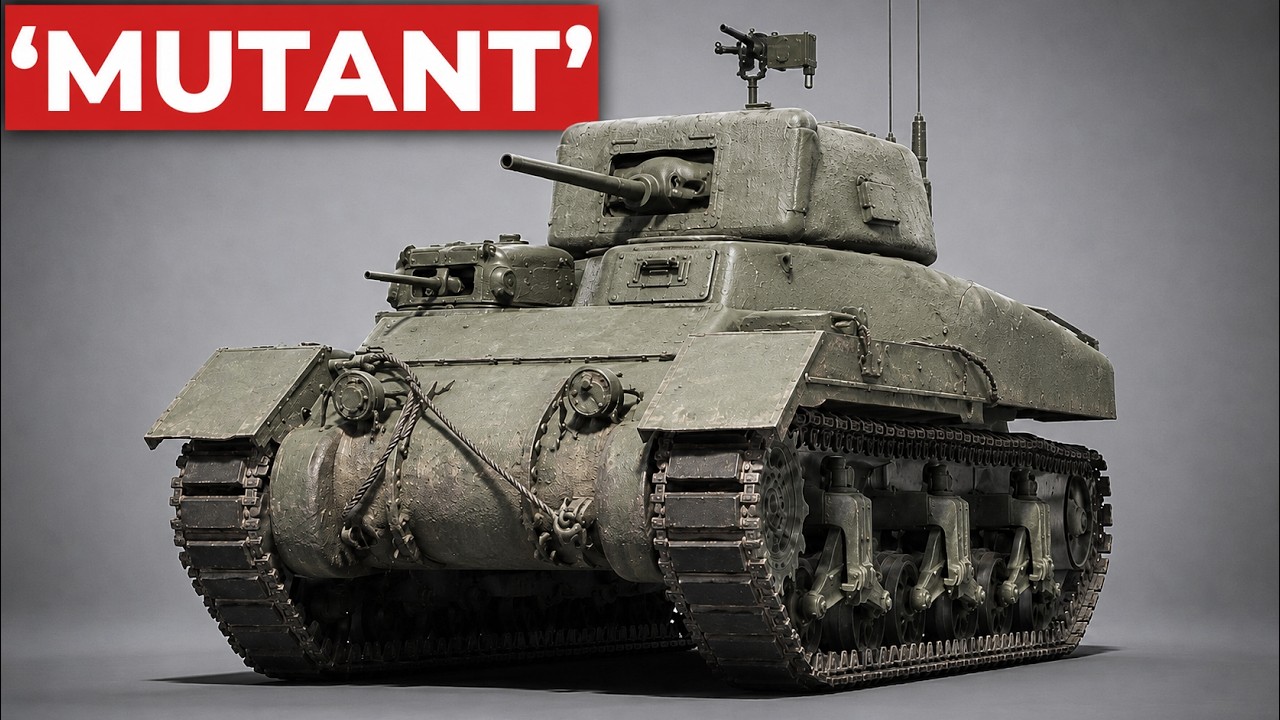
The hull machine gun was retained and a second Browning mounted on the turret ring. Each Ram Kangaroo could carry two crew and 11 infantry. On October 24th, 1944 at Tilburg in the Netherlands, the 1st Canadian Armoured Personnel Carrier Squadron was expanded into the 1st Canadian Armoured Carrier Regiment under Lieutenant Colonel Churchill.
A British twin, the 49th Armoured Personnel Carrier Regiment joined alongside. Both came under Major General Percy Hobart’s 79th Armoured Division, the famous Hobart’s Funnies. The cap badge was an erect kangaroo over the Latin motto “Armatos Fundit”, meaning it pours forth armed men, a reference Churchill drew from book two of the Aeneid and the Trojan Horse.
The regiment’s combat record stretched across every major Commonwealth operation from Le Havre to Oldenburg. At Le Havre in September 1944, the regimental history records only one infantry casualty among troops carried. At Bologna, the casualty figure for infantry inside the Kangaroos was zero. The story goes that during the Calais operation, a Canadian Kangaroo driver rammed and captured a German Tiger tank and earned a military medal.
That account appears in several unit histories, though it has never been confirmed by official records. Operation in January 1945 made the regiment the 1st Canadian unit entirely on German soil. Operations Veritable and Blockbuster pushed them through the Siegfried Line, across the Reichswald, through Moyland Wood and the Hochwald Gap.
On March 26th, 1945, the regiment became the 1st Canadian Armoured unit across the Rhine. The Ram Kangaroo’s superiority over contemporary infantry carriers was built on protection. The German Sd.Kfz. 251 halftrack carried eight men behind 6 to 14.5 mm of open-topped armor. The American M3 halftrack offered 6 to 12 mm, also open-topped.
The Ram Kangaroo wrapped 25 to 87 mm of steel around all sides. Its glacis was six to eight times thicker than either halftrack. It was fully tracked and could follow Shermans and Churchills through any ground they could cross. Unlike halftracks whose unpowered front axles bogged in mud, the regiment’s last lift was at 700 hours on May 5th, 1945, northeast of Oldenburg.
According to the regimental war diary, it ended with the complete surrender of an Austrian infantry battalion without a shot fired. The 1st Canadian Armored Carrier Regiment was disbanded on June 20th, 1945, at Penheim, Germany. It remains the only Canadian regiment both raised and disbanded on foreign soil. Over 9 months, it carried infantry from 20 Canadian and 38 British regiments at a cost to itself of 18 killed and 71 wounded.
The Kangaroo did not end with the war. The Canadian Encyclopedia draws the direct line from Simon’s as field conversion to every tracked APC that followed. The canceled Canadian Bobcat program of the 1950s was explicitly designed to replace the Ram Kangaroo. The American M113 entered service in 1960. The British FV432 followed in 1963.
Both institutionalized what the Kangaroo had improvised in a field nearby you. The purest modern descendants are the Israeli heavy APCs, vehicles that take the Kangaroo philosophy of tank grade armor around an infantry compartment to its logical conclusion. The Namer, built on the Merkava 4 chassis, weighs 66 tons.
It is the most heavily protected personnel carrier ever constructed. The Ram Kangaroo’s central insight, that the safest way to move infantry into an assault is in a turretless tank, is now mainstream doctrine worldwide. Picture it again. June 1941, Montreal. A strange tank with an extra turret growing out of of hull, built by locomotive engineers who had never made a weapon before.
It looked wrong. It was outgunned before it could fight. It never fired a round. And stripped of everything that was supposed to make it a tank, it became one of the most consequential armored vehicles of the 20th century. Not because of what it was designed to do, but because Commonwealth engineers gave it a welding torch, 3 and 1/2 days, and a completely different job.
Lieutenant Colonel Churchill’s farewell address to his regiment at Pennheim captured it cleanly. They had been instrumental in saving the lives of countless soldiers who, without the kangaroos, would have had to advance on foot, unprotected from enemy fire. The pointless tank carried an army. British and Commonwealth engineering was not luck.
It was innovation under pressure, producing solutions that worked when nothing else could.