The ‘Rejected’ American Armoured Car That Only The British Actually Wanted — And They Were Right D
Late 1942, the Pentagon, Washington. A board of senior American officers has just killed one of the most advanced armored cars ever built. Brigadier General Palmer’s special armored vehicle board has ruled that no armored car should weigh more than seven short tons. The vehicle in question weighs 15.
Twin engines, automatic transmissions, power steering, a gyro-stabilized gun. The board’s verdict is blunt. They call it a tank on wheels, and they do not consider it justified by any military necessity. Production is to be canceled immediately. Every vehicle already rolling off Chevrolet’s assembly line is to be scrapped or abandoned.
The T17E1 Staghound is dead. Except it is not, because 3,000 mi away, the British Army has other ideas. The problem facing British armored car regiments in 1942 was simple and lethal. They needed a vehicle that could fight for information, not sneak, not run, fight. In the Western Desert, reconnaissance meant driving directly into the enemy, engaging his screen, and forcing him to reveal his strength.
That required armor thick enough to survive return fire, and a gun capable of hitting back. The Daimler armored car, Britain’s best indigenous design, weighed just 7 and 1/2 tons. It carried 16 mm of armor at most. One burst from a German 20-mm autocannon could punch through it at 500 m. The Humber was even more vulnerable.
Against the Afrika Korps, British armored car crews were paying for information with their lives. What Britain needed was something heavier, something with real protection, something with the range to operate across vast desert distances without constant resupply. But British factories were already stretched beyond capacity.
Every production line was committed. There was no spare industrial capacity to design and build a new heavy armored car from scratch. The solution would have to come from America. In July 1941, 5 months before Pearl Harbor, the United States Army Ordnance Department issued specifications for a medium armored car.
The British Purchasing Commission in New York, which had been quietly funneling American equipment to Britain since 1940, saw an opportunity. Their liaison officers embedded directly with the Chevrolet design team, led by a brilliant young engineer named Earl S. MacPherson. MacPherson would later become famous for inventing the MacPherson strut suspension found in most modern cars, but in 1941, his job was building an armored car that could survive a desert war.
The British shaped the design from the inside. They insisted on at least two crew members in the turret, reflecting hard lessons from combat, where single turret vehicles left commanders overwhelmed. They demanded the radio be placed near the commander, not buried in the hull. They specified a full turret basket, allowing the crew to rotate with the gun.
These were not minor requests. They fundamentally altered the vehicle’s architecture. What MacPherson delivered was astonishing for 1942. Two rear-mounted GMC model 270 inline six engines, each producing 97 horsepower, feeding through separate hydromatic automatic transmissions into a single transfer case driving all four wheels.
The other engine could be shut down and disconnected while the vehicle was still moving. If one engine took a hit, the crew could keep driving on the other. Power steering was electrically driven hydraulic, switchable from the driver’s panel. The turret mounted a 37-mm M6 gun with a gyroscopic stabilizer, a coaxial 30-caliber Browning, and a 2-in smoke mortar.
Hull armor was welded steel up to 22 mm on the front. The cast turret front reached 44 and 1/2 mm at 45°. Floor armor was 13 mm, enough to resist mine blast. Total weight came in at just under 14 tons, crew of five, top speed of 89 km/h, and with external jettison fuel tanks, a range of 724 km. According to Ordnance Department records, the first pilot vehicle reached Aberdeen Proving Ground in March 1942.
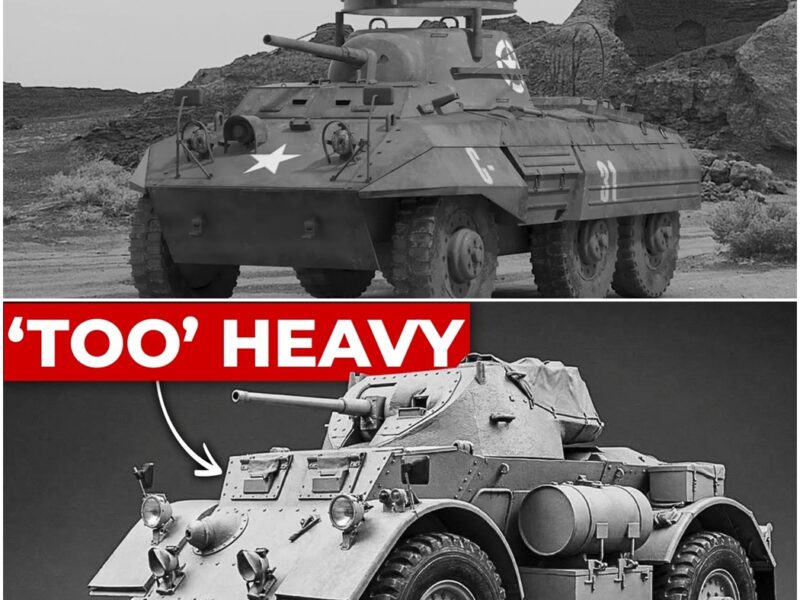
Testing revealed correctable flaws in the steering and cooling systems, but the basic design was sound. By mid-1942, approximately 3,500 were on order. Then came the Palmer Board’s rejection in December. The Americans wanted light, cheap, expendable scouts. They chose the M8 Greyhound instead. Half the weight, open-topped turret, 6 and 1/2 mm of floor armor, so thin that crews stacked sandbags inside to survive mines.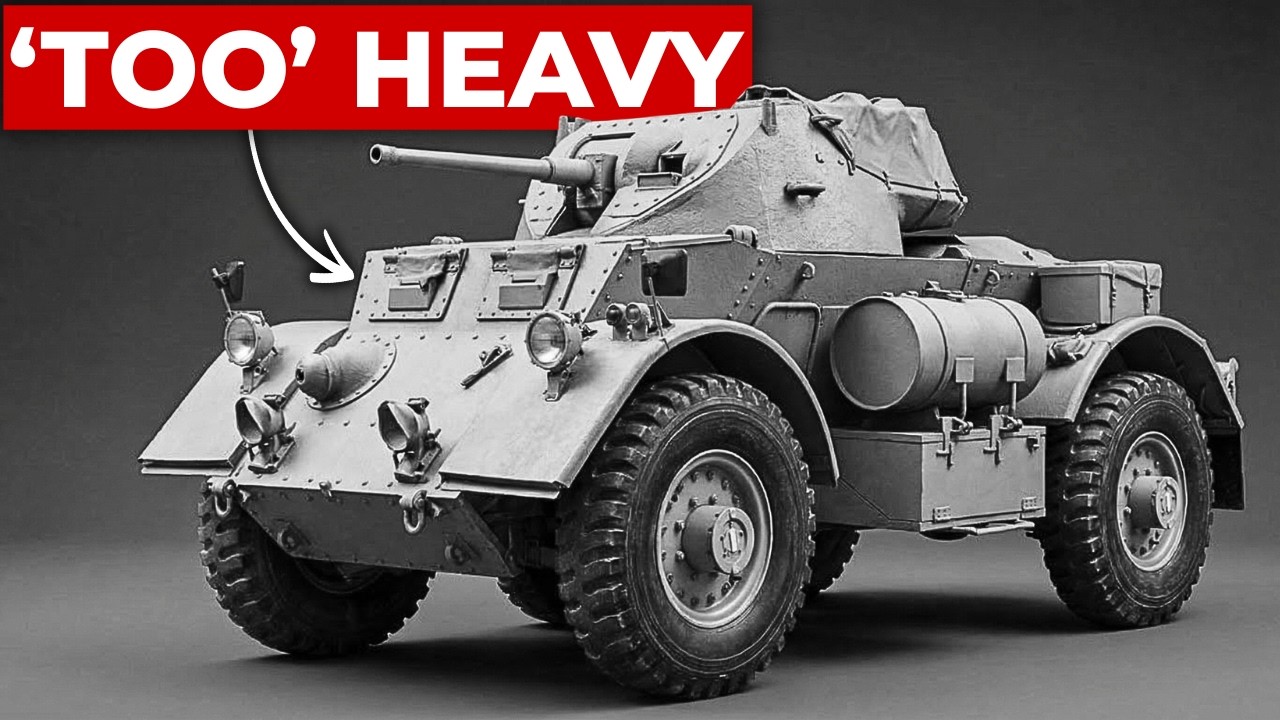
The M8 was exactly what American doctrine demanded, and it was the wrong vehicle for British doctrine. The British Army staff in Washington intervened directly, requesting the entire Staghound production run be diverted to Commonwealth forces under Lend-Lease. This single decision saved the program.
Between October 1942 and December 1943, Chevrolet built approximately 3,844 Staghounds. Not one entered American service. Now, before we get into how this rejected American vehicle actually performed in British hands, if you are enjoying this deep dive into a weapon nobody was supposed to want, hit subscribe. It takes a second and helps the channel grow. Right. Back to the combat record.
The Staghound arrived too late for North Africa. That campaign ended in May 1943, and units did not begin receiving Staghounds until the summer. Italy became the combat debut. According to Imperial War Museum records, South African units were the first to use Staghounds in combat in Italy in late 1943.
The New Zealand Divisional Cavalry Regiment received theirs at Maadi Camp in Egypt in August 1943, and deployed to the Italian front in September. They fought at the Moro River in December, then through the grinding battles around Monte Cassino in early 1944. Italy was unkind to the Staghound. Narrow mountain roads and thick mud exposed its greatest weakness, sheer physical size.
A vehicle designed for open desert was now squeezing through medieval Italian villages. The New Zealanders ultimately reorganized as infantry in October 1944 because armored cars of any type proved unsuitable for the terrain. Their last mounted attack came on 21 October 1944 at San Giorgio di Cesena, but Northwest Europe was a different story entirely.
After the Normandy landings, British and Canadian armored car regiments deployed Staghounds alongside Daimlers. The standard war establishment allocated 14 Staghounds at regimental headquarters level with five Staghound AA cars per regiment while the fighting squadrons used 45 Daimlers. They were complementary.
Daimlers scouted, Staghounds provided the firepower and protection behind them. The 12th Manitoba Dragoons, a Canadian regiment equipped entirely with 72 Staghounds, landed at Juno Beach in July 1944. Initially frustrated by the static hedgerow fighting around Caen, they came alive during the August breakout. Their vehicles were photographed passing a destroyed Tiger 2 near Vimoutiers on 22 August and crossing the Seine at Elbeuf on 28 August.
The 2nd Household Cavalry Regiment provided one of the war’s iconic liberation moments when their commanding officer entered Brussels in his Staghound on 4 September 1944 surrounded by ecstatic crowds. Crew opinion followed a consistent pattern. According to ww2db, crews initially considered the Staghound too large and lacking the maneuverability of the smaller Daimler, but once they saw combat, they rapidly appreciated its speed and surprising nimbleness.
The Manitoba Dragoons war diary noted that the German army had already developed a healthy respect for the Staghound and its speed, size, and firepower. Crews found the automatic transmissions and power steering made the vehicle easy to drive, though British drivers accustomed to manual gearboxes were initially bewildered by the lack of a clutch pedal.
The weight penalty was real though. During the advance through Hochwald Forest in March 1945, Manitoba Dragoons Staghounds became so hopelessly bogged in mud that horses had to be requisitioned from a nearby German village to haul two 14-ton vehicles free. That image captures the trade-off perfectly.
Protection cost weight, and weight cost mobility in soft ground. The British also proved far more creative with the Staghound than Chevrolet ever intended. Field workshops produced the Staghound Mark II, replacing the 37-mm gun with a 3-in howitzer for close support. More dramatically, the Mark III fitted an entire Crusader tank turret, carrying either a 6-pounder or a 75-mm gun with a BSA coaxial machine gun.
An estimated 300 were converted this way. The Canadians even experimented with the Tulip variant, mounting four 60-lb RP-3 aircraft rockets on launch rails attached to the turret. Testing began in November 1944. Accuracy was poor, rockets sometimes failed to detonate, and blast damage to the vehicle’s own hull ended the project by February 1945.
Against its direct competitors, the Staghound’s strengths were clear. The Daimler offered better agility and a 2-pounder gun with slightly superior armor penetration, but just 16 mm of protection and 330 km of range. The M8 Greyhound carried the identical 37-mm gun in an open-topped turret with 19 mm of armor and that dangerously thin floor.
The German Puma, arguably the finest armored car of the war, mounted a 50-mm long-barreled gun that could destroy a Staghound from any angle, but only 101 Pumas were ever built. You cannot win a war with 101 vehicles, no matter how good they are. Nearly 4,000 Staghounds could be in a lot of places at once.
Numbers are their own form of superiority. The Staghound’s post-war career proved its worth more conclusively than any wartime assessment. Israel acquired 112 for the 1948 war. Australia used them until 1970. Italy’s Carabinieri operated them into the 1970s. Denmark fielded Mark III variants with 75-mm guns.
Lebanon kept 56 Staghounds in service from 1949 through the civil war with various militia factions still operating them as late as 1983, roughly 40 years after they rolled off Chevrolet’s production line. 15 nations across four continents adopted a vehicle that the United States Army did not consider justified by any military necessity.
The Staghound that Brigadier General Palmer dismissed as a tank on wheels in December 1942 went on to serve in more countries across more decades and in more conflicts than the M8 Greyhound America chose instead. Macpherson’s twin-engine creation outlasted not just its critics, but most of the armies that fielded it. 44.
5 mm of turret armor kept crews alive. 724 km of range kept them moving. Automatic transmissions and power steering kept them fighting when fatigue should have stopped them. Britain looked at a vehicle America had thrown away, saw exactly what it needed, and was proved right by 40 years of unbroken service.
The numbers proved it. The combat record confirmed it, and the 15 nations that adopted it after the war settled the argument permanently. British judgment turned an American reject into one of the most successful armored cars ever fielded.