The ‘Ridiculous’ British Armoured Car That Carried A Tank Gun On Six Wheels And Never Lost D
1958, the Alvis factory, Holyhead Road, Coventry. A vehicle rolls out of the production bay into the grey English morning. Six massive wheels, a full rotating turret, a long low cannon barrel pointing forward. The kind of gun you expect to find bolted to a tank, not perched on something with tires.
Men in overalls step back to look at it. Some of them say nothing for a long moment. It looked wrong. It looked absurd. It looked like an engineer had lost an argument with a committee and built the compromise anyway. It weighed nearly 12 tons. It sat on six wheels instead of tracks.
Its gun was 76 mm wide, the same caliber found on contemporary light tanks, and it was operated by just three men. A crew so small that the commander also had to load his own weapon in combat. Everything about it suggested something that would not work. It worked. It worked for over 40 years and across four continents.
It served in 26 nations, fought in over a dozen conflicts from the streets of Aden to the jungles of Borneo to the mountains of Dhofar to the border roads of Northern Ireland. It was sold to enemies Britain would later face in battle, and it outlasted the vehicles that were supposed to replace it. Some of the nations that bought it still have it on military strength today.
Its designation was FV601, and its name was the Alvis Saladin. It was the last great armored car Britain ever built. To understand why the Saladin existed, you need to understand the problem Britain faced in 1946. The war had ended, but the empire had not. From Malaya to Palestine to Kenya to Cyprus, British troops were patrolling enormous territories with vehicles designed for a different kind of conflict entirely.
The wartime Daimler and AEC armored cars that had served in the Western Desert were aging, lightly armed, and poorly suited to the low-intensity colonial emergencies that were already beginning to ignite. The British Army issued a formal requirement in January of that year. The new vehicle had to defeat 7.62 mm armor-piercing rounds from all angles.
It had to survive the blast of a 9-kg mine under any wheel, and it had to achieve full speed in reverse every gear, every ratio, identical performance retreating as advancing. That final requirement was not symbolic. Reconnaissance vehicles found the enemy by driving toward it and then had to disengage fast.
The Fighting Vehicles Design Department at Chertsey began work. Alvis Limited of Coventry won the contract for two prototypes in 1947. The original design called for a four-man crew and a two-pounder gun. Then the War Office changed its mind. The two-pounder was inadequate for the modern battlefield.
A new 76-mm gun would be commissioned from the Armament Establishment at Fort Halstead. That gun would not be ready until 1953. The five-year wait forced a complete redesign of the turret. The crew shrank from four to three. The whole program slowed to a crawl. Then the Malayan Emergency erupted in 1948, and Alvis was directed to prioritize production of the Saracen, an armored personnel carrier that shared the same chassis.
The younger vehicle entered service in 1953, six years before its elder ever reached troops. A handful of pre-production Saladins were subcontracted to Crossley Motors in Stockport 1955, a firm with historic armored car expertise, but a future measured in months. Crossley closed in 1958.
A final armor upgrade was ordered at the last moment. The definitive production Saladin, the FV601 Charlie, finally entered British Army service in 1959, 13 years after the requirement was issued. The vehicle itself was a masterpiece of practical engineering, if you understood what it was actually built for. The Rolls-Royce B80 engine sat in the rear, an eight-cylinder water-cooled petrol unit producing 170 brake horsepower.
It drove all six wheels through a Daimler pre-selective gearbox, offering five forward and five reverse gears. Every single ratio was available in both directions. On a flat road, the Saladin could reach 72 km/h forward. It could do exactly the same in reverse. The four leading wheels all steered, assisted by hydraulic power, giving the vehicle a turning circle that surprised soldiers who had never driven anything like it.
Each wheel rode on independent suspension using torsion bars and telescopic dampers, which meant a blown tire or even a mine under one wheel station did not necessarily immobilize the vehicle. Cross-country speed was 48 km/h. Road range was 400 km on a single 240-L tank. The turret carried the QF 76-mm L5A1 gun.
This was a low-pressure rifled weapon with a sliding breech block and semi-automatic operation. It could depress 10° below the horizontal and elevate 20° above it, turning fully 360° by hand. The crew carried 42 rounds vertically stowed throughout the hull. Those rounds came in several types. The HESH round, high explosive squash head, could defeat 80 mm of rolled steel at combat ranges, adequate against the light armored vehicles Britain expected to encounter in colonial theaters.
The HE round produced over 800 fragments with a lethal radius of 6 and 1/2 m. The canister round, a thin-walled casing packed with steel shot, turned the main gun into a giant shotgun effective to 100 m, devastating against men in the open. The vehicle also carried approximately 3,000 rounds of 7.
62 mm ammunition for the two Browning machine guns, one mounted beside the main gun, one on the commander’s hatch for anti-aircraft use. 12 smoke grenade dischargers, six on each side of the turret, could be fired electrically from inside. The armor was 32 mm at the turret front, enough to stop rifle fire and shell fragments, not enough to stop a bazooka, a recoilless rifle, or a rocket-propelled grenade.
The designers knew this. The Saladin was not built to stand and fight tanks. It was built to find the enemy, fire with overwhelming local effect, and then leave at 45 mph in the direction it came from. Now, before we get into where the Saladin actually fought, if you are finding value in this kind of detailed breakdown of Cold War British engineering, hit subscribe.
It costs nothing, takes 1 second, and it helps the channel grow. The Saladin’s first serious combat theater was Aden in the years 1963 to 1967. The emergency began with a grenade attack on the High Commissioner on the 14th of December, 1963, and escalated into one of the most complex urban counterinsurgency campaigns Britain ever fought.
The 1st Queen’s Dragoon Guards provided the most extensively documented Saladin service with three squadrons rotating through the city in the final two years of the campaign. During a single five-day period in April 1967, crews were involved in over 90 separate incidents, firing 6,000 rounds of Browning ammunition and hundreds of rounds of other small arms in close-quarter street fighting.
On the 4th of April, Lieutenant Holmes’s Saladin was destroyed by a mine in Sheikh Othman while supporting infantry rescuing a besieged police station. The driver and gunner survived. The V-shaped lower hull had absorbed most of the blast. Corporal Bybee and Trooper Fordham were shaken. They were not dead, but the most revealing moment in Aden came not from a vehicle destroyed, but from a gun kept silent.
On the 20th of June, 1967, the South Arabian police mutinied following the Six-Day War, killing 22 British soldiers in the Crater District. Second Lieutenant John Shaw led a patrol supported by a Saladin into the firefight. The Saladin commander radioed Brigade Headquarters for permission to fire the 76-mm gun at the positions being used against them.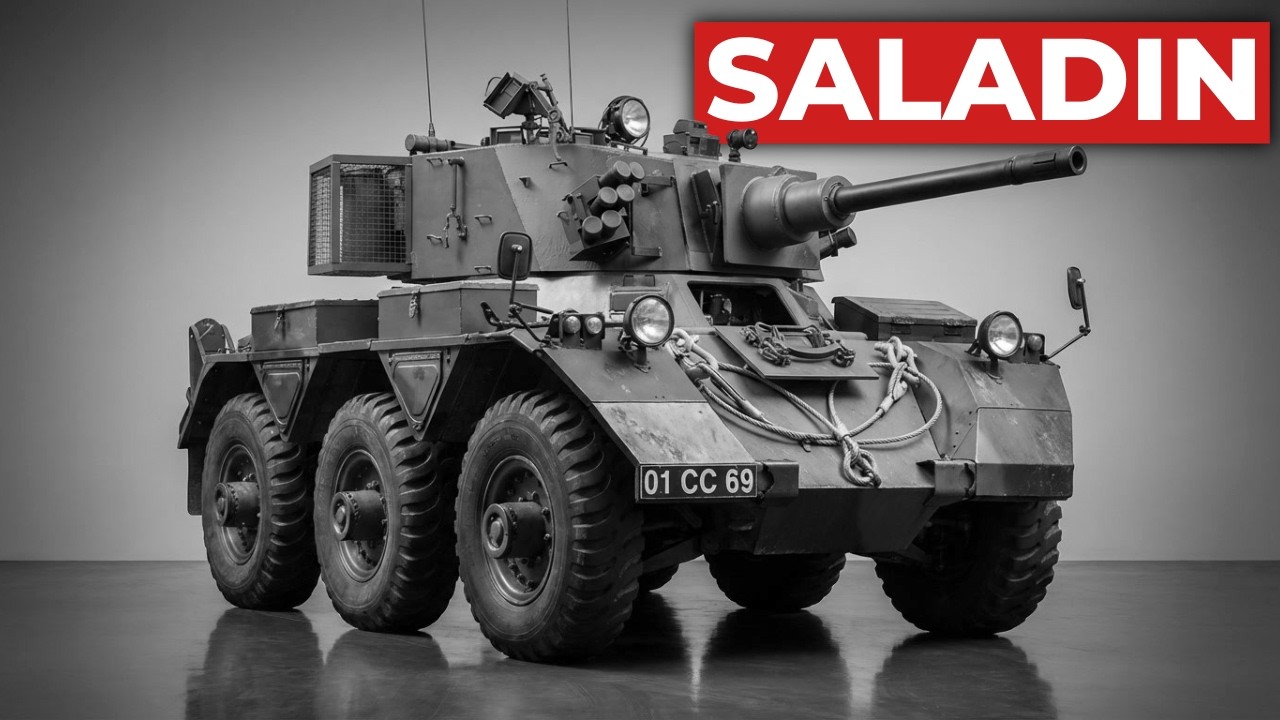
Permission was refused. The crew withdrew under threat of recoilless rifle fire with their most powerful weapon loaded and silent. An officer named Vaughan Griffith of the Queen’s Own Hussars received the Military Cross for an action in which he was forced to expose himself from his turret under heavy fire for 2 hours because minimum force restrictions prohibited him from using his main armament at all.
The Saladin’s greatest frustration in Aden was not the enemy. It was the chain of command above it. Borneo was a different problem entirely. The Indonesian Confrontation from 1962 to 1966 sent British armored car squadrons into terrain utterly hostile to wheeled vehicles. The jungle tracks were too narrow, too wet, and too unstable for conventional armored operations.
The 4th Royal Tank Regiment deployed Saladins in Kuching and Wong Padong, confined largely to road escort and checkpoint duty. In the absence of suitable direct fire targets, crews improvised. They dug Saladins into firing positions and used the 76-mm gun in the indirect role, lobbing rounds over the tree line onto pre-planned coordinates, using an armored car as a makeshift artillery piece.
But Borneo contained an irony that sat uncomfortably with everyone who served there. Indonesia fielded 69 Saladins of its own, purchased from Britain in 1960 and 61 in a standard Cold War arms transaction. Officers of the 4th Royal Tank Regiment recalled being briefed that the enemy possessed identical vehicles.
Theoretically, a Saladin crew on one side of the border might encounter a Saladin crew on the other. No such engagement ever occurred. The jungle made armored contact impossible, but the fact remained Britain had sold the weapon it was now opposing. Oman’s Dhofar province provided the longest and most grueling Saladin campaign of all.
Approximately 36 vehicles of the Sultan’s armored car squadron fought through the 1960s and into the middle of the 1970s against Dhofari rebel forces equipped with Katyusha rockets, rocket-propelled grenades, heavy machine guns, and anti-tank mines. Many of the crews were British officers and non-commissioned officers serving on secondment, nominally in Omani uniform, supporting SAS teams, Firqat tribal militias, and eventually Iranian troops sent by the Shah.
The roads of the Jebel were mined constantly and systematically. Vehicles were blown up, patched up, and sent back out. According to a first-hand account titled The Tin Equivalent, written in 1977, the pattern of an operational day frequently involved a mine strike before noon, a field repair through the afternoon, and a patrol continuing by dusk.
The Saladin’s engine reliability, the interchangeability of parts with the Saracen and Stalwart that served alongside it, and the toughness of its suspension kept it running in conditions that would have broken less robust vehicles far sooner. Northern Ireland produced the Saladin’s most absurd image in the years from 1969 to 1977.
Saladin’s were deployed across Belfast and the border counties under Operation Banner. The 76 mm gun barrel was fitted with a lubricated wooden bung, a plug inserted to demonstrate visually that the main armament was not loaded and would not be fired. No rounds of 76 mm ammunition were carried at all.
The vehicle that had been built around its gun was now operating without it. A three-man crew in 11 tons of steel with machine guns and a decorative cannon. The 14th and 20th King’s Hussars used Saladin’s for road patrols, vehicle checkpoints, and overwatch during infantry operations, always accompanied by a Saracen carrying dismounts.
According to accounts from veterans of the 1972 Belfast tour, the Saladin’s and Ferrets served primarily as presence, as visible deterrents. The gun barrel plugged, but the silhouette still menacing enough to influence behavior on the street. The Saladin was eventually deemed too aggressive in appearance for the domestic counter-insurgency role and withdrawn from Northern Ireland in the late 1970s.
On paper, the Saladin’s chief commercial rival was the French Panhard AML 90. And on paper, the Saladin lost badly. The Panhard weighed 5 and 1/2 tons, roughly half as much. Its 90 mm gun was actually more powerful, capable of penetrating the armor of main battle tanks in the right conditions.
It was faster at 90 km per hour. It had a greater range. And it was significantly cheaper. The numbers reflected this. Approximately 4,800 Panhard AMLs were built in France, with another 1,300 produced under license in South Africa as the Eland. Together, over 6,000 vehicles for more than 54 nations.
The Saladin achieved 1,177 built for 26 nations. But the Panhard offered 12 mm of armor at its maximum. The Saladin offered 32. In Aden, in Dhofar, in the streets of Nicosia during the 1974 Turkish invasion of Cyprus, where B Squadron of the 16th and 5th Queen’s Royal Lancers defended the airport under Nations colors, the difference between 12 mm and 32 mm was the difference between a vehicle that kept its crew alive and one that did not.
The Panhard was a vehicle designed to see and avoid contact. The Saladin was designed to see, fight, and withdraw. The British Army had always intended to buy a vehicle that could fight for its information rather than simply collect it. The Saladin was replaced in British service during the 1970s by two vehicles from the Combat Vehicle Reconnaissance Program.
The tracked Scorpion CVR(T), also built by Alvis, carried a version of the same 76 mm gun firing identical ammunition. The wheeled Fox CVR(W), a four-wheel drive vehicle of just 6 and 3/4 tons armed with a 30 mm Rarden cannon, entered service in 1975 and progressively displaced the Saladin in wheeled reconnaissance regiments.
The last British Saladin served in Cyprus into the early 1980s. Australia withdrew its Saladin’s from regular service in 1963, removed the turrets, mounted them on M113A1 armored personnel carriers, and sent those improvised fire support vehicles to Vietnam, where the Saladin’s turret fought a war the vehicle itself never reached. Dozens survive today.
The Tank Museum at Bovington holds three, including a running example demonstrated at Tankfest each year, and one believed to be the only surviving Crossley built pre-production model. The Muckleburgh Collection in Norfolk keeps a runner. The Australian Armor and Artillery Museum in Cairns has two, one of them operational.
Indonesia, Honduras, Mauritania, Nigeria, Tunisia, and Sri Lanka still technically held Saladin’s on military strength as recently as 2024. 1958 Holyhead Road, Coventry. A vehicle that took 13 years to reach production rolls out of the factory and into a career that none of its designers could have anticipated. It had no night vision.
It had no missile armament. It had no amphibious capability in service. Its armor was thin enough to be defeated by weapons already widespread in 1960. Its three-man crew was too small. The commander too burdened. The reverse gear the fastest thing about it. And yet it worked.
In the dust of Aden, where it absorbed mine blasts and kept its crew alive. In the jungles of Borneo, where it became improvised artillery. In the mountains of Dhofar, where it was mined and repaired and sent out again. In the streets of Nicosia, where it held an airport under invasion. In the hands of 26 nations who kept buying it and keep running it still.
The Saladin was not elegant. It was not fast. It was not cheap. It was British. And it endured long after every rival it ever faced had been reduced to scrap. That is not coincidence. That is what happens when you build a vehicle that is honest about what war actually demands.