The ‘Second-Hand’ British APC Ukrainians Crowdfunded In 36 Hours To Fight Russia D
November 2, 2022. Morning in Kyiv. A charity foundation run by a former comedian opens a crowdfunding page. The target is 200 million hryvnia. The goal is 50 armored vehicles sitting in British warehouses. Within 9 hours, ordinary Ukrainians have donated more than 100 million hryvnia. Within a day and a half, the total reaches 236 million hryvnia.
The number of vehicles purchased climbs from 50 to 60. These were not new machines. They were not gifts from a government. They were second-hand British armored personnel carriers, retired by the British Army, sold off as surplus, sitting in private depots across the United Kingdom. Pensioners, children, small businesses, and Ukrainian diaspora donors had just bought 60 of them in roughly 36 hours.
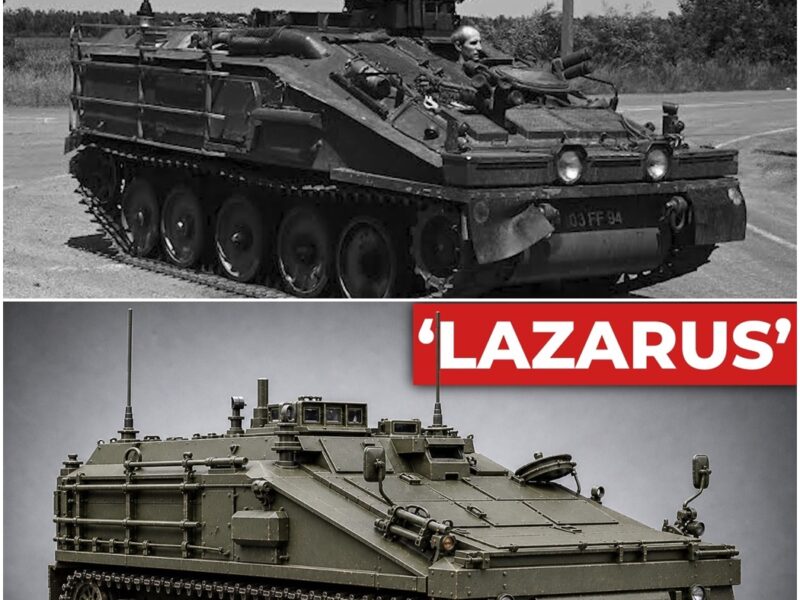
The vehicle they chose was the FV103 Spartan. A 9.5-ton tracked carrier designed in the 1960s, fielded in 1978, and dismissed by some Western analysts as obsolete the moment it left British service. What followed proved them wrong. Ukraine in the autumn of 2022 faced a problem that Western governments were slow to solve.
Frontline infantry needed protected mobility. They needed something that could move troops through Donbas mud, survive shell fragments and small arms fire, and arrive in numbers. State-to-state deliveries existed, but they were slow, political, and limited. The Ukrainian government had received 35 Spartans donated directly by the United Kingdom in April 2022, but more were needed. Far more.
And there were no more donations coming. What did exist was a surplus market. The British Army had spent more than a decade retiring its combat vehicle reconnaissance tracked family. Spartan replacement had begun in 2009. By 2022, hundreds of vehicles had passed through private dealers in Britain. The vehicles were low mileage.
According to the Guardian, they had each been driven less than 16,000 km. They were sitting in secret warehouses waiting for buyers. The problem was simple. Buying them required money the Ukrainian state could not easily spend on second-hand equipment when it was begging for tanks. That is where Serhiy Prytula came in, a television presenter turned volunteer logistician.
Prytula had already run the famous people’s Bayraktar campaign earlier that year. His foundation knew how to move money fast. On November 2, 2022, they launched the Spartan appeal. The branding was direct, “Grab them all.” Per Ukrayinska Pravda, the foundation ultimately collected more than 235 million hryvnia, roughly 6.5 million United States dollars, in literally a day and a half.
Prytula himself posted on social media on November 3. His words, translated, “No one never ever can defeat our nation because we are the Ukrainians. We have crowdfunded for 60 British Spartan APCs in only 1.5 days. But 60 Spartans was only the headline. The final contract signed across five different British private dealers covered 101 vehicles from the broader combat vehicle reconnaissance tracked family.
40 Spartans, 21 Sultan command vehicles, eight Stormer carriers, and assorted recovery, ambulance, and FV430 variants. The Spartans alone came to 2 million 138,000 pounds, at between 41,000 and 60,000 pounds per vehicle. The volunteer rush had driven the market up. Ukrainian World Congress organizer Andriy Potichny told Ukrayinska Pravda that prices for armored vehicles in Britain had increased 25 to 35% since the summer of 2022.
A Spartan that had cost $35,000 before the war was now selling for $79,000. So, why these vehicles? Why a 1970s tracked design when faster wheeled options existed? The answer lies in the metal. The Spartan is built from 7017 aluminum-zinc alloy. This was not the obvious choice in the 1960s. The American M113, designed in the same era, used 5083 grade aluminum.
Easier to weld, easier to manufacture, cheaper. Alvis, the British designer, rejected it. 7017 is harder, more difficult to work, and more expensive. But, it offered something the American alloy could not. A hull light enough to keep the vehicle under 11 tons combat weight, strong enough to resist 14.
5 mm heavy machine gun fire across the frontal arc at 200 m, and durable enough to last decades. The full armor envelope stops 7.62 mm armor-piercing rounds across the rest of the vehicle. The choice mattered. Ground pressure on a Spartan is close to that of a foot soldier. In Donbas mud, that is the difference between a vehicle that moves and a vehicle that does not.
The Spartan also fits inside a C-130 Hercules transport aircraft. Two Scorpions, the related light tank, fit inside a single Hercules. Russian equivalents could not match this. Maxim Kostetsky, the Protula Foundation’s transport coordinator, explained the choice plainly to the Guardian. His words, “The base is tracked, and due to that fact, it can move around in bad weather conditions because we have rain almost every day right now during the autumn season.
It is going to start snowing soon, and the Spartans will be very good on the front line, especially in Donbas where the heaviest fighting is going on right now.” The full specification, combat weight, 10,670 kg. Crew of three plus four passengers. The original Jaguar J60 4.2 L petrol engine produced roughly 190 horsepower, later upgraded in 1999 to the Cummins BTA 5.9 L diesel at 235 horsepower.
Road speed up to 96 km/h. Range around 510 km. Standard armament is one 7.62 mm L37A1 one machine gun with 2,000 rounds fireable from under armor. The vehicle is amphibious with an erected flotation screen. Production reached 691 Spartans by the end of 1986. Now, before we see how this performed in combat, if you are enjoying this deep dive into British engineering, hit subscribe.
It takes a second, costs nothing, and helps the channel grow. All right, let us get into the combat record. The first batch of 24 Petula funded Spartans arrived in Ukraine on March 1 and 2, 2023. The foundation showed them publicly on March 3. Within weeks, they were on the front line. The first batch went to territorial defense and volunteer units.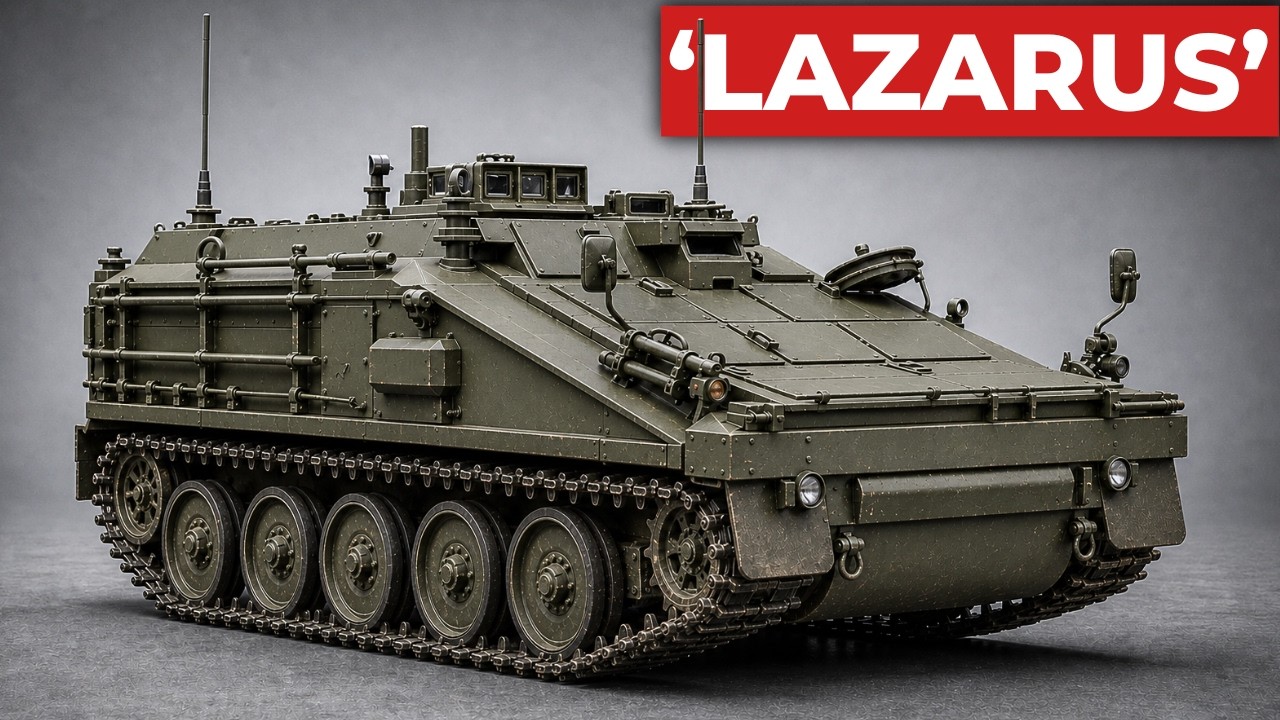
Among them, the 251st Territorial Defense Battalion, the 127th Territorial Defense Brigade, the first separate mechanized battalion of the 67th Mechanized Brigade. Ukrainian crews modified them immediately. The original 7.62 mm machine gun was inadequate for the threat environment. Crews bolted an M2 Browning .
50 caliber heavy machine gun and a Mark 19 automatic grenade launcher onto the AV number 16 turret. This added firepower, but forced the gunner to expose himself when firing. So, additional steel plating was welded onto the turret to compensate. The combat record that followed surprised observers. Consider one documented case.
A Spartan supplied through the Ukrainian World Congress was struck twice by Russian Zala Loitering Munitions in Donetsk Oblast. Two direct hits. The Ukrainian soldier filming the aftermath delivered his verdict on camera. His words, “Okay, in short, Spartan is intact. Some parts of the wing hit it, and I cannot say it is damaged.
Everything adjacent to the Spartan lies destroyed nearby, but on the Spartan itself, there is no damage. That was not a one-off. According to the open-source loss tracking project Oryx, which counts only visually confirmed losses with photographic evidence. The Spartan combat record as of January 2025 stood at 17 destroyed, four damaged, and two captured.
23 total visually confirmed losses against well over 100 vehicles delivered across all sources. That is a survival rate that few armored vehicles in Ukrainian service can match. The Spartan is not invincible. Andriy Petyshny of the Ukrainian World Congress described one of their donated vehicles destroyed by Russian artillery near Bakhmut.
His words to Ukrayinska Pravda, “The vehicle came under artillery fire. It burned out, but the crew survived. It has saved the lives of several defenders.” That phrase, “The crew survived,” recurs in Spartan combat accounts. The vehicle’s job is not to win firefights, it is to deliver infantry alive. Now, the comparison. How does a 1970s British design compare to its Russian and NATO contemporaries on the same battlefield? The Russian equivalent most often encountered is the BTR-80.
13.6 tons, eight-wheeled, steel armor between 7 and 9 mm with up to 14 mm on the turret. Frontal protection rated against 12.7 mm rounds, which is less than the Spartan’s 14.5 mm frontal rating despite the BTR being 3 tons heavier. Armament is stronger with a 14.5 mm KPVT and a coaxial machine gun.
Road speed 80 to 90 km per hour. The improved BTR-82A added a 30-mm auto cannon, spall liners, and improved mine protection. But at 16 tons combat weight and on wheels, it sinks in conditions where the Spartan still moves. The closer Russian comparison is the MTLB. 11.9 tons, tracked, steel armor between 3 and 14 mm.
A 1960s Kharkiv design originally intended as an artillery tractor, pressed into service by both sides as an improvised troop carrier. The MT-LB carries more infantry, 13 total including crew, but its armor stops only rifle fire across most of the vehicle. Its single 7.62-mm machine gun is outclassed by the Spartan’s Ukrainian upgraded armament.
And its steel hull is heavier per unit of protection than the Spartan’s aluminum. The NATO equivalents tell a similar story. The American M113 is the obvious comparison. 11.3 tons, tracked. 5083 aluminum hull rated for The Spartan’s 7017 alloy provides better frontal protection for similar weight. The German TPz Fuchs is wheeled, weighs up to 23 tons combat loaded, and trades cross-country mobility for road speed.
The Stryker, the most modern of the comparisons, weighs over 18 tons, and per Oryx data has suffered 67 M1126 and 9 M1132 destroyed, damaged, or captured as of August 2025. The Spartan’s niche becomes clear. It is not a fighting vehicle. It is a fast, light, well-protected tracked taxi that delivers infantry to where they need to be in terrain that defeats wheels, with crew protection per ton that exceeds every contemporary in its weight class.
There is one popular story worth addressing directly. A widely shared 2026 account describes a vehicle absorbing 52 drone strikes and continuing to function. This story is real, but it refers to a Leopard 1A5 tank crewed by a Ukrainian commander whose call sign is Spartan. It is not the FV103 Spartan APC.
The two have been frequently confused in social media coverage. The actual Spartan combat record does not need that story. The verified record is impressive enough. The strategic impact of the Protura campaign extended beyond the vehicles themselves. Ukrainska Pravda calculated that by spring 2023, Ukrainian volunteer groups had bought 155 armored vehicles in Britain.
The Petro Poroshenko Foundation delivered two more Spartans in December 2022. The Ukrainian World Congress procured 13 Spartans within a broader 57 vehicle package for $2.8 million. The British Army retired its entire combat vehicle reconnaissance tracked fleet by 2023 under the future soldier plan. The Scimitar variant left service in April 2023.
As of May 2023, 114 vehicles awaited disposal, 97 of them Scimitars. These vehicles, judged surplus to British requirements, are still earning their keep on the largest land war in Europe since 1945. The Spartan that British soldiers drove in the Falklands campaign, the same hull design that served in the Gulf War, in Bosnia, in Iraq, and in Afghanistan, is now delivering Ukrainian infantry to assault positions in Donetsk Oblast.
There is something almost embarrassing about this for Western defense establishments. While NATO governments debated for months over each Marder, each Bradley, each Leopard, ordinary Ukrainians used bank transfers to buy 101 British armored vehicles in a day and a half. Vehicles those governments had already declared obsolete.
And those vehicles went to war and saved lives. The 7017 aluminum alloy that Alvis insisted on in the 1960s is still stopping 14.5 mm rounds in 2026. The low ground pressure that mattered in the Falkland Islands still matters in Donbas mud. The air transportability that British paratroopers valued in 1978 still mattered when Ukrainian volunteers needed to move 60 vehicles across Europe in weeks rather than months.
The same engineering choices decades apart solving the same fundamental problems. The Spartan was never glamorous. It was never the headline vehicle of any British campaign. It is not the Challenger. It is not the Warrior. It is the unassuming aluminum box that gets the infantry to the fight and gets them home.
60 of them are doing that job right now, paid for by Ukrainian pensioners and school children and small business owners because they trusted British engineering when their own government’s allies were too slow to deliver. The pensioners and school children were right.
A 1970s design, dismissed by some as obsolete, became one of the most quietly effective armored vehicles of the war in Ukraine. That is what British engineering looks like when nobody’s watching. Built to last, built to work, built to bring crews home alive. 40 years after the first Spartans rolled off the Alvis production line in Coventry, ordinary Ukrainians staked their own money on the same proposition that the British army had bet on in 1978. The aluminum held.