The Simple British Beaufighter Nose Trick That Spotted German Convoy Ships Through Thick Fog D
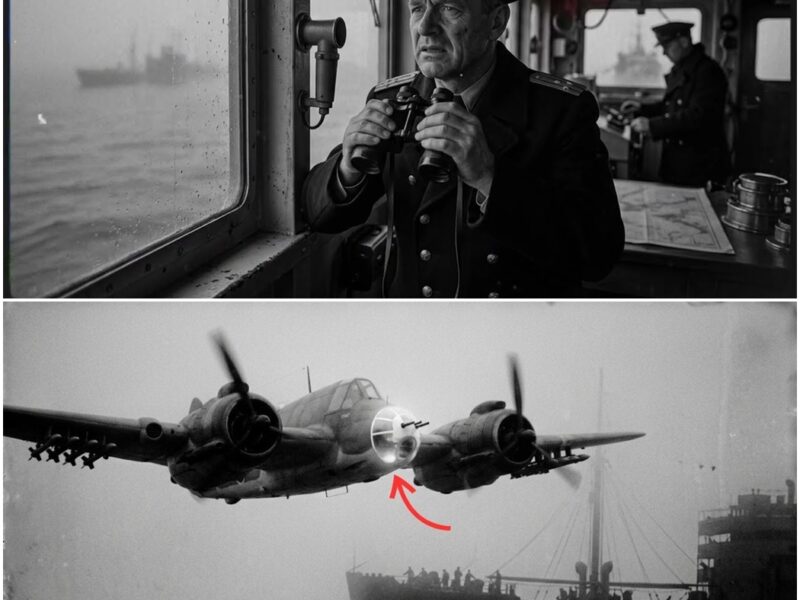
The North Sea, 14th November, 1942. A Bristol Beaufighter skims low over the gray water. Its twin Hercules engines producing a sound described by those who heard it as somewhere between a roar and a sustained thunderclap. The crew of two, pilot and navigator observer, are flying into weather that would ground most aircraft.
A dense bank of sea fog rolls across the surface, swallowing the horizon entirely. Visibility has dropped to perhaps 200 m. Somewhere ahead, intelligence has suggested a German supply convoy is moving southward along the Norwegian coast carrying fuel and ammunition to the garrison forces holding the occupied ports. The pilot cannot see it.
The navigator cannot see it. But tucked into the nose of this aircraft is a device that can. The observer reaches forward and adjusts a small control. On his cathode ray tube display, a faint line of green interference pulses into something more structured. Echoes, returns. The shapes of ships rendered not in light or vision, but in reflected radio waves bouncing back from steel hulls cutting through the murk.
He calls out bearings. The pilot banks. The Beaufighter, armed with rockets and cannon, lines up on a target it cannot see with human eyes. What happens next? The attack run, the results, the chaos visited upon a convoy that believed fog was its ally would be repeated dozens of times along those coastlines before the war’s end.
And it would happen because of something so straightforward in its conception that the wonder is not that it worked, but that it took so long to think of it. This is the story of British ingenuity, driven by operational desperation, placed centimetric radar into the nose of a strike aircraft and fundamentally changed the nature of maritime attack.
It is a story about the gap between what exists and what is needed and the uncomfortable process of closing that gap under fire. To understand why this mattered, you have to appreciate the particular problem that Coastal Command and strike aviation faced in the early years of the war. The German war economy was heavily dependent on coastal shipping.
Moving supplies, raw materials, and troops by sea along the Norwegian and Dutch coastlines was far more efficient than overland transport and the Germans knew it. The routes were short, relatively sheltered, and crucially, difficult to interdict. The Luftwaffe could provide fighter cover. The convoys moved in daylight only initially, then increasingly at night and in poor weather, precisely because they had learned quickly and painfully that British aircraft could find them in clear conditions. The problem for the RAF was simple to state and extraordinarily difficult to solve. They needed to find and attack ships in conditions of low visibility, night, fog, overcast, the particular murk that settles over the North Sea for weeks at a time between October and March. Without the ability to find targets in those conditions, enormous stretches of
the German supply network operated with near impunity. Estimates at the time suggested that as much as 40% of the German coastal supply effort moved during periods of poor visibility, specifically timed to avoid British air attack. The material consequences were significant. Fuel reaching Norway sustained the Tirpitz and the other heavy units sheltering in the fjords.
Ammunition reaching the channel port supported the Atlantic wall. Every convoy that slipped through in fog was a convoy that had not been stopped. The solution that existed before centimetric radar was navigation by dead reckoning and hope. Crews would be given the last known position of a convoy, calculate where it ought to be based on speed and heading, fly to that position, and then conduct a visual search.
In clear weather, this worked adequately. In fog, it was nearly useless. Some units experimented with flares, which illuminated the water surface, but also announced the attacker’s presence and invited immediate anti-aircraft fire from convoy escorts before the crew could properly acquire a target. There were losses, significant grinding losses of highly trained aircrew conducting what amounted to blind searches over open water in aircraft that were not easy to fly at low level even in good conditions. Something had to change. The Air Ministry and the Telecommunications Research Establishment at Malvern had been working on airborne radar since before the war, primarily in the context of night fighter interception. The early AI airborne interception B sets had demonstrated that radar could
be made small enough to fit into an aircraft and sensitive enough to detect another aircraft at useful range, but those sets operated on metric wavelengths, which produced a minimum detection range that was too large for low-level maritime work and a beam that was too broad to give precise enough targeting information.
The fundamental limitation was physics. Longer wavelengths meant larger antennas for equivalent performance, and larger antennas created aerodynamic and structural problems. They also struggled to resolve small targets close to the surface. A ship was not an easy radar return when the sea itself was producing clutter.
The breakthrough came from centimetric radar operating at wavelengths around 10 cm rather than the 1 and 1/2 m of the earlier sets. The cavity magnetron developed at Birmingham University by John Randall and Harry Boot in 1940 made this possible. It generated microwave power at useful levels from a device small enough to hold in one hand.
The magnetron is worth dwelling on for a moment because its importance extends far beyond the Beaufighter. It is essentially a vacuum tube in which electrons are forced into circular paths by a magnetic field and interact with a series of resonant cavities machined into a copper block. The result is microwave radiation at frequencies that earlier technology could not approach in terms of power output.
The cavity magnetron was arguably the most important electronic component of the entire war, and the British gave the design freely to the Americans in 1940 as part of the Tizard mission. An act of technological generosity that the Americans repaid in manufacturing capacity. What the centimetric wavelength allowed, in practical terms, was a much narrower beam from a much smaller antenna.
A dish antenna, perhaps 60 cm in diameter, could produce a beam narrow enough to resolve individual ships within a convoy and distinguish them from one another. The same antenna mounted in the nose of a Beaufighter and rotating to scan ahead could present the operator with a clear picture of the sea surface ahead with ship targets showing as distinct bright returns against the sea clutter.
The system fitted to the Beaufighter was designated ASV Mark III, air-to-surface vessel radar in its third generation. And the installation involved placing the rotating scanner behind a Perspex nose cone that replaced the original solid nose of the aircraft. This was the trick. Not a complicated trick.
Not a piece of exotic engineering requiring years of development, but a conceptually elegant solution to a defined problem. The Beaufighter’s nose was already a logical housing for equipment being a large and relatively accessible compartment. The Perspex was transparent to microwave radiation in the same way that glass is transparent to light.
The scanner rotated inside sweeping the sea ahead and the returns were displayed on a plan position indicator. Essentially, a circular screen on which the aircraft’s position was at the center and the radar picture painted itself around it as the antenna rotated. A ship at 5 km showed as a bright spot.
A convoy showed as a cluster of bright spots. The operator could read the display and direct the pilot onto the target without either of them being able to see anything at all through the cockpit. The manufacturing of the ASV Mark III sets was conducted primarily by a number of British electronics firms working under Ministry of Aircraft Production contracts with final installation and calibration carried out at maintenance units before aircraft were delivered to operational squadrons.
The exact production numbers remain subject to some uncertainty. Wartime records were not always complete and some figures remain classified even now. But estimates suggest that several hundred sets were produced and installed in various maritime strike and patrol aircraft by the war’s end with the Beaufighter receiving the majority of the strike dedicated installations.
If you are finding this interesting, a quick subscribe helps more than you know. The operational use of the ASV Mark III equipped Beaufighter began in earnest in late 1942 and accelerated through 1943 as more aircraft were modified and more crews trained on the equipment. The results were, by the standards of a war that often produced modest returns for enormous effort, genuinely impressive.
Squadrons operating from bases in northern Scotland, from airfields in Cornwall, and eventually from bases in the Mediterranean, reported successful attacks against convoys in conditions that would previously have meant returning to base without finding the target. The fog and overcast that the Germans had been exploiting as cover became, in effect, irrelevant.
Specific operations during the winter of 1942 to 1943 along the Norwegian coast demonstrated the practical effect most clearly. Convoys that had been scheduled to move during periods of poor weather were intercepted with a regularity that initially confused German convoy commanders who could not understand how aircraft were finding them in zero visibility.
The psychological effect on convoy crews, merchant sailors, and naval escorts alike of being attacked from the fog by aircraft that should not have been able to see them was considerable and is documented in captured German accounts. There is something particularly unnerving about an attack that arrives without the sound of aircraft engines building gradually in the distance without any of the visual cues that allow defensive preparation.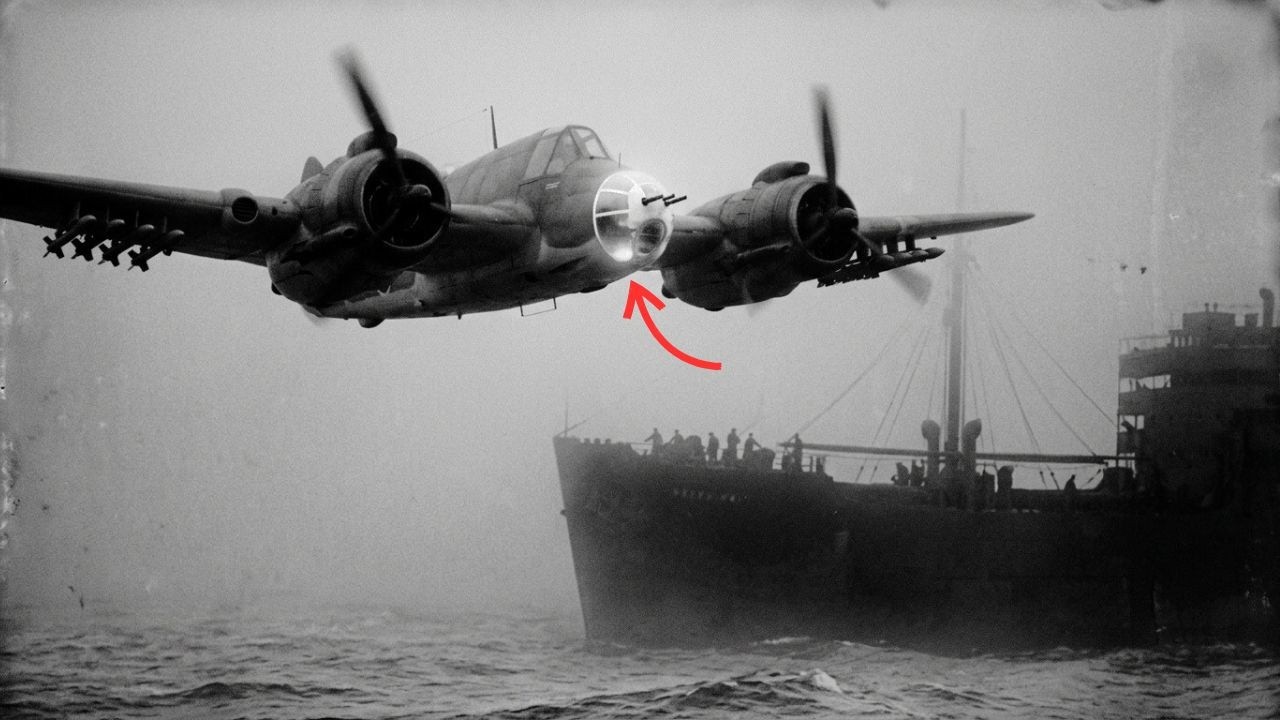
It simply materializes from the gray murk with cannon fire and rockets already incoming. The records for individual operations are patchy in places as is inevitable with operational strike missions conducted in poor weather against moving targets. Post-attack damage assessment was difficult when the attacking aircraft could not visually confirm results and German records of convoy losses in this period were not always captured or preserved.
What can be said with reasonable confidence is that the tonnage of German coastal shipping lost to British air attack increased significantly in the periods and areas where radar-equipped Beaufighters were operating and that the German response additional escort vessels modified routing attempts at increased speed is itself evidence that the threat was being taken seriously.
The comparison with German efforts in this area is instructive. The Luftwaffe had its own maritime strike capability primarily in the form of the Heinkel He 111 and the Focke-Wulf F w 200 Condor operating in the anti-shipping role. German airborne radar development had produced the FuG 200 Hohentwiel system which was fitted to maritime patrol aircraft and offered broadly comparable performance to the earlier British ASV Mark II in terms of detection range against surface targets, however, the centimetric revolution that the cavity magnetron had enabled in Britain was not replicated in Germany during the war. German radar development continued to rely primarily on metric wavelengths, which meant broader beams, less precise targeting information, and continued
difficulty distinguishing individual targets within a convoy or resolving targets against coastal clutter. The reasons for this gap are complex and have been the subject of considerable post-war analysis. German scientists were aware of the principle of centimetric radar and had conducted some research in this direction.
But the industrial and organizational focus required to transition to centimetric systems was not achieved. The cavity magnetron itself was recovered from a crashed British aircraft in 1943. The Germans had captured enough components to understand what they were looking at. But reverse engineering a device and building the industrial infrastructure to produce it in useful quantities are very different challenges.
By the time German centimetric radar might have reached operational use, the air war had moved well beyond the point where it could have made a decisive difference. The American approach to the same problem followed the British lead closely, partly because the British had shared the magnetron design in 1940, and partly because American radar development benefited enormously from the Radiation Laboratory established at MIT specifically to pursue centimetric radar technology.
American ASV radar fitted to patrol aircraft and attack aircraft operating in the Pacific and Atlantic theaters used broadly similar principles and achieve broadly similar results. The British and American approaches were sufficiently compatible that there was genuine interoperability between systems by the latter stages of the war which simplified logistics and training considerably.
The legacy of what the Beaufighter and its radar achieved is worth considering carefully because it operates on several levels simultaneously. At the most immediate level, it represents a genuine operational success in a campaign that mattered materially. German coastal shipping losses attributable to air attack taken across the entire war amounted to a significant drain on the supply network sustaining occupation forces and naval units in Norway, the Low Countries, and the French coast.
Every tanker sunk was fuel that did not reach the fjords. Every ammunition ship lost was a gap in the supply chain for coastal artillery and garrison troops. At a deeper level, the ASV Mark III installation in the Beaufighter represents an important moment in the development of all-weather strike capability.
The idea that an aircraft could attack a surface target it could not see relying entirely on electronic sensing to acquire, approach, and engage was not new in principle by 1942. But the Beaufighter made it practical and repeatable in operational conditions. The concepts developed in this period the integration of radar display into the crew workload the development of attack procedures based on radar rather than visual acquisition the training of operators who could read a radar picture and direct an attack from it all fed directly into the post-war development of strike aviation. Surviving Beaufighters with their characteristic Perspex nose cones can be seen at several museums in Britain and elsewhere. Including at the Royal Air Force Museum at Hendon in North London. And at the National Museum of Flight in Scotland.
The Perspex nose, to those who know what they are looking at, is immediately identifiable as the signature of the radar installation. The window through which the invisible world of reflected microwaves was translated into the destruction of ships that believed themselves hidden by weather. Return to that November morning in 1942.
The gray water, the sea fog, the Beaufighter running low and fast toward a target it cannot see. The pilot trusts his observer. The observer trusts his display. The display trusts the magnetron, spinning in its copper block, generating microwaves that spread ahead into the murk, and return, changed, carrying the shapes of steel ships.
The convoy moves on, its crew confident in their invisibility. They are wrong. They have been wrong since the day that someone at the Telecommunications Research Establishment thought to put a centimetric scanner behind a Perspex nose cone and see what it would show. What it showed was that fog is not protection.
That weather is not a shield. That the idea of hiding in poor visibility, an idea as old as maritime navigation itself, as fundamental as the instinct to move at night or in rain, or in the low gray murk of a North Sea winter, could be rendered obsolete by a copper block the size of a man’s fist and a display no larger than a dinner plate.
The German convoys did not stop moving, of course. They adapted as military organizations under pressure always do. They added more escorts. They changed their routes. They tried to concentrate their movements in periods when British strike squadrons were most likely to be stood down for weather or maintenance.
But they could no longer rely on the fog. The fog had been taken from them. And the weapon that took it was not, in the end, a marvel of engineering complexity or a triumph of theoretical physics applied in ways that strained comprehension. It was, at its heart, a straightforward solution to a defined problem.
A scanner, a display, and a Perspex nose. Simple. Effective. And, for the men in the ships it found, devastating. The Beaufighter that left that North Sea fog on November 14th, 1942, turned for home having done what its crews had been unable to do the previous winter. It had found its target.
It had pressed home its attack. And it had demonstrated, in the unglamorous, necessary, grinding work of maritime strike, that the electronic spectrum could be made to do what human eyes could not. That lesson has never been unlearned. Every modern strike aircraft that can find and engage a surface target in zero visibility, every sea-skimming missile that homes on radar returns, every ship that tracks aircraft it cannot see on optical sensors, traces a line of descent back to this moment, this aircraft, this trick with a Perspex nose and a spinning dish. Not complicated. Just decisive.