The Simple British Gladiator Trick That Held Malta Against 5,000 Italian and German Aircraft Alone D
It is the morning of the 11th of June, 1940 and the harbor at Valletta is still. The limestone walls of the Grand Harbor glow amber in the early light. The same color they have been for 400 years. Worn smooth by the Mediterranean sun and the salt wind that rolls in off the sea. Fishing boats bob quietly against their moorings.
A cathedral bell rings somewhere in the old city. And then from the north comes a sound that will become the defining soundtrack of the next two and a half years. The low, rhythmic drone of Italian bombers. Savoia-Marchetti SM.79s cutting through the morning sky in tight formation. Their shadows sliding across the ancient stone like something dark and inevitable.
Italy has declared war on Britain and France less than 12 hours earlier. Mussolini, sensing the fall of France and eager to claim his share of the spoils, has cast his lot with Hitler. And Malta, that small, stubborn island sitting 60 miles south of Sicily, has just become one of the most strategically important and most desperately vulnerable pieces of territory in the entire war.
It sits almost exactly at the midpoint of the Mediterranean. A dagger pointed at the Axis supply lines running from Italy to North Africa. Whoever controls Malta controls the sea lanes. Both sides know it. What the Italian bombers did not expect as they crossed the coast that morning was opposition.
Malta was supposed to be defenseless. The island had no modern fighter aircraft assigned to it. No Hurricanes, no Spitfires. The RAF had consistently argued that Malta could not be defended and had directed its precious modern fighters elsewhere. What waited for those Italian bombers instead was something so unlikely, so hopelessly outmatched on paper, that it ought to have made no difference at all.
Three obsolete biplanes, each one a full generation behind the aircraft they were about to fight, scrambled from Hal Far airfield and climbed to meet the enemy. Their pilots knew what they were flying into. They went anyway. Those three aircraft were Gloster Gladiators, the last biplane fighters ever operated by the Royal Air Force, and the story of what they did, and crucially, how they did it, is one of the most extraordinary chapters of the entire Second World War.
It is not simply a story of bravery, though there is bravery in extraordinary abundance. It is a story of deception, improvisation, and a psychological trick so simple and so effective that it rewrote what was thought possible in the defense of a besieged island. It is the story of how three obsolete aircraft, through a combination of desperate ingenuity and calculated illusion, helped hold Malta against more than 5,000 enemy sorties and bought the island the time it needed to survive.
To understand why any of this matters, you have to understand just how completely Britain had written Malta off before the war began. The island was small, roughly 27 km long and 14 km wide, with a civilian population of around 270,000 people crammed onto a piece of limestone that had almost no natural resources, no fresh water to speak of, and no capacity to feed itself.
Everything came in by ship. Everything. Food, fuel, ammunition, aircraft parts, medicine. The island was, in the bluntest strategic terms, a liability. It required constant supply and offered, in the view of many pre-war planners, no realistic prospect of being held against a determined attacker. The air defense situation was particularly grim.
Before the war, the RAF had assessed Malta and concluded that modern fighter operations from the island were impractical. The airfields were poor, the radar coverage was thin, the anti-aircraft guns were inadequate in both number and caliber, and there were simply not enough fighters to go around. Britain was rearming frantically in the late 1930s, but every Hurricane and Spitfire coming off the production line was earmarked for Fighter Command, for the defense of Britain itself.
Malta was far down the list. When Italy entered the war in June 1940, the island’s air defense consisted, in its entirety, of those three Gladiators, aircraft that had been left behind from a passing aircraft carrier and were technically owned by the Fleet Air Arm, and a handful of anti-aircraft guns whose ammunition supply was carefully rationed from the very first day.
The Gloster Gladiator had been a fine aircraft in its time. Designed in the early 1930s, it first flew in 1934 and entered RAF service in 1937. It was a beautiful machine in the old tradition, a fabric-covered biplane with a fixed undercarriage powered by a Bristol Mercury radial engine producing around 840 horsepower, capable of reaching speeds of around 414 km/h.
It carried four Browning machine guns, which was a respectable armament. In 1937, it was competitive. By 1940, it was not. The aircraft it was now being asked to fight, the Macchi C.200, the Fiat CR.42, and later the Messerschmitt Bf 109, were monoplanes with retractable undercarriages, more powerful engines, and significantly higher top speeds.
On paper, the Gladiator had no business fighting any of them on equal terms. What the pilots at Hal Far understood, however, was that the fight was never going to be on equal terms, regardless of what they flew. They were always going to be outnumbered. They were always going to be scrambling to altitude against bombers already overhead.
The question was not how to win in the conventional sense. The question was how to make the enemy uncertain. How to impose a cost high enough that the bombing raids would be disrupted. How to protect the harbor and the airfields long enough for reinforcements, if reinforcements ever came to arrive. And that is where the trick came in.
The three Gladiators were given names. This is the detail that most people know, and it has become the most famous part of the Malta story. Faith, Hope, and Charity. The names were not an official designation. They were given by the people of Malta themselves, who watched these three tiny biplanes climb day after day into skies full of bombers, and who needed, perhaps, to make them human.
The names stuck, and they became symbols of the island’s resistance. But the naming was only the beginning of something more calculated and more deliberate than it might appear. The pilots, Flight Lieutenant George Burgess, Flight Lieutenant Peter Keeble, and Flying Officer William Woods, joined later by others as the situation developed, quickly worked out that three aircraft could not defend Malta by flying together.
Three aircraft in formation was simply three targets, easily identified, easily counted, easily dismissed. What they needed was to appear as something other than what they were. They needed the enemy to be unsure of how many fighters were defending the island, unsure of where the attacks would come from, unsure of whether a second or third wave of defenders was waiting above the clouds.
They needed, in the most precise sense, to manufacture uncertainty. They achieved this by splitting up. Rather than operating as a unit, the Gladiators flew separately, attacking from different directions and at different altitudes, so that the crews of the Italian bombers could never be entirely certain how many fighters were in the air.
A bomber crew attacked from the left by one Gladiator, then from above by another, and then, as they turned for home, harassed from the rear by a third, would have every reason to believe they had encountered a significantly larger defending force. Debriefings, it could be reasonably assumed, would reflect that uncertainty.
And uncertain bomber crews fly less accurately, release their bombs higher, and are more willing to be turned away from their targets. The pilots also made deliberate use of the Gladiator’s one genuine advantage over the more modern Italian fighters, its turning circle. The biplane configuration, for all its aerodynamic obsolescence in terms of speed, gave the Gladiator a remarkably tight turn.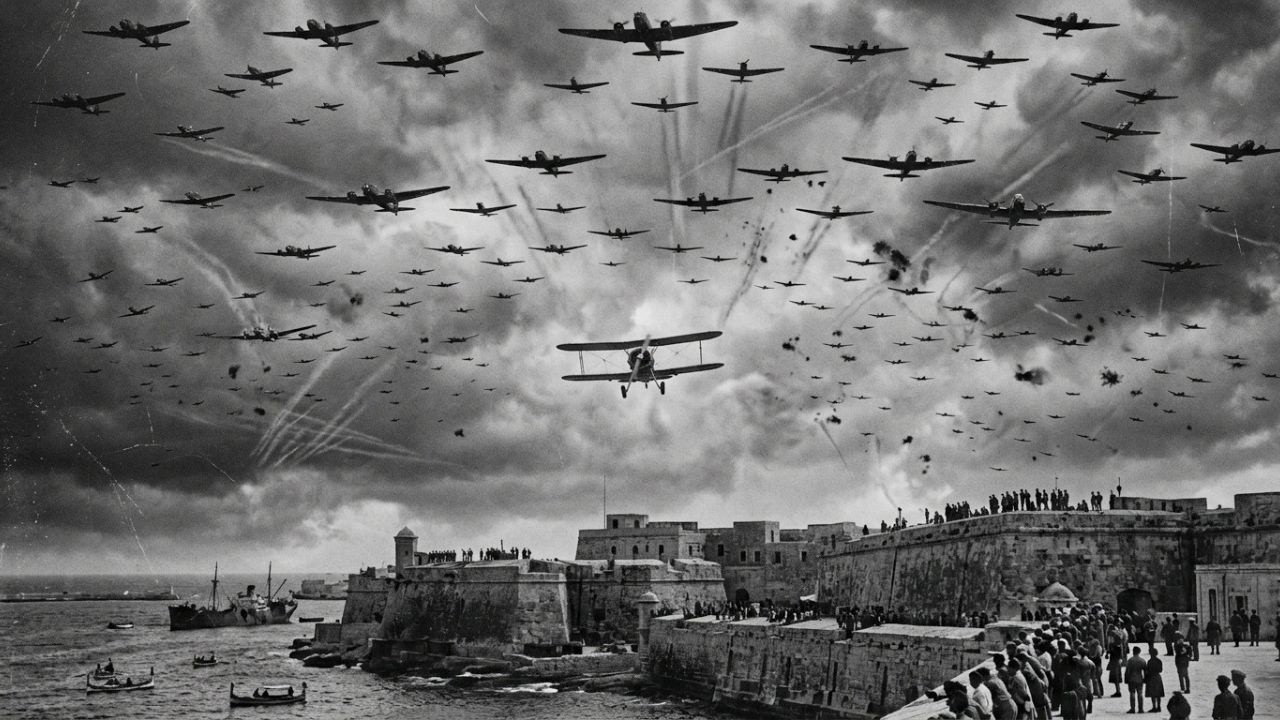
A Macchi C.200 coming in fast for a firing pass would find that the Gladiator had turned inside it before the burst could be properly aimed. The Italian pilot pressing the attack risked overshooting and becoming the target himself. It did not make the Gladiators invincible, far from it, but it meant that engagements could be survived, broken off, and repeated, which was precisely what was needed.
If you are finding this interesting, a quick subscribe helps more than you know. The logistical reality of the defense was relentlessly punishing. There were almost no spare parts for the Gladiators. Every component that failed or was damaged in combat had to be cannibalized from other aircraft, improvised from whatever the ground crews could find, or simply done without.
The ground crew at Hal Far, whose contribution to the defense has been consistently undervalued in the popular telling of the story, performed feats of improvisation that were in their own way as remarkable as anything done in the air. Aircraft were patched with fabric cut from abandoned tents. Engine components were machined by hand in the workshops at the dockyard.
One Gladiator shot up in the course of a morning would be returned to airworthiness by the afternoon through a combination of skill, determination, and what one account described simply as “Whatever was available.” By the time the first Hurricanes began arriving in Malta in the late summer of 1940, the Gladiators had been in continuous action for more than 2 months.
The exact number of enemy aircraft confirmed destroyed is difficult to establish with precision as the records from this period are incomplete and the claims made in the heat of combat are notoriously unreliable on both sides. What is not in dispute is that the bombing of Malta’s harbor and airfields during those first weeks, while severe, failed to achieve the rapid neutralization that the Regia Aeronautica had anticipated.
The ships in the Grand Harbor continued to be repaired and resupplied. The airfields continued to operate. The Italian experience over Malta in the summer of 1940 is instructive when compared with what had been expected. Mussolini’s air force was not a negligible force. It was large, reasonably well equipped, and had combat experience from Ethiopia and Spain.
The SM.79 bomber was a capable aircraft, fast enough that it was sometimes described as difficult to intercept even for modern fighters. And yet the raids on Malta, despite their numerical superiority, were persistently disrupted. Italian aircrew returning from sorties over the island reported fighter opposition that seemed, from their accounts, more substantial than three Gladiators could possibly have provided.
Some Italian records from this period suggest that the defending force was estimated at a dozen aircraft or more at various points in July and August 1940. The actual number on any given day was rarely more than two and sometimes only one. The Luftwaffe’s arrival in Sicily in January 1941, with Fliegerkorps 10 specifically tasked with neutralizing Malta and its airfields, changed the nature of the threat entirely.
The Germans brought Junkers Ju 88s and Heinkel He 111s escorted by Messerschmitt Bf 109s, and the weight and precision of the attacks increased dramatically. The Gladiators by this point had been largely replaced by Hurricanes, though not in numbers sufficient to match what was coming. But the psychological and tactical framework that had been established in those first desperate weeks, the idea that Malta would fight back, that the island would contest every raid, that no bomber over the Grand Harbor could count on a free run, that framework held. The comparison with how other besieged positions were handled during the same period is stark. In Crete, in May 1941, the RAF was overwhelmed by a combination of superior numbers and the loss of its airfields, and the island fell in less
than a fortnight despite a fierce ground defense. In Tobruk, the garrison held on in large part because it maintained the capacity to threaten and harass the besieging force. Malta, by contrast, never simply absorbed punishment. It hit back constantly, disproportionately, with whatever was available.
The Gladiators established that pattern, and it survived the Gladiators themselves. The American contribution to the Mediterranean air war, when it arrived, came in the form of heavier bombers and longer-range fighters that reflected a fundamentally different philosophy. The strategic bombing campaign aimed at industrial targets and supply infrastructure.
It was effective, ultimately, but it required bases, logistics chains, and numerical superiority that simply did not exist in the Mediterranean theater in 1940 and 1941. The British approach in Malta, contested airspace, constant harassment, the deliberate inflation of apparent defending strength, was born of necessity, but proved in the specific conditions of a besieged island to be remarkably well suited to the problem.
What the Gladiators achieved was not, in the end, measurable purely in enemy aircraft destroyed or sorties turned back. The true measure of what those three biplanes accomplished is the Grand Harbor in late 1940 and 1941. Still functioning, still receiving convoys, still repairing ships, still sending submarines out against the Axis supply lines to North Africa.
Rommel’s Africa Corps at several critical points in the desert campaign was starved of fuel and ammunition because the convoy supplying it had been intercepted by forces operating out of Malta. The island’s contribution to the outcome of the North African campaign is difficult to overstate, and that contribution depended entirely on Malta remaining operational.
Remaining operational depended on not being neutralized from the air in the summer of 1940, and not being neutralized in the summer of 1940 depended, in the final analysis, on those three Gladiators and the men who flew them doing something that should not have been possible. Making themselves appear to be more than they were, imposing doubt on an enemy that had every reason for certainty, and buying time in the only currency available to them, which was courage.
One of the original Gladiators, Faith, the only one of the three to survive the entire siege, is preserved today in the National War Museum in Valletta, housed in the old Fort St. Elmo that has guarded the entrance to the Grand Harbor since the Great Siege of 1565. She’s battered, patched, and incomplete. Missing components that were stripped off over the course of the campaign and never replaced.
She looks exactly like what she is. An aircraft that was used until there was almost nothing left to use. The fabric on her fuselage has been repaired in places with material that does not quite match. And the overall impression is less of a museum piece than of a working tool that has simply been set down after a very long shift.
Standing in front of her, it is possible to understand something that statistics and sortie records cannot quite convey. This is not the aircraft of a well-resourced air force with production lines running around the clock and depots full of spares. This is the aircraft of an island that had almost nothing and chose to use what it had without reservation.
Every dent in that fuselage represents a calculation made by a ground crewman at 2:00 in the morning. Can we fix this by dawn? Every patch of mismatched fabric is the answer. Yes, we can and we did. The Siege of Malta was eventually broken by the arrival of the convoy Operation Pedestal in August 1942.
The most costly convoy operation of the entire war. In which 14 merchant ships sailed for the island and only five arrived. The tanker Ohio arriving with her back broken and lashed between two destroyers. Her precious fuel cargo, the margin between survival and starvation. By that point, Malta had been under bombardment for over two years, had absorbed more bomb tonnage than London during the Blitz, and had been awarded the George Cross, the civilian equivalent of the Victoria Cross by King George VI in recognition of the collective bravery of the entire population. It remains the only time the George Cross has ever been awarded to a place rather than a person. But the seed of that survival was planted in June 1940 on an airfield on the south coast of a limestone island where three old biplanes took off into a
sky full of enemies. They were slow. They were obsolete. They were outnumbered on the first day and every day that followed. And they were through the ingenuity of the men who flew and maintained them invisible in plain sight. Always somewhere the enemy didn’t expect. Always suggesting a strength that wasn’t there.
Always making the simple and devastating calculation that uncertainty even briefly imposed was worth more than any odds. Malta did not survive because it was strong. Malta survived because it refused consistently and at enormous cost to behave as though it was weak. Three gladiators named Faith, Hope, and Charity taught it how.