The Simple British Potassium Crystal That Made German Aviation Fuel Ignite in Storage Tanks D
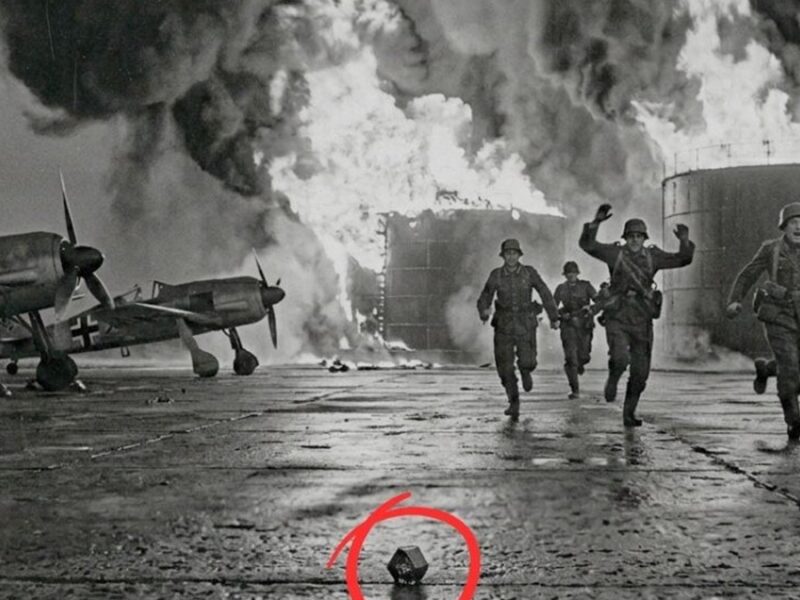
It is the spring of 1943 and somewhere beneath the grey skies of occupied France a Luftwaffe ground crew is going about its morning routine. The airfield is quiet save for the mechanical groaning of engines being warmed and the distant bark of orders carried on a cold wind. Rows of Focke-Wulf 190s sit gleaming under their camouflage netting fully fueled and ready for the day’s sorties.
The fuel high octane aviation spirit precious beyond measure shipped at enormous cost and risk from refineries deep inside the Reich sits in storage tanks just off the apron. It has been there for 3 days. Nobody is particularly worried. Why would they be? The tanks are sealed. The fuel is stable.
And yet within 48 hours one of those tanks will be burning from the inside. Not from a bomb, not from a strafing run. From a crystal no larger than a man’s thumbnail dropped in weeks earlier by a man nobody noticed who left no trace and who was already back across the channel before anyone thought to ask questions. What follows is the story of one of the most elegantly destructive ideas to emerge from the Second World War.
A weapon so simple it bordered on the absurd and so effective it drove German logistics officers to the edge of madness. It is the story of potassium permanganate of a small workshop in London of the men and women who thought not in bullets and bombs but in chemistry and patience and of how a handful of violet crystals helped deny the Luftwaffe the one thing it could not fight without.
To understand why this mattered it is necessary to understand the fuel crisis that Germany was quietly trying to conceal from the world and increasingly from itself. By 1943, the Reich’s aviation fuel supply chain was under enormous strain. The synthetic fuel plants at Leuna, Pölitz, and Blechhammer were producing at near maximum capacity.
And every liter of high-octane Avgas had to be refined, transported by rail, transferred to road tankers, and finally delivered to forward airfields spread across an enormous arc from Norway to North Africa. Each step in that chain was a vulnerability. Each liter that was lost to accident, to spoilage, to enemy action was a liter that could not be replaced quickly.
The Germans knew this. The British knew this, too. The standard approach to denying the enemy his fuel was, of course, strategic bombing. Waves of heavy bombers at enormous cost in air crew and aircraft would attempt to destroy the refineries and storage depots that kept the Luftwaffe airborne. This was important work, and it achieved significant results over the course of the war.
But bombing was blunt. It was expensive. It was visible. It announced itself with a roar that could be heard 40 km away. And it could not reach the small forward fuel dumps, the concealed storage tanks, the dispersed depots that the Germans, learning from experience, were increasingly using to protect their supplies.
What was needed was something that could get inside those dispersed stores, something that could travel quietly, carried by a single person, that would do its work long after the carrier had gone. Something that asked not for a thousand bombers, but for one calm individual with steady hands and good timing.
The answer came not from a weapons laboratory in the conventional sense, but from section D of the Special Operations Executive, working in close collaboration with the boffins at Station Nine, a requisition country house called The Frythe, near Welwyn in Hertfordshire. The Frythe was a peculiar place.
Behind its respectable Edwardian facade, chemists, engineers, and inventors of varying eccentricity worked on the practical science of clandestine warfare. They were not designing tanks or aircraft. They were designing things that could be hidden in a coat pocket, buried in a vegetable garden, or slipped into an enemy fuel supply without anyone being the wiser.
The team responsible for what would become one of their most successful creations was working on a deceptively simple chemical principle, one that any secondary school pupil with a reasonable chemistry teacher might have encountered in a classroom demonstration. Potassium permanganate is, in its natural state, a deep violet crystalline solid.
It has the look of crushed amethyst, or of the kind of mineral a geologist might pick up on a hillside and hold to the light. It is strongly oxidizing, which means it releases oxygen readily and reacts vigorously with materials that can be oxidized, including, crucially, petroleum products. On its own, dropped into a tank of aviation fuel, it would react, but the reaction would be immediate and obvious.
A tank that suddenly erupted or began fuming would alert ground crews instantly. The saboteur’s art required something far more patient than that. The genius of the Station Nine approach was not in selecting potassium permanganate, that was known chemistry, but in solving the timing problem. The crystals needed to be coated, encapsulated in a substance that would dissolve slowly in the fuel, releasing the oxidizing agent only after a delay of hours or days, long enough for the saboteur to be far away. Long enough for the fuel to have been moved perhaps from the depot to the airfield, from the tanker to the aircraft. The coating the chemists settled upon was a wax-based compound, carefully formulated so that it degraded at a predictable rate when immersed in high-octane petroleum. The precise formulation was, and in many
cases remains, classified. What is known is that it worked. The coated crystals, roughly the size of a large grape or a small walnut, depending on the batch, could be prepared to begin their reaction after anywhere from several hours to several days, giving agents in the field the flexibility to match the device to the target.
The manufacturing process was, by the standards of the time, remarkably low-tech. The crystals were prepared at facilities connected to Station 9 and to SOE’s workshops in and around London, wrapped in their wax coatings and then packaged for field use in containers designed to look entirely innocuous.
Lumps of coal, blocks of wood, innocuous-looking sachets. The coal disguise, used for a range of SOE incendiary devices, was particularly effective. A lump of what appeared to be ordinary coal, tossed into a fuel store or left near a heating system, was the kind of thing that a tired sentry in an occupied country might not look at twice.
The potassium permanganate devices were different in their application. They needed to enter the fuel itself. But the principle of disguise was the same. They were compact. They were portable. And they required no technical expertise to deploy. An agent needed only to approach the fuel tank, open it, drop in the device, and walk away.
The entire operation in favorable conditions could take less than 30 seconds. The effects, once the wax coating had dissolved and the potassium permanganate made contact with the fuel, were not immediately explosive Hollywood sense. This was not a device designed to produce a fireball visible from the next village.
Its power was more insidious than that. The permanganate would begin oxidizing components of the fuel, degrading the carefully calibrated octane rating on which high-performance aircraft engines depended absolutely. Aviation fuel for aircraft like the Focke-Wulf 190 or the Messerschmitt 109 had to meet extraordinarily tight specifications.
The wrong octane rating, even slightly wrong, could cause pre-detonation, knocking, inside the engine cylinders. This was not merely an inconvenience. Pre-detonation at high power settings could destroy an engine within minutes, seizing pistons, cracking cylinder heads, and in the worst cases causing engine fires in flight.
The permanganate could also, in sufficient concentration and given enough time, initiate actual combustion within the storage tank itself, producing fires that were difficult to extinguish precisely because the oxidizing agent was already dissolved throughout the fuel supply. A tank fire caused by contaminated fuel looked from the outside like a spontaneous combustion event.
It left, in the absence of a laboratory investigation, no obvious evidence of sabotage at all. If you are finding this interesting, a quick subscribe helps more than you know. The documented operational use of potassium permanganate devices spans multiple theaters and multiple years, though the precise records remain, in many cases, either classified or lost in the chaos of a war that destroyed as many archives as it created.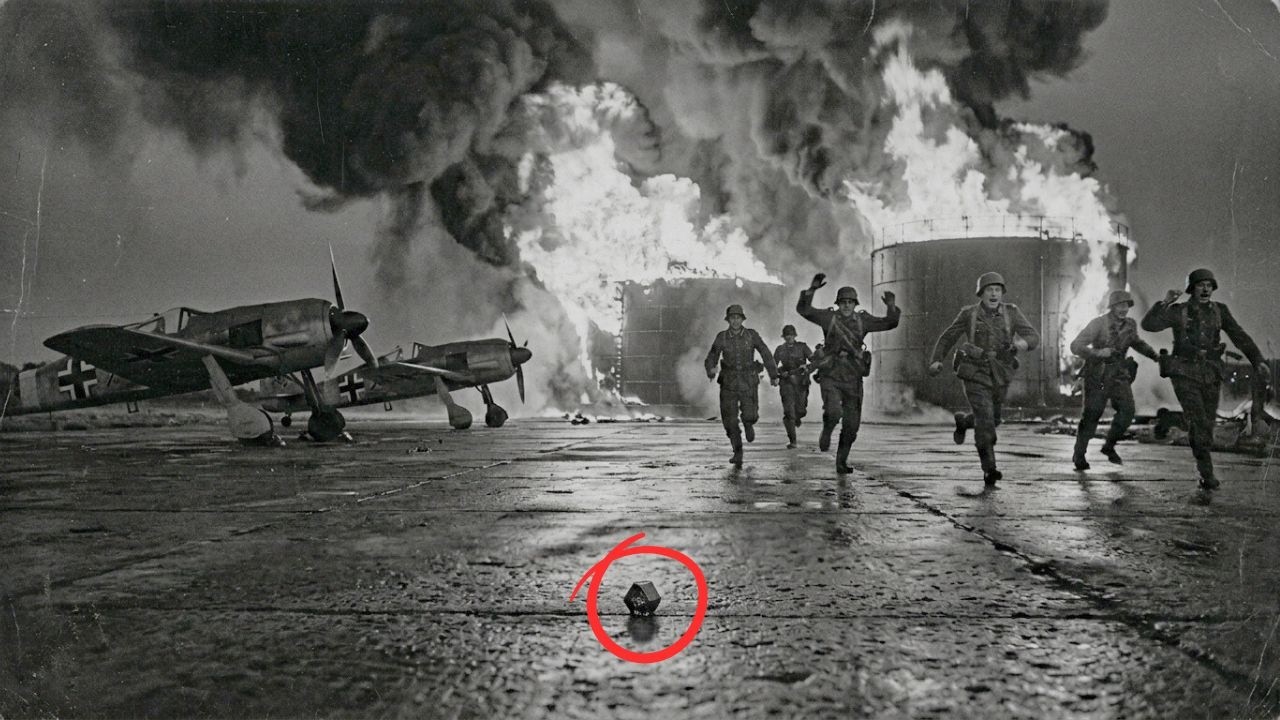
What is known from SOE records, post-war debriefings, and the accounts of agents and resistance members is that the devices were deployed widely across occupied Europe, with particular concentration in France, the Low Countries, and Norway. Resistance networks operating under SOE direction received batches of the devices along with other sabotage materials, and agents were trained in their use at the various SOE schools that operated throughout the British Isles.
The accounts of those who used them describe an operation that was, in practice, nerve-racking in a way that defied its apparent simplicity. Approaching a guarded fuel depot was never a casual matter regardless of how small the device being carried. The Norwegian networks, in particular, developed considerable expertise in fuel sabotage, operating against Luftwaffe installations supporting operations over the North Sea and the Arctic convoys.
In France, the circuits that fed intelligence and sabotage operations to London reported numerous instances of Luftwaffe fuel stores being affected by contamination events that German investigations attributed, at least initially, to manufacturing defects or poor storage practices. This was precisely the point.
The best sabotage is the sabotage that looks like bad luck. It is worth considering, for the sake of fair comparison, what the Germans themselves were doing in this domain, and how the British approach measured up. Germany had its own sabotage and special operations capability. Most famously in the Abwehr under Admiral Canaris, and later in the SS formations that absorbed many of those functions.
German sabotage operations used a range of incendiary and disruptive devices. Some of them chemically sophisticated. The Americans, too, developed fuel contamination devices through the Office of Strategic Services, the OSS, which worked in close collaboration with SOE, and shared technical developments across the Atlantic.
The American equivalents tended towards slightly larger, more robust devices, reflecting a slightly different approach to the problem of field durability. The British devices were optimized for concealability and ease of carriage. Where the German Abwehr made extensive use of trained saboteurs inserted by submarine or parachute, men and women prepared for long deep cover operations, SOE’s approach leaned increasingly on local resistance networks who could not afford to carry conspicuous equipment, and who needed devices that could be passed from hand to hand, hidden in an ordinary jacket, and deployed without specialist training. The permanganate crystal met all of those requirements in a way that bulkier alternatives did not. In terms of pure chemistry, the German technical establishment was perfectly aware of potassium permanganate’s properties.
It was not a secret compound. The innovation was entirely in its weaponization. In the coating, in the packaging, and in the distribution system that got it from Hertfordshire to a fuel dump in the Pas-de-Calais. Assessing the actual strategic impact of fuel contamination operations is genuinely difficult.
And it would be dishonest to overstate the case. The Luftwaffe’s fuel crisis of 1943 to 1945 was driven primarily by Allied strategic bombing of synthetic fuel plants and the attrition of the German tanker fleet. Sabotage operations, including but not limited to potassium permanganate devices, were one element of a much larger effort.
What is clear is that the cumulative effect of contamination events added a layer of uncertainty and inefficiency to German fuel logistics that had measurable operational consequences. When a Luftwaffe ground crew could not be certain whether a batch of fuel was uncontaminated, when engines were failing in ways that ground engineers could not immediately explain, when storage tanks were catching fire without obvious external cause, the administrative and psychological burden on German airfield operations was real and continuous. Mechanics spent time testing fuel that would previously have gone straight into aircraft. Investigations were launched. Suspicion fell on French workers, on local contractors, on anyone who had had access to the stores. This disruption, the friction added to every routine operation, was itself a form of damage that the permanganate crystals inflicted
independently of any fire they started or engine they damaged. The legacy of Station 9 and its chemical sabotage work extended well beyond 1945. The basic principle using chemistry rather than explosive to deny an enemy a critical resource influenced thinking about unconventional warfare throughout the Cold War period.
The idea that a small covert team could impose disproportionate costs on a sophisticated military adversary through carefully targeted low signature intervention became a cornerstone of Western special operations doctrine. The SOE was disbanded in January 1946. Its records scattered between the war office, MI6, and a bonfire of inconvenient documents that historians have been mourning ever since.
But the intellectual inheritance passed on. The men and women of station nine who had thought so carefully about how to make a crystal work for 30 seconds and caused damage for three days contributed to a tradition of lateral thinking about warfare that persists in the special operations community to this day.
Some of the devices they developed are preserved at the Imperial War Museum in London where they sit in glass cases and look to the uninitiated entirely harmless which is of course exactly the point. A lump of coal, a small waxy pellet the sort of thing you would walk past without a second glance. Come back then to that airfield in France in the spring of 1943.
The ground crew has gone about its morning. The fog wolves have been armed and fueled. Somewhere in the logistics chain three days ago or perhaps a week ago a quiet individual with a forged identity document did something unremarkable opened a hatch reached into a pocket withdrew something no larger than a large olive, dropped it in, closed the hatch, and kept walking.
The crystals are already at work now, dissolving slowly in 10,000 L of precious aviation spirit. Their wax coatings thinning with every hour that passes. The ground crew knows nothing of this. The pilots know nothing. The Luftwaffe intelligence officer, who will be asked to investigate in 2 days time, knows nothing yet, either.
The war, to everyone on that airfield, is proceeding normally. Then the tank begins to smoke. Then, it begins to burn. And three Focke-Wulfs that were supposed to be over the channel at noon are still on the ground at 4:00 in the afternoon, while mechanics with foam extinguishers try to understand what happened.
Three sorties canceled. Three opportunities to contest Allied air superiority over northern France gone. Multiply that by the number of operations running simultaneously across occupied Europe. Multiply it by the months and years the campaign ran, and the arithmetic of patience begins to look very different from the arithmetic of bombs and aircraft and air crew lost over German cities.
The potassium permanganate crystal did not win the air war. Nothing so small could claim that credit. But it did something that no bomber could do. It got inside the system. It traveled in a coat pocket across a checkpoint, through a gate, past a sentry, and into the heart of the enemy’s most critical resource.
It asked nothing of the man or woman carrying it except nerve. It required no fuse, no detonator, no training beyond the instruction to open and drop. And it burned quietly and without drama from the inside. In a war decided by the accumulation of countless small advantages, that was not nothing. That was in its own modest and violet-colored way, rather a great deal.