The ‘Ugly’ American Mine Truck That Made Roadside Bombs Useless And Saved Hundreds Of Lives In Iraq D
2003, a highway south of Baghdad, Iraq. A vehicle lumbers onto the road. It is enormous, 25 tons of welded steel riding on six wheels, rising 13 ft into the air. Its nose a blunt fist aimed at the tarmac. From the front bumper, a mechanical arm extends 30 ft forward ending in a claw. The thing looks industrial, slow, wrong for a war zone.
Soldiers watch it pass. Some laugh. One calls it a junkyard crane on wheels. Within that same year, improvised explosive devices will kill or maim more American soldiers than any other weapon in Iraq. Flat-bottomed vehicles designed for a Cold War that never came are shattering under blasts that rise straight through the floor and into the crew. Humvees are burning.
Bodies are being recovered from the roadside. The ugly machine rolls forward. Its claw prods the earth. It finds a buried bomb. The crew sits behind 6 in of armored glass, safe. By the time American forces leave Iraq, this vehicle will have absorbed nearly 1,000 bomb detonations. Its crews will survive blast after blast that would have killed everyone in any other vehicle on the road.
It will become the most important piece of machinery in the American military’s war against the roadside bomb, and it will sit at the center of one of the most damning procurement scandals in the history of modern warfare. Its designation is the Buffalo MPV, Mine Protected Clearance Vehicle, and it is the machine that proved the roadside bomb could be beaten.
To understand why the Buffalo existed, you need to understand what was happening to American soldiers on Iraqi roads in 2003 and 2004. The improvised explosive device, the IED, was not a new weapon. Insurgents in Iraq had learned quickly that the most powerful military on earth was vulnerable at the wheel. A vehicle moving down a road is predictable.
A bomb buried under that road is invisible, and the problem was not the size of the blast. The problem was geometry. The M1114 up-armored Humvee, the standard vehicle the United States Army was sending down those roads, had a flat underside. When an IED detonated beneath it, the blast traveled in the path of least resistance, which was straight up through the floor.
The force had nowhere to go except through the vehicle and through the people inside. The Humvee absorbed the energy, the crew paid the price. By 2005, the Brookings Institution’s Iraq Index reported that IEDs were responsible for 80% of all American soldier casualties in Iraq, deaths and injuries combined, 80% from one weapon buried in the road.
The answer to that weapon had existed for 30 years. It had simply come from a place no American procurement officer was looking. In 1970, the South African Council for Scientific and Industrial Research, the CSIR, received a formal request from the South African Defense Force to develop vehicles that could survive mine blasts.
South African forces were fighting a long insurgency along the border into Namibia and Angola against opponents who had learned to bury Soviet anti-tank mines along every patrol route. The mines were not sophisticated, but they were lethal and they were everywhere. Dr. Vernon Joynt, a South African engineer at the CSIR, spent the next decade developing a principle that would change armored vehicle design forever.
He called it the V-hull. Instead of a flat floor that caught a blast and channeled it upward, the hull of the vehicle was angled sharply on both sides like the bottom of a boat. When a mine detonated beneath it, the blast spread outward along the angles rather than upward into the crew.
The force was deflected, the vehicle was damaged. The people inside survived. Joynt and his team produced a series of vehicles through the 1970s and early ’80s, most famously the Casspir, a four-wheeled armored carrier that became the benchmark of mine protected design. More than 2,500 Casspirs were built. They fought through the South African Border War.
They were later used by United Nations demining operations in Mozambique, Angola, and Sudan. They proved, over decades of brutal use in the Southern African bush, that a V-hull would keep a crew alive. In 1999, the United States Army was running a program at Fort Leonard Wood, Missouri to develop a ground-based mine detection vehicle.
A South African firm called Mechem submitted an entry, the Lion II, a direct descendant of joint CSIR designs. The Americans tested it. In early 2001, they selected it as the basis of what would become the Buffalo. The company that built it was Force Protection Incorporated, based in Ladson, South Carolina. In 2002, they delivered the first 10 vehicles under a $6.5 million contract.
Vernon Johns himself was hired as chief scientist. The man who had spent 30 years designing mine protected vehicles for the African bush had moved to South Carolina to apply the same ideas to the roads of Iraq. The vehicle that resulted was unlike anything in the American military inventory.
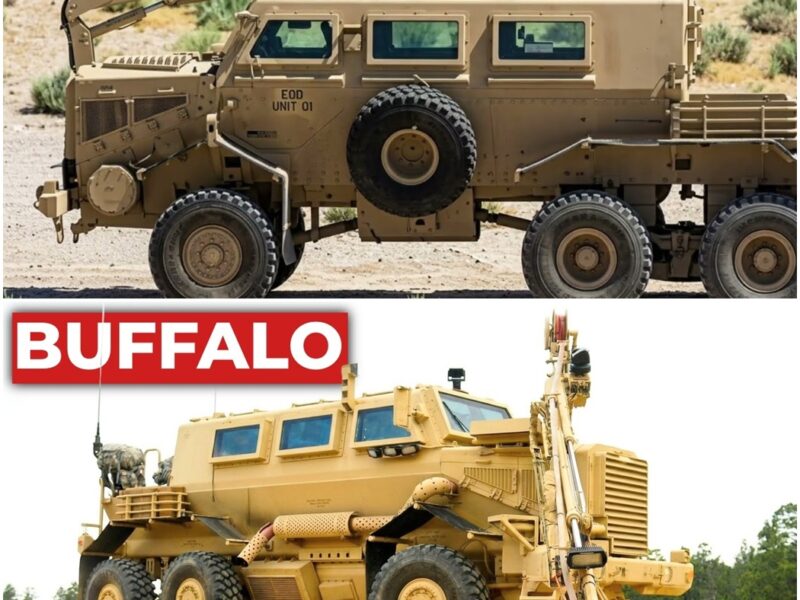
The Buffalo stood 13 ft tall on six driven wheels. It weighed 45,320 lb in base configuration and up to 56,000 lb combat loaded. Its hull was welded monocoque steel, angled in a sharp V beneath the crew compartment. Under any single wheel, it could survive the detonation of 45 lb of explosives. Under the center line of the hull, 30 lb. These were not estimates.
They were certified blast tolerances, proven in repeated South African test detonations before a single Buffalo rolled into Iraq. The crew of six sat inside a capsule of 6-in laminated armored glass, not 6 mm, 6 in. Standard vehicle glass would shatter at the first blast. Buffalo glass did not. The defining feature was the arm.
From the front right corner of the bumper, a hydraulically actuated claw extended 30 ft ahead of the vehicle. The operator inside the capsule could probe suspected IEDs, dig down into the roadbed, inspect buried objects, and place a demolition charge, all without any crew member leaving the vehicle.
The crew never had to step outside the armor to do their job. The machine did it for them. Top speed was 65 mph on a paved road. Range was 300 miles on 85 gallons of fuel. A Caterpillar C13 engine producing 440 horsepower pushed it through terrain that would have stopped most military trucks. It was not elegant.
It was not subtle. But on the roads of Iraq, where IEDs were killing soldiers every week, it was the most survivable vehicle the United States had ever put into a war zone. Now, before we get into what the Buffalo actually did on those roads, and the extraordinary story of how it saved lives again and again when nothing else could, if you are finding this deep dive into modern military engineering valuable, hit subscribe.
It takes 1 second and costs nothing, and it helps the channel grow. The 895th Engineer Battalion received Buffaloes in Iraq in 2003. Assigned to route clearance operations across the most dangerous corridors around Baghdad, the mission was called the route clearance patrol. A team of vehicles with the Buffalo at the front would move down a designated road.
The arm probing culverts, soft shoulders, and suspicious patches of disturbed earth hunting for buried bombs before the convoys behind them drove over them. Staff Sergeant Ryan Grandstaff of the Ohio National Guard 612th Engineer Battalion told reporters in 2005 that he had been through countless explosions inside a Buffalo. He was still alive.
He said the vehicle made him feel 100% safe. Specialist Feldman, operating out of Camp Striker south of Baghdad Airport in 2007, gave a figure that stopped people in their tracks. His crew had found 150 IEDs and been struck 60 times in 9 months of operations. 210 IED events in a single deployment. His crew was intact. Scott Sexton, a demolition specialist with the Kentucky Army National Guard, survived four IED detonations, three of them inside a Buffalo.
He described the experience plainly. He said you would be sitting there, and all of a sudden you would hit something, and the entire front of your truck would be gone. The blast would peel away the the arm and shred the bumper, and leave a crater in the road and the crew would be alive. By October 31st of 2006, Force Protection Vice President Wayne Phillips stated publicly that Cougar and Buffalo vehicles had absorbed approximately 1,000 IED hits since their 2003 deployment to Iraq with no loss of life.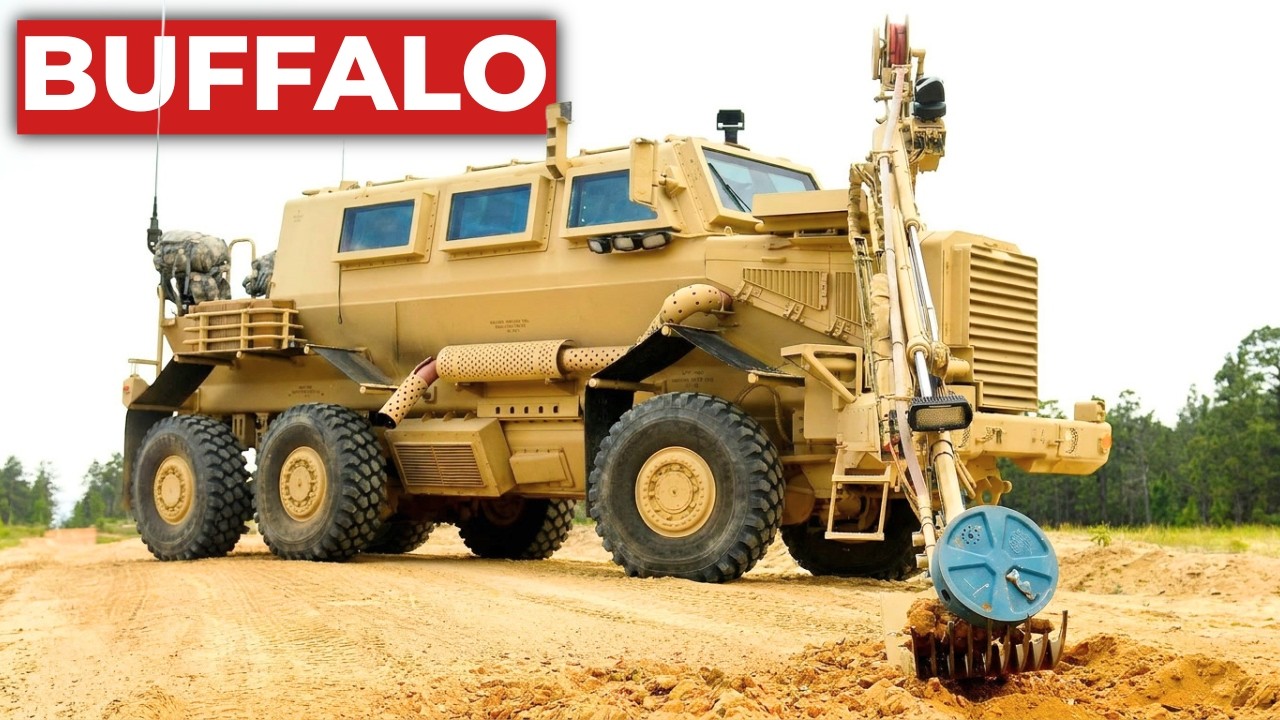
An unnamed military medic was quoted as having said the Buffalo had saved his life 13 separate times. The Army National Ground Intelligence Center’s Anti-Armor Incident Database, covering 2005 to 2011, was cited by then Deputy Secretary of Defense Ashton Carter in a statement to the press. The data showed that a soldier was between 9 and 14 times less likely to be killed in an MRAP than in a Humvee.
14 times less likely to die. In Afghanistan, the story continued. The 530th Combat Engineers operated Buffaloes around Spin Boldak in Kandahar province, working routes that insurgents had seeded with homemade explosives packed into culverts and buried beneath the loose gravel of secondary roads.
The 883rd Engineer Battalion North Carolina Army National Guard ran clearance patrols out of Forward Operating Base Laghman in Zabul province in 2012. The arm probed, the claw dug, the crew came home, but the Buffalo story carries a wound alongside its record of survival. It is the story of how a vehicle already proven to keep soldiers alive should have been fielded years earlier and was not because of bureaucracy, institutional inertia, and decisions made by men who were not the ones dying in Humvees. In February of 2005, Brigadier General Dennis Hejlik, commanding Multinational Force West in Iraq, signed an urgent operational needs request for 1,169 MRAP-type vehicles. His letter stated plainly that Marines could not continue taking serious and grave casualties from roadside bombs when a commercial solution already existed and was already working in theater. The Marine Corps quietly stopped processing the request in August of 2005. The commandant at the time, General Michael Hagee, preferred
to continue with up-armored Humvees, viewing them as the quickest path to improve protection. In January of 2008, Marine Corps civilian science advisor Franz Gayle, who had spent 5 months in Iraq with the First Marine Expeditionary Force, delivered an internal report to the Marine Corps leadership.
His conclusion was that bureaucratic delays, occurring after Hedglick’s request was filed and ignored, had cost hundreds of American lives. He wrote that if mass procurement of MRAPs had begun in 2005, hundreds of deaths and injuries would have been prevented. The report triggered an investigation by the Department of Defense Inspector General, which confirmed that the department had known of the mine and IED threat in Iraq before the 2003 invasion, and had not pursued MRAP type vehicles.
On May 8th, 2007, Secretary of Defense Robert Gates declared the MRAP program the Department of Defense’s number one acquisition priority, committing $1.1 billion in fiscal year 2007 alone. The first vehicles from that surge arrived in Iraq in July of 2007, 2 years after Hedglick’s letter, hundreds of funerals after his letter.
On paper, the up-armored Humvee looked like the sensible solution. It was already in production. It was cheaper. It was faster across rough terrain. The Army knew how to maintain it and how to crew it. Every logistics argument favored it. In practice, its flat underside made it a collector of blast energy.
Every IED it drove over transferred maximum force directly into the crew. The Buffalo deflected that energy outward with each detonation. The Humvee carried a crew of four and offered them what amounted to a sealed metal box above a flat plate aimed at the ground. The Buffalo carried a crew of six in a monocoque capsule behind 6-in glass, riding above a hull designed by a scientist who had watched what blast energy actually does to metal and to people.
The Cougar, a smaller vehicle from the same Force Protection family, posted similar survival figures for convoy escort and patrol operations. The MaxxPro MRAP, fielded later in the surge extended comparable protection to infantry units, but neither could do what the Buffalo did. Neither carried a 30-ft interrogation arm, neither could probe a culvert from inside an armored capsule.
The Buffalo’s specialist function, route clearance, was not replaceable by any other vehicle in the American arsenal. Force Protection was acquired by General Dynamics Land Systems in December of 2011 for $350 million. Production of the Buffalo ran until June of 2014 when the 795th vehicle came off the line.
The United Kingdom took delivery of 18 Buffaloes for Royal Engineers clearance operations in Afghanistan. Canada acquired 15 to 19. Italy, France, and Pakistan received smaller numbers. As recently as August of 2024, the Ukrainian Ministry of Defense approved the transfer of Buffalo vehicles to Ukraine.
The Pentagon’s MRAP Joint Program Office estimated that the entire MRAP family of vehicles, the Cougar, the MaxxPro, the Buffalo, and the others, saved up to 40,000 lives across Iraq and Afghanistan combined. 2003, a highway south of Baghdad, a machine that looked like a junkyard crane rolled down the road. It was slow.
It was vast. It was ugly in a way that made soldiers laugh the first time they saw it. It had no cannon, no armor-piercing ammunition, no missile. Its weapons were geometry and mass and a 30-ft claw and 6-in of laminated glass. It had no night vision system in its earliest variants.
It was too wide for some Iraqi roads. Insurgents could see it coming from half a mile away. Its front arm would be sheared off by a large enough blast and need replacing. None of that changed what it was because the geometry it carried had been developed in a South African laboratory in 1970, proven in the Namibian bush across 15 years of border warfare, ignored by American procurement for two decades, and then deployed too late and too few just in time to save the lives it could.
A soldier who rode in a Buffalo was 14 times less likely to die than a soldier who wrote in a Humvee. That is not luck. That is the difference between a vehicle designed around the threat and a vehicle designed before anyone admitted the threat existed. Hundreds of soldiers came home because someone finally asked the right question.
The answer had been waiting since 1970.