The ‘Unknown’ Colombian Armored Vehicle Built For A Jungle War No Foreign Designer Ever Solved D
2011, a defense exhibition hall in Paris, France. Millipol, the largest internal security trade show in Europe. Hundreds of European, American, and Israeli defense contractors line the floor with armored vehicles, surveillance drones, and tactical communications platforms worth billions. And in one corner of the exhibition, almost unnoticed, a small Colombian company called Armor International, rolls out something that nobody in the room has ever seen before.
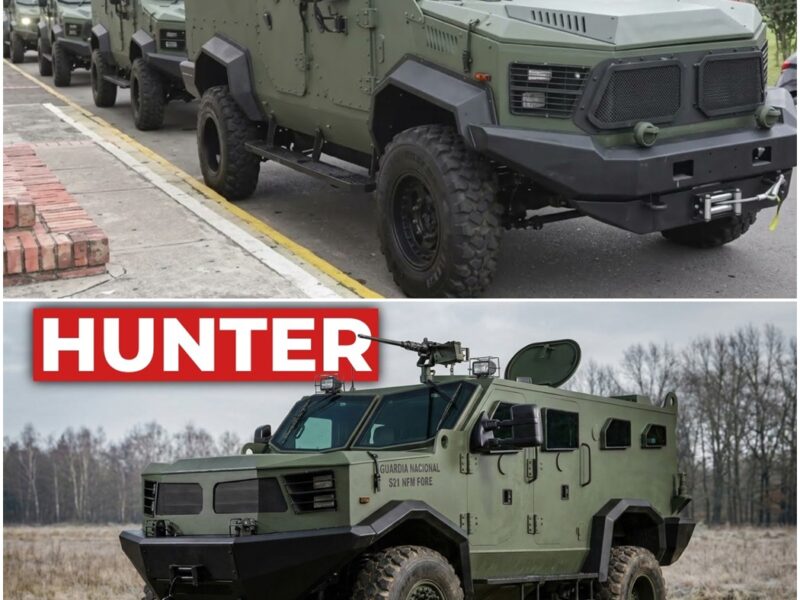
It is a 4×4 armored truck. It weighs just over 9,000 kg. Its hull sits high off the ground on a reinforced chassis. And underneath, the belly is shaped into a sharp V angled to deflect blast energy outward and away from anyone sitting inside. The armor is rated to stop 7.62 mm armor-piercing rifle rounds at close range.
A turret ring on the roof can mount a 12.7 mm heavy machine gun, a 7.62 mm generalpurpose weapon, or a 40 mm automatic grenade launcher. It carries 12 people, a driver, a commander, and 10 fully equipped soldiers. And it can do all of this for a unit price of roughly $190,000. It looked like something a wealthier nation would have thrown together in a weekend. It looked improvised.
It looked like a country that had no business building armored vehicles had tried anyway. It would go on to become the only Colombian designed armored vehicle ever exported to a foreign military. It would be tested in live combat against guerilla ambushes, roadside bombs, mortar attacks, and sustained rifle fire across some of the most difficult terrain on Earth.
And according to its manufacturer, not a single occupant has ever been killed or seriously injured inside one. Its designation was the Hunter TR12, and it was the product of a war that lasted over 50 years, a war that no foreign arms dealer ever truly understood, and a war that Colombia eventually had to solve on its own.
To understand why the Hunter TR12 existed, you need to understand the problem Colombia faced at the turn of the 21st century. The Colombian armed conflict, which had begun in 1964 with the formation of the Revolutionary Armed Forces of Colombia, known by its Spanish acronym FRC, had by the late 1990s escalated into something that resembled a full-scale civil war fought across terrain that defied every conventional military doctrine ever written.
Colombia is not one landscape. It is at least five. The Andes split into three separate mountain chains running north to south, creating corridors of altitude that climb from sea level to over 5,000 m. To the east lie the vast grasslands of the Yanos and then the Amazon basin, some of the densest jungle on the planet.
To the west and northwest, the Pacific coast descends into lowland rainforests so thick that entire FC columns could move for weeks without being seen from the air. And connecting all of this was secondary roads, unpaved, winding through mountain passes and river valleys, where a single improvised explosive device could destroy a military convoy and vanish the attackers into terrain that swallowed pursuit. Colombia had armored vehicles.
It had imported over 128 Brazilian E9 Caskavl armored reconnaissance cars and 56 E11 U2 armored personnel carriers from Engizer in the 1980s. These were decent machines for their era. Flatbottomed, wheeled, built for open terrain and conventional engagements. But by the mid 1990s, two things had gone catastrophically wrong.
First, Enisa went bankrupt. The Brazilian manufacturer filed for protection in 1990 and was formally dissolved by a Brazilian court on October 18th, 1993. The spare parts pipeline died overnight. Colombian Army Mechanics was suddenly maintaining a fleet of nearly 200 armored vehicles with no manufacturer support, no replacement components, and no clear path forward.
Second, the FRC changed tactics. By 2000, the guerrillas had shifted decisively toward improvised explosive devices as their primary weapon against military movement. And the Uru, with its flat hull designed for a different kind of war, was exactly the wrong vehicle to survive a blast from below. Colombia needed something new.
It needed a vehicle that could survive mine and IED attacks on unpaved mountain roads. It needed a vehicle light enough to cross bridges rated for civilian truck traffic because most Colombian rural infrastructure was never built for military loads. It needed a vehicle that could ford rivers, climb 60% gradients, and operate for extended periods in temperatures ranging from the freezing Andian highlands to the suffocating heat of the Amazon basin.
It needed a vehicle that could be maintained by ordinary army mechanics using commercial truck components available in Bogotaar. not specialized European or American parts ordered from a catalog and shipped across the Atlantic. And it needed all of this at a price that a nation spending most of its defense budget on manpower and helicopters could actually afford.
No major foreign manufacturer had ever designed a vehicle for this specific combination of requirements. The American M117 armored security vehicle, which Colombia would later receive in large numbers through United States excess defense articles programs, was effective, but cost roughly 10 times more per unit. The Canadian LAV3, of which Colombia purchased 24 in a $65.
3 million Canadian contract in 2013, was a superb machine, but was designed for a different doctrine entirely. Conventional combined arms warfare on open terrain, not counterinsurgency on jungle roads. The South African mine reses vehicles that had emerged from the bush wars of the 1970s and 80s were closer in concept, but they were designed for the African savannah, not the Andes.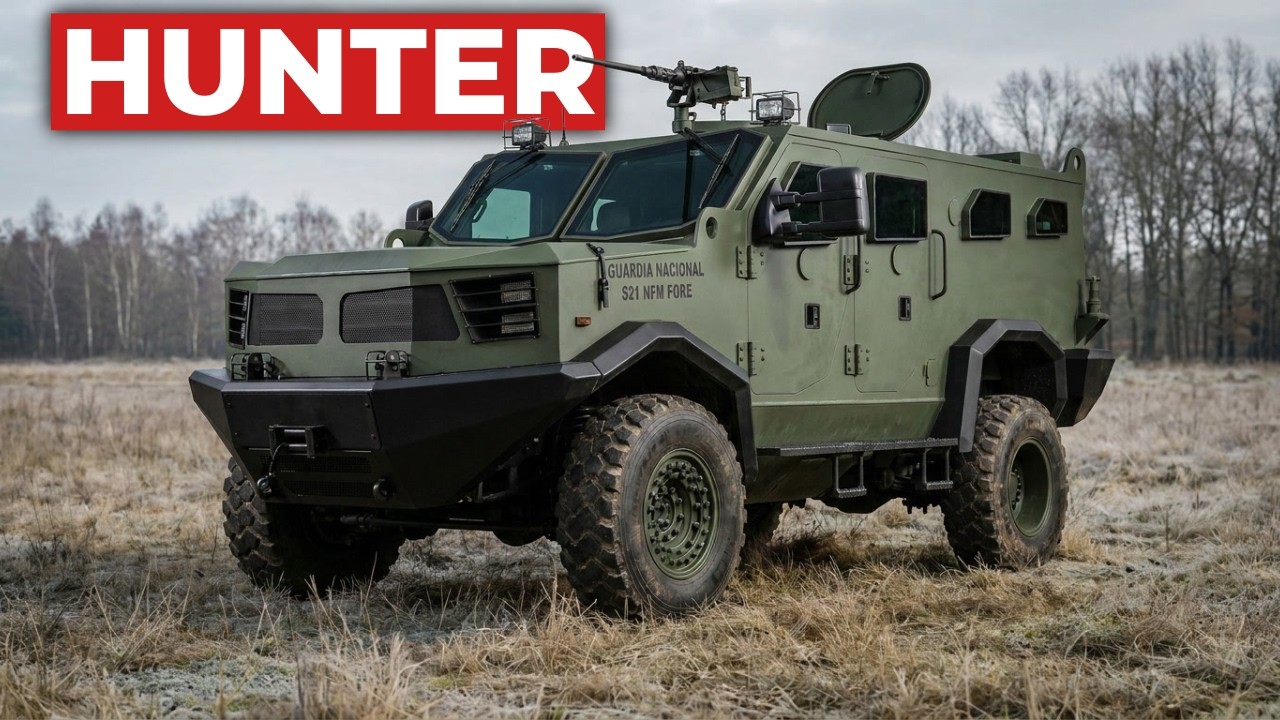
Armor International, a private Colombian firm founded in Bogatar in 1984, had spent two decades armoring civilian vehicles, cash and transit trucks, executive sedans, and government cars for a country where kidnapping and assassination had been facts of daily life for generations. By the 2000s, the company had accumulated more practical experience in ballistic protection engineering than most boutique defense firms in Europe.
What it had never done was build a purpose-designed military vehicle from the ground up. The Hunter TR12 changed that. The vehicle was built on a commercial Ford chassis using a 6,700 cm Ford V8 turbo diesel engine, producing 300 horsepower at 2,800 revolutions per minute and 660 lb feet of torque at 1,600 revolutions per minute, mated to a six-speed automatic transmission and a permanent four-wheel drive system.
The choice of a commercial powertrain was deliberate. Every component, every gasket, every belt, every filter could be sourced from a Ford dealership in any major Colombian city. The vehicle did not require a specialized military supply chain. It required a phone call. The hull was welded steel, rated to B6 under the European EN 1063 ballistic standard, meaning it could defeat multiple hits from 7.
62 by 51 mm NATO armor-piercing rounds at a range that simulated close-range ambush conditions. The V-shaped underbody was designed to channel blast energy from mines and IEDs outward and downward away from the crew compartment. The wheelbase measured 3,580 mm. Overall length was 6,500 mm. Width was 2,420 mm. Height was 2,600 mm.
Ground clearance was sufficient for the ruted washedout tracks that passed for roads in Ceta, Putumo, and the Choco. Now, before we get into where the Hunter actually fought and how it performed under fire, if you are enjoying this deep dive into Colombian military engineering and the story of a country that built its own answer to a war nobody else could solve, hit subscribe.
It takes a second, costs nothing, and helps the channel grow. The Hunter TR12 entered Colombian Army Service in December of 2012, just 1 month after the Army formally selected it in November of that year. But the initial procurement was not conventional. The first vehicles were not purchased through the Colombian ministry of defense.
They were donated to the army and the national police by the state oil company Eco Patrol by the meta departmental government and by the national roads agency known as INV. This was a pattern unique to Colombia where civilian institutions operating in conflict zones, oil pipelines, highway construction projects, and agricultural cooperatives had a direct stake in military protection and sometimes purchased the equipment themselves.
Deployments concentrated in southern Colombia in the departments of Hila, Cata, and Putayo where FARC dissident factions and ELN guerilla columns remained active even as the broader FRC peace process advanced toward the 2016 Havana Accords. The terrain was exactly what the vehicle had been designed for.
narrow mountain roads descending into jungle valleys, river crossings without bridges, ambush corridors where tree cover came within meters of the road surface, and IEDs buried in culverts hidden under road surfaces and detonated by command wire or pressure plate. According to Armor International marketing director Caesar Castro speaking in a January 2024 interview with Zona Militar, the Hunter TR12 was tested in multiple realorld combat engagements across Colombia and demonstrated excellent performance, resisting attacks as promised. According to the manufacturer, no occupant has been killed or seriously injured inside a Hunter during its more than a decade of operational service. Whether independent verification of this claim exists in Colombian military records remains unclear as the Ministry of Defense does not publish disagregated vehicle survivability data. The vehicle also saw service with the Colombian National Police which received four units for high-risisk patrol and rapid response operations. And then came something no one in Bogotaar had
expected, export orders. Surinam purchased a single hunter for its armed forces. And in 2024, Chile’s Caribbeanos, the National Police Force, took delivery of four Hunter TR12s for public order and security operations, making Colombia an armored vehicle exporter. For the first time in its history, on paper, the Hunter TR12 does not compare favorably to the vehicles that wealthier nations sent to Colombia.
The Canadian LAV6, 55 of which were ordered under a $418 million Canadian dollar contract announced in June 2023, is a vastly more capable platform with superior armor, a larger weapon station, amphibious capability, and full digital integration. The American M117, of which Colombia has now received over 269 units across four separate deliveries, offers heavier protection and a proven 40-year track record.
The Israeli Plan Sandat, also in Colombian service, brings cuttingedge composite armor technology that steel alone cannot match. But none of those vehicles were designed in Colombia. None of them were built by Colombians. None of them can be maintained with parts from a commercial dealership in Bogatar, and none of them cost $190,000.
The Hunter exists alongside Colombia’s other indigenous armored programs. the Mdicol family of prototype vehicles dating back to the Zipper of 1993, the ISBI Blindia’s Meteoro and Kodiak conversions used in highway protection, and the army’s own BAN workshop built Buffalo and Cobra conversions.
But the Hunter is the only one that crossed the line from prototype to sustained production, from domestic service to foreign export, from a sketch on an engineer’s desk in Bogotaar to a vehicle standing in formation with Chilean police halfway down the continent. At Expo Defenser 2025, Armor International unveiled the Hunter TR122026, an upgraded variant built on a Navastar defense chassis with a reference combat weight of 10.
2 metric tons, designed to compete in international markets, including Ecuador and the United States. 2011, a defense exhibition in Paris. A small Colombian company rolls out a vehicle that looks improvised, looks too simple, looks like it was built by a country that had no business trying. It had no composite armor.
It had no digital battle management system. It had no independent suspension or run flat tire inserts. It had a commercial Ford engine and welded steel plates and a price tag that most European defense contractors would mistake for a rounding error. And yet not a single soldier has died inside one.
It worked in the mountains of Hila. It worked in the jungles of Puayo. It worked on the shattered roads of Ceta where billiondollar foreign platforms were never designed to go. It was not elegant. It was not advanced. It was Colombian. Built by a country that fought the longest internal conflict in the Western Hemisphere.
Built because nobody else was going to solve the problem. And built to keep 12 people alive on the worst roads on Earth. That is not luck. That is what happens when a nation stops waiting for someone else to save