The ‘Unreliable’ British Tank That Fought Rommel Despite Catching Fire Every Other Engagement D
June, 1941. The docks at Alexandria, Egypt. Cranes swing crated steel off the deck of a transport ship that has spent 3 months sailing the long way around Africa to avoid the Mediterranean. On the quayside, British fitters unbolt shipping frames and drain preservative oil from engine blocks.
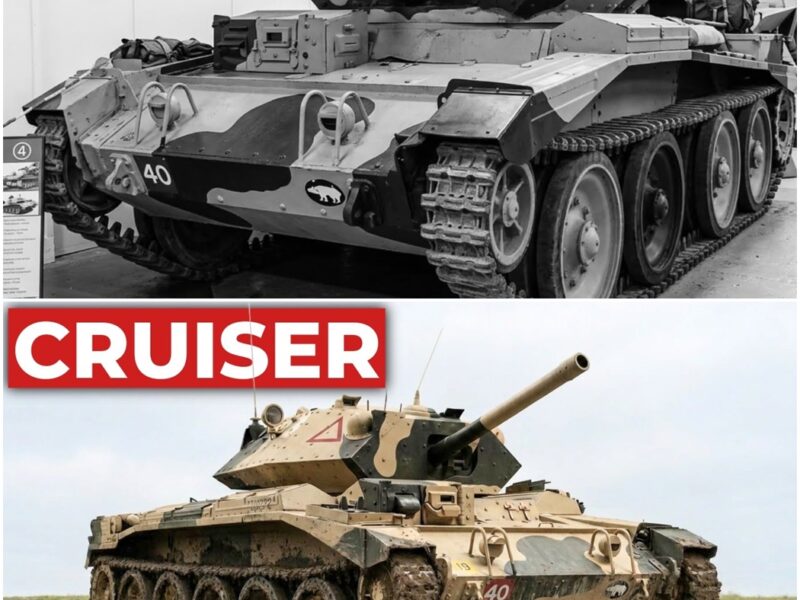
What rolls off the transporter ramps and onto Egyptian concrete is a low-slung cruiser tank painted desert yellow with a turret barely taller than a standing man. Five Christie suspension wheels per side, a compact 2-pounder gun, and a small auxiliary turret bolted beside the driver’s hatch mounting a single machine gun that no crew will ever want to fire.
It looked fast. It looked elegant. It looked, for once, like Britain had built something that could actually keep pace with a Panzer. It could not keep pace with anything because its engine would overheat before it reached the battlefield. Over the next 18 months, tanks exactly like this one would fight in every major engagement of the Western Desert Campaign.
They would charge German anti-tank screens at Halfaya Pass, burn across the escarpments at Sidi Rezegh, retreat through the disaster at Gazala, and hold the line at El Alamein. More than 5,300 would be built. An entire British offensive would be named after them. And for most of that war, they would break down faster than the enemy could destroy them.
Its designation was the Cruiser Tank Mark VI, the A15. The British Army called it the Crusader, and it was the most unreliable tank that ever won a desert war. To understand why the Crusader existed, you need to understand the problem Britain faced in 1938. The army needed a new generation of fast cruiser tanks to replace the obsolete A9 and A13 designs, and it needed them in enormous numbers before a war that everyone could see coming.
The General Staff issued two parallel specifications. One went to the London, Midland, and Scottish Railways Engineering Division, which produced the Covenanter. The other went to Nuffield Mechanizations and Aero, the armaments arm of Lord Nuffield’s motor empire, which produced the Crusader.
Nuffield had been offered a share of Covenanter production. They refused. They wanted to build their own tank their own standards with their own engine. That engine was the problem. The Nuffield Liberty was a development of the American Liberty L12, a 27-liter 512 aircraft engine originally designed in 1917.
Its creators, Jesse Vincent of Packard and Elbert Hall of Hall-Scott, had laid out the complete design in just five days at the Willard Hotel in Washington. It was brilliant for its era. Over 20,000 were built before the end of the First World War. It powered everything from bombers to speedy boats to experimental tanks.
And by 1940, it was 23 years old. Nuffield reconfigured the Liberty to fit the Crusader’s deliberately low hull profile. The modification wrecked the water pumps. It compromised the cooling fan drive. It created an engine base so cramped that desert sand choked every seal and filter the moment the tank moved.
The engine produced 340 horsepower, enough to push the Crusader to 27 mph on a good road, but in the Libyan desert at temperatures exceeding 40° C, the cooling system could not dissipate the heat fast enough. Engines seized. Oil leaked between block and cylinders. Fan drive chains snapped. Tanks that could outrun a Panzer III on paper could not complete a 50-mile approach march without half the squadron falling out of line.
The armament compounded the problem. The 2-pounder gun was adequate against light armor, but it had no high explosive round. A Crusader crew that encountered enemy infantry or anti-tank guns dug into defensive positions had exactly one option, and that was to charge directly at them. The auxiliary turret of the driver was so cramped and poorly ventilated that firing the BESA machine gun inside it filled both the gunner’s and the driver’s compartments with choking cordite fumes.
Most crews simply left it unmanned. Many units removed it entirely. Armor protection was thin, 40 mm on the hull front of the Mark I, 14 mm on the sides. A tank that was designed to exploit breakthroughs with speed had neither the protection to survive a firefight nor the reliability to sustain the speed it was built around, and yet Britain had nothing else.
The Crusader entered mass production before the prototype trials were even complete, ordered straight off the drawing board because the war office could not afford to wait. Now, before we get into where the Crusader actually fought, if you are enjoying this deep dive into British armored warfare, hit subscribe. It costs nothing, takes a second, and helps the channel cover more vehicles like this one.
The Crusader’s combat debut was Operation Battleaxe, launched on June 15th, 1941, to relieve the besieged garrison at Tobruk. 50 Crusaders of the 6th Royal Tank Regiment, 7th Armoured Brigade, rolled forward into the desert south of Halfaya Pass. At Hafid Ridge, B Squadron pursued what appeared to be a retreating German column over a low rise.
On the far side, concealed and waiting, was a screen of 88-mm anti-tank guns. 11 Crusaders were destroyed within minutes. Six more were heavily damaged. By the end of the first day, the 6th RTR had gone from 50 runners to roughly 20 by the end of the three-day battle. British forces had lost around 91 tanks. The Germans had lost 12.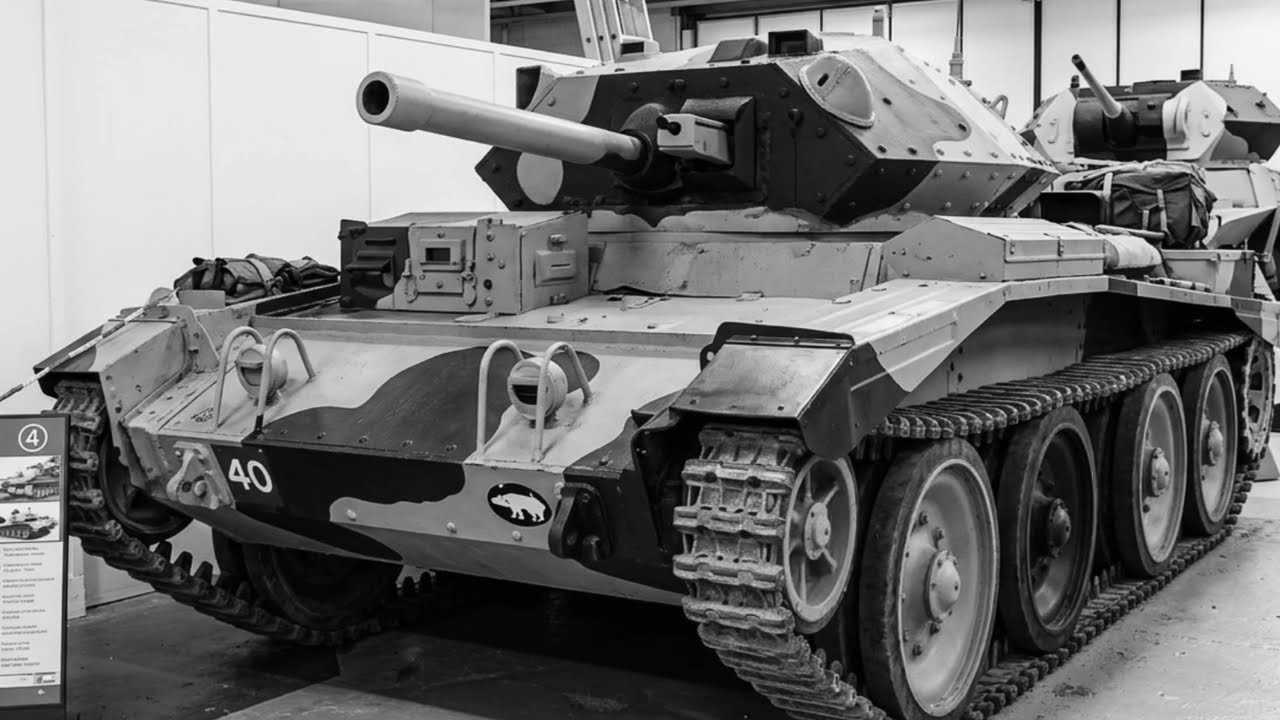
Battleaxe was not a defeat. It was an education in how not to use armor against prepared defenses. Five months later came the offensive that bore the Crusader’s name, Operation Crusader, launched on November 18th, 1941, was the 8th Army’s second attempt to relieve Tobruk. Roughly 770 British tanks advanced into Cyrenaica, and the Crusader formed the armored core of the attack.
At Bir el Gubi on November 19th, the 22nd Armoured Brigade, fresh from England and largely untested, charged the dug-in Italian Ariete Division. The Italians held. 25 Crusaders were knocked out against 34 Italian tanks destroyed. It was one of the few clear Italian armored victories of the entire war, and it was won against British tanks that had driven themselves to mechanical exhaustion before the shooting even started.
At Sidi Rezegh, the battle became a slaughter. German combined arms tactics, infantry screens backed by concealed anti-tank guns drawing British armor into kill zones, destroyed Crusaders by the dozen. Corporal Ron Dallas of the Royal Gloucestershire Hussars described the fighting as absolute chaos and recalled that his unit discovered to their bitter cost that their 2-pounders were useless against German tanks at combat range.
Between November 18th and 22nd, the British lost over 500 tanks. The Germans lost roughly yet Operation Crusader succeeded, not through superior equipment, but through sheer attrition. The British could replace their losses. Rommel could not. Tobruk was relieved. The Axis fell back to El Agheila.
The Crusader had bled terribly, but it had bled in sufficient numbers to exhaust the enemy. The cost was not only combat. The war diary of the Queen’s Bays serving in the 2nd Armoured Brigade recorded that during a single operation in January 1942, 21 of their Crusaders broke down mechanically.
That was 77% of their strength. Their American-built M3 Stuarts, operating in the same conditions over the same ground, suffered an 11% breakdown rate. The comparison was devastating. By the Battle of Gazala in May 1942, the Crusader was being supplemented by M3 Grants with 75-mm guns high explosive ammunition.
Rommel’s counteroffensive shattered the 8th Army. Tobruk fell. The retreat known bitterly as the Gazala Gallop carried what remained of British armor back to the Egyptian border. Crusaders broke down on the retreat as readily as they had on the advance. But the Crusader was not finished. In the workshops behind the lines, a new variant was arriving.
The Crusader Mark III mounted the 6-pounder gun, a 57-mm weapon that could finally penetrate the frontal armor of a Panzer III at combat range. The crew was reduced to three to make room for the larger breach. A new Mark IV Liberty engine producing 410 horsepower with improved water pumps and a shaft-driven cooling fan replacing the failure-prone chain drive gave the tank a genuine chance of reaching the battlefield intact.
At the second battle of El Alamein, launched on October 23, 1942, the Crusader fought its last major action as a gun tank. Of over 1,000 British tanks committed, 216 were Crusader Mark IIs and 78 were the new Crusader Mark IIIs. The 9th Armoured Brigade’s costly charge through the Axis anti-tank screen at Tell el Aqqaqir included Crusaders alongside Shermans and Grants. The breakthrough succeeded.
Rommel’s army began its long retreat westward. In Tunisia, Crusader IIIs served with the First Army through the winter and spring of 1942 to 43. By May, they were withdrawn from front-line tank service for the last time. On paper, the Panzer III was superior in almost every respect that mattered.
It had been designed from the outset for progressive upgrades. And by 1942, it mounted a long-barreled 50-mm gun that outranged the two-pounder at every distance. Its armor was thicker, its engine was more reliable, its logistics chain was shorter. The M3 Grant that began replacing the Crusader in early 1942 offered what the Crusader never had, a 75-mm dual-purpose gun that could fire both armor-piercing and high-explosive rounds.
The Sherman that followed it to El Alamein was more reliable, better armored, and carried its main gun in a fully traversing turret. Both were superior fighting machines. But the Crusader had one quality that no comparison chart could capture. It was there. It was there in numbers at Battleaxe when nothing else was ready.
At Sidi Rezegh when the desert war hung in the balance. At Gazala when the line collapsed. And at Alamein when the tide finally turned. Over 5,300 were produced. No other British cruiser tank was built in anything close to those numbers during the critical years of 1941 and 42.
And the Crusader’s war did not end in Tunisia. Stripped of its gun turret and fitted with a 40-mm Bofors anti-aircraft gun, the Crusader AA Mark I rolled across Normandy in June 1944, providing air defense for armored columns. The 1st Polish armored division used their Crusader AA tanks against ground targets at the Falaise Gap.
Converted into gun tractors with boxy armored superstructures, Crusaders towed 17-pounder anti-tank guns across Northwest Europe through to May 1945. A tank that had been declared obsolete in the desert found a second life as a chassis, serving longer in support roles than it ever had as a fighting vehicle.
Roughly two dozen Crusaders survive worldwide today. A running Crusader Mark is maintained at The Tank Museum Bovington. A wreck sits in the sand at the El Alamein Museum in Egypt, where Crusaders fought their last great battle. Egypt itself operated Crusaders into the 1960s. Some gun tractors sold to Argentina were converted into self-propelled guns.
The turret of one Crusader was mounted in a fixed emplacement to defend Hanoi during the First Indochina War. June 1941, the docks at Alexandria. A low-slung cruiser tank rolls off a transport ramp painted yellow. Fitted with an engine designed in a Washington hotel room in 1917, it was underpowered. It was undergunned.
Its engine overheated in conditions it was specifically built to operate in. Its cooling system failed so routinely that 77% of one regiment’s tanks broke down in a single operation. It caught fire when hit, not because of its petrol engine as the myth suggests, but because its ammunition was stored in unprotected racks that detonated when fragments penetrated the thin armor.
And yet it fought at Halfaya Pass, at Bir el Gubi, at Sidi Rezegh, at Gazala, at El Alamein. It fought when nothing better was available, and it kept fighting until something better arrived. It held the desert war together through 18 months when Britain had no other cruiser tank to send. The Crusader was not the best tank in North Africa.
It was not the most reliable. It was not the most feared, but it was the tank that showed up, broke down, caught fire, and came back the next morning to do it again. That is not engineering. That is endurance. And in the Western Desert, endurance decided everything.