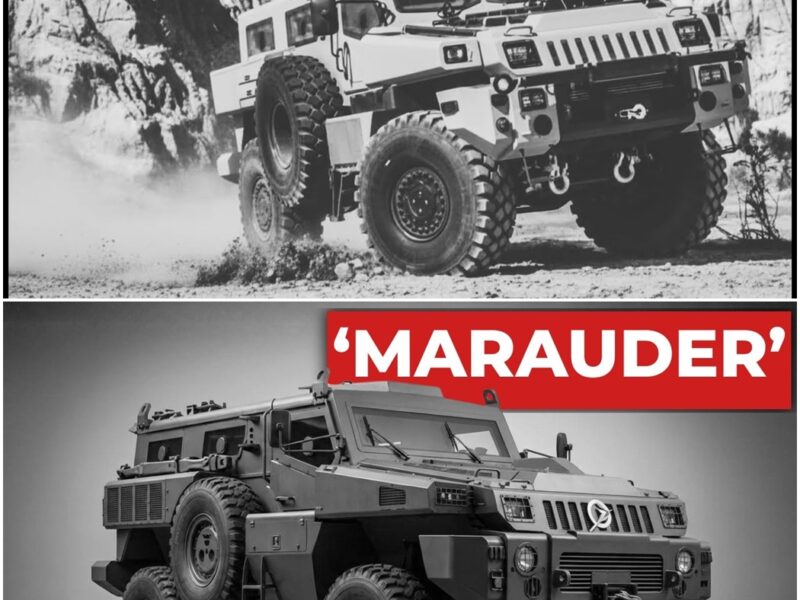
The ‘Unstoppable’ South African Armored Beast That Survived A Plastic Explosive Test On Top Gear D
2000, Isando Campus, Kempton Park, south of Johannesburg, South Africa. Inside a workshop the size of an aircraft hangar, a team of engineers is bolting the final panels onto something that does not look like a military vehicle. It looks like a building that someone put wheels on. The hull is square and brutal, 2.
48 m wide and 2.66 m tall, welded from double-skinned steel so thick the whole structure could absorb a direct hit from a machine gun without flinching. The ground clearance sits at 420 mm, high enough to drive over a land mine and redirect the blast sideways before it reaches the crew. Four enormous 14-in Michelin run-flat tires absorb what the hull does not. It looks absurd.
It looks excessive. It looks like a building site vehicle dressed up for Halloween. And that is precisely the point. That vehicle will go on to be exported to over a dozen nations across four continents. It will survive anti-tank mines, improvised explosive devices, and direct small-arms fire on three separate continents.
A television presenter will drive it through a brick wall and declare it the best vehicle in the world. 15 tons of welded South African steel will survive a 7-lb plastic explosive detonation that turns a rival American vehicle to scrap. It will be combat-proven in the Caucasus, the Sahel, and the jungles of Mozambique. It will be manufactured under license in Kazakhstan, Jordan, Singapore, and Azerbaijan.
Roughly 300 of them are operating across the globe right now. Its name is the Paramount Group Marauder and it is the most survivable armored vehicle Africa has ever produced. To understand why the Marauder exists, you need to understand the problem southern Africa solved in the 1970s and 1980s that the rest of the world had not yet figured out.
The Rhodesian Bush War, running from 1964 to 1979, killed soldiers in a way that conventional military doctrine had no answer for. Not artillery, not aircraft, land mines, pressure-triggered anti-vehicle mines buried in dirt roads killed more soldiers than any other weapon in that conflict. The flat-bottomed armored vehicles inherited from conventional warfare channeled blast energy directly upward into the crew. The effect was catastrophic.
Engineers in Rhodesia responded with a solution that was radical in its simplicity. Raise the vehicle. Shape the hull into a V. Force the blast outward and away. The 1974 Rhodesian Leopard was the first application of this principle to a wheeled military vehicle, designed by engineer Ernest Konschel.
South Africa refined it into the Buffel in 1978 and the legendary Casspir in 1981. These vehicles changed the mathematics of mine warfare. They sent blast energy into the ground. Crew survived. The Marauder is the direct descendant of that philosophy, applied with three additional decades of engineering capability.
Paramount Group was founded in 1994 by Ivor Ichikowitz, a young South African who had studied drama at the University of the Witwatersrand and worked as an ANC activist during the apartheid era. He had no military background. What he recognized was that South Africa had built, under decades of international sanctions and out of sheer necessity, a world-class defense technology base.
When apartheid ended, that knowledge base had nowhere to go. Ichikowitz built it into the largest privately owned defense company on the African continent. The Marauder was designed entirely without government funding. Paramount financed every stage of development from its own revenue. The engineering brief was unambiguous.
Build a vehicle that survives what kills people in African and Middle Eastern asymmetric warfare, mine blasts, improvised explosive devices, ambushes with rocket-propelled grenades and heavy machine guns. Build it light enough to be carried by a C-130 Hercules transport. Build it cheap enough for African and Middle Eastern defense budgets.
Build it simple enough that its drivetrain can be serviced at commercial MAN truck dealerships anywhere on Earth. The vehicle they built weighs 9,900 kg empty and carries up to 17,000 kg fully loaded. The engine is a Cummins ISBe 4300, a six-cylinder turbo diesel producing 300 horsepower and 1,100 Newton meters of torque, driving through a four-speed fully automatic transmission.
Top road speed is 120 km/h. Range on a standard fuel load is 700 km, extendable to 1,000 km with long-range tanks. Approach angle of 38°, departure angle of 46°, fords 900 mm of water without preparation, climbs gradients steeper than 60%. The hull is constructed using a monocoque double-skinned welded steel architecture, meaning there is no separate frame beneath.
The hull is the structure. It is not bolted together. It is welded. The inner and outer skins create a cavity that can accept additional armor plates as threats evolve. The entire main hull is formed from just three self-jigging plates, a manufacturing innovation that allows license production in partner countries with limited tooling investment.
The V-shaped underbody deflects anti-tank mine blasts rated at 8 kg of TNT beneath the hull and up to 14 kg beneath the wheel. The sidewalls absorb up to 50 kg of TNT equivalent in a lateral explosion. Anti-blast seats decouple crew members from the floor during a detonation event. Breakaway suspension components are designed to fail in a controlled manner and can be replaced in the field in approximately 1 hour.
The vehicle carries two crew and eight to 10 dismounted soldiers in a standard configuration. According to Army Guide technical data, the Marauder can be fitted with a wide range of weapon stations from 12.7 mm heavy machine guns to 20 mm auto cannons. Optional systems include nuclear, biological, chemical, and radiological protection, night vision, and remote weapon stations.
None of these are standard. All are modular. Operators equip the vehicle for their specific threat environment. Now, before we go into where this vehicle actually went to war, if you are enjoying this deep dive into African defense engineering and armored vehicle design, hit subscribe. It takes 1 second.
It costs you nothing and it helps this channel keep making content like this. The Marauder’s first major customer was Azerbaijan. In 2006, the Azerbaijani Ministry of Defense signed an initial agreement for 30 vehicles. The relationship expanded rapidly. By 2014, over 100 Marauders and their companion vehicle, the larger Matador, had been delivered or manufactured locally in Azerbaijan.
The vehicle entered Azeri service under the local designation Tufan. Contracts with Azerbaijan across the full fleet are valued in the hundreds of millions of dollars. What happened to those vehicles in 2020 was the definitive proof of concept for everything Paramount had claimed. September 27, 2020, the Republic of Azerbaijan launched a large-scale military offensive to recapture the Nagorno-Karabakh region from Armenian-backed forces.
The 44-day conflict that followed was the most intense conventional warfare in the South Caucasus since the collapse of the Soviet Union. Azerbaijani Marauders operated on front lines where anti-tank mines, artillery, and drone-delivered munitions were constant threats. Azeri Defense Magazine published footage of a Marauder detonating two anti-tank mines under its wheels in rapid succession.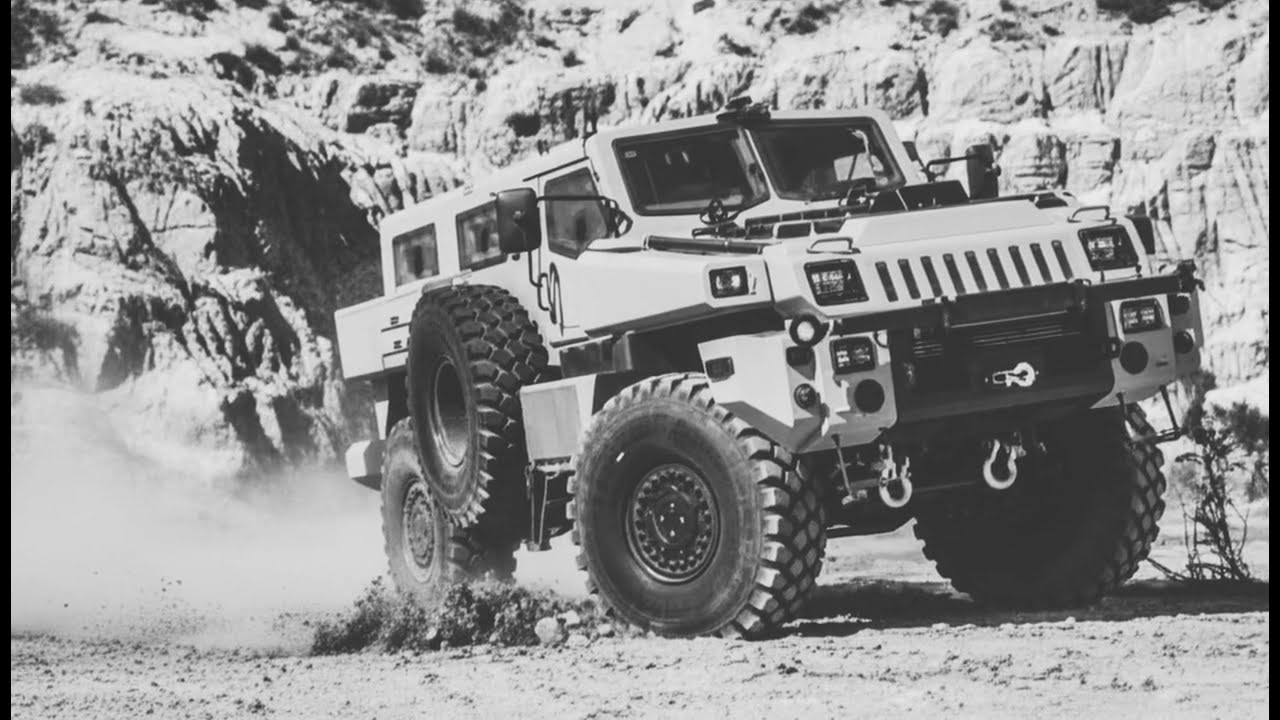
Both explosions lifted the vehicle from the ground. The crew walked away. According to Army Recognition reporting on the conflict, both the Marauder and the Matador provided high levels of protection against land mines, enemy fire, and shrapnel from artillery and mortar shells. Open-source defense analysts documented at least four Marauders damaged or abandoned during the 44 days of fighting.
None were destroyed. The Azerbaijani military described the vehicle’s performance as highly valued, with superior characteristics compared to other armored vehicles in their inventory. West Africa followed a different path. In March 2019, the Nigerian Air Force Regiment took delivery of Marauders equipped with Jordanian-made Snake Head turrets mounting 7.
62 mm machine guns, camouflaged for desert operations, destined for northeastern Nigeria. The northeastern states of Borno, Yobe, and Adamawa had been locked in a decade-long insurgency against Boko Haram and the Islamic State West Africa Province. The roads in that region are some of the most heavily mined in Africa.
Improvised explosive device attacks had destroyed lighter vehicles and killed hundreds of soldiers and civilians. Paramount Senior Vice President Eric Ichikowitz stated explicitly that the vehicle’s 50-kg side blast protection was critical for the asymmetrical warfare experienced in the northern parts of the country.
The Nigerian Air Force does not publicize operational incident reports. What is documented is that they continue to operate the vehicles and did not seek replacements. Mozambique arrived last and the circumstances were the most urgent of all. November 2020. The Cabo Delgado province in the far north of Mozambique had been burning since 2017.
An Islamist insurgency operating under the name Ansar al-Sunna, linked to Islamic State networks, had killed thousands of civilians, displaced over 300,000 more, and seized the port town of Mocímboa da Praia. The Mozambican government was losing. Five Marauders were transferred to Mozambican security forces that November, confirmed by South Africa’s National Conventional Arms Control Committee.
The vehicles arrived fitted with turret-mounted machine guns. They were deployed into an active counterinsurgency campaign in terrain that had already destroyed lighter vehicles and conventional security infrastructure. On paper, measured against its American contemporaries, the Marauder presents a complicated picture.
The Oshkosh M-ATV, the United States Army’s primary MRAP class vehicle in Afghanistan from 2009 onward, weighs 11,340 kg empty, carries five to seven occupants, and costs approximately $470,000. It was produced in quantities exceeding 8,000 units. Its independent suspension system delivers off-road mobility the Marauder cannot match in broken terrain.
Its full integration with American C4ISR communications, remote weapon stations, and NATO logistics chains gives it institutional advantages no African-manufactured vehicle can replicate. The Force Protection Cougar, the de facto standard MRAP of the Iraq War, has thousands of documented improvised explosive device survival events in its operational record.
The Marauder’s documented combat data is a fraction of that, but but the comparison misses the point of what the Marauder actually is. The Marauder carries 10 occupants to the MATV’s five. It runs further on a single fuel load. Its drivetrain components are available at commercial MAN truck dealerships in Lagos, Nairobi, Baku, and Amman without military logistics contracts or American part supply chains.
It fits inside a C-130 Hercules without disassembly. At approximately $485,000 per unit, it costs less than the MATV while carrying twice the soldiers. The Marauder was not designed to fight in Kandahar with American logistics at its back. It was designed to fight in northeastern Nigeria with whatever spare parts the local market could provide.
That is a fundamentally different engineering philosophy, and it produces a fundamentally different vehicle. The Marauder Mark II, unveiled in August 2022, introduced a universal hull configurable for both left-hand and right-hand drive in under 2 hours, updated driver ergonomics, modular interchangeable dashboard systems, and production line improvements enabling manufacture for stock rather than pure build-to-order fulfillment.
The variant family now encompasses a patrol pickup, ambulance, command post, mortar carrier using a 120-mm mortar in a 6×6 configuration, and armored recovery vehicle. The vehicle’s global reputation, however, was made not by any of this. It was made by a television program. June 26th, 2011, series 17, episode 1 of BBC Top Gear, presenter Richard Hammond drove a bright red Marauder through the streets of Johannesburg.
He parked it next to a Hummer H3 to establish scale. The Marauder was more than double the size. He drove through a brick wall at moderate speed. The wall disintegrated. The Marauder was unmarked. He attempted a fast-food drive-thru, discovered the 90-mm thick bulletproof windows do not open, and was forced to use the vehicle’s external intercom system and a small access port to receive his food.
He drove through a safari park and noted that the external windshield wipers represented the vehicle’s one genuine vulnerability to lions. The finale involved 7 lb of plastic explosive detonated first beneath a Hummer H3, then beneath the Marauder. The Hummer was destroyed completely. The Marauder sustained one blown tire.
The crew compartment was untouched. Hammond drove away. The verdict was immediate and final. Paramount adopted the resulting description as its official marketing tagline. The clip became one of the most viewed military vehicle videos in the history of online media. 300 vehicles, 14 confirmed operator nations, combat records in the Caucasus, West Africa, and Southern Africa.
Licensed production in Kazakhstan, Jordan, Singapore, and Azerbaijan. Two detonated anti-tank mines under the wheels in the 2020 Nagorno-Karabakh War. Zero crew fatalities confirmed in documented blast events. The Marauder is slow by fighter standards. It lacks night vision as standard. It carries no integrated communication suite.
Its electronics package compared to American systems is decades behind. Its total production run fits inside a single American industrial quarter’s output, and yet it worked. In the mine roads of northeastern Nigeria, in the insurgency-torn tracks of Cabo Delgado, in the artillery-saturated front lines of the South Caucasus, on a television program in front of an audience of millions, it worked.
Half a century ago, bush war engineers in Rhodesia looked at a flat-bottom vehicle and understood that geometry could save lives that armor alone could not. They shaped the hull into a V and pointed the energy into the ground. Ivor Ichikowitz and Paramount Group took that lesson, privately funded it, and built a global industry around it. That is not luck.
That is Africa building the weapon Africa needed.