This “Budget” French 6×6 Carries The Gun Britain Couldn’t Field After Billions Spent D
November 2025, Bulford Wiltshire. A British Army squadron stands in formation as officials declare a new armored vehicle ready for war. Cameras roll. A minister calls it a transformational capability. 30 years of waiting for a new reconnaissance vehicle finally over. 6 weeks later, soldiers are pulled out of that same vehicle mid exercise.
Some can’t stop shaking. Some are vomiting. The readiness declaration is quietly withdrawn in January. The program that produced it has already swallowed more than 5.5 billion pounds. And as of this writing, not one full squadron of it can be trusted to operate without a medical monitor standing by. This is not a story about a vehicle that failed. Plenty of vehicles fail.
This is a story about a cannon that succeeded, just not in the country that helped build it. Because the gun inside that grounded British vehicle, the 40mm cased telescoped cannon is not a uniquely British weapon. It was developed jointly on a 50-50 basis by a British company and a French one.
Two nations bet on the same barrel. One of them has it sitting in storage depots while lawyers argue over blame. The other has been firing it from the deck of a vehicle in NATO maneuvers in counter drone trials at sea and in the hands of an export customer for nearly four years. That vehicle is the French EBRC Jaguar.
And at 4 to6 million euros a copy, it is doing on a fraction of the British budget what billions of pounds and 15 years still have not bought the British army. To understand how that happened, you have to go back to where the gun itself was born and to two countries that looked at the exact same problem and walked away with two completely different vehicles.
By the early 2000s, both France and Britain were staring at the same uncomfortable fact. Their light armored reconnaissance fleets were museum pieces wearing camouflage. Britain’s CVRT family, the Scimitars and Scorpions, had been rolling since 1971. France’s reconnaissance cavalry leaned on the AMX10RC, the ERC90 Saga, and the VAB HOT.
Vehicles designed before satellite navigation, before digital radios, before anyone seriously planned for a battlefield saturated with drones. Three separate platforms doing three separate jobs. None of them built to talk to each other. All of them approaching 40 years in service. Their electronics were analog.
Their optics were a generation behind anything a peer adversary could field. Their radios couldn’t talk to a modern command network even if someone wired them in. Replacing any one of them on its own would have been routine. Replacing all three at once while also rebuilding the doctrine they fought under was the harder and far more expensive question.
And it’s the question both countries were really answering when they sat down with CTA International to talk about a gun. Out of that shared frustration came a shared idea, a new cannon built around a radical concept called case telescoped ammunition, where the projectile sits embedded inside its own propellant casing instead of stacked on top of it.
In a conventional 40mm round, the warhead purches above a long charge, making the cartridge bulky and the feed mechanism complicated. Bury the projectile inside the casing instead, and the round gets shorter, flatter, and far simpler to cycle through a rotating brereech. Shorter rounds, flatter rounds, far less recoil for the same punch, light enough to mount on a 25 ton wheeled hull instead of a 60 ton tank.
A British company and a French one working through a joint venture called CTA International split the development 50/50. On paper, this was the rare procurement story with a happy ending built in from day one. Two NATO allies, one weapon, shared cost, shared risk, shared payoff. Then the two countries went their separate ways to build the vehicles around it. Britain moved first.
In March 2010, General Dynamics UK won a competition to build what would become known as Ajax based on an existing Spanish Austrian chassis called the Ascode 2. A full production order followed in September 2014. 589 vehicles across six variants for3.5 billion. France moved four years later, awarding its own contract in December 2014 to a three company consortium, K&DS France, handling the turret, thalis the electronics and arus the chassis, building a vehicle from scratch with almost no inherited parts. No existing hull to borrow, no head start, just a blank sheet and a deadline. You would expect the country with the 4-year jump and the mature donor chassis to win the race to the battlefield. That is not what happened. The Jaguar that rolled out for its first public unveiling in May 2018 looked unlike
anything the French army had fielded before. Six wheels on three axles, switchable between 6×4 for road marches and 6×6 for rough terrain with rear axle steering tight enough to reverse the vehicle out of a narrow street ambush. a militarized Volvo diesel producing 500 horsepower, a 7-speed automatic gearbox, a top road speed near 90 km/h, and a sustained off-road pace near 70.
A 500 L fuel tank stretches its range to roughly 800 km, enough to cross most of Western Europe on a single tank. Independent hydraulic suspension with adjustable ground clearance, central tire pressure regulation, run flat inserts, the ability to ford over a meter of water and climb 50% gradients, all while still fitting inside an A400M transport aircraft for rapid deployment.
At 25 tons combat loaded, it carries a Stanag 4569 level 4 protection as standard. enough to stop 14.5 mm armor-piercing fire and artillery splinters with a V-shaped underbody to deflect mine blasts outward. The crew compartment is sealed against chemical, biological, and radiological threats and air conditioned for desert operations.
None of this is exotic by modern standards. This is the entry fee for a serious medium reconnaissance vehicle in 2026. The Jaguar is not winning this comparison on armor, and it was never trying to. The turret is where the comparison actually starts. The T40 turret carries that same 40mm cased telescoped cannon both nations helped develop, firing at 200 rounds per minute with 180 rounds carried and 65 ready to fire immediately.
Three ammunition families give it a strange kind of versatility for a gun its size. An armor-piercing tungsten penetrator punches through more than 140 mm of steel at 1,500 m, enough to threaten the frontal armor of all the main battle tanks and any infantry fighting vehicle on the planet. A programmable air burst round detonates above or beside a target, scattering fragments across a lethal radius, useful against entrenched infantry and increasingly against drones.
A point detonating round chews through over 200 mm of reinforced concrete. The terminal effect of a single 40mm high explosive round runs roughly four times that of the 30 mm cannons most comparable vehicles still carry. Bolted to the turret’s right side sits a deployable pod with two readyto-fire Acron MP missiles with two more stored inside the turret ring.
Built by MB-Day France, this fifth generation fire and forget man-in-the-loop missile punches through more than 1,000 millimeters of armor, defeating the frontal arc of any tank in service today, including those wrapped in an explosive reactive armor. Its range exceeds 4,000 m, and in a 2018 test, round struck targets out to 5,000.
A fiber optic data link lets the gunner retarget the missile mid-flight or abort the shot entirely, engaging targets the missile itself could never have seen at the moment of launch, tucked behind a hill or a building. Twin saffron electrooptic sites give the commander and gunner independent fields of view, so one can hunt for the next target while the other engages the current one.
The design logic is almost stubborn in its simplicity. Use the cannon for everything from infantry vehicles down to drones. Use the missile for anything wearing heavy armor from a range where the enemy cannot shoot back. One crew of three. No swapping weapon systems midfight.
No closing to suicidal range to kill the hardest target on the field. Before we get into where this thing has actually deployed and how badly that compares to the country that helped invent its own cannon. If you’re finding this breakdown useful, take a second to subscribe. It cost nothing and it’s the only thing that keeps this channel making more of them.
France’s first production Jaguars reached the army’s procurement agency in December 2021. 20 vehicles, 18 of which went straight to the training regiment at Canurers. 38 more arrived through 2022. By the end of 2023, 60 were in French hands. By April 2025, the first foreign cavalry regiment had fully converted, becoming the first unit in the French army equipped exclusively with the new platform.
The plan now calls for roughly 135 delivered by the end of 2025, 238 by 2030, and the full run of 300 by 2035. In May 2024, six Jaguars loaded onto rail cars and traveled 3,000 kilometers across five countries to Estonia, joining NATO’s enhanced forward presence under Mission Links, the vehicle’s first deployment beyond French soil.
Months later, during a multinational exercise, those Jaguars demonstrated live target handoff with Griffin carriers and Allied forces they had never trained alongside before that week. A sensor on one vehicle feeding coordinates to a weapon on another in real time. That handoff isn’t a side feature. It’s the entire point of the program the Jaguar belongs to.
Every Scorpion family vehicle, the Griffin troop carrier, the servil patrol vehicle, the modernized cleric tank runs the same battle management software and the same softwaredefined radio sharing one tactical picture instead of fighting as isolated machines. The French call it combat collaborative collaborative combat.
And the Jaguar is built to act as its eyes and teeth at once. A target spotted by one vehicle can be killed by a weapon on another without either crew ever exchanging a word over voice radio. It’s a quieter kind of advantage than a bigger gun, but on a real battlefield, it tends to matter more. Then in September 2024, off the coast of Tulon, a Jaguar was chained to the open deck of an amphibious landing craft and fired its cannon against drone targets in the French Navy’s first dedicated counter drone exercise. An improvised but successful answer to the exact threat that has been sinking ships in the Black Sea and harassing shipping in the Red Sea. Export orders followed before the vehicle had even finished proving itself at home. Belgium signed for 60 Jaguars and 382 Griffins under the bilateral como program with deliveries beginning in 2025 and live fire qualification completed that April. Luxembourg approved 38 Jaguars in November 2024 with a contract signed the following
December and a joint Belgian Luxembourg reconnaissance battalion planned around them. Ireland is reportedly negotiating a full package worth over a billion euros. KN&NDX is now marketing the same turret system for integration onto other chassis entirely, the VBCI2 and the Boxer among them, chasing customers in the Gulf and Southern Europe.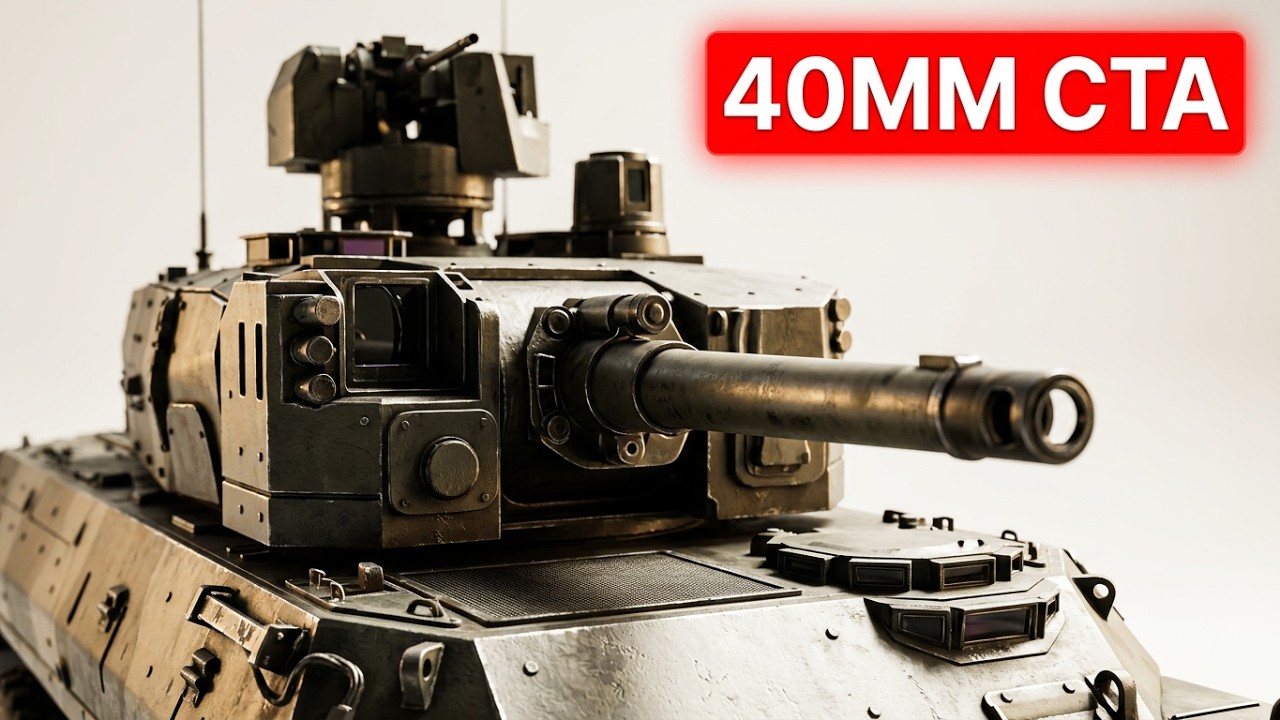
None of this happened in a vacuum, and none of it happened cheaply either. The unit cost has roughly doubled from its original target, landing somewhere between 4 and 6 million. A fact worth sitting with for a moment, because that number is about to look very small. On paper, the Jaguar isn’t even the most heavily armed vehicle in its class.
Italy’s Centauro 2 carries a full 120 mm smooth boore gun, the same caliber as a main battle tank on a heavier 8-W wheeled hull built to kill armor headon. Japan’s Type 16 maneuver combat vehicle mounts a 105mm rifled gun on a similar eight-wheel chassis for fire support across the home islands. Both outgun the Jaguar in raw bore size.
Neither carries a missile that can kill a modern tank from 4 km away without ever closing into the range where a 25ton ton wheeled hull becomes a liability. The Jaguar’s designers made a different bet. A smaller cannon to handle everything up to armored infantry and a missile to handle the one threat that cannon was never meant to beat.
It’s a narrower gun and a wider envelope. And so far, it’s proven the cheaper one to actually keep running. Now look at what the other half of that 50/50 cannon partnership has been doing with the same 15 years. Britain’s Ajax program built on the ASCO chassis with a head start most engineers would kill for has spent over 5.
5 billion pounds and by some accounts north of 6 billion once support contracts are counted on a vehicle that has barely left British soil. Early trials in 2020 and 2021 uncovered severe vibration and noise inside the hull. bad enough to cause long-term hearing damage and require medical monitoring for soldiers who’d spent extended periods inside. Testing was suspended.
Multiple investigations launched, one military, one independent, alongside a national audit office review that pointed at inconsistent build quality. Hulls arriving from the manufacturer’s Spanish production line reportedly out of true, misaligned just enough, the components shuttered as the vehicle moved.
Deliveries that were supposed to start in 2017 slipped to 2020, then 2021, then kept slipping past that. In November 2025, after redesigns, extra hearing protection, and tens of thousands of kilometers of trials, the Ministry of Defense finally declared initial operating capability for the Household Cavalry Regiment, the first new armored vehicle to enter British service in close to 30 years.
It was framed, understandably, as a turning point. It lasted weeks. During a subsequent exercise, more than 30 soldiers reported falling ill after extended time inside the vehicles. Symptoms severe enough to include uncontrollable shaking and vomiting. Training was suspended again. In January 2026, the ministry formally withdrew the initial operating capability status.
It had just announced an almost unheard of reversal for a program that had already consumed a decade and a half. As of this writing, trials have only just resumed. full operational capability is still pinned to the end of the decade at the earliest and parliamentary questions are circling whether officials knew the readiness declaration was premature when they made it.
Strip away the politics and the number that remains is the only one that matters. A weapon system co-developed by two nations on equal terms is right now operational and exporting on one side of the channel and sitting in limited medically supervised use on the other after roughly twice the perunit budget.
The French didn’t outenineer the British on the gun itself. They share the same gun. They outengineered them on everything wrapped around it. The chassis, the integration, the willingness to build something new rather than retrofit something old. The Jaguar is not without its own honest weaknesses, and they’re worth stating plainly rather than glossing over.
Its Stanag level four passive armor will not survive a direct hit from a tank gun or a heavy anti-tank missile. And at 25 tons, it is noticeably lighter than most eight- wheeled rivals in its class. It currently carries no hard kill active protection system, though one built around Thales’s Diamont Interceptor is in development for fielding later this decade.
Its price has already drifted well past its original target, climbing from an early goal of roughly €3 million to the 4 to6 million euro range it sits at now. And like every we wheeled reconnaissance vehicle in service anywhere, nobody has fully answered how it survives a battlefield where cheap loitering munitions and first-person view drones can find and kill armor that cost 100 times what they do.
That question remains open for the Jaguar exactly as much as it does for Jacks, for the Centauro, for every vehicle in this class. What’s different is that France has had the chance to find out under real conditions in Estonia off the coast of Tulon in a Belgian export contract already delivering hardware while Britain is still negotiating with its own contractor over who pays for the fix.
Back in Bulford, the formally withdrawn readiness declaration still sits in the official record. A reminder that a flag raising ceremony and a working weapon system are not the same thing. Off the coast of Tulong, a six- wheeled vehicle that was never supposed to be the cheap option is quietly proving that the gun itself was never the problem.
France did not build a better cannon than Britain. They shared the exact same one. What France built was a vehicle willing to actually carry it into the field. While the other half of the partnership was still figuring out how to keep its own crews from getting sick, both countries bet on the same 40mm barrel back when it was just a blueprint and a shared contract.
One of them built a chassis humble enough, cheap enough, and finished early enough to actually let that barrel do its job. The other built a more expensive vehicle around the same gun and is still more than a decade later trying to prove it’s safe to sit inside. There is a version of this story where the moral is simply that the French got lucky or that British procurement is uniquely cursed.
Neither holds up. France has had its own troubled programs and the Jaguar’s own turret stabilization software needed fixing before it could be trusted at sea. The difference here is narrower and more uncomfortable than that. It’s the difference between a program that treated good enough on time as a real design requirement and one that kept chasing a perfect vehicle on top of an imperfect chassis until the bill and the soldiers riding inside it both started paying the price.
Whether that gap closes or widens by the end of the decade is the only question that still matters