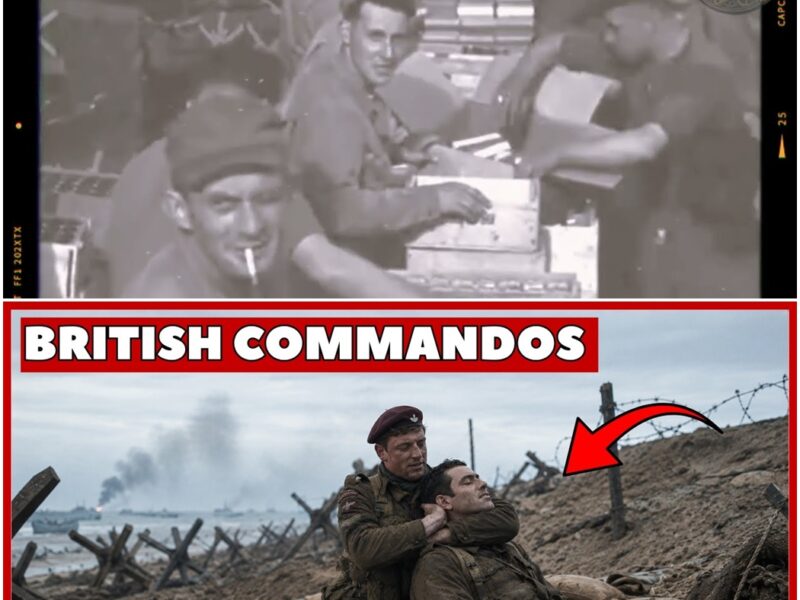
What British Commandos Did When Their Mission Was Supposed to Be Impossible? The WW2 Desk with Thomas D
The Loire Estuary at night smells of salt and mud and something else, something industrial, diesel and rust from the ships. And in late March 1942, it was dark in a way that a peacetime visitor would not recognize. No harbor lights, no glow from the town. The Germans had blacked out Saint-Nazaire thoroughly, which meant the searchlights, when they came on, were the only light in the world, sudden and total, turning the river silver.
That is where this story lives, in that specific darkness, on that specific river, between midnight and dawn on the 28th of March. What happened in those hours has been called the greatest raid of all. It earned five Victoria Crosses, more than any other single operation of the Second World War. It destroyed the only dry dock on the Atlantic coast capable of repairing the German battleship Tirpitz, and in doing so, it locked that ship in Norwegian waters for the rest of the war.
It also killed 169 British servicemen and left 215 more in German captivity. But here is what I did not expect to find when I started working on this story. The moment that decided everything. The moment when the whole thing either worked or collapsed did not happen in the dark. It happened in broad daylight, 9 hours after the shooting stopped, when a group of senior German officers climbed aboard a wrecked British destroyer to have a look at the damage.
What happened next is the detail this whole story turns on. We will get there. If you had family on the Atlantic convoys, destroyers, escort duty, any of it, I want to hear about it. The men who ran those routes barely talked about what they went through. Whatever is still known in your family, write it in the comments.
It belongs in the record. The 28th of March began technically somewhere in the middle of the Loire, 611 men, 16 wooden motor launches, one converted destroyer, a motor gunboat, a motor torpedo boat, and two escort destroyers waiting offshore. The escort destroyers had done their job, seen the flotilla across the Bay of Biscay, helped drive off a German U-boat that had surfaced and spotted them the previous morning, and were now standing off the coast waiting for whatever came back. Not much would come back. The planners knew that before the flotilla left Falmouth. At the head of the formation, HMS Campbeltown moved at 10 knots. Slow, deliberately slow, to avoid the engine noise and bow wave that would announce a faster approach. She was showing a German ensign. Every vessel in the flotilla was. The signal on motor gunboat 314 had captured German codes and had been using them for the past hour to answer the increasingly
suspicious challenges from the shore. The deception had bought them almost 2 mi of river. Campbeltown herself had been modified specifically for this night. Two of her four funnels had been removed. The remaining two had been cut at an angle and repositioned so that her silhouette at night, at a distance, might pass for a German Merv class torpedo boat.
She was no longer quite the ship she had been, which is appropriate given what she was about to become. Her bow contained a concealed charge. 24 depth charges, each of 180 kg, cemented together in a steel and concrete casing and hidden behind the forward bulkhead. Four and a quarter tons of explosive in total.
The concealment had been Tibbets’ central problem for weeks, not the charge itself, the hiding of it. After the ram, German engineers would board the ship. They were competent men who would look at a wrecked British destroyer with professional thoroughness. The charge had to be invisible to inspection.
So, Tibbets encased the depth charges in a purpose-built steel tank, poured concrete around them, and positioned the whole arrangement so that it appeared to anyone probing the forward compartments to be structural. It looked like part of the ship. It was part of the ship in a sense, just not a part that any ship had ever carried before.
The pencil fuses had been primed at 11:00 in the evening of the 27th by Tibbets himself below deck, quietly, while the ship was still running the deception signals above him. Three separate fuses for redundancy, each set to fire between 8 and 10 hours after activation. He primed them, replaced the access panel, and went back on deck to wait with everyone else.
That put the explosion somewhere between 7:00 and 9:00 in the morning of the 28th of March. That put the explosion somewhere between 7:00 and 9:00 in the morning of the 28th of March. On the quayside at Saint-Nazaire, the German garrison was already at heightened alert. The RAF had sent 62 bombers as a diversion.
The original plan had been for 350, but the number was cut to minimize French civilian casualties, which meant the aircraft had to bomb above cloud, and most of their ordnance fell wide. What the raid produced was not distraction, but German soldiers already standing at their positions when the British flotilla came round the last bend of the Loire.
The plan that had brought all of them here had been conceived in February 1942, and had nearly died in committee before it left London. The strategic situation at the start of 1942 was, to use the gentlest available word, difficult. German submarines were sinking Allied merchant ships faster than the shipyards could replace them.
The Royal Air Force had tried four times to sink Tirpitz in Trondheim Fjord, and lost 12 aircraft without landing a significant hit. The Japanese were sweeping through Southeast Asia. Singapore had fallen in February. The The from every front was running in the wrong direction. Into this situation, someone in Mountbatten’s Combined Operations staff asked a question that was simple enough to sound obvious in retrospect.
What if you could not sink Tirpitz, but you could make the Atlantic irrelevant to her? Tirpitz needed a repair base on the French coast before she could risk deep Atlantic operations. Without one, any damage sustained in action meant a return voyage through waters that had killed Bismarck. The Normandy Dock at Saint-Nazaire was the only facility on the Atlantic coast that could handle her.
Destroy the caisson gate, and Tirpitz became a Norwegian problem rather than an Atlantic one. The Admiralty rejected the initial plan, too costly. The losses were predictable and unacceptable. Mountbatten threatened to cancel Operation Chariot entirely unless a destroyer was provided. The Admiralty produced one, an old American one transferred under Lend-Lease, originally commissioned as USS Buchanan in 1919, and renamed Campbeltown on transfer to British service.
Old, slow, four-funneled, and entirely expendable. But a destroyer. The operation was approved on the 3rd of March 1942, less than 4 weeks to prepare. In those weeks, Campbeltown was taken to Devonport and remade. Two of her four funnels removed, the remaining two cut at an angle to mimic a German Mowe class silhouette.
Extra armor plating fitted around the upper deck, Oerlikon cannons mounted along the sides, and in the bow, Tibbets’ concealed device encased and disguised, waiting for the night the ship would need it. She sailed from Devonport looking like something between what she had been and what she was about to become. Neither quite British nor quite German.
Neither warship nor bomb. Both. The dockyard men who worked on her presumably understood what they were building, though none of the surviving accounts mention how that knowledge sat with them. They were practical men doing a specific job. The ship left when it was ready. That is all the record says. Commander Robert Ryder, 34, lean, in command of the naval element, had worried about exactly this before they left England.
He was a man with a long naval record behind him already. Submarine service, an Arctic expedition in the 1930s, command of a frigate. He had a quality mentioned by multiple officers who served under him of being genuinely hard to rattle. What he was doing in the estuary of the Loire with a flotilla of wooden boats and a destroyer full of concealed explosive was not the sort of assignment that came to cautious men.
So had Lieutenant Colonel Charles Newman, pipe-smoking officer of the Essex Regiment, commanding the commando force. Newman had briefed his men the day before they left Falmouth. He had told them the target, the plan, the casualty estimates, and the honest assessment of the odds. He had not dressed it up.
The men who survived described a particular quality of stillness in the briefing room afterwards. Not fear exactly, not denial, but a kind of settling that came from knowing the full truth of a situation and having decided to go anyway. Both Ryder and Newman had raised the concern about the air diversion formally.
Both had written it into their pre-operation reports. Both had made the argument that 62 aircraft bombing above cloud to avoid civilian casualties would produce alert defenders rather than distracted ones. The concern was logged and the decision was overruled. Minimizing French civilian deaths was a genuine and defensible priority, and there was no clean answer to the problem it created.
Both men accepted the decision. Both went in anyway. That quality, making your professional objection, having it overruled, and then committing fully to the plan as it stood, is something I find genuinely difficult to locate a modern analog for. Not because it does not exist now, but because it appears so consistently in the accounts of the men who ran these operations that it seems structural rather than individual.
They were not pretending the problems had been resolved. They knew exactly what the inadequate air diversion meant for the river approach. They went in regardless. At what point in this approach does a military commander stop calculating the odds and simply commit to the action? Ryder and Newman had known for days that the diversion was inadequate.
They had flagged it. And they were still here, in the dark, on the Loire. The signals exchange had been running for the better part of an hour. The German shore post challenged, the British signaler, working from captured enemy codes, answered back. “Friendly vessels damaged in action with British forces, requesting permission to enter harbor. Please do not illuminate.
Please do not fire.” Each reply from the shore grew more insistent. The German signals officer was not satisfied. There was something wrong with this unscheduled convoy, and he knew it, but he could not find the specific wrong thing in the answers he was getting back. The British signaler gave him nothing to grip. Every exchange bought time.
3 minutes, 5 minutes. The flotilla was covering the distance at 10 knots, which is not fast, but it is fast enough when you are working in minutes, not hours. By the time the shore finally lost patience with the signals game, Campbeltown was within striking distance of the dock gate.
At 12:22, the searchlights came on. The lights found the flotilla when it was roughly a mile from the dock gates. What followed, for about 12 minutes, was a specific kind of controlled chaos. The British ensigns went up to replace the German ones. The commandos who had been lying flat on Campbeltown’s armored deck got to their feet and gripped whatever was nearest.
The gun crews on the motor launches went to their weapons. The German shore batteries opened fire. Tracer was the main thing you saw, red and white lines crossing the water from both banks of the Loire converging on the flotilla from multiple angles simultaneously, so that the river became a grid of intersecting fire.
The motor launches drew it first. They were the smallest, least armored things in the flotilla, and they were positioned on the flanks where the shore angles were sharpest. Wooden hulls, thin-skinned, burning quickly when a tracer round found something to light. Several were hit within the first 2 minutes of the searchlights coming on.
Men went into the water, which was cold in late March and moving fast with the outgoing tide. Other launches kept moving, past the burning ones, past the men in the water, because stopping in that river meant dying in that river, and they were commandos to deliver to the shore. The commando officers on those launches, the ones still afloat, were doing something that does not appear in any training manual.
Sitting on a wooden boat in a lit-up kill zone and waiting for the order to disembark. They were passengers at this point. The sailors were driving. The shore was getting closer. There was nothing to do but grip the rail and watch the tracers go past. On Campbeltown, Lieutenant Commander Stephen Beaty held his course.
Bearded, known to his crew as Sam, constitutionally calm in a way that several survivors later mentioned specifically. Not performing calm, apparently, but genuinely untroubled. He had accepted, before they left Falmouth, that he was sailing a ship into a dock gate. There was no version of this where Campbeltown came home.
His job was to put her exactly where she needed to be. The remaining distance to the caisson gate was approximately 1 mile when the lights found them. They covered it in just over 12 minutes. At 1:34 in the morning, Campbeltown hit the Normandy dock caisson at 21 knots. She drove 37 ft into it. The gate buckled and held the ship.
Beaty had aimed at a target roughly 50 ft wide in the dark under fire with searchlights in his eyes. He hit it first time. The four and a quarter tons of explosive in the bow said nothing. The fuses were running. Nobody on shore knew. They came off Campbeltown within seconds of impact down ramps that had been specially fitted to the bow structure onto the quayside into whatever was waiting.
Newman was already planning to go ashore not to watch to lead. He had told his officers before the operation that he would be with them in the dock area. Several of them had noted this with varying reactions from reassurance to the slightly uncomfortable feeling that comes when your commanding officer announces he will be standing next to you in the part of the plan most likely to go wrong.
The commando force had been rehearsing for 3 weeks. They had trained on mock-ups of the dock equipment built from RAF reconnaissance photographs and from detailed plans of the King George V dock in Southampton whose gate mechanism closely resembled Saint Nazaire’s. They had run the drills at night carrying dummy explosive loads over and over until the routes were reflex.
The force was divided into demolition teams, assault parties, and protection squads. Each team had one target. The pump house. The caisson winding gear, the gate mechanism, the impounding basin controls. These were the specific things that destroyed would make the Normandy dock inoperable.
Not the gate alone which Campbeltown had already buckled but the entire mechanical apparatus that allowed the dock to function. The demolition teams had trained carrying 90-lb rucksacks of dummy explosives at a run through obstacle courses in the dark. This sounds like ordinary commando preparation until you consider what it actually prepared them for, arriving on a hostile quayside under fire, navigating to a specific location they had only ever practiced on a mock-up, placing charges on equipment they had studied from photographs, and completing the work while German soldiers were actively trying to stop them. The training was specific because the task was specific. There was no room in the plan for improvisation on the objectives. Getting to them, yes. What happened once there, exactly as rehearsed. Lieutenant Stuart Chant commanded the pump house team. He had been wounded during the approach, both legs, before they ever reached the shore. He went to shore. His team made it to the pump
house. The charges were placed and fired. The pump house came down. Similar things were happening across the dock complex simultaneously. Some teams reached their targets, others were stopped by German resistance before they arrived. The garrison had recovered faster than the planners had hoped, and the streets between the landing points and the deeper dock installations were contested from the first minutes.
Lieutenant Stuart Chant commanded the pump house team. He had been wounded during the approach, both legs, caught in the German fire before he ever reached the shore. He went to shore anyway. His team made it to the pump house. The charges were placed and fired. The pump house came down.
Similar things were happening, or trying to happen, across the dock complex simultaneously. Some teams reached their targets, others were stopped by German resistance before they arrived. The German garrison had recovered from the shock of the initial impact faster than the planners had hoped. Meanwhile, on the water, the motor launches were being destroyed.
This is the section that tends to get compressed. The commando demolitions get the narrative, as they should, but the men on the motor launches paid a price that does not fit easily into a sentence. 16 wooden boats, each carrying either commandos for the shore or crew assigned to bring people out afterward.
The Loire between the landing points and the open estuary was, by 2:00 in the morning, a running firefight between the launches and the German gun positions on both banks. The launches had no armor worth the name. Wood burns. One after another they were hit, caught, stopped. Some exploded when the fire reached their torpedo warheads.
Some simply drifted, burning on the current. Men went into the river and the river was cold. Some were rescued by the launches still moving. Many were not. Able Seaman William Savage was at the pom-pom gun on motor gunboat 314, the boat carrying Ryder and Newman. He had been at that gun through the entire approach, the contact at 12:22, and the minutes of running fire that followed.
He stayed there through the attempt to extract survivors. He was killed at his gun. He had not left it. Sergeant Tommy Durrant was on motor launch 306. The launch was trying to clear the estuary when it encountered the German destroyer Jaguar. What followed lasted roughly an hour and has no straightforward military explanation.
Jaguar was a warship. Motor launch 306 was a wooden boat. The mathematics of the engagement were not remotely ambiguous. The German commander, Kapitänleutnant Paul Schultze, offered terms. Surrender and the killing stopped. Durrant was at the twin Lewis guns, First World War weapons, open, no protection, no cover of any kind.
He kept firing. Schultze offered terms again. Durrant was hit. He kept firing. Hit again. The offers continued. So did the fire from the Lewis guns until Durrant had been hit 25 times and could no longer hold the gun. He died on board Jaguar after they had taken him off the launch and given him medical treatment.
Schultz took care of the British wounded with considerable attention. He later visited Newman in captivity to describe what Durrant had done. That description became the basis for a posthumous Victoria Cross. The enemy officer made the recommendation. That has happened perhaps once or twice in the entire history of British military decorations.
Of 16 motor launches, two returned to Britain. Two. The rest were sunk, burned, scuttled, or abandoned damaged beyond recovery. The men who had crewed them, who had signed up for what was described as a combined operations exercise, in some cases without full knowledge of the target until the flotilla was at sea, had spent the night in some of the most exposed positions imaginable on a defended river.
The launch crews were not commandos. They did not have months of specialist training for this specific night. They were sailors assigned to motor launch duties who found themselves in the middle of a full-scale assault on a defended port. When the launches that were still floating tried to pull out of the estuary with whatever survivors they had collected, they ran the same gauntlet of German fire that had destroyed the others on the way in.
Two made it to open water and eventually home. The men who survived on those two boats had watched most of their flotilla burn around them. I found going through the decorations list that several of the 89 awards went to men whose official contribution was described simply as maintaining their vessel under fire for a sustained period.
Which is a way of saying they stayed on a wooden boat in a river that was trying to kill them for as long as the boat had a motor and a hull worth standing on. By 3:00 in the morning, it was clear to Newman, standing in the dock area with the German response hardening around him, that the evacuation had failed. Not failed partially, failed as a coherent plan.
The launches that should have been pulling commandos off the quayside were gone, burning in the river, sunk, or making desperate runs for the open sea with whatever survivors they had already picked up. The men ashore were on their own. Newman made a decision. He would attempt to break out overland through the town in small groups moving south toward unoccupied France and eventually Spain.
The Spanish border was roughly 800 miles from Saint-Nazaire across occupied territory. The operational logic here was, to put it carefully, optimistic. But Newman was not a man who waited to be surrounded when there was still a direction to move. The German roadblocks were already up. The town had been sealed.
One group after another ran into the cordons, ran out of ammunition, or simply ran out of viable options. Most of the commandos who had made it ashore were captured that morning. Some were wounded when they surrendered. A number hid with French civilians for days before being found. Five men from the entire operation made it to Spain.
Each of those five stories is its own improbable journey through hundreds of miles of occupied France, each one dependent on French civilians taking mortal risks to shelter and pass along British soldiers who stood out in every possible way. Newman was not among them. He was captured that morning, processed through the German military system, and spent 3 years in captivity.
His Victoria Cross was awarded on repatriation. What the commando veterans who survived remembered most clearly in the accounts they gave years later was not the firefight on the quayside or the moment the launches started burning. It was the silence that settled over the town by dawn. The Germans had the prisoners.
The launches were gone. The ship was wedged in the dock gate with its bow caved in. The raid, from the German perspective, appeared to have been repelled at significant cost to the attackers, which is exactly the state of mind that made what came next so devastating. He had gone ashore ahead of his men.
He had stayed on the ground while the evacuation collapsed. He had attempted the one remaining option even when its chances were close to none. The citation for his Victoria Cross describes this in the measured language of official documents. The reality was somewhat less measured. This is the part of the story I held back.
Through the early morning of the 28th of March, while Newman was being rounded up and the prisoners were being assembled in the harbor area, something else was happening at the Normandy Dock. German officers arrived to inspect the British destroyer embedded in the caisson gate. This was entirely natural. A British warship had driven itself into your dock gate.
Of course, you send people to look. Engineers to assess the damage to the gate structure, naval officers to understand what had been attempted, senior men curious to see what the enemy had managed to do. The local military commander presumably felt some professional obligation to document what had happened.
Tibbets had done his concealment work extremely well. The charge in Campbeltown’s bow was encased in steel and concrete and hidden behind the forward bulkhead. The German inspection found the ship wrecked and partially flooded. They found nothing that alarmed them. The consensus by mid-morning was that the British had lost, that the raid had been repelled, that the ship was harmless wreckage, and that the dock gate, though damaged, had held the assault.
A gathering of senior German personnel was on and around Campbeltown by late morning. The ship was lodged in the caisson with her bow caved in and her superstructure battered. She was also, from the outside, simply a wrecked British destroyer, a trophy of sorts, evidence of a raid repelled. The Germans had lost men in the fighting. They had prisoners.
The dock gate was damaged, but the ship appeared to be inert. The inspection teams that had gone through her had found nothing of concern in the forward compartments. The consensus by 10:00 in the morning was that the crisis was over. Some accounts mentioned French dock workers and civilians among the people who gathered to look at the ship.
The town of Saint-Nazaire, after all, had been occupied for 2 years. Something as dramatic as a British destroyer embedded in the dock gate drew people simply out of human curiosity, the same way any extraordinary sight does. The precise number on or near the ship at 10:35 is impossible to reconstruct with certainty.
Every source puts it in the hundreds. Some sources put it considerably higher. Tibbets, in captivity by this point, he had been captured during the overnight fighting on the quayside, did not know yet whether his device had survived the German inspection undiscovered. He found out the same way everyone else did.
At 10:35 in the morning, the pencil fuses reached the end of their chemistry. The explosion killed more than 360 Germans. It destroyed the caisson completely. Seawater poured into the empty basin. The Normandy dock was wrecked. Hitler sacked the officer responsible for the Western defenses. He ordered his architects to double the concrete going into Atlantic Wall fortifications.
By June of 1942, the Germans were pouring Betong into coastal positions at rates previously used only for submarine pen construction. At a meeting with Albert Speer in August that year, Hitler demanded 15,000 new bunkers from Norway to Spain by May of the following year. One raid, 611 men, the reverberations ran for months.
The Normandy dock’s caisson was the specific thing the whole operation was designed to destroy, not the dock itself, the gate. The caisson was the massive steel structure that sealed the entrance to the basin, allowing the water inside to be pumped out so a ship could sit in the dry for repairs. Without a functioning caisson, the dock could not be used as a dry dock at all.
A case on that size could not be improvised or quickly replaced. The nearest equivalent facility capable of manufacturing and installing a new gate of that scale was in Germany, and getting a replacement to Saint-Nazaire and installed meant a major engineering project under wartime conditions on a coastline that was being increasingly targeted by Allied forces.
The Germans never completed the repairs during the war. The Normandy dock sat useless for the remainder of the conflict and for several years after it. That was the outcome that justified, in the minds of the men who planned Operation Chariot, the price they had asked 611 men to pay. 611 men left Falmouth on the 26th of March, 1942.
169 were killed. Of those, 105 were Royal Navy and 64 were Commandos. 215 were taken prisoner. Nearly half of them were wounded when they were captured. 227 returned to Britain. Five reached Spain overland. Each of those five journeys its own separate extraordinary story of French civilian courage and British persistence across hundreds of miles of occupied territory.
The rest, the ones who were not killed and did not make it home, spent the remainder of the war in German captivity. The prisoners included men who had completed their demolition objectives and were captured during the withdrawal, men who were wounded in the initial attack, and men who had been on the motor launches when they went down and were pulled from the Loire by German rescue boats.
They arrived in captivity as the men who had just done the thing Britain was calling the greatest raid of all. That knowledge did not make the years in Germany shorter. 72% of the Commando force was killed, wounded, or captured. Two of the 16 motor the came home.
Five Victoria Crosses, more than any other single operation of the Second World War. Beattie received his for holding Campbeltown’s course into the dock gate. Ryder received his for commanding the naval force under fire and remaining in the estuary to organize the withdrawal. Newman received his after repatriation for leading the commandos ashore and attempting the overland breakout.
Savage was awarded his posthumously for staying at his gun. Durrant was awarded his posthumously on the recommendation of the German officer who had fought him and then cared for his wounded. 89 decorations in total. Four Distinguished Service Orders, 17 Distinguished Service Crosses, 11 Military Crosses, four Conspicuous Gallantry Medals, five Distinguished Conduct Medals, 24 Distinguished Service Medals, 15 Military Medals, and five Victoria Crosses.
They distributed across every rank, Navy and Army alike, which tells you something about what was asked of every man who went, not just the ones whose names appeared in the citations. The decorations list for Saint Nazaire reads differently from most. They’re not clustered at the top. An able seaman on a motor launch who kept his post for 3 hours under fire while the other launches around him burned received the same category of formal recognition as the officers who planned and led the thing.
That is not how British military decorations usually worked. It reflects something specific about the nature of what everyone present was required to do. The Normandy dock was put out of action for the remainder of the war and several years beyond it. Tirpitz never entered the Atlantic. She sat in Norwegian fjords for 2 and 1/2 more years, Trondheim, Alta, Tromsø, absorbing air attacks, surviving submarine strikes in September 1943, taking damage but never deploying to the open water for which she had been designed. On the 12th of November, 1944, Lancaster bombers dropped Barnes Wallis’s 6-ton Tallboy bombs on her in Tromsø Fjord. She capsized. Around a thousand of her crew went down with her. She never threatened a convoy, not once. There is a historical argument, a serious one, that Tirpitz might never have broken for the Atlantic, regardless of what happened at Saint-Nazaire. Hitler was deeply reluctant to risk
capital ships after Bismarck, and the records show recurring tension throughout ’42 and ’43 between German naval commanders who wanted to use Tirpitz aggressively and a Führer who kept pulling back. The Normandy Dock may never have been needed. I find this argument worth knowing and genuinely difficult to fully accept.
A ship that has a repair base within operational range is a different strategic problem from a ship that has no repair option short of home waters. The calculus of what Tirpitz might have done is unknowable. What is knowable is what the Normandy Dock represented as a possibility, and that the possibility ended on the 28th of March.
The option of deploying Tirpitz into the Atlantic, sustaining damage, and patching her up in France, that option was real before the 28th of March, 1942, and it did not exist afterwards. Whether the Germans would have used it is a different question from whether it was there. The men who took that option away paid a specific price.
The price is documented with the precision that military records allow. 169 dead, 215 prisoners, 227 home. What would have happened if they had not gone is not documented because they went. History does not preserve the things that were prevented. There is a memorial at Saint-Nazaire on the quayside near the dock.
The town has kept the memory of that night with a seriousness that the passage of 80 years has not much diminished. The dock itself still functions. The caisson was eventually replaced, the basin repaired, the whole structure pressed back into civilian service. If you stand at the gates now, the structure around you is post-war concrete and post-war steel because the original was destroyed at 10:35 on the morning of the 28th of March, 1942.
The strange thing about researching this story is that the closer you get to the men, the closer you get to Beattie holding his course, to Durrant at the Lewis guns, to Tibbets below deck in the dark priming fuses by hand, the less useful the strategic framing becomes. Whether or not Operation Chariot genuinely changed the course of the Atlantic War is a question historians can debate.
Whether Tirpitz would ever have broken out regardless of what happened to the Normandy dock is genuinely uncertain. What I find harder to debate is the specific texture of the night as it appears in the survivor accounts. The detail that stays with me is not one of the obvious ones, not the ship hitting the gate, not the explosion, not Durrant in the Lewis guns, though all of those are extraordinary.
It is the singing on the voyage out. Several separate accounts mention it. Men who had been briefed on the target, who understood the casualty estimates, eating ham and raisins and singing while the flotilla moved south through the Bay of Biscay. I have no explanation for this that does not sound either sentimental or reductive. It was simply what happened.
And it seems important to say so because it resists the kind of tidy narrative that turns human beings into symbols before they have even arrived at the thing they are about to do. What is not uncertain is what 169 men paid for the answer. They left Falmouth on a sunny afternoon, and some of them sang on the way down, and by morning most of them were dead or in German hands.
The ones who came home carried the night in the Loire Estuary for the rest of their lives, which is a thing the official histories record in their own way with the word charioteers. That is what the survivors called themselves ever after. Charioteers. As if the name of the operation had become the thing they were permanently instead of what they had done once in the dark.
If you stay till the end, write caisson in the comments. It is the specific piece of engineering that the whole night turned on and it is the only way I know how many of us were here for all of it.