When an English Pub Owner Defended a Black US Soldier D
Megar Evers was shot dead in his own driveway in Jackson, Mississippi on the 12th of June, 1963. He was 37 years old. He had spent the previous decade as one of the most important civil rights leaders in America, organizing, investigating, refusing to stop in a state that wanted very badly for men like him to stop.
The bullet that killed him was fired from a distance. He made it to his front door before he fell. He had served in England during the war. He said more than once that Britain had shown him what was possible. That among people he had never met and had no reason to expect anything from, he had seen with his own eyes that the world did not have to be the way Alabama had made it.
He never forgot that. He carried it home and he used it right up until the night someone decided he had carried it long enough. Evers wasn’t alone. Across England, hundreds of thousands of black American soldiers were discovering the same thing. This is the story of one of them. His name was James.
He grew up in Alabama in the 1920s and 30s. He had a habit of turning his army cap in his hands when he was thinking. rotating it slowly by the brim, which the men in his unit learned to recognize as the sign that he was working something out, and best left alone. His grandmother had raised him after his mother died young, a small woman with large hands, who ran a tight household, and had very clear views about how a black boy survived in Alabama.
You keep your eyes down, she told him when he was seven, after a shopkeeper struck him across the mouth for asking a question too directly. You wait until they tell you what you need to know. He nodded. He spent the next decade learning she was right. By the time he was 12, he knew which sidewalks to cross before reaching them.
By 17, he could answer yes sir to a white man who called him boy with such smoothness that his own father standing next to him said nothing. They walked home in silence. That night his father sat on the porch and stared at the road and never turned around and James never found the words. He enlisted in January 1942. He believed the uniform might change something.
wearing the same clothes, carrying the same rifle, serving the same flag, some acknowledgment of shared purpose. He found out on his first night at the training camp in Georgia, separate billets near the latrines, eight in shifts after the white soldiers finished. An officer explained the arrangement in the tone of a man describing weather.
This is how we maintain order. No one asked questions. He became part of an engineer combat battalion. Construction, supply, road building. They would not see combat. Their role was to support those who did. He carried timber, drove trucks, laid gravel in muddy fields that became air strips.
He did the work and did not ask too carefully what it meant that the army needed him enough to take him but not enough to trust him with a rifle in a foxhole. In April 1944, his unit shipped out from New York. The colored troops were assigned to the lowest decks where the air was thick with diesel and the crossing happened in near darkness.
He lay in his bunk in the dark, listening to the groan of the metal around him, and thought about his grandmother, about the rules she had given him, about whether those rules would mean anything on the other side of the Atlantic, or whether an ocean was wide enough to put some distance between a man and the life he’d been handed.
England appeared through fog on a cold morning. Green fields, stone walls, hedros tangled and old, smaller than America, more contained, as though everything had been arranged with care and used properly. The base in Wiltshire was the same as Georgia in the ways that mattered. Separate billets, separate facilities, officers who made the arrangement clear from the first day.
But the town was something else entirely, and James discovered this on his first Saturday pass. He walked into the village expecting the usual markers, the invisible lines he had spent a lifetime learning to read. A woman behind a shop counter looked at him directly and asked what he needed. When he handed her money, she counted his change into his palm without flinching, without the exaggerated care that white shopkeepers in Alabama used to avoid contact with his skin.
She thanked him and wished him a good afternoon. He stood outside the shop for several minutes, cap turning slowly in his hands, trying to understand what had just happened. Over the following weeks, he found that this was not an exception. British civilians greeted him on the street, made room for him on crowded buses without shifting away in the seat, spoke to him in pubs with genuine curiosity about America, asking about the food and the weather and the size of everything, as though he were simply an interesting person from a far away place rather than a problem to be managed. An elderly man he met on a park bench one afternoon invited him to Sunday dinner simply because they had fallen into conversation about the weather and got along. His wife served potatoes and rabbit and asked about his family as though he were any other guest. At one
point their dog climbed onto the bench beside him uninvited, settled its head on his knee and went to sleep. The woman laughed and said he always does that with people he likes. as though this were the most ordinary thing in the world. James sat very still for a moment, then he laughed, too.
He noticed that a group of local boys, perhaps 12 or 13 years old, had taken to gathering near the base in the afternoons to watch the American trucks come and go. One Tuesday, they appeared at the fence while James was working nearby. One of the boys called out and asked where he was from. Alabama,” James said.
The boys had never heard of it. He told them about the heat, the cotton fields, the rivers, the food his grandmother made. They listened with the total attention of children hearing about a foreign country for the first time. One of them asked if he would come back and tell them more tomorrow. He said he’d try.
He did. They were there again. He understood that Britain had its own hierarchies. Class and accent and region divided people in ways invisible to him, but absolute to those inside them. He was foreign here, but not foreign in the specific way he had always been foreign in his own country.
The difference between those two things was larger than he had words for. He spent several evenings trying to write it in a letter to his father and could not find the right sentences. What he did not know yet was that all of this was about to be tested by people who had crossed the same ocean he had and brought everything with them.
The American military had transported its rules to England along with its troops. Orders circulated about conduct in town. Colored soldiers directed toward certain establishments, white soldiers toward others. The separation was maintained through informal pressure, through timing, through quiet understandings that passed between officers without being written down.
White American soldiers sometimes brought their expectations directly into British pubs and acted on them. Across the country, there were incidents. GIS demanding landlords refuse service to black soldiers. Confrontations in dance halls. British civilians told they were damaging relations with American forces by socializing across the color line.
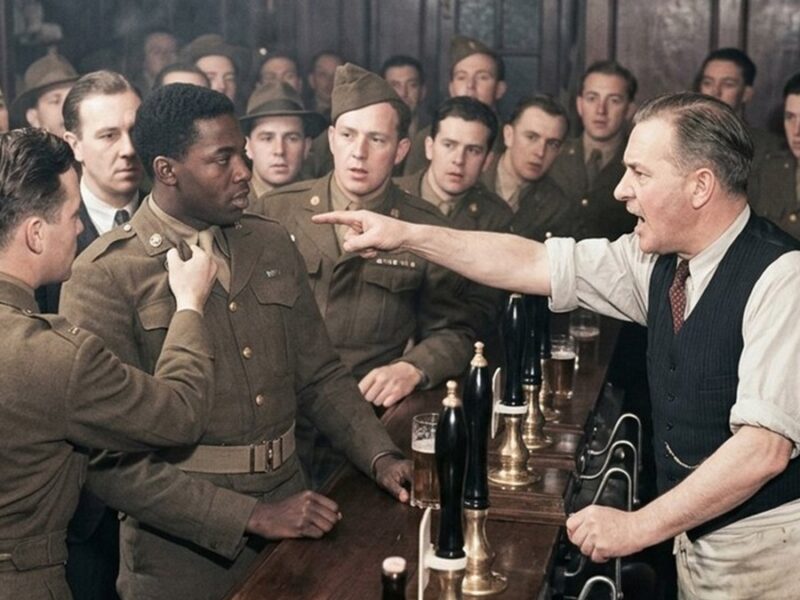
Some establishments quietly complied. Others did not. In a village in Lanasher called Bamber Bridge in the summer of 1943, white military police tried to enforce American racial rules in a pub that had decided not to observe them. The British landlord had put up a sign, black troops only.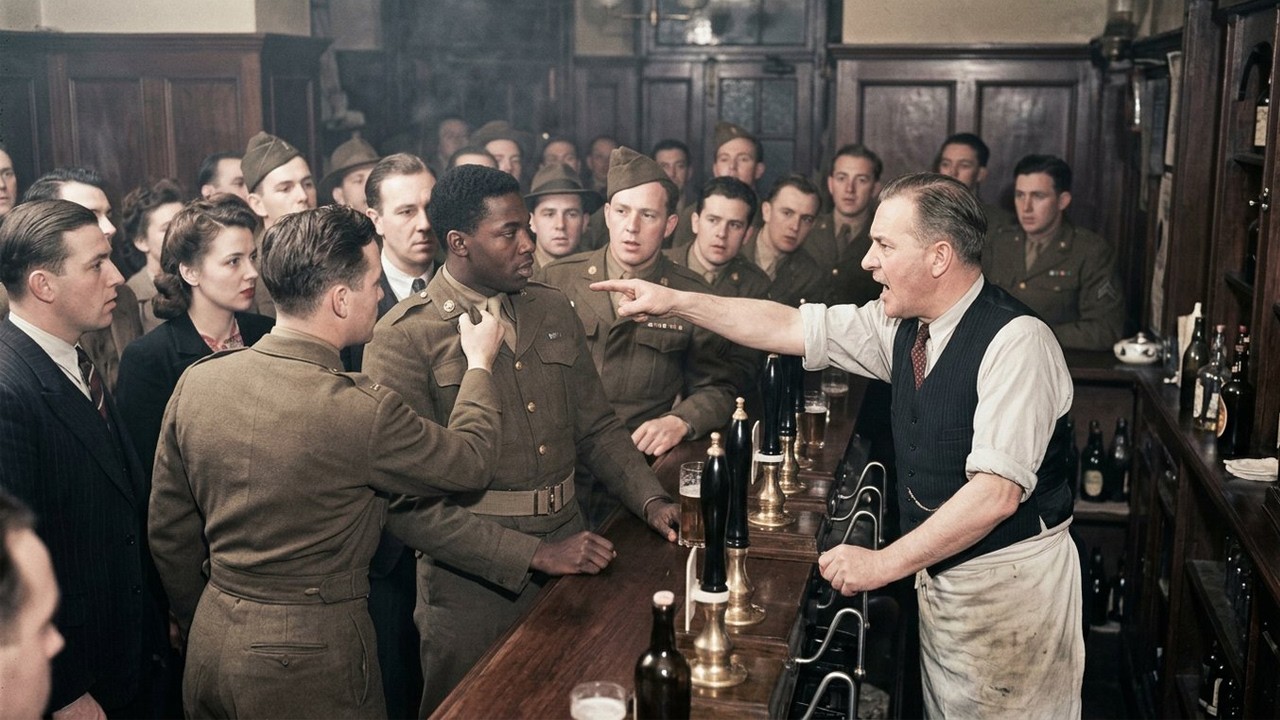
What followed escalated through the night into something requiring armed troops to resolve. Hundreds of men involved papers. The next morning, the army tried to bury it. The army did not entirely succeed. Bamber Bridge made it clear that Britain was not going to enforce American racial customs simply because Americans expected it.
And that black soldiers, who had been told their entire lives that resistance was impossible, were capable of something else entirely when the ground beneath them shifted. James knew about Bamber Bridge. They all did. It circulated through the colored units the way important things always did, in fragments, quietly between men who understood what it meant without needing it explained.
There was a pub near the base that the men in his unit used on Saturday evenings, a quiet place that had accepted them without incident. James went there. It was safe, which was the right word for it, and safe was what he knew how to value. One Friday evening in early June, he was walking back from the village alone when he passed a different pub, one he had never entered.
Warm light through the windows, the low sound of people at the end of a working week. He stopped, stood there for perhaps 2 minutes with his cap in his hands. A British couple came out, nodded at him in passing, went on their way. He watched them go. Then he turned and walked back to the base.
He told himself it wasn’t worth the trouble, that he had no reason to push it, that the rules here might be different, but he didn’t know how different. Not really, not when it mattered. His grandmother’s voice was very clear in his head that evening. “You wait,” she said. “You keep your eyes down, and you wait.
” He kept his eyes down for three more weeks. The swan and crown sat on a corner near the center of town. tutor beams, diamond pained windows, beer that was warm and slightly bitter and nothing like back home. He had walked past it many times without entering. On a Tuesday evening in late June, after a long day laying steel mat for a new airfield, he found himself outside it with a few hours of liberty and nowhere particular to be.
Through the window the light looked warm, and the sound of voices suggested ordinary life going about its business. He stood there with his cap in his hands, turning it slowly. He thought about the Friday 3 weeks earlier. He thought about the couple who had nodded and walked on.
He thought about his grandmother. Then he went in. No one turned. No one stared. He made his way to the bar and waited. The landlord, a man in his 50s with a face that suggested decades of hard work, finished serving another customer and looked at him without any particular expression. Will you have? He ordered a mild and found a spot near the wall.
He drank slowly. He had been there perhaps 20 minutes when three white American soldiers came in already loud from somewhere else, their voices filling the room in the way that certain men’s voices do when they want the room to know they’re in it. One of them noticed James. The soldier came over and stood in front of the table blocking the light.
You lost, boy? James kept his eyes on his drink. No. Well, this ain’t the kind of place for you. I’m just having a drink. The white soldier leaned closer, his voice dropping to something more deliberate than mockery. We don’t drink with your kind. Not back home, not here, not anywhere. You need to leave. The room had gone quiet.
The British civilians were watching. The landlord stood behind the bar, his hand resting on the counter, his face unreadable. James felt the calculations run through him the way they always did. He could leave. He had left a thousand other places under similar pressure. His grandmother had taught him that survival meant swallowing what you felt in exchange for getting through the day.
She had taught him because it was true and because she loved him and because the alternative was worse. But something held still in him this time. He thought about the park bench, the dog on his knee, the boys at the fence asking about Alabama, the woman counting change into his palm. “I’m staying,” he said quietly.
The white soldier’s hand closed around his collar. Then the landlord’s voice came across the room. Take your hand off him. The white soldier turned. What? Take your hand off him. He’s done nothing wrong. He’s I know what he is. He’s a customer in my pub, same as you. The white soldier let go, but didn’t step back.
You don’t know what you’re dealing with. This isn’t back home, the landlord said. calm, but with no uncertainty underneath it. In this pub, a man who pays for his drink is welcome to sit and drink it. That’s how we do things here.” One of the other soldiers called from the bar. You’re making a mistake.
Maybe so, but it’s mine to make. The three soldiers looked at each other. Then they left, slamming the door hard enough to rattle the windows. The normal sounds of the pub returned slowly, conversations restarting in low voices, people returning to their drinks as though nothing of particular consequence had occurred.
The landlord came out from behind the bar, asked if James was all right, brought him another pint without being asked, set it on the table, and went back to work without another word. James sat with the glass in both hands. No one in his life had ever done that, not when it cost something. What the landlord did not know in that moment, and what matters is what happened next.
The following week, an American officer came to the Swan and Crown and made clear that the establishment’s cooperation with American forces depended on its willingness to maintain appropriate arrangements. The landlord listened carefully. He thanked the officer for coming and then he carried on exactly as before.
This was not unique to one pub in Wiltshire. Across England, ordinary people, landlords, shopkeepers, boarding house owners found themselves being leaned on by American military officials and made the same quiet decision. Some lost American business. Some were put on unofficial lists, which meant white soldiers were redirected elsewhere, which meant real money lost in a country already exhausted by years of war.
These were not wealthy people making a costless choice. They were ordinary working people who, when it came to it, decided there was a line, and they were not going to step over it. James returned to the Swan and Crown many times over the following months. The landlord greeted him with the same quiet courtesy he showed everyone, never mentioning what had happened, never seeking acknowledgement or gratitude.
The British regulars treated him with the same casual indifference they always had, which by now felt more valuable to James than any explicit welcome could have. In August, a letter arrived from his father. His grandmother had died in her sleep peacefully. No warning. The funeral had been well attended.
They missed him and prayed for his safe return. He read the letter sitting on his bunk in the Nissen hut while the other men moved around him going about their evening routines. He sat for a long time with it in his hands. He thought about her lessons, about the rules she had built into him over a lifetime to keep him alive in a world that had decided what he was before he could speak.
He wondered what she would have made of the swan and crown, of the landlord, of the woman who counted change into his palm, of the boys at the fence who wanted to know about Alabama, whether she would have trusted it, or whether she would have warned him, as she always had, that kindness from white people was always provisional, always subject to withdrawal. He didn’t know.
He folded the letter carefully and put it away. When repatriation came, he went home to Alabama, and the rules reassembled themselves around him exactly as he had known they would. Patient, immovable, indifferent to where he had been. But he carried something back that he had not brought over.
the knowledge from his own experience that it was possible for things to be different, not imagined, not theoretical, real, because he had lived inside it briefly in a pub in Wiltshire on a Tuesday evening in 1944 and on a park bench and outside a shop and at a fence where a group of boys wanted to know what Alabama looked like.
Megar Evers came home from England and spent the next 18 years in Mississippi organizing, investigating, registering voters, refusing to stop. He was shot dead in his driveway in 1963. The man who killed him was acquitted twice by all white juries. He was finally convicted in 1994, 31 years after the murder.
Evers had said more than once that Britain had shown him what was possible. That knowledge ran underneath the movement that followed, the marches, the legislation, the long struggle that consumed the next two decades of American life, built in part on the testimony of men who had been to England and seen a different world and come home unable to pretend they hadn’t.
The landlord of the Swan and Crown is long gone. James is long gone. But what passed between them on that Tuesday evening in 1944 did not stay in that room. It traveled in the people who were there and in the people they became and in everything that came after. That is not a small thing. It never was.