Why 6 NATO Armies Run On The Same ‘German’ Truck The British Army Built Its Entire Logistics Around D
Tapa, Estonia, 2024. A British Army Royal Logistic Corps convoy pulls into a refueling point shared with a German Bundeswehr battle group. The British driver climbs down from his cab. The German fuel handler walks across with the nozzle. The same diesel flows into the same tank. The same wheel nuts fit the same hubs.
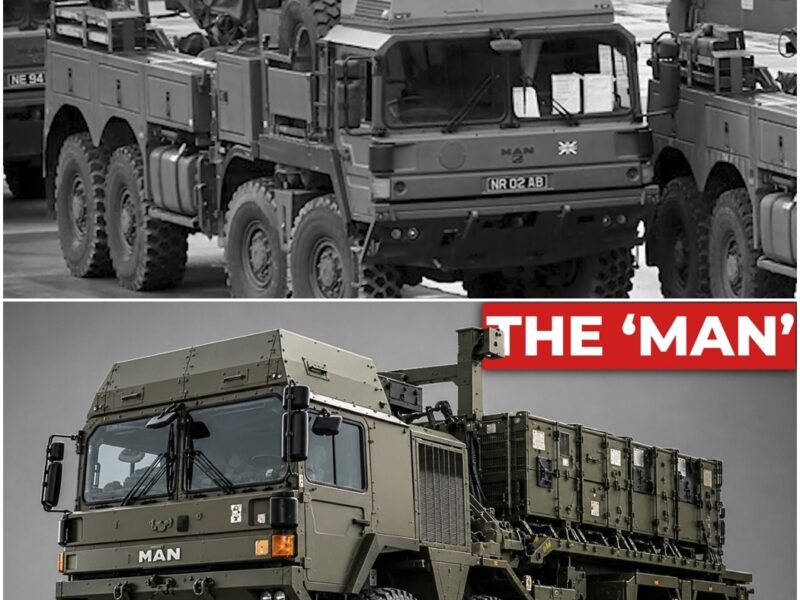
A Norwegian REME mechanic three vehicles back is checking the same chassis. Officially, the British call it the Logistic Support Vehicle. Officially, the Germans call it the UTF. Officially, the Norwegians call it the HX. It is the same truck. Six NATO armies, the United Kingdom, Germany, Australia, Sweden, Norway, and Denmark bought it.
Britain bought it first, and Britain bought it biggest. In the process, a country that no longer builds its own military lorries, a country that watched Bedford, Leyland, AWD, and ERF collapse one after another, took a German design from a factory in Vienna, and turned it into the logistics backbone of NATO’s eastern flank.
This is not a story about British engineering. This is a story about British procurement at scale. By the late 1990s, the British military truck industry was finished. Bedford Vehicles, the firm that had built the MK series for the British Army for decades, stopped heavy truck production at Dunstable in 1986.
Bedford had lost the four-ton contract to Leyland, and the parent company Vauxhall saw no future in low-volume military work. AWD Trucks bought the Bedford remnants in 1987, continued building military variants for 5 years, and then went into receivership in 1992. Leyland fared no better. Leyland Trucks merged with the Dutch firm DAF in 1987.
The combined Leyland DAF collapsed in February 1993. The British arm survived through a management buyout, and was eventually sold to the American giant Paccar in 1998. ERF, the last independent British heavy truck builder, was acquired by the German firm MAN in 2000. The Middlewich factory closed in March 2002. The ERF brand was killed off entirely by 2007.
By the time the Ministry of Defense published its support vehicle requirement, there was no domestic manufacturer left standing. The Bedford MK was elderly. The Leyland DAF 4-ton fleet was elderly. The Foden drops heavy trucks were elderly. The existing British fleet could not meet the tonnage requirements that operations in the Balkans, Sierra Leone, and the early Afghanistan campaign had exposed.
The Gulf War of 1991 had taught the British Army a lesson. Modern operations demand more lift than the Cold War fleet was designed to deliver. Armored brigades cannot fight without fuel, water, ammunition, and ration packs arriving in tonnage. The trucks that bring them forward need off-road performance, NATO single fuel compatibility, and protection against ambush and improvised explosive devices.
The existing British fleet had none of those things at the level required. The Strategic Defense Review of 1998 identified logistics as a critical capability gap. Three separate projects were launched. The future cargo truck, the future fuel vehicle, and the future wheeled recovery vehicle.
They were originally planned as private finance initiatives. PFI was dropped in March 2001. In April that year, the three projects were merged into a single program called support vehicle, SV for short. The scale of what the Ministry of Defense now had to buy was unprecedented. Thousands of trucks across four-wheel drive, six-wheel drive, and eight-wheel drive configurations with payloads from 6 to 15 tons, plus dedicated tankers, recovery vehicles, and palletized load systems.
The remaining British industrial base could not deliver any of it. Britain did not buy a foreign truck out of preference. Britain bought a foreign truck because there was nothing left to buy at home. In January 2002, the Ministry of Defense issued an invitation to tender. The project was valued at 1.6 billion pounds.
8,620 vehicles were on offer. Six bidders responded. Oshkosh and Stewart and Stevenson from the United States, Volvo from Sweden, Mercedes-Benz and MAN from Germany, and Leyland trucks, by then PACCAR owned, but still the closest thing Britain had to a domestic contender. Demonstrators were thrashed around Millbrook proving ground through July 2003.
Final bids went in that October. In a written ministerial statement preserved in Hansard for the 12th of October 2004, Defense Minister Adam Ingram announced that MAN ERF UK Limited had been selected as preferred bidder. The four finalists had been MAN ERF, Mercedes-Benz UK Defense, Oshkosh Truck Corporation, and Stewart and Stevenson TV SUK Limited.
The actual contract scaled down to 1.1 billion pounds for 5,165 vehicles and 69 recovery trailers was signed on the 31st of March 2005. The deal included 1,098 modular armor kits and a 20-year through-life support package, meaning the British fleet is contractually maintained into the 2030s. In June 2006, the Ministry of Defense exercised an option for a further 2,077 vehicles, finally replacing the Leyland DAF 4-ton fleet.
MAN won on three measurable things. First, maturity. The HX family was already proven, derived from MAN’s commercial TGA range and field tested through German army service. Second, cost. The HX hits a payload per pound sweet spot that the heavier American Oshkosh family deliberately overshoots. Third, production capacity.
MAN’s plant in Vienna, Austria, the former Steyr facility, could deliver thousands of trucks on a timeline that did not require new tooling. The British family runs from the 4×4 HX60, the 6-ton support vehicle cargo light, replacing the Bedford MK, through the 6×6 HX58, the 9-ton support vehicle cargo medium, replacing the Leyland DAF 8-ton, up to the 8×8 HX77, the 15-ton support vehicle cargo heavy.
Add the improved mobility SX chassis variants for harder ground. The unit support tanker carrying 7,000 L of fuel or water, the 8×8 recovery vehicle with its EKA crane and Rotzler winches, and the enhanced palletized load system truck with its Cargotec hooklift for moving ISO containers and ammunition pallets. 42 variants in total.
Around 4,000 of the British fleet are the basic HX60. The power plant across the medium and heavy fleet is the MAN D2676, a 12.4 L common rail straight-6 diesel tuned between 400 and 520 horsepower depending on variant, mated to a ZF 12-speed automated gearbox. Permanent all-wheel drive on the SX variants, central tire inflation, run-flat tires, NATO single fuel compatibility on F-34 diesel, operating envelope -32° C to +49, with the Royal Marines winterized kit -46.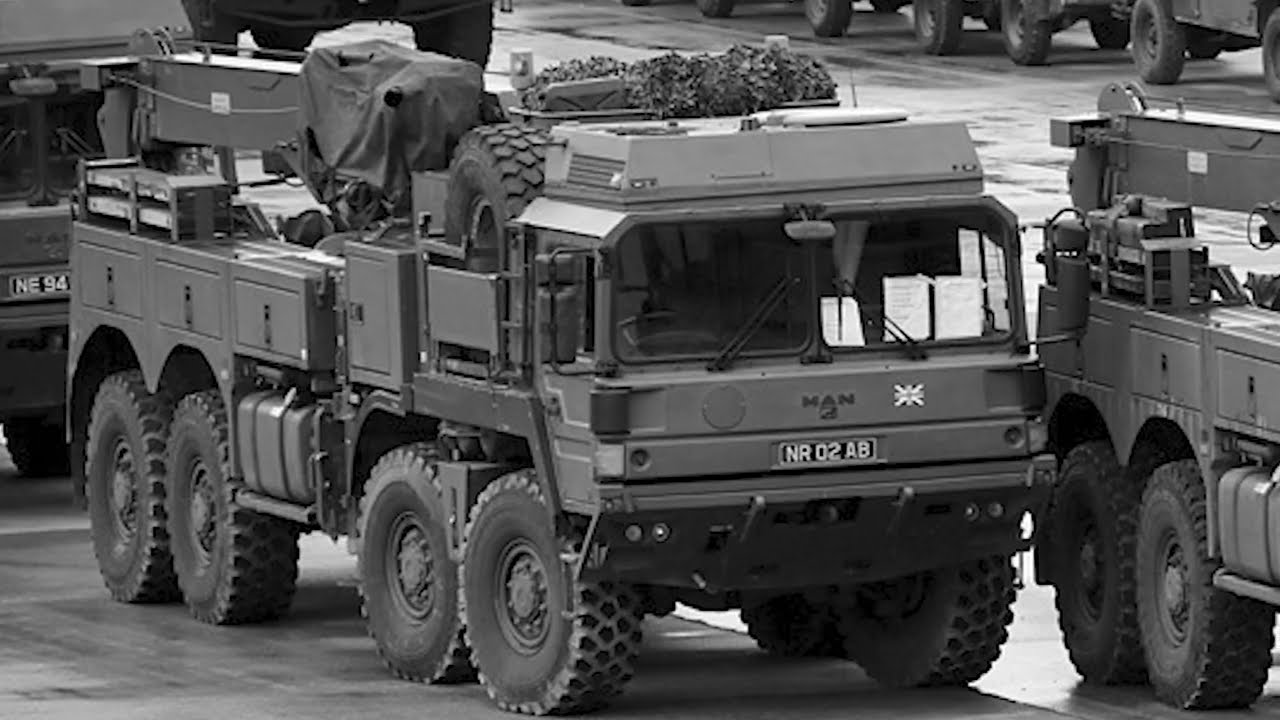
Fording depth 1.5 m. The cab can be fitted with the modular armor cabin applique kit, around 1,500 kg of bolt-on protection, or the heavier integrated armor cabin for higher threat environments. The British modification work, the armor fitting, the Bowman radio installation, the LEP radar truck conversion, the Cargotec hooklift fitment, was carried out at the former ERF facility in Doncaster.
The chassis is Austrian, the drivetrain is German, the finishing is British. Nobody at the Ministry of Defense pretended otherwise. Before we get into the combat record and how this fleet ended up running half of NATO’s logistics tail, if you are enjoying this deep dive into British procurement strategy, hit subscribe.
It takes a second and it helps the channel grow. Now, back to the trucks. First, British deliveries reached the British Army in June 2007. By May 2008, the first 36 trucks were in Iraq under Project Fortress, fitted with theater entry standard armor and electronics. By late that year, around 50 were in Afghanistan.
Project Barricade pushed 87 new build enhanced palletized load system trucks straight to Helmand to replace the failing Leyland DAF and Foden heavy trucks. According to Carl Schulze, writing in Joint Forces News, the older fleet had problems coping with the environmental conditions and meeting operational demands.
A total of 393 MAN support vehicles were eventually brought up to theater entry standard. The kit added modular armor, an ISTEC protected weapon station, base platform armor, mobility component protection, Bowman radios, electronic countermeasures, enhanced electronic countermeasures, infrared lights, and night vision goggles for both driver and co-driver.
The fleet went on to serve on NATO’s Operation Cabrit in Estonia from 2017, Exercise Trident Junction in Norway in 2018, and Exercise Steadfast Dart in 2025. Then comes the interoperability story, and this is where the procurement decision becomes strategy. The United Kingdom remains the largest operator, more than 7,400 trucks under the original support vehicle contract, plus a 282 million pound 500 vehicle enhanced palletized load system top-up order signed in February 2024.
All 500 were delivered to the Ministry of Defense depot at Ashchurch by the 16th of December that year. Major General Darren Crook of Defense Equipment and Support told industry that the contract went from conception through approvals to contract award and first delivery in just 7 months.
By un-rushed Ministry of Defense standards, that is unprecedented. Germany came to the HX2 for its own general logistics late, but went all in. A 900 million euro framework signed in July 2017, a record 3.5 billion euro framework signed on the 1st of July 2024 for up to 6,500 more trucks, a further 770 million euro call-off announced in October 2025.
By Rheinmetall’s own statement in August 2025, around 7,000 HX vehicles have been delivered to the Bundeswehr since 2017. Australia closed out its Land 121 Phase 3B and Phase 5B programs on the 20th of February 2025. 3,588 HX trucks delivered to the Australian Defense Force. Sweden ordered 215 trucks under the joint Norway-Sweden framework signed in March 2014, followed by 40 more for the Patriot air defense system, and another 48 for the Archer artillery system in 2024.
Norway ordered around 95, then placed a further 300 TG 3M 188 trucks in a single 150 million euro call-off in May 2023. Denmark bought just over 200 HX trucks from late 2006. And then, on the 27th of November 2025, the Danish Procurement Authority signed a fresh framework with Rheinmetall MAN for up to 1,000 additional HX and TG trucks with first deliveries booked before the end of 2027.
Six NATO armies, one platform. New Zealand bought 194 of them as well for 113 million New Zealand dollars, delivered between 2013 and 2014. They are not in NATO, so they do not make the headline count, but they are the bonus track. By Rheinmetall’s count, well over 20,000 HX trucks are now in service worldwide, many of them in EU and NATO countries.
The contrast with the Russian logistics tail is brutal. The Kamaz 63508 by 8 carries a maximum load of 10 tons by the factory’s own published specification. The Ural 43206 by 6 carries about 7.9. Russian field officers, quoted in the trade title Voyenno-Promyshlenniy Kuryer, openly preferred the old Ural over the new Kamaz off-road.
Neither truck has central tire inflation. Neither has modular armor preparation. Neither matches the spare parts depth of the HX family. According to the open-source tracker Oryx, more than 1,500 Kamaz and Ural trucks have been visually confirmed destroyed or captured in Ukraine. The Ural 4320 alone accounts for at least 1,454 confirmed losses as of November 2024.
Meanwhile, around 350 HX trucks from allied stocks, including British HX 60 donations, are still moving Ukrainian colors late November 2025. Exercise Titan Storm on Salisbury Plain, a propeller shaft fails on a MAN support vehicle, then another. Once the count of prop shaft failures across the fleet crossed 10 in 24 months, the Defense Safety Authority’s rules automatically triggered a fleet pause.
The entire British MAN support vehicle fleet, reported as around 6,000 trucks in active service, was grounded. The fault was identified within days. Propeller shaft components had been fitted incorrectly, not a design flaw, a fitting error. The Ministry of Defense statement was precise. A number of MAN military support vehicles have been affected by a mechanical fault.
On the recommendation of the Defense Safety Authority, vehicles have been paused while affected parts are replaced. No wider underlying safety concerns with the vehicle. Remedial work began immediately. Vehicles returned to service in batches through December. The MAN support vehicle story is what happens when a country with a collapsing industrial base makes the right procurement call.
Britain did not build the best truck. Britain picked the best foreign truck after open competition, bought it at sufficient scale to make it the default, and let five more NATO armies follow onto the same platform. NATO logistics standardization did not happen by treaty. It happened because Britain’s 2005 order was big enough to set the standard for everyone else.
When the next NATO convoy rolls out of Tapa or Senelager or Ashchurch, the truck at the front of the column will be a German design with an Austrian chassis and a Union Jack on the door. Five more national flags follow down the line. British engineering did not win this one. British procurement did.