Why American Tankers Wanted Britain’s Sherman Firefly? BRITAIN HAD THE ANSWER! D
The American Army that landed in Normandy in June 1944 was by almost every measure that military planners used to assess fighting power the most lavishly equipped force in the history of warfare. It had more artillery than any force in the field. More aircraft, more trucks, more fuel, more food, more spare parts, more of almost everything that a modern industrial nation at the peak of its wartime production could manufacture and ship across an ocean to the far side of the Atlantic.
What it did not have was a tank gun that could reliably kill a panther from the front. The official American ordinance report is specific on this point. The APCM61 round fired from the 75 mm gun on the standard M4 Sherman would not penetrate the frontal armor of the Panther tank at any practical combat range.
Not at 500 m, not at 200, not at point blank range. The Germans had deployed Panthers to Normandy in numbers that Allied intelligence had not anticipated. The planners had assumed the Panther would be a rare heavy tank, a specialized weapon used sparingly like the Tiger one. What the crews found instead was a German medium tank fielded in quantities approaching those of the Panza 4, whose frontal armor the standard American gun could not defeat at any range.
The men who discovered this were not staff officers reviewing intelligence summaries. They were tank crews in burning Shermans in the Norman Bage, learning the lesson at the cost that lesson always extracts when it is learned in the wrong order. The British and Canadian forces fighting alongside them had something different.
One tank in four in every armored troop carried a gun that could do what the American gun could not. The Americans noticed. They noticed very quickly and they did not stop noticing for the remainder of the campaign. This is the story of how a British engineers’s obstinacy, a rejected proposal, a bureaucratic reversal under operational pressure, and approximately 11 months of frantic production work produced the one Allied vehicle in Normandy that German tank commanders were specifically ordered to destroy before engaging anything else on the battlefield. It is also the story of what it meant to be on the other side of that equation. To watch a vehicle in the field next to yours accomplish something that yours could not. And to understand that the difference was not training, not positioning, not crew quality, but the specific ballistic performance of the weapon pointed at the same German tank you were both trying to kill. The
17 pounder had been designed as a towed anti-tank gun. The distinction matters because it shaped everything that followed. The gun was engineered for maximum ballistic performance rather than for the weight and size constraints that governed what could be mounted in a tank turret.
The result was a weapon of extraordinary capability and considerable inconvenience. In its towed form, the 17 pounder entered service in 1942 and was immediately recognized as the most effective Allied anti-tank gun of the war. Its standard APCBC round, armor-piercing capped ballistic cap, penetrated the frontal armor of the Tiger 1 at 1,000 m against the Panther, whose highly sloped 80 mm Glacis deflected many rounds that should theoretically have penetrated.
The 17 pounder was effective at comparable ranges. Against every other German armored vehicle it was likely to encounter, it was decisive. British anti-tank regiments armed with the towed 17p pounder in Tunisia, Italy, and eventually Normandy regarded it as the weapon that finally equalized what had been an increasingly unfavorable exchange with German armor since 1941.
The obvious question, why not put it in a tank, was being asked before the gun even entered service. The answer for most of 1942 and well into 1943 was that it would not fit. Not through any lack of will, but through the specific constraints of the turrets then available. The 17 pounders breach mechanism was large.
Its recoil travel was approximately 1 m. The turret ring diameter required to accommodate those dimensions exceeded what the Cromwell, the Valentine, the Crusader, or any other British tank then in production could offer without complete redesign. The Challenger, a modified Cromwell chassis built specifically to carry the 17 pounder in a larger turret was attempted, but the resulting vehicle was tall, ungainainely, structurally compromised, and produced in numbers too small to matter.
The Ministry of Supplies tank decision board considered the proposal of mounting the 17 pounder in the Sherman and rejected it. The Sherman was an American design. Its turret was American dimensioned. The official assessment was that the modification was not viable within the time frame available. The man who disagreed with this assessment and persisted in the disagreement until it became official British policy was Lieutenant Colonel George Witheridge.
He had served in North Africa. He had watched British tank crews engage German armor with progressively inadequate weapons across two years of desert fighting. And he had the particular quality of determination that is sometimes described as stubbornness and sometimes when it produces the right outcome as visionary.
Witheridge working with a small team that initially operated without formal authorization demonstrated that the 17 pounder could be installed in the Sherman turret. The demonstration required solving several specific engineering problems that the Ministry of Supplies Assessment had treated as insurmountable and that Witherage’s team treated as problems requiring solutions.
The gun breach had to be rotated 90° from its standard orientation, allowing the loader to work from the left side of the turret rather than the right. The recoil system had to be completely redesigned. The main recoil cylinders shortened. Additional cylinders added to exploit the available width of the Sherman turret.
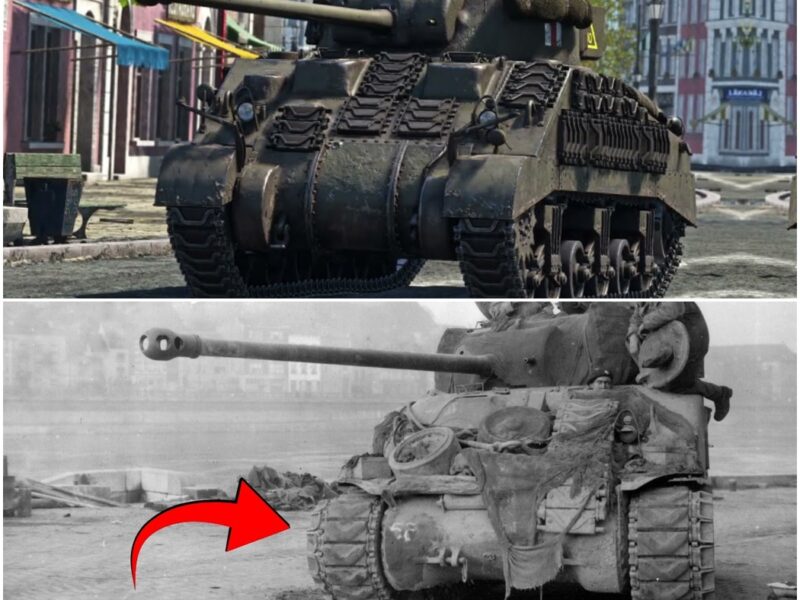
The gun cradle had to be shortened, which introduced a stability problem with the barrel under recoil that was resolved by extending the untapered section at the base of the barrel, producing the distinctive profile that became the Fireflyy’s most immediately recognizable characteristic. The co-driver, the fourth crew member who sat alongside the driver in the standard Sherman hull operating the hull-mounted machine gun was eliminated.
His position and the space it occupied were given over to additional ammunition stowage for the 17 pounders rounds which were physically larger than the 75 mm shells they replaced. A new hatch was cut into the turret roof over the gunner’s position because the 17 pounders installation prevented access through the standard hatches.
The radio moved from the turret to the hull. What remained when all of this was done was a vehicle that looked from any distance greater than comfortable combat range almost identical to a standard Sherman. Same hull, same tracks, same basic turret shape with a gun installed in it that the Ministry of Supply had said could not be installed.
Wither’s informal demonstration became a formal program. The Sherman Firefly went into production in January 1944. By the 31st of May 1944, 6 days before the Normandy landing, 342 Sherman Fireflies had been delivered to Montgomery’s 21st Army Group. The distribution worked out to one Firefly per armored troop of four tanks.
Every British and Canadian troop going ashore in Normandy would have one vehicle capable of engaging German heavy armor from the front at standard combat ranges, surrounded by three vehicles whose primary gun could not accomplish the same task. The American armored divisions landing alongside them had no fireflies.
This was not parimony or interallied politics. It was the consequence of a different national decision about tank gun requirements made at a different point in the war’s development that had seemed reasonable when made and proved inadequate in the specific conditions of Normandy. American armored doctrine held that tanks should fight other tanks only as a last resort.
The primary anti-tank role was assigned to tank destroyers, the M10 Wolverine and later the M36 Jackson, which carried heavier guns mounted in open topped superructures. The tank’s role was infantry support and the exploitation of breakthroughs, not the defeat of enemy armor in direct engagement. For this infantry support role, the 75 mm gun with its useful high explosive round was a reasonable choice.
The doctrine collapsed in Normandy because Panthers arrived in numbers and Panthers did not cooperate with a doctrine that assumed enemy armor would be handled by someone else. The American response was to rush the M4A1 with the 76 mm high velocity gun into production and ship it to France.
The reports that came back from the field were disheartening to the ordinance department and unsurprising to anyone who had studied the ballistic data carefully. The 76 mm was better than the 75. It had a higher muzzle velocity, a flatter trajectory, more penetrating energy at extended ranges against lightly armored targets.
It was not better against the Panthers frontal armor at the ranges where Normandy tank engagements were being fought. Field reports from American tank units through the summer of 1944 consistently indicated that the 76 mm was no more reliable than the 75 against the Panthers and Tigers they were encountering.
Something as the Chieftain’s Hatch historical analysis of the period later noted was wrong. What was wrong was that the 76 mm gun, whatever its advantages over the 75, was not the 17 pounder. The velocity was lower. The penetration figures at combat ranges were lower. The British had declined to compromise on anti-armour performance.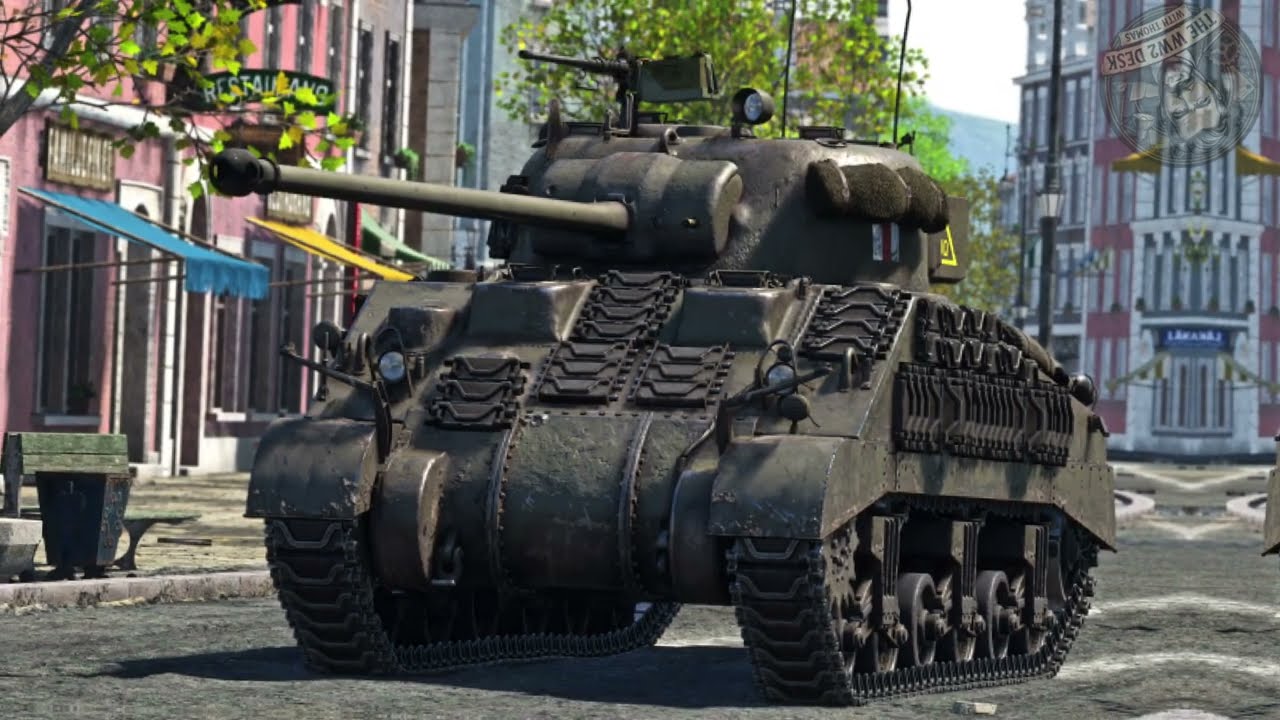
They had taken the best available weapon, done the considerable engineering work required to install it in a tank turret and accepted every consequence. The reduced crew, the modified ammunition stowage, the altered turret access, the gun so long it caught on the hedge of Normandy during movement. The technical report ARME-TR-1702 assessing Allied tank gun performance against German armor concluded specifically the British had sufficient numbers of Firefly variant Sherman tanks for the realworld tank versus tank combat in Normandy France. American tankers were struggling with the inadequacy of their 75 mm gun. In the meantime, the British fit the 17 pounder to the Sherman well before the American army considered the 76 mm for tank armament, unencumbered by tactical doctrine that assigned the anti-tank mission to a different vehicle. The Fireflyy’s long barrel was simultaneously its primary tactical
attribute and its principal tactical liability. The same visible length that told the gunner he was operating the most capable Allied anti-armour weapon in Normandy told every German tank crew and anti-tank gun crew in the vicinity exactly which vehicle in the Allied troop to shoot first. The German order was specific and documented.
Engage the Firefly before anything else. destroy the vehicle with the long barrel, and the remaining three Shermans in the troop became manageable opponents whose 75 mm guns could be defeated by Panther and Tiger armor at normal engagement ranges. The British and Canadian response was camouflage of a particular kind. Crews painted the rear portion of the barrel in a pale color, often a light gray or sand, while leaving the front in the standard vehicle camouflage.
From the ranges at which a German commander or anti-tank gun crew might be acquiring targets, the two-tone barrel created the visual impression of a shorter gun, mimicking the profile of a standard 75 mm Sherman. An observer with binoculars and sufficient time could still distinguish the Firefly.
An observer making a quick acquisition decision under fire at a range where fine detail was difficult to resolve might be deceived long enough to matter. The camouflage worked imperfectly and was applied universally. Every firefly in the Normandy campaign carried the painted barrel. Whether it saved more Fireflies than the priority target order cost them is an accounting that the records do not allow with precision.
What the records do allow is the observation that fireflies were lost in Normandy at rates that suggest the German targeting priority was implemented and survived at rates that suggest the camouflage occasionally helped. Operating the gun itself imposed specific demands on the crew that had no equivalent in the standard Sherman.
The muzzle flash when the 17 pounder fired was in the testimony of every crew member who has left a record of the experience extraordinary. Not impressive, extraordinary. A blast of flame so intense and so brilliant that both the gunner and the commander had to blink at the precise moment of firing.
If they failed to blink, they would be temporarily blinded and unable to observe whether the round had struck the target. In a tank engagement where the outcome of the next 3 seconds depended on knowing whether your first round had penetrated, temporary blindness was not an acceptable alternative to the reflex that prevented it.
Experienced Firefly crews developed the blink as a trained response. The right timing became habitual, requiring conscious attention at first and later automatic. New crews arrived without the habit and learned it under conditions that provided immediate feedback on the consequences of failure. The muzzle flash had one additional effect that was relevant specifically to the bokeage terrain of Normandy.
It set fire to things. After one or two rounds, the hedges and undergrowth directly in front of the tank would begin burning from the flash. In terrain characterized by dense hedger rows that both sides used for concealment, a firefly that had fired twice was announcing its position through the smoke and flames in front of it as clearly as through the gun report.
The barrel length created practical problems during movement through the boage that had no equivalent in standard Sherman operation. The 17 pounder extended well beyond the hull when the turret faced forward, and when traversed to the side, it reached distances from the vehicle’s center line that the crew had to be conscious of constantly.
Moving through narrow Norman lanes, through the gaps in hedgerros that provided passage between fields, through the streets of villages, all of it required awareness of where the barrel was and what it might contact. Crews learned to face the gun forward before moving through confined spaces and to traverse slowly through openings rather than at the speed that tactical situations sometimes demanded.
Ken Tout, who served as a gunner and later commander in the first Northamptonshire ymanry throughout the Normandy campaign, described the practical reality of the 17 pounder installation. The co-driver’s position eliminated, his space taken by ammunition, the massive breach dominating the turret interior, the loader working from a position that required learning a new physical routine because the gun’s orientation was not what any previous British tank gun had required.
The trade was accepted without complaint because the alternative was the 75 mm gun and the specific inadequacy the 75 mm gun represented. By August 1944, a specific engagement had demonstrated in the clearest possible terms what the Firefly was capable of and why the German priority target order was not irrational.
Near the village of Santan de Clamil on the 8th of August, a Firefly commanded by Lieutenant James Gordon with Sergeant Joe Eekins as gunner was positioned in an orchard when German Tiger 1 tanks appeared moving along a road below. In the lead tiger was SS Halpderm Furer Michael Vitman, the most decorated tank commander in the Vafen SS on the Western Front.
Vitman’s confirmed score by August 1944 exceeded 130 Allied tanks and anti-tank guns destroyed. His action at Verkage in June, where his Tiger had personally accounted for 23 Allied armored vehicles in approximately 15 minutes, had made him a figure of genuine tactical significance rather than merely propaganda interest.
He was, by any reasonable assessment, the most dangerous individual tank commander in Normandy. Echin pressed the firing button. The 17 pounder fired a round at approximately 3,000 ft pers toward the Tiger below. His loader chambered the next round. Echkins fired again. Both rounds struck Vitman’s Tiger. Within moments, it was burning.
Gordon ordered the Firefly back into the orchard before the German vehicles could acquire and return fire. The engagement from first shot to withdraw, had lasted seconds. Vitman, the most celebrated tank commander the German armored force had produced, had been killed by a Firefly gunner.
The Germans specific instruction to destroy fireflies before anything else was not a precaution based on fear. It was a military assessment based on accurate ballistic data. Echin and Gordon had just demonstrated why the standard Sherman alongside the Firefly in that orchard had the same crew quality, the same training, the same tactical positioning.
Its 75 mm gun could not have accomplished what Ekins had just accomplished. This was not a reflection on the crew of that other Sherman. It was ballistics. The APDS round, armor-piercing, discarding Sabo, entered British service in August 1944 and was distributed to Firefly crews in the field. The principle behind it was distinct from standard armor-piercing ammunition.
A smaller, denser penetrating core was enclosed in a lightweight carrier that filled the barrel and fell away as the round left the muzzle, leaving the dense penetrator to continue at velocities that conventional fullbore rounds could not achieve. The reduction in mass after leaving the barrel allowed the velocity to be maintained over greater distances than standard ammunition allowed.
against the Panther’s frontal armor with APDS. The 17 pounders engagement envelope extended to ranges that made the standard Sherman’s 75 mm combat parameters look limited. Against the Tiger 1, the combination of velocity and penetrator density was decisive at distances that removed the Tiger’s ability to fire from a range where it was protected by its own armor advantage.
The round generated significant and documented disagreement between British and American ordinance officers during the campaign. American testing found that APDS was less accurate than APCBC at extended ranges, producing dispersion patterns that fell outside acceptable standards by American testing criteria.
The American Army could not endorse a round whose accuracy it could not certify at the ranges where American doctrine assumed engagements would be decided. The British position, articulated in the language of field experience rather than testing range standards, was that a round capable of penetrating panther frontal armor somewhere on the target at 1,000 m was more useful than a round that could not penetrate the same target regardless of where it hit.
The argument ran through committees and reports for months without resolution. The war ended before resolution was required. What was resolved by the campaign from D-Day through to the German surrender was more concrete. 2,000 Fireflies had been produced and deployed. They had equipped every British and Canadian armored troop in Normandy with one vehicle capable of defeating German heavy armor from the front.
They had killed Tigers and Panthers at ranges where the standard Sherman’s gun was ineffective. They had, according to the specific words of the American Technical Report, provided the Commonwealth forces with sufficient anti-armour capability for the realworld tank combat of the campaign. While American crews with the same basic vehicle and a different gun fought the same enemy at a systematic disadvantage that no amount of tactical skill could fully compensate for.
In March 1945, the American Army formally requested Fireflies of their own. 18 M4 Shermans were converted to Firefly specification in the United Kingdom. The production work was done. The vehicles were ready to be shipped. The war in Europe ended in May 1945. The Americans received their Fireflies 11 months after the Normandy landing, during which their tank crews had fought German heavy armor with a gun that could not penetrate the Panther’s frontal armor at point blank range.
The converted vehicles never left the United Kingdom. The reasons the American army did not develop its own equivalent are documented and debated, and the debate has not been fully resolved in the decades since. doctrine played a role. A doctrine that assigned anti-tank missions to tank destroyers rather than tanks meant there was less institutional pressure to develop a tank gun with maximum anti-armour performance.
Manufacturing considerations played a role. The 17 pounder was a British weapon built in British factories and integrating it into American production lines would have required lead time that the program schedule did not contain. Intelligence played a role. The assumption that panthers would be rare, which proved incorrect, reduced the apparent urgency of an anti-Panther capability in the months when development decisions were being made.
All of these reasons are real. None of them changed what Normandy demonstrated to American crews who watched Fireflies operate alongside their own vehicles. The vehicle next to them had a gun that could kill the tank trying to kill them. Their vehicle did not. This was not a matter of doctrine or manufacturing lead times or intelligence assessments.
It was a matter of which gun was mounted in the turret when the German armor appeared. The men who drove standard Shermans through the Normandy campaign were not, by any assessment, inferior crews or inferior soldiers. They were men operating a vehicle whose gun had been designed to a specification that Normandy proved inadequate in conditions that made the inadequacy visible every time a panther appeared in their field of view.
And they calculated, as experienced crews inevitably calculated what the engagement would require and whether their weapon was sufficient for it. The Firefly was the British answer to that calculation. 2,000 of them built from the ground up in approximately 11 months on the basis of an idea that the Ministry of Supply had initially rejected, pushed into production by a left tenant colonel who had watched enough inadequate guns fail against adequate armor to know what the right answer looked like.
It was not a perfect tank. The loss of the co-driver reduced its close-in defensive capability. The muzzle flash required a learned reflex to manage. The barrel length created operational constraints in close terrain. The priority target order meant that German gunners were specifically looking for it, which concentrated opposing fire in ways that cost Firefly crews their lives.
But it could kill a panther from the front. It could kill a Tiger at 1,000 m. It could do what the 75 mm gun could not do, and what the 76 mm gun could not reliably do, and what the American army eventually acknowledged in March 1945, it needed done badly enough to request 18 of them. The standard Sherman crews who watched Fireflies work in Normandy knew all of this.
They knew it in the specific, practical, unambiguous way that men who are being shot at by tanks their guns cannot penetrate understand the value of a gun that can. That is why they envied the firefly.