Why German Soldiers Chose Britain’s Ugly Gun Over Their Own D
In the spring of 1943, a German sergeant on the Eastern Front wrote a letter home that his family kept for decades. He described a firefight near Kharkov in which his unit had taken shelter in a ruined farmhouse. British weapons captured from Allied supply drops had been distributed among the defenders holding the opposite end of the street.
And then he wrote something that puzzled his family for years after the war. He said the British guns were the ugliest things he had ever seen. Crude, badly finished, assembled like plumbing rather than weapons. And then he said he had asked to keep one. His family assumed he meant as a souvenir. He didn’t.
He meant he wanted it as his weapon. That weapon was the Sten gun. And before this story is finished, you’ll understand exactly why a German soldier fighting for a nation that produced some of the finest small arms in the world chose to carry a British weapon that his own country’s propaganda had dismissed as scrap metal.
But to understand how the Sten came to exist at all, you have to go back 3 years to a beach in northern France and to the moment Britain came closer to losing the war than most people today fully appreciate. The evacuation of Dunkirk in May and June of 1940 saved approximately 338,000 British and Allied soldiers from capture or death.
In the decades since, it has been remembered rightly as a story of extraordinary improvisation and courage. Small boats crossing the channel, men standing chest deep in the sea, waiting for hours in the hope that something would come. It was by any measure remarkable. But there is a number attached to Dunkirk that tends to get left out of the more comfortable versions of the story.
The British Army left behind approximately 90,000 rifles, 2,000 artillery pieces, 7,000 tons of ammunition, nearly every vehicle, every heavy weapon, almost all the equipment of a modern expeditionary force abandoned on the beaches or destroyed to keep it out of German hands. The soldiers came home.
Almost everything else did not. And in the summer of 1940, with German forces controlling the entire western coastline of Europe and invasion expected within weeks, Britain faced a question with no comfortable answer. How do you rebuild an army’s arsenal when you have almost no time and almost no money, and the men who need the weapons might need them before the year is out? The answer they arrived at would have been unthinkable 6 months earlier.
It would come from two men who were not by any traditional definition gunsmiths and it would produce a weapon that the British army itself wasn’t sure it wanted. Major Regginald Shepard was an army officer with an engineering background. Harold Turpin worked at the Royal Small Arms Factory at Enfield, not as a weapon designer, but as an expert in production methods.
The name Sten came from both of them. S for Shepherd, T for Turpin, EN for Enfield. What made them the right men for this particular problem was precisely what might have seemed like a disadvantage. Neither of them thought the way gunsmiths thought. They didn’t ask how a proper military weapon should be built.
They asked what a weapon needed to do and what was the cheapest and fastest way to make something that would do it. The result offended almost everyone who saw it. The receiver was stamped from sheet metal and welded together rather than machined from solid steel. The barrel was a basic rifled tube.
The bolt was a chunk of metal with a firing pin. The magazine was welded to the side of the receiver at an angle that looked wrong to anyone who’d ever handled a weapon. The whole thing had 47 parts. A Thompson had over a 100. A German MP40 around 70. A soldier could strip a Sten with no tools in seconds.
And if it broke, almost anyone with basic metalwork skills could fix it. The cost difference was staggering. A Thompson cost around $200 and took roughly 70 hours of skilled labor to produce. A Sten cost the equivalent of a few pounds. Some early versions came in at 17 shillings and sixpence and took around five man-hour to build.
A single factory producing stens could outproduce 10 factories making Thompsons at a fraction of the cost. By 1943, Britain was manufacturing over a million Stens a year in facilities that had never been intended as weapons factories. One of them was the Triang Toy Factory, the same company that made children’s pedal cars and tin trains.
Thousands of Stens came off a production line that had months earlier been making toys. 4 million were produced in total at a combined cost of around £8 million. For context, that was less than the development budget of many individual aircraft programs. For £8 million, Britain armed its infantry and as we’ll come to much of the resistance movement across occupied Europe with firepower that would otherwise have been impossible to afford.
But there was a problem, and it was a problem that would cost lives before anyone fully understood how serious it was. A home guard instructor sometime in 1941 was demonstrating the Sten to a group of assembled troops in a church hall. He wanted to show them the weapon was safe to handle, so he threw it onto the table in front of him to prove it wouldn’t fire accidentally. It fired.
The bullet passed between the assembled men and embedded itself in the wall. By some mercy, no one was hurt. The story spread quickly through home guard units across Britain. It was not the last time something like it happened. The Sten’s trigger mechanism was dangerously sensitive in its early versions, and the weapon could discharge if dropped or struck with enough force.
There were accidental deaths. There were men who came home from the war with a hatred of the Sten that never fully left them because they’d watched a friend die, not in a firefight, but because someone had stumbled or tripped and the weapon had gone off. A veteran who’d served with the Chindits in Burma, said years later that his uncle had laughed every time a war film showed British soldiers killing enemies cleanly with stens because in the jungle the things were forever jamming when you needed them most. A soldier who’d fought with the Eighth Army in North Africa said the Sten was a bombardment weapon, not a fighting weapon. You couldn’t hit anything with it at range. The sights had no reliable fixed relationship with the barrel. The dust got into everything. He dropped his at the first opportunity and picked up something else. And yet, the story doesn’t end there. Because the Sten, as thousands of men slowly discovered, was
a weapon that rewarded those who understood it and punished those who didn’t. In Tunisia, where the dust and sand that disabled more precisely machined weapons blew straight through the Sten’s loose tolerances without affecting the mechanism, it kept working when other guns stopped. Men who’d cursed it in training found in the field that the very sloppiness they’d complained about was what made it reliable when conditions were at their worst.
One veteran put it in a way that has stayed with everyone who heard it. The Sten, he said, was a brilliantly judged weapon rather than a good one in its own right. It wasn’t built to be excellent. It was built to be adequate in enormous numbers, and in the conditions that mattered most, close, fast, brutal, adequate was often enough.
Meanwhile, on the other side of the wire, something was happening that nobody in Britain had anticipated. When German soldiers first captured Stens in North Africa, the reaction was exactly what you’d expect. Propaganda photographs circulated showing German troops holding up captured stens. Look, the message ran, look at what the British are reduced to.
Scrap metal, welded pipe, a nation that can no longer build proper weapons. The mockery was genuine and by the standards of traditional gunsmithing, not entirely unfair. But contempt in war has a way of meeting reality and coming off worse. German soldiers who actually fired the captured weapons found they worked.
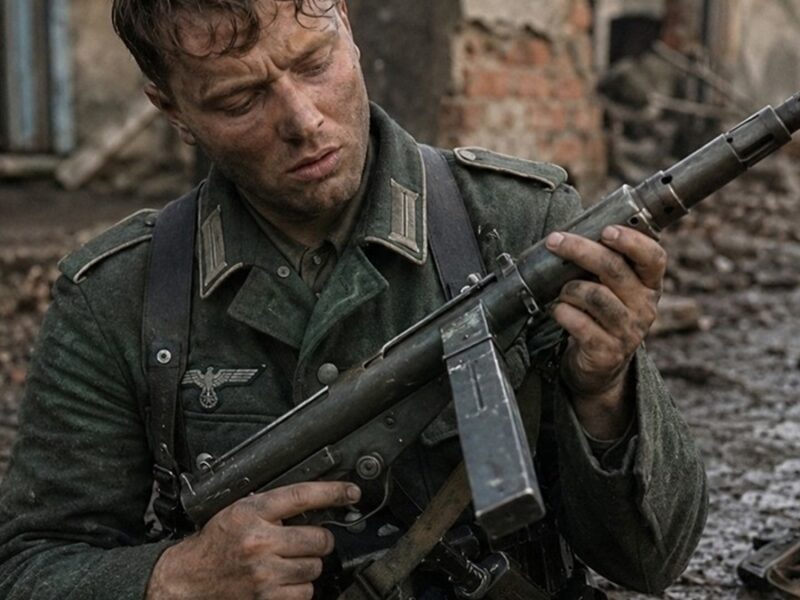
The 9mm ammunition was identical to what their own MP40s used, which meant there were no supply complications. A captured Sten went straight into service. The mechanism was simple enough to maintain with whatever tools came to hand, and its tolerance for rough handling for the mud and cold of the eastern front for conditions that the more precisely engineered MP40 sometimes struggled with was quietly impressive.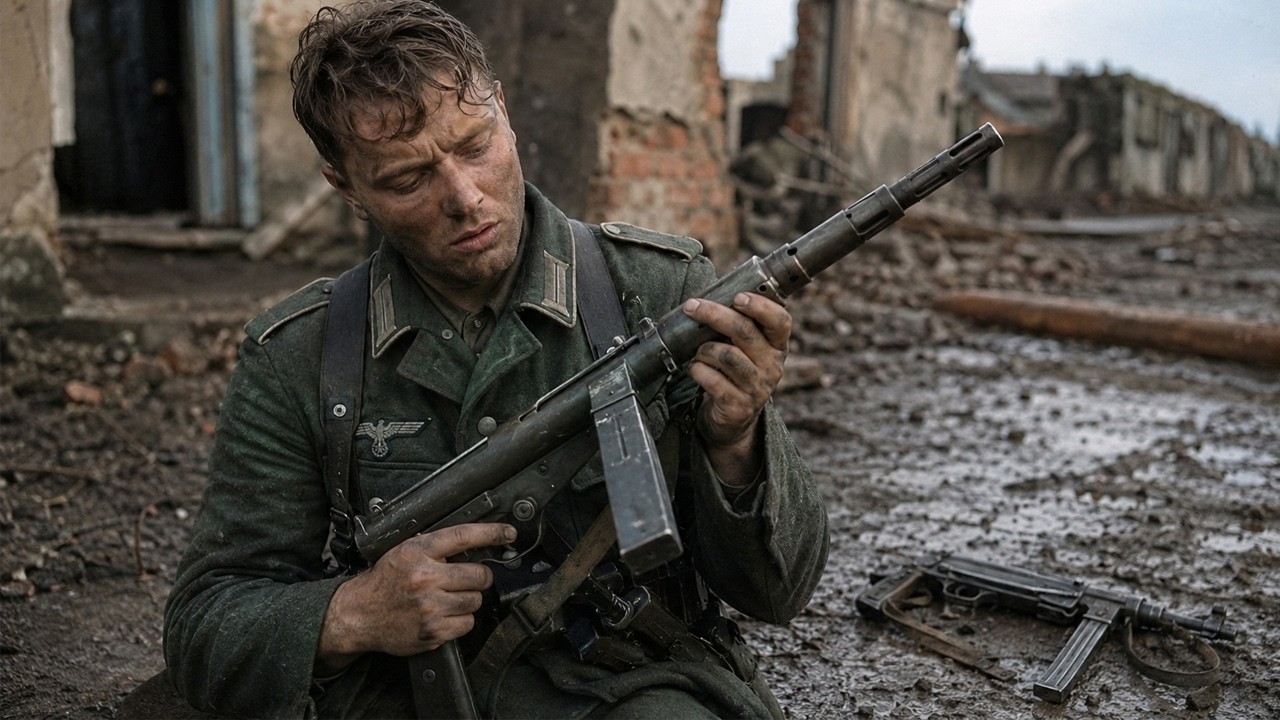
By 1943, German units were routinely keeping captured stens rather than turning them in. German ordinance analysts examining the weapon professionally acknowledged something the propaganda had been designed to obscure. The Sten’s crudeness was a deliberate engineering choice, and it had produced advantages that more refined designs couldn’t match.
And then Germany, facing its own crisis in the final years of the war, desperate, running short of everything, needing weapons fast, did something remarkable. German engineers developed a weapon called the Gret Stam. It was with only minor modifications, a direct copy of the Sten. the same stamped metal, the same sidemounted magazine, the same deliberate, unashamed crudeness.
Germany’s industrial collapse meant it was never produced in significant numbers. But the fact that German ordinance experts, given the choice of any Allied weapon to copy, chose the one their own propaganda had called scrap metal. That tells you more clearly than any test result what the professionals on both sides actually thought of it.
Which brings us to the part of this story that is perhaps the least well-known and perhaps the most important. From 1942 onwards, the special operations executive began dropping stens into occupied Europe by the tens of thousands. The logic was straightforward. The Sten was the only weapon Britain could afford to give away in the quantities that resistance movements needed.
The French resistance received over a 100,000 stens before D-Day. The Polish home army received tens of thousands more. Norwegian, Danish, Belgian, and Dutch underground networks were armed with them. Partisan forces in Yugoslavia and Greece received them through British supply drops. In Palestine, there was a clandestine factory operating in a space beneath a kibut’s laundry, nominally working under British Army contract, that was secretly manufacturing stens and ammunition for the Hagana, the Jewish paramilitary organization that would within 3 years be fighting the British themselves for Israeli independence. A resistance fighter with a sten could be taught to use and maintain it in an afternoon. Its ammunition could be captured from German forces or produced in improvised
workshops. And it was small enough to be concealed in a way that a rifle never could. Every German soldier assigned to guard a railway bridge or a telephone exchange or a munitions factory against a resistance attack that might never come. was a soldier not fighting at the front.
Every convoy that was ambushed, every supply line that was disrupted, every act of sabotage that a resistance fighter with a sten carried out, all of it imposed costs on Germany that had to be paid from somewhere. The Sten, built for a few pounds and dropped from an aircraft in the middle of the night in a French field, was forcing Germany to garrison an entire continent.
On the 5th of June 1944, the night before D-Day, resistance groups across France rose to support the Allied landing. They cut telephone lines. They ambushed German reinforcements moving toward the coast. They attacked supply convoys in those critical first hours when the invasion’s survival was still uncertain and every delay to German response mattered.
The weapon most of them were carrying was the Sten. When British and Allied forces landed on the 6th of June, the Sten was there too. Paratroopers dropping into Normandy in darkness carried Sten as their primary weapons. light, compact, and built for exactly the close quarters fighting they expected to find when they landed.
Commandos used them to clear bunkers. Infantry advancing through the Bage, that dense hedge Norman landscape where fields were separated by high embankments, and firefights erupted at ranges measured in yards rather than hundreds of meters, found the Sten suited to almost every engagement they encountered.
German defenders found themselves facing regular British forces and armed resistance groups simultaneously, both carrying the same basic weapon. The ugly British submachine gun that German propaganda had photographed as evidence of industrial desperation 3 years earlier was in the lanes and villages of Normandy very difficult to argue with.
Now, there is something that needs to be said plainly here, because this story is sometimes told with more patriotism than it deserves. The Sten was not the finest submachine gun of the Second World War. That distinction probably belongs to a weapon that most people in Britain have never heard of, the Australian Owen gun.
The Owen had a top-mounted magazine that fed by gravity, an ejection port at the bottom of the receiver that let water and dirt drain out naturally, and a level of reliability in mud and jungle conditions that no other submachine gun of the war could match. It was tested against the Thompson, against the Sten, and against every other Allied weapon.
And in those tests, the Owen was the only one that never jammed. It went on to serve in Korea and in Vietnam. Australian soldiers mourned it when it was finally replaced. Every serious assessment of Second World War submachine guns puts the Owen at or near the top. The Sten lost to the Owen in any objective comparison.
This is simply true. But here is what is also true. Australia produced around 45,000 Owen guns during the war. Britain produced 4 million Stens. And that difference was not a failure of British engineering. It was a choice made under desperate circumstances with limited time and limited money to produce a weapon that was good enough in enormous numbers rather than excellent in limited ones. The Sten armed British Infantry.
It armed the French resistance, the Polish Home Army, the Norwegian Underground, and partisan fighters from the Balkans to Palestine. It forced Germany to garrison a continent and helped resistance movements across occupied Europe survive long enough to matter when the invasion finally came. The Owen was the better gun.
The Sten was the right answer to the problem Britain actually faced. And there is one final thing worth remembering. That German sergeant, the one whose letter opened this story, the one who asked to keep his captured Sten rather than draw a replacement from German supply. He carried that weapon through the rest of his service on the Eastern Front.
His family still had it when the war ended, brought home among his few possessions. It was by every objective standard an ugly, crude, cheaplymade piece of welded pipe and stamped metal. It was also by the measure that matters most exactly what it needed to