Why Germans Couldn’t Believe the British Bridged the Rhine in One Night D
Wesel, Germany, March 23rd, 1945. General Leutnant Werner Derbig stands at his command post on the eastern bank of the Rhine and runs through the numbers one final time. The British Second Army has been massing on the western bank for weeks. He knows this. His reconnaissance officers have tracked the build-up with professional precision.
The fuel convoys, the infantry concentrations, the stacks of bridging equipment accumulating in the tree lines west of the river. He has watched Montgomery’s army assemble itself with the methodical patience of a commander who intends to cross this river correctly, which in every professional understanding Derbig possesses means slowly. Slowly is fine.
Slowly is survivable. The Rhine at Wesel is 1,500 ft wide. Its current in late March runs at 6 mph fed by alpine snowmelt, cold enough to kill a man who falls in before his unit can retrieve him. His artillery commands the eastern heights with clean fields of fire over every approach. The bridges are gone, demolished with the precision that German military engineers still, even now in the fifth year of a losing war, brought to the task of destroying things.
Everything that could be done has been done. Montgomery will have to build. He will have to build under fire across 1,500 ft of fast black water, and the calculations say this will take days, perhaps a week, long enough for reserves to arrive, long enough for the Rhine to perform its ancient function, which is to stop armies dead and make them pay for the privilege of continuing east.
What Derbig’s calculations do not include, what no staff officer in his headquarters has modeled, is what the Royal Engineers have been quietly perfecting for 3 years on rivers in England, in North Africa, in Italy, and in France. He does not know about Bailey Bridge.
He does not know what it can do, how fast it goes up, or how little expertise the men assembling it actually require. He does not know that somewhere in a war office drafting room in 1940, a quiet civil servant named Donald Bailey sketched a bridge on the back of a personal card and changed the engineering arithmetic of the entire war. He is about to find out.
If this is the kind of history that makes you want to understand not just what happened, but why it could only have happened the way it did, subscribe and share this video because there is more where this came from. By the winter of 1944, the geography of the European war had compressed to a single question, the Rhine.
Everything else, the Siegfried Line, the Ardennes Offensive, the desperate repositioning of depleted German divisions across a shrinking map, everything had been a negotiation with time, a purchase of weeks, an attempt to make the Western Allies pay enough in blood and logistics that some other outcome, a negotiated settlement, a political fracture in the coalition, anything other than unconditional surrender, remained conceivable.
The Rhine was the last argument. At its relevant crossing points, it stretched between 800 and 1,500 ft wide. Its spring current was dangerous enough that experienced swimmers drowned in it. Its eastern bank offered commanding defensive positions from which even depleted German formations could impose serious casualties on any crossing attempt. And every bridge was gone.
Every single one, demolished in an act of destruction so comprehensive that German engineers had achieved in ruin something they could no longer achieve in construction. The river was clean, the bridges were rubble. The Rhine was, by every measure that mattered to a defending army, defensible.
Montgomery agreed. Which is exactly why Operation Plunder, his plan for forcing the Rhine crossing at Wesel, was the most elaborately prepared set piece operation of the entire Western campaign. 25 divisions, 3,500 artillery pieces positioned along the western bank, an airborne assault deploying two full divisions, the 6th British Airborne and the 17th American Airborne, 21,000 men dropped behind the Rhine defenses on the morning of the crossing.
Months of logistical preparation. A preliminary bombardment beginning the night of March 23rd that one German survivor described as a sound beyond sound, something felt in the chest before it was heard by the ears. It was not subtle. It was not designed to be subtle. Montgomery understood that the Rhine crossing was not a tactical problem.
It was a logistical and engineering problem of the first order, and he intended to solve it with a sufficiency of force so overwhelming that failure became structurally impossible. What he had and what German defenders had consistently failed to account for in their calculations was the Bailey bridge.
Donald Bailey was not a soldier. He was a civil engineer employed by the British War Office, a methodical man who had spent years thinking about military bridging with the specific anxiety of someone who had studied what inadequate equipment cost armies in the previous war. The bridge he designed, sketched initially on the back of a personal card, tested at the Military Engineering Experimental Establishment at Christchurch, and adopted for production in 1941, was not elegant in the architectural sense. It was elegant in the engineering sense, which is a different and far more useful thing. The Bailey bridge operated on a single radical principle. Every panel was identical. Every panel was interchangeable. Every panel weighed exactly 570 lb. Every panel could be carried by six men without mechanical equipment. The panels connected to each
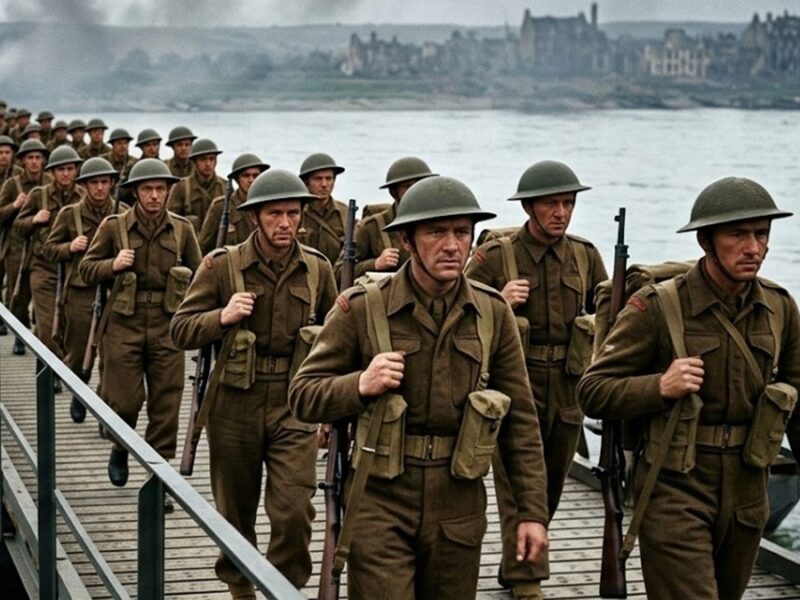
other with simple steel pins. Construction required no welding, no specialist knowledge, no crane. What it required was men who had practiced the sequence until the sequence became automatic, which is precisely what the Royal Engineers had spent 3 years producing. By March 1945, re-bridging units had built Bailey bridges in Tunisia, in in Sicily, across the Volturno, across rivers in France and Belgium.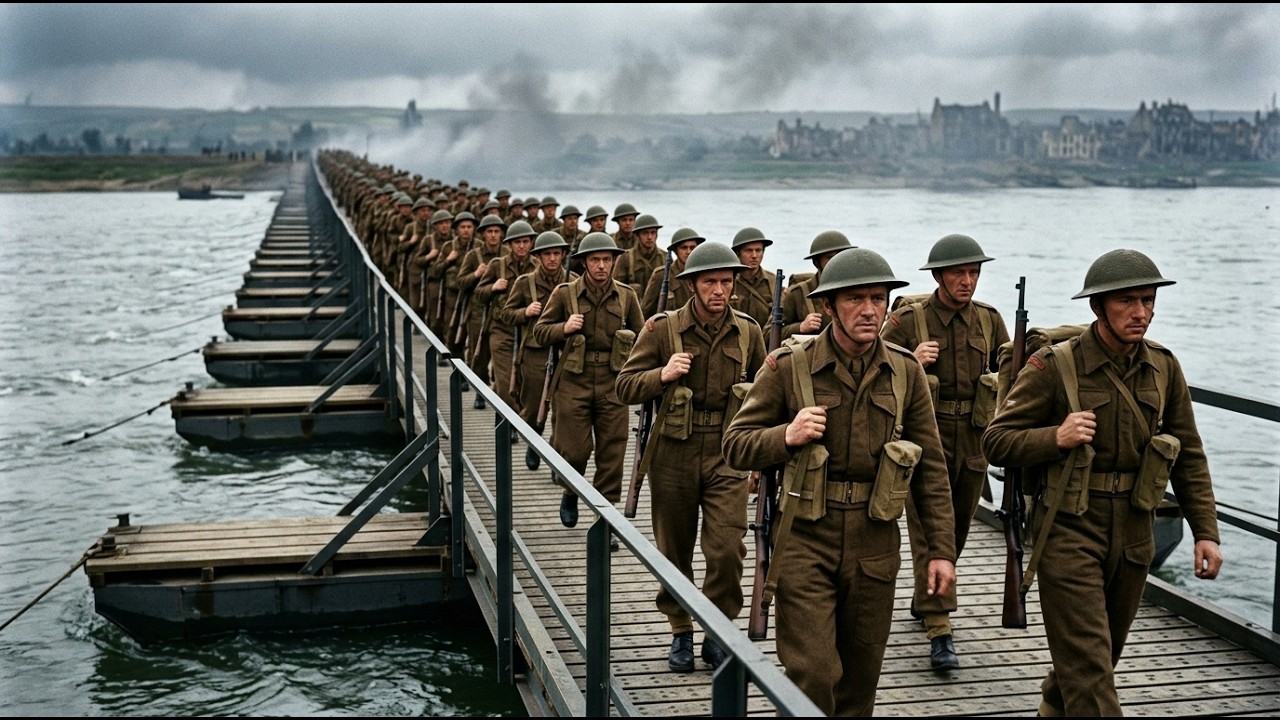
Each crossing adding institutional memory to a core that was, by the night of Wesel, operating with a depth of practical experience that had no equivalent on the German side of the river. The numbers define what that experience produced. A standard Bailey panel took six men approximately 90 seconds to position and pin.
A trained Royal Engineer company of 200 men could advance a Bailey bridge across water at rough 25 ft every 10 minutes in combat conditions. The Class 40 Bailey, capable of bearing a Churchill tank weighing 40 tons, required no additional heavy equipment beyond what the engineers carried themselves to the riverbank. Let that settle for a moment.
No crane, no specialist machinery. Six men and 90 seconds per panel. On the night of March 23rd to 24th, with the artillery bombardment turning the western horizon orange and the German positions on the eastern bank under fire intense enough to suppress organized resistance, Royal Engineer units began bridge construction at multiple points along the Wesel sector.
They worked in the dark. They worked in the current. They worked in the practiced methodical sequence that years of repetition had made indistinguishable from instinct. The first bridge capable of bearing infantry and light vehicles was operational within hours of the initial assault crossing.
The Class 40 bridge capable of bearing armor was complete by morning. By the afternoon of March 24th, less than 18 hours after the first assault boats touched the eastern bank, British tanks were crossing the Rhine. German engineering officers who reviewed the British construction timelines after the war returned repeatedly to one question.
Not how, they understood how. The Bailey system, once examined, was comprehensible to any trained engineer. The question was who? Who were the men who built this in the dark under artillery fire in the March current of the Rhine? What level of expertise did they carry? What years of specialist training had produced soldiers capable of this? The answer was the thing that unsettled them most.
The Royal Engineers who built at Wesel were not specialist craftsmen with deep civilian engineering backgrounds. They were trained soldiers, many with 18 months of dedicated bridging practice behind them. Young men who had been handed a system so thoroughly deskilled by its design that mastery of it required not genius, but repetition.
This was precisely the point. Donald Bailey’s genius was not the bridge. His genius was recognizing that the bridge needed to be buildable by ordinary men in extraordinary circumstances. And that this was achievable only if every element of complexity was designed out of the system at the drawing board stage before a single sapper ever touched a panel in the field.
German military engineering operated on an opposite principle. The Pioniere were trained to understand, to comprehend the material, the load dynamics, the water behavior, the structural logic of what they were building. This understanding made them formidable when fully supplied and operating at strength.
It made them fragile when depleted because you cannot compress understanding into six weeks of training. You can compress procedure. By March 1945, Germany was training procedure. And procedure without the underlying system that makes it executable under any conditions is just a list of steps.
The Royal Engineers were not following steps. They were executing a system. The difference on the night of the Wesel crossing was 18 hours. The strategic consequences of those 18 hours are difficult to overstate. German defensive planning assumed that even a successful initial infantry crossing would require days before armor could follow.
This assumption shaped everything. Reserve positioning, counter-attack timing, the prioritization of sectors. It was a reasonable assumption built from every river crossing doctrine the German military had developed across six years of war. It was wrong at Wesel for the same reason it was wrong at Oppenheim, wrong at Remagen, wrong at every point where British and American engineers produced a timetable that German doctrine had classified as physically impossible.
When armor arrived on the eastern bank 18 hours after the infantry, the window for a coordinated counterattack had already closed. The reserves that might have contained the Wesel bridgehead were being consumed by Oppenheim. The reserves that might have contained Oppenheim were being drawn toward Remagen.
Field Marshal Kesselring, who had replaced von Rundstedt as commander-in-chief West in the war’s final weeks, received the confirmed reports of the Wesel bridges with the professional recognition of a man watching a structure collapse not at any single point, but everywhere simultaneously. Not because the British had surprised him with the crossing itself.
The crossing was expected. What German planning had not modeled was the speed at which the crossing became a highway. There is a photograph from Wesel taken in the days after the crossing. It shows a Bailey bridge from the eastern bank looking west and on it a column of vehicles moving east.
Churchill tanks, Bren carriers, artillery pieces, supply trucks. An unbroken column moving with the unhurried steadiness of men who know the difficult part is finished. The photograph does not show Donald Bailey. It does not show the RE Sappers who stood in the Rhine current positioning panels in the darkness.
It shows vehicles. History photographs what crosses the bridge, not what builds it. What built it was a decision made years before the war reached the Rhine. A decision to design complexity out of a critical military capability so thoroughly that the capability could be executed by men who had never seen a major river before enlistment.
A decision that treated military engineering not as a craft to be preserved in specialists, but as a system to be distributed to anyone willing to practice the sequence until the sequence became habit. Germany’s engineering tradition was deep and genuinely brilliant. It produced things that stood as monuments to technical mastery.
But mastery concentrates. It pulls in experts. And experts in the fifth year of a war that had consumed everything were not available in the numbers the moment required. The Bailey bridge was available. The trained sappers who could build it in darkness were available. The system that had made their training possible was available.
And on the night of March 23rd, 1945, availability was the only currency that mattered. Derbig looked at that bridge in the cold light of March 24th and understood that his calculations had been wrong. Not about the river, but about the men across it. He had calculated what a Rhine crossing required. He had not calculated what a system patiently built over years and deliberately stripped of everything that could go wrong could make ordinary men do in the dark.
The armies were already across. The bridge was already built. And somewhere downstream, the Royal Engineers were already surveying the next river.