Why Germans Underestimated Britain In WWII D
In the summer of 1940, a 65-year-old man stood at a radio microphone in London and said something that had no business being true. His name was Winston Churchill. He was overweight. He drank a bottle of champagne before breakfast. And he’d spent the better part of the last decade being laughed out of every serious political room in Britain.
His own party considered him a reckless embarrassment. The newspapers called him a warmonger. The king privately wished someone else had the job. And yet, on June 18th, 1940, with France collapsing, with the British army having just barely escaped through Dunkirk, leaving behind 68,000 vehicles, 2,500 guns, and nearly all of its heavy equipment, with Adolf Hitler controlling more of Europe than Napoleon ever had, Churchill stood at that microphone and told his people that this was their finest hour. Not their darkest hour. Their finest. 700 miles away, in a comfortable office in Berlin, the man who had just conquered Western Europe in 6 weeks read the speech and shook his head. Hitler had offered Britain a generous peace. He genuinely expected them to take it. He could not understand why they wouldn’t. Britain was finished.
Everyone could see it. The numbers were clear. The math was obvious. He was about to discover that math is only as good as the assumptions underneath it. And every assumption he had made about Britain was wrong. If this kind of deep, research-driven history is what you came here for, hit that subscribe button right now and share this video with someone who loves history.
It takes 2 seconds and it means everything to a channel like this. Now, let’s get into it. Let us start with why Hitler’s confidence seemed completely reasonable in the summer of 1940, because it did. It was not lunacy. It was logic built on real evidence reaching completely wrong conclusions. By June of 1940, Germany had done something military historians still struggle to fully explain.
It had defeated France, Belgium, the Netherlands, Luxembourg, Denmark, and Norway in roughly 10 weeks. The French army, which most European military planners considered the finest on the continent, had simply ceased to exist as a fighting force. French generals who had spent careers studying warfare sat in their headquarters and watched their entire doctrine collapse in days.
Britain had sent its best to help. The British Expeditionary Force, roughly 338,000 men, the professional core of the British army, had been encircled, driven to the coast, and saved only by a combination of Hitler’s famous halt order and a desperate naval evacuation that became known as the miracle of Dunkirk.
They escaped with their lives, almost nothing else. German military intelligence compiled its assessment of Britain in the weeks that followed. The picture they painted was not wrong on the surface. Britain’s army was re-equipping from scratch. Its air force was outnumbered. Its navy, while powerful, was designed for ocean control, not for stopping an invasion across 22 miles of English Channel.
The country had not fought a major land war on its own soil in 900 years. Its people, the assessment concluded, had grown comfortable. They were a trading nation, a maritime empire, merchants, not warriors. Hermann Göring, whose Luftwaffe had just helped crush France, told Hitler he could bring Britain to its knees from the air alone.
He did not need a ground invasion. Six weeks of sustained bombing and the British would beg for terms. Hitler believed him. And here is where the first crack in the assumption appeared because Göring was measuring British willpower by French willpower. They were not the same thing. They were not even close to the same thing.
And a man who had grown up poor in Dublin, who had lost his only son in the First World War, who had been telling anyone who would listen for 5 years that Hitler was not going to stop, already knew that. His name was Hugh Dowding, and he was about to prove every German assumption about Britain wrong at 30,000 ft.
Picture this. It is the autumn of 1939 before a single German bomb has fallen on British soil. Air Chief Marshal Hugh Dowding, commander of RAF Fighter Command, is sitting in his office at Bentley Priory, a converted country house north of London that smells of old books and cold radiators. He is 57 years old, thin as a rail, so emotionally reserved that his own pilots called him Stuffy.
He has one son, Derek, who flies Hurricanes for the very command his father leads. He has spent the last 4 years doing something that no one in the German High Command believed Britain was capable of doing. Planning. Dowding had not waited for war to begin. He had spent years arguing, lobbying, and when necessary fighting the British government for the resources to build a defensive system unlike anything that existed anywhere on Earth.
A network of radar stations along the coast connected by telephone lines to a central operations room feeding real-time information to fighter controllers who could vector squadrons to intercept incoming German aircraft before they reach their targets. The Germans knew about British radar. Their intelligence reports mentioned it.
What they fundamentally failed to understand was that radar was not just a piece of technology, it was a system. And the British had spent years learning how to use it. Dowding’s genius was not in any single invention. It was in integration. He understood that modern air defense was not about having the most aircraft.
It was about being able to put the right aircraft in the right place at the right time, every time, without exhausting your pilots flying endless patrols over empty sky. Here is the number that explains the Battle of Britain better than any other. German intelligence estimated that RAF Fighter Command could sustain roughly 4 days of intense combat before its reserves were exhausted.
The Battle of Britain lasted 114 days. That gap between 4 days and 114 is the distance between what Germany assumed and what Britain had actually built, right? I need to be honest with you here because this channel does not exaggerate. The RAF came extraordinarily close to losing. In late August and early September of 1940, Göring shifted the Luftwaffe’s focus to attacking Fighter Command’s airfields and sector stations directly.
And it was working. British aircraft production was strong, but pilot losses were becoming unsustainable. Experienced flight leaders were dying faster than training programs could replace them. Some squadrons went into battle with pilots who had fewer than 10 hours on Spitfires. Remember that detail. It matters.
Because here is what Germany could not account for. Britain did not fight the Battle of Britain alone. And the RAF was not a British institution. It was something far stranger and more powerful. It was a collection of people from everywhere unified by a single purpose. There were 303 Squadron, Polish pilots who had already watched their country be destroyed and had flown to Britain with nothing but the clothes on their backs and a ferocity that made even experienced RAF commanders uncomfortable when time. They became, by kill ratio, the most effective fighter squadron in the entire Battle of Britain. Men who had lost everything and had nothing left to lose except the chance to hit back. There were Czechoslovak pilots, Canadian pilots, South African pilots, New Zealanders and Australians who had crossed entire oceans to sit in a
Spitfire cockpit over the English Channel. There were even Americans, volunteers, who were not yet supposed to be in this war. And there was Al Deere, a New Zealander who was shot down seven times during the Battle of Britain and kept coming back. He once crash-landed his Spitfire, was knocked unconscious, regained consciousness, walked to the nearest road, hitchhiked to his airfield, and asked to fly again that afternoon.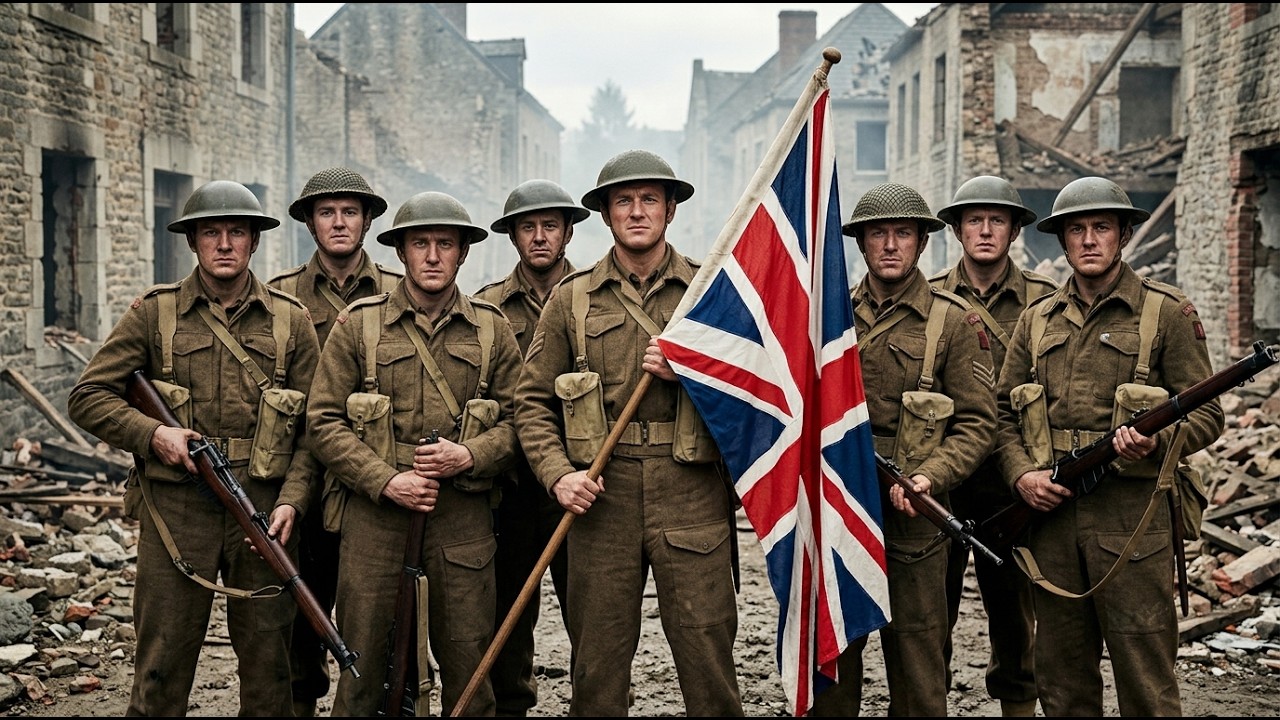
Churchill’s famous line, “Never in the field of human conflict was so much owed by so many to so few,” was not poetry. It was a precise accounting of the mathematics of survival. But here is what the Germans truly missed. They were measuring British resistance by the size of Britain. They were not measuring it by the size of the idea that Britain had come to represent.
To the Poles in 303 Squadron, Britain was not just a country. It was the last place on Earth where fighting back was still possible. That is not a calculation that fits into an intelligence report. But, it decides wars. By September 1940, Göring made the decision that saved Britain. Frustrated by the RAF’s refusal to collapse, partly responding to a British bombing raid on Berlin that had enraged Hitler, the Luftwaffe shifted its bombing campaign from Fighter Command’s infrastructure to London and other civilian cities. The Blitz had begun. The German logic was not irrational. If you destroy civilian morale, the population pressures the government to surrender. It had It worked before in other countries against other people. What German intelligence had failed to correctly assess was a specific quality
embedded in British national character that had no precise military equivalent. Call it bloody-mindedness. The specific, stubborn, almost irrational refusal to accept that the situation is as bad as it clearly is. Here is what that looked like on the ground. Ada Harrison was 44 years old in September 1940.
She ran a small grocery shop in the East End of London, the area that took the worst of the early Blitz. Her shop windows were blown out in the first week of bombing. She hung a sign in the empty frames that read, “More open than usual.” The next morning she was open. The morning after that, she was open.
She kept a kettle going the entire war, so anyone who came in shaken could have a cup of tea. She was not exceptional. She was typical. Multiply Ada by millions, and you begin to understand what the German bombing campaign ran into. But, this is not just a story about civilian morale, because morale without material is sentiment, and sentiment does not win wars.
What made the British survival remarkable was that it was simultaneously physical and psychological. While Londoners slept in underground stations, British factories kept running. While cities burned, the industrial machine kept producing. Here is the number that tells the story. In 1940, despite fighting for its survival, despite the Blitz, despite losing much of its army’s equipment at Dunkirk, Britain produced 15,049 aircraft.
Germany, the nation that was supposed to be crushing it, produced 10,826. Britain, the defeated country, the country that was supposed to be suing for peace, outproduced its conqueror in the weapon that mattered most. German intelligence had this data. They did not believe it. The assumption that Britain was finished was too embedded to be revised by facts that contradicted it.
That is not an intelligence failure. That is a belief system masquerading as analysis. By the spring of 1941, the Luftwaffe had lost over 1,700 aircraft in the Battle of Britain alone. Experienced pilots, men who had been flying combat since Spain, since Poland, since France, were gone. Replacements arrived with fewer hours and less experience.
The same arithmetic that would eventually destroy the Luftwaffe over Germany had quietly begun over England. Imagine you are German bomber crew in the autumn of 1940. You have flown 20 missions over Britain. You have watched friends fail to return. You have sat in your aircraft at 15,000 ft while Spitfires come at you from directions your gunners cannot cover.
Your fighter escort runs low on fuel and turns back while you are still over the target. Every mission, the RAF is there. Every mission, They are supposed to be finished. You have been told they are finished. They are clearly not finished. That feeling, that specific corrosion of confidence in official assessments, spread through the Luftwaffe like a slow poison.
German pilots began to privately doubt what they were being told about British losses. They had reason to doubt it. They were watching mission after mission an air force that was supposed to be on the verge of collapse sending fresh squadrons after them. On September 15th, 1940, the day now commemorated as Battle of Britain Day, the Luftwaffe launched its largest assault.
Göring told his crews that Fighter Command had fewer than 50 Spitfires left. His intelligence was wrong by a factor of roughly 10. The RAF that day flew over a thousand sorties. Göring had promised Hitler air superiority over Britain within 4 weeks. 4 weeks came and went, then 8, then 12. On September 17th, Hitler quietly postponed Operation Sealion, the invasion of Britain, indefinitely.
He never rescheduled it. And here is the final devastating irony of Germany’s misjudgment of Britain. By forcing Hitler to keep his western flank unresolved, by refusing to collapse on schedule, Britain bought time. Time for the Soviet Union, attacked in June 1941, to survive its catastrophic early losses.
Time for American opinion to shift. Time for the arsenal of democracy to begin filling up. Every week that Britain held out was a week that Germany could not devote entirely to the east. Every Spitfire that clawed a German bomber out of the sky over London was a resource Germany could not send to Stalingrad.
Churchill understood this better than anyone. Britain’s job in 1940 was not to win. It was to survive long enough for winning to become possible. That is exactly what it did. The German generals who had watched France collapse in 6 weeks and assumed Britain would follow had made the oldest mistake in the book.
They assumed that because two situations look similar on paper, they would produce the same outcome. They had not accounted for the human variable. They had not accounted for a 65-year-old man with a radio microphone, a 57-year-old air marshal with a telephone network, a Polish pilot who had already lost everything, a New Zealander who got shot down seven times and kept asking to fly, and a grocer from the East End who hung a sign in her blown-out window and put the kettle on.
Germany looked at Britain in the summer of 1940 and saw a small island nation with an exhausted army, a shrinking air force, and no realistic hope of survival. They did not see what was actually there. A country that had decided, collectively, without a vote or a decree, that this was simply not the hill it was going to die on.
And in the entire history of military miscalculation, there is no more expensive mistake than underestimating people who have decided they are not going to lose. The 1,000-year Reich lasted 12 years. Britain is still standing. If this changed how you see that moment in history, subscribe and share it with someone who needs to hear it.
The next story about the one decision that gave the Allies the war in North Africa before most Americans knew the war had started is coming next. I’ll see you there.