Why Iraqi Tank Crews Couldn’t Believe A British Troop Carrier Knocked Out Their T-55s D
February 1991, the southern Iraqi desert in the last cold hour before dawn. The wind carries fine sand across a low ridge, and the temperature on that ridge sits near freezing. Captain Naseer commands a troop of T-55 tanks, dug in hull-down along the reverse slope. He is not a novice.
He is the best gunner his battalion ever produced. 15 years in armor, a man who knows the T-55 the way a watchmaker knows a watch. He has been warned that the British are coming, and he has prepared carefully for the one thing he is right to fear. The big tank, the Challenger. Through his optics, through the blowing grit, he finds them.
The heavy British tanks exactly where he expected. He knows that fight. He may lose it, but he understands it. What he does not understand is the second line, lower, faster, a row of smaller boxes on tracks coming on behind the tanks, and then, impossibly, coming on through them into the fight among his armor. He has the recognition cards.
He knows what those boxes are, troop carriers, infantry taxis, vehicles built to carry men forward and then pull back out of the killing. So, he waits for them to pull back. They do not pull back. They stop, and men climb out of them on foot, in the dark, into his minefield, among his dug-in tanks, and they begin to take his troop apart from the ground.
He tries to make it make sense. A navigation error, perhaps. A unit that got lost. A mistake someone will pay for. He runs through every explanation his training gave him, and not one of them fits, because in the doctrine he was taught, the carrier carries and the tank fights, and the bus does not come into the duel.
It was built to carry men, not to fight tanks. This is not a story about a tank battle. This is a story about a vehicle that was never meant to be in one. About why the men who designed it, and the men who rode in it, turned a battlefield bus into something a professional enemy could not explain. And we’re going to take that story apart slowly, the way Naseer tried to take apart what he was and we’re going to be honest about every piece of it, including the pieces the legend gets wrong. Part 1.
The world view that was wrong. To be fair to Captain Naseer, his logic was not stupid. It was the inherited logic of one of the most successful armies of the 20th century, and on its own terms, it had won wars. The Iraqi army of 1991 was built on a Soviet model, and the Soviet model had a clean, hard division of labor at its heart.
Tanks killed tanks. That was the duel, settled by armor and a big gun, decided in the open. Infantry carriers had a different job, and only that job. They carried a section of riflemen through the danger zone, dropped them where they were needed, and then got out of the way of the real fight.
A carrier that tried to trade blows with a tank was a carrier that died and took its passengers with it, so it did not try. The whole shape of the doctrine kept the bus out of the brawl. At the center of that world view stood the tank itself, and Naseer’s tank was not a foolish choice. The T-55 was, by any honest measure, one of the great industrial weapons of the age.
A low, simple, rugged machine, easy to build and easy to crew, carrying a 100-mm gun that had ended plenty of arguments. It had been sold and shipped and copied across half the planet. Here is the number that tells you how serious the idea was. Counting the wider family it belongs to, the T-54 and the T-55 together were produced in numbers that ran into the tens of thousands, by some counts approaching 100,000 vehicles.
It is one of the most produced tanks in the history of the world. Now, set that against the thing Naseer was watching come over the ridge. Britain had built a few hundred of those boxes for its own army, and not one of them had been designed to kill a tank. So, look at the sum the way Baghdad would have looked at it.
On one side, an army founded on a tank made in numbers near 100,000. On the other, a small expeditionary force of carriers built in the hundreds. Troop taxis, are that the manuals themselves said should never be in the tank fight at all. By that arithmetic, the boxes did not matter. By that arithmetic, the boxes were a rounding error. Pause on that.
The maths was not insane. It was based on the data Naseer had. The problem was that the data described a kind of war that was about to stop existing. To understand what he was about to see, you have to go back, not to 1991, but to the world the T-55 was built for. It was a machine of the 1950s, designed for mass, for a war of huge tank fleets grinding across Europe, where numbers and simplicity and a good gun would carry the day.
In that war, the carrier really was just a taxi, because the things that decided a battle were too big and too fast for a thin-skinned box to interfere with. And here is what the doctrine never accounted for. It assumed the enemy would also fight that way. It assumed the duel would stay a duel, tank against tank on terms both sides understood.
It did not plan for an enemy who would arrive with a different idea about what every vehicle on the field was for. The model worked. For decades, the model worked until the morning it met an army that had quietly stopped playing by it. Part two, the tool that broke the model. Name the thing properly because it deserves it, the Warrior.
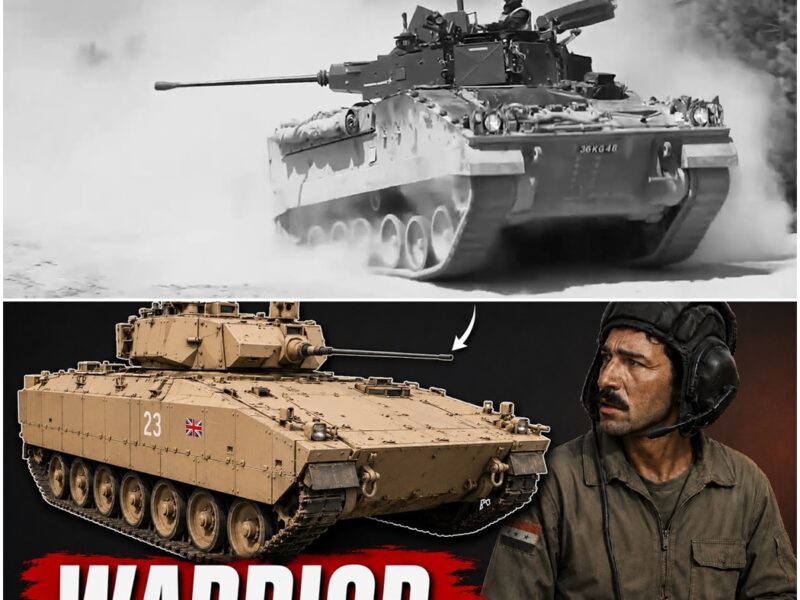
The FV510, an infantry fighting vehicle that began life under the plainest possible label, the mechanized combat vehicle for the 1980s, a project Britain started back in 1972 to replace an older, slower carrier. The firm GKN built it. It was accepted for service in November of 1984, and the first vehicles went to the first battalion of the Grenadier Guards in May of 1987.
Read the design brief and you will not find the word tank anywhere near the word kill. The Warrior was built to do three things, and to do them better than anything in its class. Carry a section of seven riflemen under armor. Keep pace with the Challenger across open ground, which it could at around 75 km/h.
And survive long enough to put those riflemen down where they mattered. Three crew, seven passengers, 10 men in a steel box that could run with a heavy tanks and live. Look at its gun and the honesty of the design becomes clear. The Warrior carried a 30-mm Rarden cannon and the Rarden is a strange, very British weapon. It is not a hose pipe.
It loads by hand in little clips of three rounds and it fires slowly and deliberately because it was designed in the 1960s to be accurate rather than fast. To defeat light armor, to punch the thin flank of a Soviet vehicle. The men who built it would have told you plainly what it could do. It could gut an armored personnel carrier.
In the right spot at the right range, it could hurt the side of a tank. It was never going to drill through the frontal armor of a main battle tank and nobody serious ever claimed it would. No firing ports for the men inside, no second turret, no illusions about what it was. It was a carrier with teeth and the teeth were there to clear the path for the passengers, not to win a tank duel.
So, how did this thing end up in the legend at all? Because when the ground war opened in late February of 1991, the Warrior went exactly where the doctrine said a carrier should never go and it stayed there. In the 7th Armoured Brigade, the first battalion of the Staffordshire Regiment fought from their Warriors alongside the Challengers of the Queen’s Royal Irish Hussars.
At a position the British called Objective Lead, that battle group tore through an Iraqi armored position and destroyed more than 40 armored vehicles and took more than 800 prisoners. And among those prisoners was the commander of the Iraqi 52nd Armoured Division himself. Two of the officers there, Major Simon Napper and Major John Rochelle, would be awarded the Military Cross.
A little to the side in the 4th Armoured Brigade, the first battalion of the Royal Scots went into a position called Objective Brass. Their commanding officer, Lieutenant Colonel Ian Johnston, left a first-hand account of it and his account is the most honest version of this whole story. The attached heavy tanks, he wrote, destroyed the first enemy tanks.
And once those tanks were burning, his men rolled up the flank in their carriers. Some of the Iraqi vehicles were dug in so deep that the riflemen had to climb out of their Warriors and destroy them from the ground, on foot, by hand. His tally for the night was roughly 60 T-55s, around 20 carriers, and a clutch of anti-aircraft guns.
That is the truth behind the title, and it is better than the myth. The Warrior did not usually kill a tank with its own gun. It did something the doctrine found far harder to survive. It carried the men who killed the tanks. It ran with the heavy armor instead of hanging back. And when the enemy tanks were buried too deep to reach any other way, it delivered the men who walked in among them and finished the job.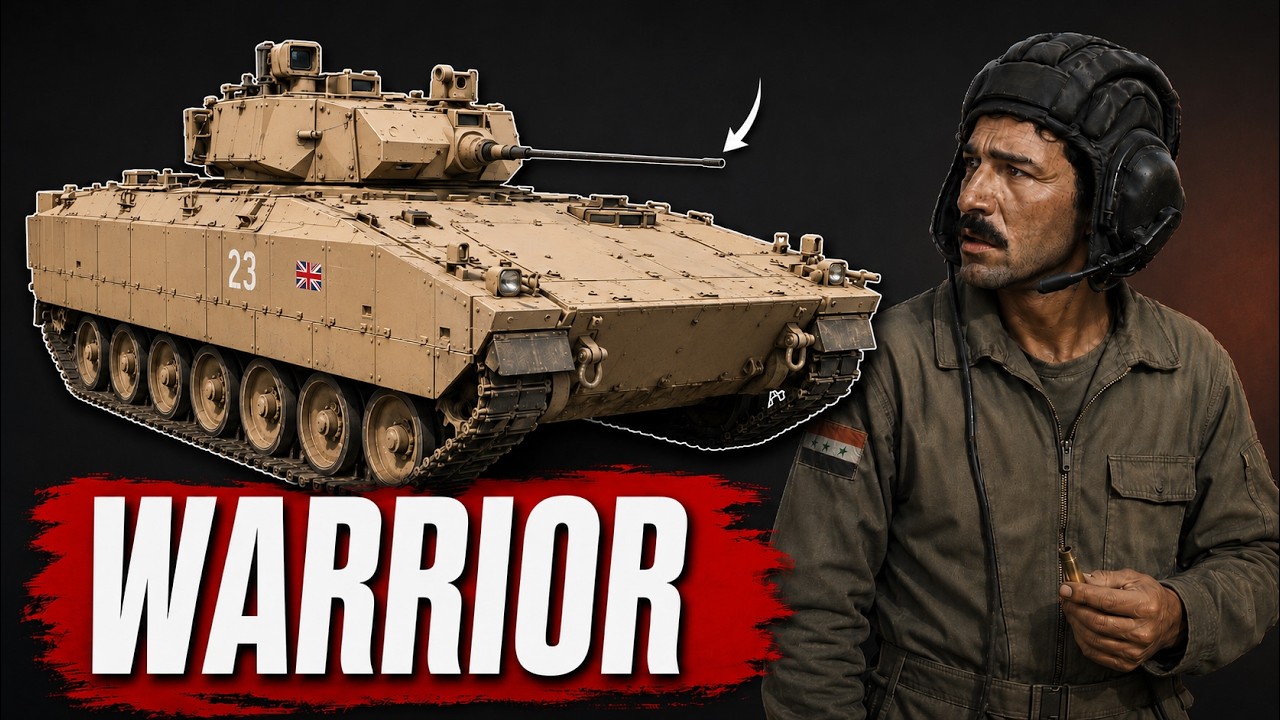
If this is the kind of history you came for, the engineering and the awkward truths and the men who lived it, then take a second now and subscribe. It costs you nothing. It keeps a channel like this one alive, and it helps these stories reach a few more people who would want to hear them. Now, back to the record.
Part three, the deeper system. Here is the thing the Iraqi maths missed. The Warrior was never the weapon. The Warrior was one visible part of a system, and it was the system that Captain Naseer could not answer. Ask why Britain could send a thin-skinned carrier into a tank fight and have it work, and the answer has almost nothing to do with the box itself. Start with the men inside it.
The British Army that came to the Gulf was a long-service, professional, volunteer force, drilled until the awkward become automatic. Its crews could shoot accurately on the move, hand off targets to one another, and read a battlefield together. Because they had trained for exactly this against exactly this enemy for years on the plains of Germany.
Then there was the way they fought, all arms together as one organism. The carriers and the heavy tanks and the engineers and the guns did not operate in separate lanes. They moved as a single battle group, each covering the weakness of the other. The Warrior’s job was to be there, fast, in the thick of it, so that the moment the Challengers cracked a position open, the infantry were already on top of it, finishing what the big guns started.
The carrier was strong precisely because it never fought alone. And then there was the seeing. The British heavy tanks carried sights that could find a target through dust and smoke and darkness, and reach out and kill it at a range the Iraqi crews could only dream of, well over three to one in their favor.
Naseer, peering through 1950s optics, often could not even find the thing that was about to kill him. The fight was decided before he could aim. Now, the number that the whole argument turns on. Britain built 789 Warriors for its own army. Not one of them was designed to kill a tank. Sit with that for a second.
789 troop carriers, none of them a tank destroyer, and they became central to the unraveling of an armored force founded on a tank produced in numbers near 100,000. That is the comparison, stated plainly and then never dressed up again. On one side, tens of thousands of T-55s, the most produced tank on Earth, the spine of a real and serious army.
On the other, a few hundred British boxes that the manual said had no business in the fight, and the boxes prevailed. Not because any single one of them outgunned a tank, but because each one arrived as part of a machine the 100,000 tanks had no way to copy, because that is the cruel part.
The thing that beat the T-55 could not simply be bought. Iraq could buy tanks. It could buy them by the thousand. And it did. What it could not buy off a shelf was the rest of it. A professional volunteer army with a decade of hard training, a command culture that trusted a junior officer to make his own decision in the dark, thermal sights, and the industry behind them.
And above all, the habit of fighting every arm together, which takes years to build and cannot be improvised the night before. The army Baghdad had built was wide and shallow. It had the tanks. It did not have the system. It was built to carry men, not to fight tanks. If your father or or your grandfather or your uncle served in the Gulf in armor or in the infantry or in support, I would be grateful if you would put their name and their unit in the comments below.
The big history gets written in books. The names get kept alive here by the people who remember them. So, leave them if you have them. This is how the memory survives. Part 4, the realization too late. There is a quiet kind of horror in being right about all the small things and wrong about the only thing that mattered.
And that is the position the Iraqi crews were left in. They were right that the British had brought fewer vehicles. They had. They were right that the Warrior was not a tank and could not duel one gun to gun front to front. It could not. And they were right that on paper, an army built on 100,000 tanks should not lose to a force of troop carriers.
Every one of those judgments was correct. What they were wrong about was the only thing that decided the battle. They were wrong about what the carrier was part of and about how far a smaller, faster, cleverer machine could reach when the men inside it knew their trade. And here is where the legend has a real kernel of truth buried inside it.
So, let me hand it to you straight because it is stranger than the myth. On February 26th, 1991, British reconnaissance vehicles, the Scimitar, a small tracked scout that is the Warrior’s lighter cousin, ran into Iraqi T-62 tanks. And the Scimitar carried the same family of small British gun, a 30-mm cannon, and it punched through those tanks and knocked them out.
A scout car, a 30-mm gun against a Soviet tank in the same fighting an Iraqi tank put 100-mm round straight through the thin hull of one of those British scouts. And the round passed clean through the vehicle without harming the crew inside. Not the gun on the Warrior, not the armor on the Warrior, not the legend exactly as it is told, but the bones of it are real.
A small, fast British autocannon in the right hands, in the right place, did the thing the manual said it could barely do. It killed a Soviet-built tank. That is the true story the rumor grew out of, and the true story is more interesting because it shows you a whole British way of war, where the light thing punches above its weight because the men and the method behind it are doing the heavy lifting. Read that again.
The light thing punched above its weight because the men and the method behind it were doing the heavy lifting. That sentence is the entire channel in one line, and it was men in the end who did the hardest part. Bring in one of them by name, Private Thomas Gow of the Royal Scots, who at Objective Brass was awarded the Military Medal for his action on the ground that night.
When the enemy tanks were dug in too deep for the vehicles to deal with cleanly, it was men like Gow who came out of the carriers and went in among them on foot, in the dark, in the cold, and did the work the doctrine swore a carrier crew would never have to do. The Warrior delivered him to the fight.
After that, it was down to him. As for Captain Naseer on his ridge, watching the buses come on and the men climb out, the explanation he could not find that morning was simply this: he was not losing to a vehicle, he was losing to everything standing behind it. Part five, the verdict.
So, we return to the question the cold open left open. Why could the Iraqi tank crews not believe what they were seeing? Why could a man who knew his tank as well as any man alive not make sense of a battlefield bus knocking out his armor? The honest answer is the one the legend leaves out, and it is more impressive than the legend.
The Warrior did not, with its own little gun, drill through the front of a T-55. Let us be completely clear about that because the comments deserve the truth. The long-range tank killing was done by the heavy British tank, the Challenger, and it was done at ranges that belong in a record book.
The single most famous British tank kill of that war was a Challenger of the Royal Scots Dragoon Guards destroying an Iraqi T-55 at a distance of more than 4 km, the longest range tank kill ever recorded. The T-55s were knocked out. They were simply knocked out by the big gun at a range their own guns could never have answered.
What the Warrior did was different and harder to copy. They had a tank built in its tens of thousands. The British had a carrier built in its hundreds. Their machine was made to win the duel. The British machine was made to carry the men who made the duel irrelevant. Their metric was the tank. The British metric was the whole battle group moving and seeing and fighting as one thing with the troop carrier running in the middle of it instead of hiding at the back.
That is why the bus was in the fight. That is why the men came out of it on foot. And that is why a vehicle that was never meant to be there became the thing the enemy could not explain. It was built to carry men, not to fight tanks. And that, in the end, is the whole answer. It was built to carry men. And it was the men it carried, and the men who built it, and the system that put it where it had no business being, who settled the account.
I owe you one more piece of honesty before the end. Captain Sear is a composite. I should tell you that plainly. The name stands in for the real Iraqi tank commanders who fought on those ridges. Professional soldiers handed an honest, outdated machine and asked to stop something their doctrine had never imagined. They were not fools.
They were brave men, well trained on a tank that the rest of the world had quietly left behind. And the fault was never theirs. They deserve to be remembered as a worthy opponent. Because a win against a worthless enemy is worth nothing. And this win was worth something. And there is a harder truth still about the Warrior’s own worst day.
The Warrior’s losses in that war did not come from the T-55 at all. They came, that same February, from the sky and from a friend. Two Warriors of the Royal Regiment of Fusiliers were destroyed by missiles fired in error by Allied aircraft. By two American jets that mistook them for the enemy. Nine men were lost in those two carriers.
The Ministry of Defense laid the facts before Parliament and an inquest later called it what it was. After that, British crews flew large flags from their vehicles, bright and unmissable, so that no friend would ever make that mistake again. The machine that the enemy could not stop was undone on its hardest day by a tragic error from its own side.
Remember those nine when you remember this story. Remember Lieutenant Colonel Johnstone and Major Napper and Private Gao and the men beside them. And then, if you want to last turn that the death that never saw coming, look at where the Warrior is now. The troop carrier that was thrown into a tank fight is going back at last to the one job it was always built for, protecting the infantry.
In recent years, British engineers have turned the Warrior into something it could never have been in 1991, a driverless machine. They fit it with a full-width plow and a remote control system and they send it forward with no one aboard, run by a single soldier from miles away to drive first into a minefield and clear a path so that the men who would once have ridden inside it never have to.
The taxi that carried men into the worst of it now goes ahead of them, empty, into the worst of it, so they do not have to follow. That is the next chapter and it is the truest thing this vehicle has ever done. If this is the kind of history you want more of, the machines and the myths and the honest accounting of both, then subscribe and stay with the channel because there is a great deal more of it to tell and leave the names