Why Manteuffel Told Bruce Clarke “You Surprised Us — We Became Cautious D
There is a letter in the Bruce C. Clark collection at the US Army Heritage and Education Center at Carile Barracks, Pennsylvania. It runs to a few dense paragraphs. The man who wrote it commanded nearly 200,000 men in Hitler’s last offensive in the West. He was writing to the American general he had spent 5 and a half days trying to remove from the board and could not.
He called the defense he was describing brilliant, outstanding, decisive, he wrote, not only for his own army, but for the sixth SS Panzer army on his right flank and for the entire offensive as a whole. He said the American positions around Saint Vith had fallen in the end. But by the time they fell, the damage to the German timetable was done and could not be compensated by any later action.
He was Hasso Echard Fryhur von Mantofl General Depanza Trooper commanding the fifth Panza army. The American he was writing to was Brigadier General Bruce Kooper Clark of the seventh armored division who had been a general officer for 11 days when he took command at St. Vith. This is the story of what Manufel wrote, what he said in person, what he told the US Army historical division on the record in 1946, and why the German general who lost the race through that Belgian crossroads spent the rest of his life acknowledging it. The documents are in the archive. The testimony is verified. This channel reads that record aloud. In December 1964, Hasso von Mantofl traveled from Bavaria to upstate New York to meet Bruce Clark on the 20th anniversary of the battle. On December 22, 1964, at a press conference in Watertown, in Clark’s home county of Jefferson, Mantofl stood before
reporters and said in English that on the evening of December 24, 1944, he had recommended to Hitler’s agitant that the German army give up the Arden’s attack and return to the West Wall. He gave as his reason the time his fifth Panzer army had lost in the Saint Vith area. By that afternoon in Watertown, that admission had already been in the written record for 18 years.
He had given the US Army Historical Division a 161page manuscript in 1946. He had sat with the British military historian Basil Henry Liddell Hart in December 1945, one year after the offensive began, and told him the same thing in custody. He would later say it again to British documentary cameras for the 1973 series The World at War, and he had written it directly to Clark in the letter now preserved at Carlilele.
He never stopped saying it because it was true. And for a German general of his generation and formation, it cost something to admit. If this is the kind of record that matters to you, the like button is what keeps it surfacing to the people who want the archive, not the legend. Hasso Ekard Fryhurvon Manantuful was born on January 14, 1897 in Potam, then the garrison capital of the Kingdom of Prussia.
His grand uncle Edwin Fryhurvon Manufel had been a field marshal in the wars of German unification. The family’s relationship to military service was not a choice. It was a current in which they had been swimming for two generations before he arrived. He entered cadet school at age 11. He commissioned into a Husar regiment in February 1916 and earned both classes of the Iron Cross before his 21st birthday fighting on the Western Front.
After the armistice, he joined Fryor Vonovven in Berlin in January 1919, then the new Reichv. Through the 1930s, he became a tactics instructor at the Panza Troop Schools at Wondorf and at Panza Troop School 2 in Berlin Krampnitz, where he served as a senior professor from February 1939. He missed Poland and France because he was teaching both.
His combat war began on May 1, 1941 with the first battalion of the seventh rifle regiment in the seventh Panza Division, the Ghost Division that Raml had made famous in France a year earlier. He commanded a regiment by August 1941, drove forward during the push toward Moscow, and won the Knights Cross of the Iron Cross in late 1941.
He was 5’2, roughly 140 lb, and almost impossible to find at headquarters because he was almost always at the front. In early 1943, he was sent briefly to Tunisia to lead an improvised formation in Hans Jurgen von Ananim’s Theater Army, returned ill, and recovered in Germany. He took command of the seventh Panza division on August 22, 1943 on the Eastern front, arriving just as Soviet pressure following Kursk threatened to split the German line in Ukraine.
In late November 1943, he led the seventh Panza in the recapture of Jitomir, breaking a Soviet encirclement of the eighth Panza division north of the city in a night operation he personally led from the front with six tanks and 100 Panza grenaders. He received the oak leaves to the Knights Cross on November 23, 1943 for that action.
On February 1, 1944, he was given command of the Panza Grenadier Division Gross Deutsland, the prestige formation of the German army serving in Ukraine. He led it through the spring defensive battles west of Kiraovagrad and through the withdrawal across Ukraine into Romania. When the Soviet summer offensive of 1944 collapsed Army Group Center to the north in June and July, the strategic shock forced a general repositioning across the German east.
Gross Deutsland was transferred from its southern sector to East Prussia where it fought to hold the Mim corridor. On September 1, 1944, Manurfel was promoted to general deanza trooper, the rank equivalent in the armor branch to a full American general, and that same day was given command of the fifth Panza army on the western front.
He arrived at army headquarters in Hofwald, southwest of Strasborg on September 11, 1944. The first thing the fifth Panzer Army did under its new commander was bleed against Bruce Clark. The battle of Aracort ran from September 18 to September 29, 1944 in Lraine. Colonel Bruce Clark was commanding combat command A of the fourth armored division, Patton’s spearhead in third army.
Mantoflel sent two Panza brigades and elements of two Panza divisions against Clark’s combat command in a series of attacks aimed at cutting Patton’s supply lines and eliminating the Moselle bridge head. Clark’s force was outnumbered at the point of contact every day the battle lasted. By the time it ended, the Germans had lost more than 200 panzas and assault guns.
Clark had lost 55 tanks and tank destroyers. Mantel’s army was pulled out of the line in mid-occtober to refit for the next operation. He did not know Clark’s name that autumn. He knew the combat command that had stopped him. He would know the name at Saint Vith. Bruce Cooper Clark was born on April 29, 191 on a farm outside Adams, New York in Jefferson County.
His father was Matthew John Clark. His mother was Isola Venita Stevens Clark. He dropped out of high school at 16, enlisted in the Coast Artillery in April 1918, and was discharged when the war ended that November. He returned to the army in January 1920 through the New York National Guard and earned his West Point appointment through enlisted service.
He graduated 33rd in the class of 1925 and was commissioned in the core of engineers. Before the war, he took a civil engineering degree from Cornell University and a law degree from Lasal Extension University. He graduated from the command and general staff school at Fort Levvenworth in 1940.
He arrived in England with the fourth armored division in December 1943 as a colonel commanding combat command A. He drove it through the Normandy breakout across France through the liberation of Nancy in September 1944 through Aracort. On October 31, 1944, he relinquished that command.
On November 1, he transferred to the 7th Armored Division and took over combat command B. A few days later, he was promoted to brigadier general temporary. He had been a general officer for 10 days when the German offensive opened on December 16, 1944. He had been a general officer for 11 days when he reached Sanvit in 1944. Sanvid was a market town of about 2,000 people, mostly Germanspeaking, sitting on a low hill in eastern Belgium, less than 12 mi from the German border.
Six paved or macadam roads converged there. A railway ran east to west through the town. The four major armored thrust routes assigned to the German offensive, what the Germans called the rollb barn, did not run through St. V. The nearest attack corridor to the north ran through Re 5 mi away.
The nearest to the south ran through Berg Royland, 5 mi in the other direction. What made St. Vith indispensable was not on those maps. It was the lateral road network that only became critical once the offensive stalled in the north. SS Obus Grupenfura Sept Dietri 6th SS Panza army had the main effort five attack corridors and the bulk of Germany’s surviving armored strength.
Three of Dietrich’s five corridors were blocked within the first 48 hours by intact American defenses on Elsenborn Ridge where the second and 99th infantry divisions refused to move. The other two were exposed to American artillery. Dietrich’s supply trains stacked up behind his stalled assault divisions in the German Eiffel.
The only practical way to feed his army westward, and Manurfel’s army with it, ran through the roads and rail junction at Sanvith, a town that was supposed to fall in a day and a half became the stopper in a bottle that held both Panzer armies east of the Muse. Manurfel knew the problem by December 17 when his forward elements first hit organized American resistance outside the town.
He had personally reconoited the American front in late November and early December in the guise of a colonel on an intelligence tour, identifying the gaps between outposts, choosing crossing sites on the hour river, picking routes for his infiltration assault detachments. He had gone forward on foot at night along stretches of the front to count the American outpost intervals with his own eyes.
He had noted that the 106th Infantry Division was holding a 12mile front that the experienced second infantry division had held only because the second had deeper reserves and organic tank support. He had presented his reconnaissance findings to Hitler in person and used them to argue for a modified assault timetable, a shorter artillery preparation, and the storm battalion infiltration technique that opened the offensive without a conventional barrage.
Hitler approved the modifications. Mantofl believed he had everything planned for. He knew the 106th Division was new in the line. He knew its regiments were strung across too wide a front. He expected to find fixed infantry thinly deployed with no armored reserve who would hold long enough to look dignified and then dissolve.
He did not expect Bruce Clark. The task of taking Saint Vith went to Mantofl’s 66th Corps under General Dartillery Walter Looked, the weakest of his three core. Looked had no organic tank division, just two Vulks Grenadier Divisions and an attached assault gun battalion. The 18th Volk Grenadier Division reconstituted in Denmark in September 1944 from the cadre of the destroyed 18th Luftwaffer field division had been in the Shne Eiffel sector since October and knew the ground thoroughly.
Luft gave it the main effort, a double envelopment of the two American infantry regiments positioned on the Shne Eiffel ridge east of Saint Vith. The 62nd Vulks Grenadier Division rebuilt from the wreckage of the old 62nd Infantry Division lost on the Eastern Front and filled with Czech and Polish conscripts who often did not share a common language with their German officers who would break through south of the ridge toward Winterfelt and seal Saint Vith from the south and west.
Mantofl’s order to look was explicit. St. Vith would be captured by 1,800 hours on December 17, 1944, the second day of the offensive. In postwar testimony, Manurflal acknowledged he had hoped privately to have it on the first day. Opposite the 66th Corps stood two regiments of the 106th Infantry Division on the Schnee Eiffel Ridge.
The 422nd Infantry was commanded by Colonel George Desanau. The 423rd Infantry was commanded by Colonel Charles Cavender. The division had relieved the second infantry division on December 11 or 12 depending on the regiment after less than a week in the line in what the men called the ghost front. Major General Alan W.
Jones the division commander had his headquarters in St. V. Captain Alan W. Jones Jr. was serving as a captain in Cavender’s 423rd Infantry on the Shne Eiffel Ridge. By the end of December 16, the German envelopment was closing around both regiments. The 14th cavalry group in the Lshim Gap to the north had been swept aside.
By the evening of December 17, the two Shene Eiffel regiments, roughly 7,000 men, were encircled. They did not yet understand it fully. That same morning, 8th core commander Lieutenant General Troy H. Middleton released the seventh armored division from 9th Army Reserve and ordered it south to St. V.
Combat Command B was the seventh armored’s lead element. Clark, riding with his operations officer, Major Owen Woodruff, and a driver in a commandeered black MercedesBenz that had once belonged to a German officer, received orders that amounted to, “Go to General Jones. He is having trouble, no tactical mission, no intelligence brief, three men in a car.
” He reached St. V at 10:30 in the morning of December 17 and walked into Jones’s headquarters at St. Joseph’s Clauster, a Catholic school and convent in the town center. The Combat Command B column was strung out along 96 km of icy Belgian road behind him. The head of it would not arrive for hours.
Jones had been dealing since before dawn with flanks that had dissolved, and two regiments encircled on a ridge he could not reach. His son was somewhere in the encirclement. He looked at Clark and said in Clark’s own subsequent recounting that he had thrown in his last chips and had nothing left and that Clark should take command.
Clark later placed that conversation at approximately 14:30 hours, 2:30 in the afternoon on Sunday, December 17, 1944. Clark had four armored vehicles on the eastern perimeter of the town when he took command. A platoon of cavalry from Troop B, 87th Cavalry Reconnaissance Squadron.
He could hear small arms fire from the east. He went into the street and started directing traffic. What Clark built over the following 24 to 48 hours is the thing Manuful was still describing in his letters 20 years later. It was not a conventional defensive line. It was a horseshoe, a curved arc of positions on the high ground east of the town with the open end facing west toward friendly lines.
The components were fragments. three companies of armored infantry from the 38th and 23rd Armored Infantry Battalions, a company of medium tanks from the 31st Tank Battalion, a troop of cavalry. The engineers of the 81st Engineer Combat Battalion, and the 168th Engineer Combat Battalion, men whose training was in building bridges and clearing roads, now fighting as infantry on a line that rifle battalions should have held.
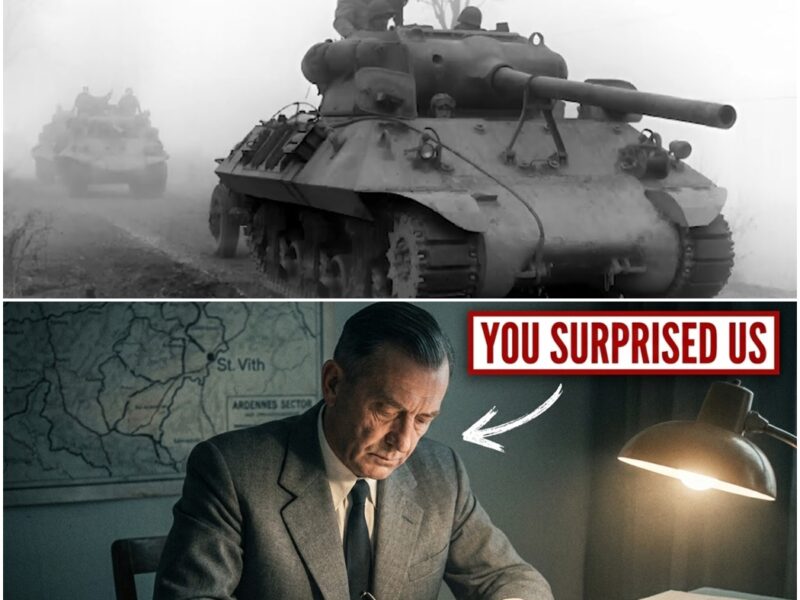
And behind the town, out of German observation, Clark kept an armored reserve. The same tanks moved from sector to sector in the dark along interior roads the Germans had not mapped gave his defense the look of something much heavier than it was. He had tank destroyers, the M36 Jacksons, with their 90 mm guns dug into firing positions oriented down the main approach roads. They would not maneuver.
They were the anchor. The armored infantry and cavalry would give ground slowly, fall back a kilometer at a time, pulling German assault elements forward into the tank destroyer zones. When German pressure massed hard enough on one sector, Clark would release the armored reserve, strike the flank, and pull it back before it could be pinned.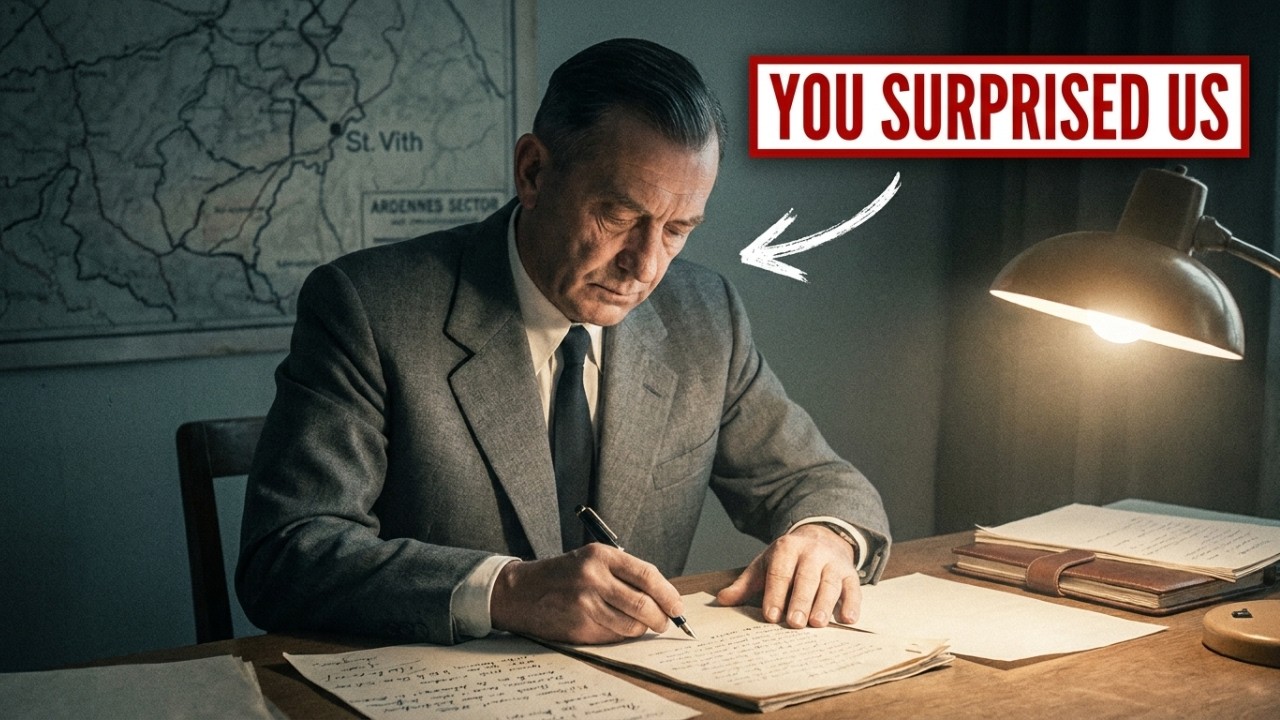
What Clark was executing had a name in doctrine, mobile defense, not a fortified perimeter waiting to be reduced. A defense that gave ground deliberately, hit back unexpectedly, then withdrew before the blow could be fixed or answered. The discipline required to run that in those first 48 hours with green troops, with half-formed units, with no coherent left flank and no coherent right flank on December 17 is the part the operational histories note but rarely linger on.
Clark’s own published account, the Battle of St. Vith, a concept in defensive tactics, describes it precisely. The tank destroyers anchored the killing zones. The armored reserve was a strike force that never stayed in the same location long enough to be placed on a German situation map. On December 17, late in the afternoon, the lead battalions of the 18th Folks Grenadier Division came within about 1 kilometer of Sand Vith from the east and ran into five Sherman tanks from company A, 31st Tank Battalion under Lieutenant John J. Dun. Five Shermans destroyed three German tanks and dispersed approximately 100 German infantry at point blank range in the fading December light. The German assault stopped for the night. And here is the thing Man Turfel had not planned for. The 18th Volk Grenadier Division, his main effort in the sector, still had two of its three regiments tied down east of St. V,
not pressing the town at all, but finishing the encirclement of the Shne Eiffel. The double envelopment looked had designed as a quick tactical stroke meant to trap the two American regiments and then pivot west was consuming twothirds of his best division for 4 days running.
Every day those regiments were pointed east. They were not driving toward Clark’s perimeter. And the Americans on the Shenee Eiffel, surrounded and cut off, kept fighting. The engineers under Lieutenant Colonel Thomas Riggs deserve particular attention in this record. The 81st Engineer Combat Battalion was not an infantry unit.
Its men had been trained to build and clear obstacles, not hold a defensive line under armored assault. At St. Vith. They fought as dismounted infantry for six consecutive days, holding a sector that a rifle battalion would have held at full strength. Rigs, 28 years old, was captured on December 21 during the withdrawal.
He escaped from a German prisoner of war transport, evaded German forces for weeks and made his way back to American lines. The ark his battalion held between December 17 and December 21 was the ark that Mantoul’s headquarters never accurately counted or placed on a map. December 18th brought four organized German attacks against the perimeter in a single day. None broke through.
More arriving elements of the seventh armored division thickened the line as the day went on. Traffic jams east of Shamberg were still strangling German logistics. The King Tiger tanks of the 56th Heavy Panza Battalion, 70 ton machines that overloaded every rural Belgian bridge and blocked every village street they encountered, had been stalled in the Eiffel for 2 days.
Their weight and the narrow roads behind the German front combined to back up Mantofl’s supply columns for kilometers in both directions. At around 1600 hours on December 18, Obus Otto Remma, commanding the Fura Bagle Brigade, received his commitment order to move from the Dawn area towards Saint Vith. The brigade set out that evening and reached the area north of Saint Vith on December 19th.
The 18th Volk Grenadier Division’s two encircling regiments on the Shne Eiffel were still pointed the wrong way. Field Marshal Walter Modle, commanding Army Group B, came forward in person to the Shawnberg area and found the road network east of the battle effectively impossible. He ordered Sand Vith taken without further delay. It was not taken.
December 19th saw continued German pressure without a breakthrough. The encircled American regiments on the Shi Eiffel had by this point been without resupply for 3 days. On the morning of December 19th, they launched a breakout attempt ordered by ETH corps, moving west towards Shamberg. German anti-aircraft guns and armored vehicles blocked the exit routes.
The attempt failed. That afternoon, Colonel Deshano of the 422nd Infantry and Colonel Cavender of the 423rd ordered the surrender of their commands. Approximately 7,000 Americans became prisoners of war, the largest single battle surrender of American forces in the European theater and the second largest in American military history in the Second World War.
That collapse was a catastrophe for the 106th Infantry Division. What it meant for Clark was that the four days those regiments spent fighting in the encirclement were four days the 18th Vulks Grenadier Division’s two encircling regiments could not pivot west. The men on the Shne Eiffel could not have known they were buying him time.
They were simply fighting the only war they had. Here is what the record from Manurful’s 161page manuscript for the US Army Historical Division states prepared at Allenorf in September 1946 and cataloged as foreign military study B51A in National Archives record group 549. He wrote that the defense around St. Vith delayed his army’s movements to a degree that could not be compensated by any later action, not a retrospective apology, not a polished memoir writer’s revision, a classified operational assessment written for American military historians while the events were still within 2 years. Basil Henry Liddell Hart interviewed Mantofl three times in British custody in December 1945. His notes from those conversations are held at the Liddell Hart Center for Military Archives at King’s College London. The published distillation appeared in the
other side of the hill, published by Castell in London in 1948 and released in the United States as the German general’s talk. The chapter on the Arden draws directly on Mantofl’s account of what he expected the American line to look like and what it turned out to be. What he expected was a thin shell of green infantry in fixed positions with no armored support unlikely to hold more than a few hours of sustained pressure from organized vulks grenadier formations.
The 106th division was newly arrived. He knew that. What he did not know was that the seventh armored division had been released from 9inth army reserve within hours of the first German shells, that its lead combat command would arrive peacemeal at St. Vith on December 17 and that at the head of it would be the officer who had stopped his Panza brigades in Lraine 3 months earlier.
This is the point Liddell Hart drew out in his December 1945 conversations. The British historian pressed Mantofl on the German intelligence picture of the American line before the attack. Mantofl’s answer, as reflected in the published account, was that German intelligence had correctly identified the weakness of the Arden’s front, the thinness of the divisions, the absence of armored reserves in the immediate area.
What it had not tracked was the release of the seventh armored division from 9inth Army north of Mastri. Mantofl had gone forward himself in the disguise of an intelligence colonel to see the American positions in person. He had identified the gaps between outposts. He had chosen the crossing sites on the hour river.
He had satisfied himself that what he was attacking was a resting front held by formations with no depth and no armor nearby. He was right about everything except the armored division that was already moving south before the first German shell landed. That gap between what German intelligence knew and what the American order of battle actually was by the time the assault reached St.
Vith is the operational mechanism behind Manuful’s confession. He had planned for a rear guard. He got a mobile defense with a concealed armored reserve. The difference cost him 5 days and the offensive and the particular irony that Mantofl himself noted in his postwar accounts was this.
The seventh armored division had been in 9th Army’s reserve area north of Mastri, assigned to a completely different sector of the front. It was not part of any defensive plan for the Arden. It moved because Middleton recognized within hours of the first German shells that Samvath needed armor.
That decision made the night of December 16 put Clark’s combat command on the road before Manufel’s infiltration teams had even finished crossing the hour river. By the time the Schneiffel resistance ended, Clark had converted what should have been a collapsing route into a functioning combined arms defense. If this record matters to you, the subscribe button is how the next document from this archive finds you. There is no algorithm trick.
You subscribe and the archive keeps coming. On December 20, Major General Matthew B. Rididgeway’s 18th Airborne Corps assumed command of the northern portion of the Bulge, including Saint Vith. That same afternoon, command of the entire northern shoulder passed from Lieutenant General Courtney Hodges’s First Army to Field Marshall Bernard Montgomery’s 21st Army Group, the 82nd Airborne Division under Brigadier General James M.
Gavin was moving into a backs stop line at Worberamont and along the Sm River west of Saint Vith, providing the depth that might allow an ordered withdrawal if the time came. December 20th was itself a day of probing attacks that went nowhere. The three German formations converging on St. Vith, the 18th Vulks Grenadier Division from the east, the 62nd Vulks Grenadier Division from the south, and the Fura Bleet Brigade from the northwest were still not fully coordinated in time and space.
Rayma’s brigade attempted a small-scale attack on the northern flank and was repulsed, losing four tanks to the American tank destroyers. The 18th Vulks Grenadier Division attempted to press toward the Sandv railway station from the east and was broken up by American artillery before it could form.
The 62nd Vulks Grenaders attempted to push toward Grufflong and Maldingan on the southern flank and was hit by artillery fire before it had even located the new American line. By the evening of December 20th, the Germans were finally positioned to mount a coordinated attack the following day. They had needed 4 days to get there.
They had planned to be inside the town on the second day of the offensive. December 21 was the day the German weight that should have arrived on December 17 finally arrived in full. The main assault opened with an artillery bombardment at 11:00 in the morning. German infantry and armor struck the horseshoe from multiple directions through the afternoon and into the evening.
By 2000 hours, the American line had been penetrated in multiple places. Clark ordered withdrawal from St. Vith itself to the ridgeel lines west of the town. The 18th Vulks Grenadier Division occupied the town that night. The men who withdrew compressed into a defensive oval west of the town on the ridge lines and road junctions between St.
Vith and the Psalm River. The shape it drew on the American situation maps gave it the name that the operational record carried forward. The fortified goose egg. roughly 20,000 men from five different formations that had never trained together, holding a 10-mi perimeter with a single road running west toward friendly lines.
Rididgeway initially wanted to hold the goose egg. He argued it would function as baston function to the south, a defended pocket supplied by air. Major General Robert Hasbuk, commanding the seventh armored division, told him directly that his men were at 50% effectiveness after six days of uninterrupted fighting and that the terrain was too heavily wooded for reliable air resupply.
Montgomery reviewed the situation and on the afternoon of December 22 sent Hasbro a message that the seventh armored veterans quoted for the rest of their lives. They can come back with all honor. It is time to withdraw. Some accounts render the message as you have accomplished your mission, a mission well done.
Both versions appear in the secondary literature and reflect the same decision. The goose egg would not be held, and the men who had built it had earned the right to leave it standing. On the night of December 22 to 23, the temperature dropped sharply. The Belgian mud froze solid. The single road running northwest from the goose egg toward Vsam became passible.
across that one road through the night and into December 23, 1944. The entire perimeter withdrew west through the 82nd Airborne’s corridor. The 82nd held the SAM crossing long enough to close the door. By the morning of December 24, Bruce Clark was asleep in the front seat of his jeep, having been continuously awake for 7 days.
Now consider what Manurfel was left with on Christmas Eve, 1944. His timetable had called for Sand Vith on the evening of December 17. He had it on the night of December 21 to 22. He had lost between 4 and 5 days. He could not recover. Not because his troops were badly led, not because the weather turned against him, but because one American combat command with a concealed armored reserve and a commander who had already stopped him in Lraine, had refused to behave like a thin shell of green infantry.
His lead element in the drive toward the muse, the second Panza division, reached its high water mark at Celle, a few kilometers short of the river near Deno on December 24, Christmas Eve. The muse was never crossed. That same evening, Mantoel transmitted to Hitler’s agitant his recommendation that the German army break off the Arden’s attack and return to the west wall.
He gave as his reason the time his fifth Panza army had lost in the Saint Vith area. Hitler refused. By early January, the sixth SS Panza army was being pulled out of the bulge for transfer east. What Manufel said about this on the record across multiple sources over three decades is worth examining in full.
His letter to an artillery officer of the 106th Infantry Division Association written around 1970 and preserved by that association states that the actions around St. Vith exerted a great influence on the result of the German intention. A whole army corps, he wrote, was delayed by the American defense around St.
V for 5 days longer than the German timetable allowed. This delay forced the attacking forces to detour so much the more as his right neighbor, the sixth SS Panza army, had had no success. That last clause is where the full strategic weight sits. The Saint Vith delay did not only cost Manufel’s fifth Panza army 5 days because the two armies shared the same Belgian road network and because the lateral roads through Saint Vith were the only viable route to move Dietrich stalled supply trains westward.
The delay choked both German armies simultaneously. Elenborn Ridge had already blocked three of Dietrich’s five attack corridors. His supply trains were backed up east of St. Vith and could not be rerouted because the roads through the town were in American hands until December 23. The personal letter Manurfel sent to Clark held in the Bruce Sea Clark collection at the US Army Heritage and Education Center at Carile Barracks, Pennsylvania reads that the brilliant outstanding delaying action around St. Vith was decisive for the drive of his troops and for the sixth SS Panza army as well and for the whole German offensive. He wrote that St. Vith had fallen in the end, but that the momentous main drive of the 47th Panza Corps had been destroyed. And in September 1964, standing on the ground with Clark at the actual site of the defense, he told the American in Clark’s own subsequent
recounting that what he had faced there was not a thin force of units, but something that had behaved like a core. What is striking about that assessment read against the operational record is its precision. Mantofl was not being gracious. He was a professional soldier, describing a professional experience with the language of his trade.
He had committed his assault forces against a sector he had personally reconoited and found to be weak. Those forces had been absorbed, delayed, struck from an unexpected direction and turned back. The command on the other side had behaved in a way consistent with core level armored depth.
that it was in fact a single combat command with an improvised mixed force, a concealed tank reserve, and interior lines the German had not mapped was information that only became available after the war when the Americans could finally show the German what their side of the situation maps had actually looked like.
The gap between the two maps is the story Manuful was describing every time he described Saint Vith. When you get surprised like this, he told American interlocutors after the war, you become cautious. It is worth saying plainly what that means from a professional standpoint. He was not confessing to timidity.
He had been in combat since 1916. He had led Panza columns from the outskirts of Moscow to Tunisia to Ukraine to East Prussia. What he was describing was the professional adjustment of a senior commander who had formed a reasonable estimate, committed his forces accordingly, and found that his estimate was wrong in a way that could not be corrected by speed alone.
When the force opposite you absorbs your attacks, and then hits your flank from a direction you thought you had already cleared, you slow down. You commit more force than you planned. You become cautious. And in an operation where the entire strategic plan rested on a speed of advance that left no margin for delay at any single point along the route, becoming cautious at St.
Vith was fatal to the offensive as a whole. What Clark had deployed at its thinnest moments would not have looked like a core to any German observer who could have seen it. Companies reduced to platoon strength consolidated under surviving sergeants. Engineers and cavalry men fighting dismounted on sectors that should have had rifle battalions behind them.
Tank destroyers immovable in dug positions, protecting ground that the armored infantry had already abandoned to preserve the force. A tank reserve that appeared on German flanks for 15 minutes and then vanished. The perimeter ran for more than 10 mi on some days, held by formations that by the evening of December 21 existed in name more than in strength. The German did not know that.
That is Clark’s professional achievement and the operational fact behind Mantofl’s 30-year acknowledgement of it. It is worth noting what Manufel’s fifth Panza army actually did accomplish in the Arden because the acknowledgement gains weight when you understand the source.
Of the three German armies in the offensive, it was Mantoflals that achieved the deepest penetration of Allied lines. The second Panza division was the German formation that came closest to the Murs. The 47th Panza Corps drove past Baston, bypassed it, and kept moving west while the 101st Airborne Division was still being encircled behind it.
Mantufull’s army, on paper, the supporting effort south of Dietrich’s main effort, outperformed the SS army on every metric except the one that mattered. It did not cross the river. The distance between what it achieved and what the plan required was measured in days, not kilometers, and those days were lost in significant part on the roads around Saint Vith.
Mantel’s postwar life ran a course that was unusual even by the standards of his generation. He was held as a prisoner of war from his surrender to British forces at Häeno Meckllinburgg on May 3, 1945 until December 1946. He joined the free democratic party of Germany in 1949 and was elected to the Bundustag in 1953 where he served as the party’s defense policy spokesman and is generally credited with coining the name Bundesphere for the new West German armed forces.
He left the Bundustag in 1957 after crossing to a smaller conservative grouping. In 1959, he was tried and convicted for having ordered the execution of a deserter in January 1944 by overriding a court marshal’s sentence of imprisonment. He was sentenced to 18 months and served approximately four. He lectured at West Point on winter armor tactics.
He gave technical advice on American war films. He appeared on camera for the world at war in 1973. He spent the decades after the war accessible to American veterans, historians, and journalists who wanted to understand what they had been facing from the other side of the line. He died on September 24, 1978 at Rereath Aam Albaktal in the Austrian Tyroll while traveling.
He was survived by his wife Armgard, the niece of the resistance officer Ewald von whom he had married on June 23, 1921. He was 81 years old. He had received the Knights Cross of the Iron Cross with oak leaves and swords on February 22, 1944 and the diamonds on February 18, 1945. The 24th German officer so decorated his foreign military study manuscript prepared at Allenorf in September 1946 and cataloged as B151A in National Archives Record Group 549.
Records of United States Army Europe is held at the US Army Heritage and Education Center at Carile Barracks, Pennsylvania. Hugh M. Cole used it as a primary source for the Ardens Battle of the Bulge, the official US Army history published by the Office of the Chief of Military History in Washington in 1965.
Bruce Cooper Clark retired from the United States Army in 1962 as a full general, four stars. He commanded the seventh US Army in Europe, Continental Army Command, and US Army Europe and NATO’s Central Army Group, including the critical months of the Berlin crisis in 1961.
He died on March 17, 1988, at Walter Reed Army Medical Center at the age of 86. He is buried at Arlington National Cemetery, section 7A, grave 130, alongside his wife, Bessie Mitchell Clark. His papers are at the US Army Heritage and Education Center, the Hoover Institution Archives at Stanford University and Syracuse University Libraries Special Collections Research Center.
He wrote one book, Guidelines for the Leader and the Commander, published by Stackpole in 1963, and dozens of professional articles, among them, The Battle of St. Vith, a concept in defensive tactics, the primary source account of the action in which he directly quotes Mantofl’s postwar assessment of what the defense had cost the German offensive.
Combat Command B of the Seventh Armored Division received a distinguished unit citation for its actions from December 17 to December 23, 1944. The seventh armored division retook Saint Vith on January 23, 1945, exactly 1 month after Clark had withdrawn from it. If the like button helps this find the people who care about what the foreign archive actually holds, use it.
The next record is waiting. In September 1964, there is footage of two men on a slope of frozen ground above what had been the eastern approaches to Saint Vith. The American towers over the German. Both are wearing dark overcoats. Both are smiling slightly. The way men smile when they are standing on ground that each of them remembers for entirely different reasons.
The German had commanded a Panza army. The American had commanded a combat command. Neither of them had seen the others face in December 1944. Neither had known for certain what the other had. Mantofl wrote 161 pages of it for the US Army in 1946. He wrote it in letters to Clark and to the officers of the 106th Infantry Division through the 1960s and 70s.
He said it to British cameras in 1973. He said it to reporters in upstate New York in December 1964. The record says what it says. General Depanza trooper Hasso von Mantufull commanding the fifth Panza army in the Arden’s offensive wrote that the defense of St. Vith delayed his army 5 days beyond the timetable forced both Panza armies onto alternate routes and contributed decisively to the failure of the last German offensive in the west.
You surprised us. We became cautious and we never reached the muse.