Why Panther Tanks Were Deadlier Than Tiger Tanks | ww2 documentary D
It is the summer of 1943 and somewhere in the tall grass east of Kusk, a Soviet anti-tank crew is waiting. They have been told what to listen for. The Tiger, they know makes a particular sound, a deep mechanical grinding, like a factory floor in motion. The sound of 57 tons of steel rolling over the step at little more than walking pace.
They know how to kill it. They have practiced. The frontal armor is formidable, yes, but the flanks and the rear are vulnerable. And if you are patient, if you hold your nerve until the great beast turns, then you have your moment. What they have not been properly warned about is the other one. The panther arrives differently.
It is lower. It is faster. It does not grown under its own weight quite so theatrically. And when it fires, that long, slender barrel traversing across the field like an accusing finger, the round it launches is moving so quickly that by the time the crew hears the report, the T34 beside them is already burning.
The Panther’s 75 mm shell does not need the brute mass of the 88. It wins through velocity, through geometry, through a kind of mechanical elegance that the Tiger never quite possessed. This is the central paradox of German armored doctrine in the Second World War. The Tiger One is the tank that history remembers. Its silhouette appears on the covers of memoirs and documentaries and scale model boxes the world over.
It is synonymous with German armored power in a way that no other vehicle quite matches. And yet by almost every metric that matters on a real battlefield, rate of production, mechanical reliability, operational range, killto- loss ratio in contested engagements, and most critically, the sheer physics of what its gun could actually do at combat ranges.
The panther was the superior machine. Understanding why requires us to look past the mythology, to examine the cold engineering reality beneath the steel, and to ask a question that military historians have debated for 80 years. How did the more famous tank end up being the lesser weapon? To understand the Panther, you must first understand the shock.
On the 22nd of June 1941, when German forces crossed the Soviet border in Operation Barbar Roa, they did so confident in the knowledge that their armored arm was among the finest in the world. The Panza 3 and Panza 4 had torn through France and the Low Countries. German crews were experienced, their tactics were aggressive and fluid, and their commanders had proven themselves masters of armored warfare.
What they encountered on the Eastern front in the opening months of that campaign shook that confidence to its foundations. The T34 medium tank and the KV1 heavy tank were in many respects superior to anything the Vermacht had deployed in the west. The T34’s armor was sloped, which meant that shells striking it at an oblique angle were more likely to deflect harmlessly away rather than penetrate.
It ran on wide tracks suited to the deep mud and snow of the Russian terrain. Its diesel engine reduced the risk of catastrophic fire that plagued the petrol-powered German vehicles, and its 76 mm gun could penetrate the standard German armor at combat distances. German reports from 1941 carry a note of something approaching alarm.
Panzer crews discovered that their standard anti-tank rounds simply bounced off the frontal armor of a KV1 at distances well within what they had assumed was lethal range. The only reliable method of destroying these vehicles was to bring up the 88 mm flack gun, an anti-aircraft weapon repurposed in desperation, and engage them at extended range, hoping the enemy crew would not identify the threat before the first shot landed.
This was not a sustainable solution. Flack guns are not designed to accompany armored formations into close engagement. They are large, slow to move, difficult to conceal, and entirely vulnerable to infantry. The Vermuck needed a proper response, and it needed one quickly.
The initial answer was the Tiger. Design work had been underway in various forms since 1937, but it was the encounter with Soviet armor that accelerated development and fixed the requirement. a heavily armored vehicle mounting the 88 mm gun in a rotating turret. By August 1942, the Tiger 1 was entering service on the Eastern Front.
At the same time, a second program was underway, drawing on a different set of lessons from the same encounter. This one would not simply scale up what already existed. It would start from different principles entirely. The specification that produced the Panther came directly from a technical study of the T34 itself. In late 1941, German engineers from the Vafen Profumpt, the Army Weapons Office, examined captured examples of the Soviet tank with extraordinary thoroughess, measuring every dimension, testing the armor, analyzing the drivetrain, and assessing the gun. What they produced was a document that was in effect a compliment. The T-34 had solved several problems in armor design that German engineering had not yet addressed, and the new vehicle would need to
incorporate those solutions. The most important of these was the slope. Sloped armor had been understood in principle for years, but the T34 demonstrated its practical value in combat at an unprecedented scale. A plate of armor set at 60° from vertical does not simply deflect shells. It effectively multiplies its own thickness.
The physics are straightforward. A round striking a vertical 80 mm plate must penetrate 80 mm of steel. The same round striking an 80 mm plate inclined at 55° as the Panther’s upper glasses would be encounters an effective resistance equivalent to somewhere between 140 and 160 mm of vertical steel depending on the caliber and velocity of the incoming round. The plate has not changed.
The geometry has. This was the central insight around which the Panther was designed, and it distinguished the vehicle fundamentally from the Tiger. The Tiger’s armor was thick, but largely vertical. Its frontal hull plate was 100 mm of steel set almost perpendicular to incoming fire. That is impressive.
The Panther’s upper glacis was 80 mm, but inclined at 55°, which in practical terms offered comparable or superior protection against most weapons the allies deployed at a significantly lower material cost. Development was assigned to machine fabric Axber Nuremberg, better known as MAN, working in parallel with Daimler Bends, which submitted a competing design.
man’s proposal was selected in May 1942 and production began at their facility in Nuremberg before spreading to additional manufacturers including Damebenz, M&H in Hanover and Henchel. At peak production in 1944, the German armaments industry was completing roughly 350 Panthers per month.
A figure that reflects both the priority assigned to the vehicle and the relative simplicity of its manufacturing demands compared to the Tiger. The gun was the other revelation. The 75 mm KWK42 was not by caliber in the same class as the Tiger’s 88, but caliber is only part of the story. The KWK42 was an L70 weapon, meaning its barrel was 70 times the diameter of its bore in length, roughly 5.
25 m from breach to muzzle. This extraordinary barrel length gave the propellant gases time to fully accelerate the shell before it left the weapon, producing a muzzle velocity of 925 m/s. To put that in perspective, the Tiger’s 88 mm KWK36 achieved 773 m/s. The Panther’s shell was physically smaller, but arrived faster.
And in armor penetration, velocity matters enormously. At 1,000 m, the Panther’s APCBC round could penetrate approximately 143 mm of vertical steel. The Tiger’s equivalent performance was around 122 mm. The smaller gun outperformed the larger one at every standard combat range. The complete vehicle weighed 44.
8 tons, 12 tons less than the Tiger, and its Maybach HL 230 engine produced 700 horsepower, fractionally more than the Tiger’s 694. The result was a tank that could achieve 46 km per hour on a hard road. The Tiger managed 38 at best and rather less in the conditions typically encountered on the Eastern Front.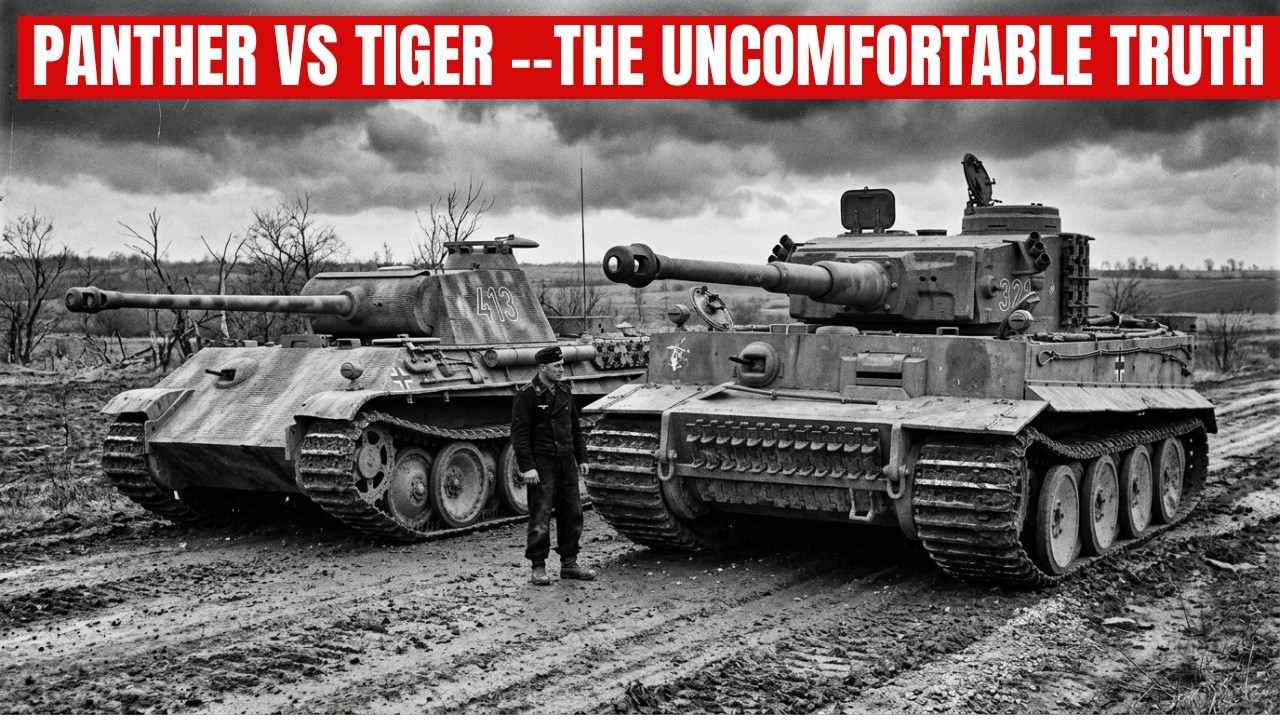
The Panther entered combat at the Battle of Kursk in July 1943, and the experience was instructive in ways that had nothing to do with enemy action. Of the approximately 200 Panthers deployed with the fourth Panza Army for Operation Citadel, a significant proportion broke down before or during the initial advance.
The final drive units, the mechanisms that transmitted power from the gearbox to the tracks, proved chronically unreliable under combat conditions. The gearbox itself was sensitive to the rough handling that intensive operations demanded. Engineers who had designed the vehicle for a production schedule driven by military urgency had not had sufficient time to resolve every mechanical weakness before the first units reach the front.
The losses from breakdown at Kusk are difficult to assess precisely. German records from the period are inconsistent and different sources attribute varying proportions of losses to mechanical failure versus enemy fire. What is clear is that the operational availability rate in the first weeks was poor. Soviet accounts describe encountering Panthers that had been abandoned by their crews, not because they were hit, but because they had simply stopped working.
This matters because it shaped the reputation the tank would carry for the remainder of the war. The Panther was described by some Allied intelligence assessments as mechanically unreliable. a characterization that was fair in 1943, but which obscured the trajectory of the vehicle’s development.
As production matured and mechanical modifications were incorporated, stronger final drives, improved engine cooling, revised transmission specifications, the rate of breakdown fell substantially. If you are finding this interesting, a quick subscribe helps more than you know. By 1944, Panther crews had learned their vehicles.
Maintenance routines had been established and the tank was functioning with considerably greater reliability than its early reputation suggested. Allied tankers in Normandy and beyond encountered a different machine from the one that had limped through the Kursk salient. Reports from American and British commanders who faced panthers in the Bokeh country of France described the experience with a consistency that commands attention.
Standard Allied anti-tank weapons were largely ineffective against the Panther’s frontal armor at typical engagement ranges in the confined terrain of the French countryside. The 75 mm guns equipping most Allied tanks required a flanking shot or a close-range engagement at an unfavorable angle for the Panther to be brought down reliably.
Surviving accounts from British tank crews describe the tactical adjustments necessitated by the Panthers presence, the suppression of enemy infantry to prevent them from directing Panther fire, the deliberate use of terrain to close the engagement distance, the coordination of multiple vehicles to present the enemy with more targets than its single gun could address simultaneously.
These were not the improvised responses of crews facing an inferior opponent. They were the disciplined adaptations of professionals dealing with a genuinely dangerous adversary. The comparison between the Panther and the Tiger resolves, when examined closely, into a question of design philosophy. The Tiger One was conceived in a particular moment of crisis, the crisis of encountering Soviet armor that existing weapons could not reliably defeat.
And it was designed to answer that crisis in the most direct manner available, give the gun a big enough barrel, give the armor enough thickness. The result was a vehicle of undeniable power and equally undeniable limitations. The Tiger 1 weighed 57 tons. Its ground pressure, the load it imposed on the surface beneath its tracks, was higher than the Panthers despite wider tracks because the weight differential was simply too great to fully compensate.
On soft ground, on bridges rated for civilian traffic, on the narrow roads of European towns and villages, the Tiger was a constant engineering challenge. Moving it required special rail flat cars. River crossings required preparation that could take hours. Its range on a full tank of petrol was barely 200 km on a hard road and considerably less cross country, meaning that a Tiger formation at full operational tempo was constantly dependent on fuel resupply.
Production numbers tell their own story. Between August 1942 and August 1944, Germany produced approximately 1,347 Tiger 1 tanks. In the same period, Panther production exceeded 6,000 vehicles. The Tiger consumed enormous quantities of specialized manufacturing capacity.
Each vehicle required careful handfitting of components that were machined to tolerances. The production lines struggled to maintain consistently. A Tiger took roughly 300,000 man-hour to produce. A Panther required significantly less. The American M4 Sherman, the tank that represented Allied armored mass in the West, mounted a 75 mm gun that was effective against the Panza 4 and manageable against the flanks of a Tiger, but which struggled profoundly against a Panther’s frontal plate.
The American response to this was broadly to produce more Shermans rather than to develop a comparable vehicle quickly. The logic was industrial rather than tactical. If you cannot match the enemy’s best tank, overwhelm it with numbers of adequate tanks supported by aircraft, artillery, and logistics.
That logic ultimately prevailed. But it should not obscure the fact that at the level of individual vehicle capability, the Panther represented a qualitative advance that Allied armor never fully matched in direct confrontation. The Soviet T34/85, introduced in 1944, was a more even contest.
The 85 mm gun gave Soviet crews a weapon that could penetrate the Panther’s frontal armor at combat ranges, and the T34/85 was produced in far greater numbers than any German vehicle. Soviet commanders used mass and tactical sophistication to offset the Panthers individual superiority. But Soviet tank crews who faced Panthers in 1944 and 1945 were under no illusions about the capabilities of the vehicle opposite them.
What the Panther meant in the larger sweep of the war depends on which question you choose to ask. As a tactical instrument, it was the finest German tank of the conflict, and a strong argument can be made that it was the finest tank deployed by any nation in the European theater. Its combination of firepower, protection, and mobility was not replicated until after the war ended when its design influence could be seen clearly in the generation of main battle tanks that followed.
The American T54 experimental tank, the postwar French AMX50, and elements of the British Centurion’s conception all reflected the lesson the Panther had demonstrated that sloped armor and a high velocity medium caliber gun represented a more efficient answer to armored warfare than sheer weight and large bore.
As a strategic instrument, the Panther was something rather different, a demonstration of what German industry could achieve when directed with clarity, and simultaneously a reminder of what it could not achieve when redirected too late. The Panther arrived in meaningful numbers in 1943 and 1944, by which point German strategic circumstances had deteriorated to the degree that no single weapon system could alter the fundamental balance.
Soviet production, American logistics, and British tactical air power had combined to create an operational environment in which tactical superiority at the vehicle level could be overcome by systemic superiority at every other level. The Panther could win engagements that the Tiger would have lost.
It could penetrate armor that the Tiger would have struggled with at the same range. It could move to positions that the Tiger could not reach without mechanical breakdown. None of this was sufficient to change the outcome of the war, but it was sufficient to cost Allied forces dearly in specific encounters and to complicate the operational planning of every Allied commander who had to account for the possibility of meeting one.
Surviving examples of the panther can be seen today at the tank museum in Bovington, England, which holds one of the finest collections of Second World War armor in the world, as well as at the Muse de Blade in Surre, France, and at the Kubinka Tank Museum outside Moscow. Standing beside one in a museum.
The proportions are striking, lower and longer than the Tiger. That barrel projecting almost aggressively ahead of the hull. The glasses plate angled in a way that still looks modern decades after its design was finalized. It has an economy of form that the Tiger lacks. Return to that field east of Kursk.
The Soviet crew is still waiting. The Tiger passes. They have held their nerve and they know exactly what to do. When the moment comes, they take their shot. The 88 mm armor is thick, but the angle is right and the round finds its mark. One Tiger, one burning tank, one crew lost. Then the Panther comes.
The shot that seemed adequate against the Tiger strikes the glacis at 55° and departs at an angle that ensures it will trouble no one. The Soviet gunner traverses. He fires again. The second round follows the first into the grass. The Panther has not slowed. It has not turned to present a flank.
It continues forward and before the anti-tank crew can reload and correct their aim, it fires once and they are answered. This is what the numbers cannot fully capture. Not just the penetration figures and the production statistics and the weight comparisons, but the moment of decision in a field where both vehicles appeared and one of them was feared for the wrong reasons and the other was not feared enough. The tiger had the reputation.
The panther had the results. History, as it so often does with complicated truths, remembered the one that looked more impressive on a news reel. The engineers who designed the Panther built a better tank. They also built the tank that in the theater of memory and mythology came second.
The 88 mm gun echoes across 80 years of military history. The 75 mm gun and the lesson it teaches about the relationship between engineering and elegance still awaits the recognition it deserves.