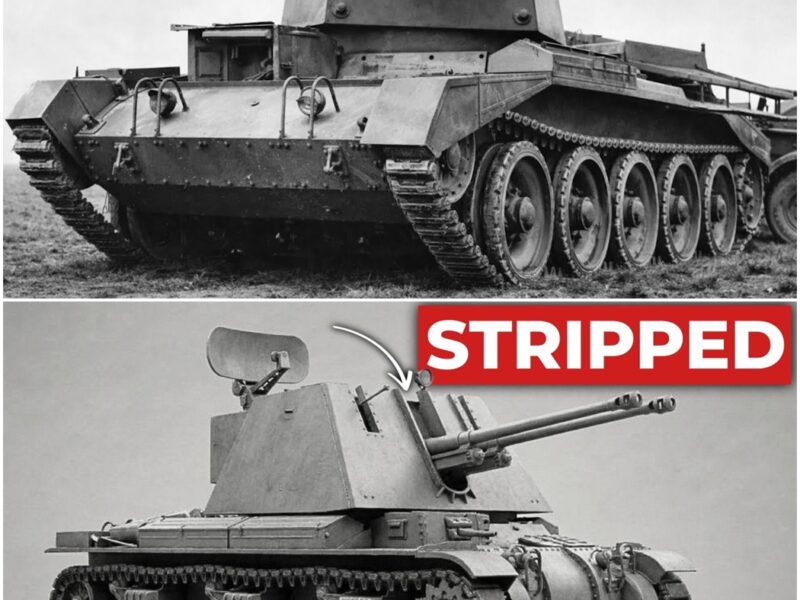
Why The British Ripped The Main Gun Off A Perfectly Good Tank And Replaced It With AA Guns S
September 1941. Somewhere inside the war office in London, a British staff officer signs a general staff requirement that sounds like a terrible idea. Take a perfectly functional cruiser tank, rip out the main gun, and replace it with anti-aircraft cannons. Not because the tank is broken, not because the gun does not work, but because the Luftwaffe is tearing British armored columns apart, and nobody has figured out how to shoot back while moving.
The solution would take 3 years, three separate variants, and over 600 conversions. It would land on the beaches of Normandy on D-Day itself. And in the cruelest twist of the entire war, it would arrive at the precise moment when Allied air supremacy meant there were almost no enemy aircraft left to shoot at.
This is the Crusader III AA, the anti-aircraft tank that proved Britain could solve a problem faster than anyone, even when the battlefield had already moved on. The problem started in North Africa. British armored formations crossing the open desert had no mobile anti-aircraft protection that could keep pace with tanks.
Towed Bofors 40 mm guns, the standard light anti-aircraft weapon, needed time to set up and could not follow fast-moving columns. Static anti-aircraft batteries defended ports and airfields, but left mobile units exposed. The flat, featureless terrain offered zero natural cover from air attack.
The Luftwaffe exploited this gap with ruthless efficiency. Sturzkampfgeschwader 3, the primary Stuka wing in the theater, provided close air support for Rommel’s Afrika Korps throughout 1941 to 1943. According to Luftwaffe operational records, the unit flew 1,400 sorties against the Free French garrison at Bir Hakeim alone during the Battle of Gazala in May and June of 1942.
Stukas operated from primitive forward airstrips, flying as many as 10 short-range sorties per aircraft per day. The Germans had perfected air-ground coordination since the Spanish Civil War, and every British column advancing across open ground was a target. Existing light anti-aircraft tanks were hopelessly inadequate.
The Vickers Light Tank AA Mark I mounted four 7.92 mm Besa machine guns. The crews hated them. The vehicles were cramped, the firepower was pitiful against modern aircraft, and the guns lacked the hitting power to do structural damage to anything tougher than a canvas biplane. Britain needed a weapon that could kill aircraft while rolling alongside Shermans and Churchills.
That meant mounting a real anti-aircraft gun on a real tank hull. The hull they chose was the Crusader, officially designated the Tank Cruiser Mark VI A15. Designed by Nuffield Mechanizations and Aero, the Crusader had been ordered straight off the drawing board in 1939 without prototype testing. Over 5,300 were manufactured between November 1940 and 1943, serving as Britain’s primary cruiser tank through the desert campaigns.
Its reputation for mechanical failure was earned. The Nuffield Liberty V-12 engine, derived from a World War I aircraft power plant, had been reconfigured to fit the Crusader’s low profile, and this badly compromised the cooling system. Sand ground down the white metal components in water pumps. The chain drive cooling fan broke constantly, causing engines to seize.
Making matters worse, according to unit war diaries, dock workers at Liverpool routinely started engines dry to reposition tanks on transport ships, inflicting damage before vehicles ever reached Africa. The Queen’s Bays war diary from January 1942 recorded that 22 of 31 Crusaders broke down mechanically during a single Axis counteroffensive, a 71% failure rate.
Only two of 19 American M3 Stuarts failed in the same action. Beyond reliability, the Crusader was outgunned. Its 2-pounder main gun lacked high explosive ammunition entirely, meaning it could not engage anti-tank gun screens. The armor was thin, 40 to 51 mm at best, and the tank brewed up easily when hit.
By the Second Battle of El Alamein in October 1942, Crusaders served only in light squadrons while Shermans carried the main fight. The last Crusader gun tanks left frontline service by May 1943, but the chassis was still fast, still mobile, and available in enormous surplus. According to production records, over 1,600 Crusaders were built in 1943 alone.
Even after the type was obsolete because the War Office could not disrupt factory lines during the changeover to Cromwell production, over 1,300 surplus hulls were converted for secondary roles, gun tractors, observation posts, command vehicles, recovery vehicles, bulldozers, and anti-aircraft tanks.
The Crusader AA family came in three main production variants, each representing a different approach to the same problem. The Mark I was the simplest. Engineers mounted a single QF 40 mm Bofors L60 anti-aircraft gun where the turret had been. The Bofors was the finest light anti-aircraft weapon in the world, firing 120 to 140 rounds per minute at a muzzle velocity of 850 m per second.
Effective range against aircraft reached approximately 2,700 m. The vehicle carried 160 rounds, fed by four-round stripper clips through a gravity feeder. Later models received a four-sided open-topped armored shield. The conversion weighed approximately 18 tons, carried a crew of four, and retained the Crusader’s Liberty engine producing 340 brake horsepower for a top speed of 42 km/h.
An Imperial War Museum’s photograph dated March 25th, 1943, shows the Mark I at the Armored Fighting Vehicle School at Lulworth in Dorset. After trials, however, evaluators judged the Bofors rate of fire too slow for engaging fast, low-level aircraft. Between 215 and 400 Mark Is were produced, though sources disagree on the precise figure.
The Mark II was far more ambitious. The prototype emerged from Morris Motors in the summer of 1943, mounting twin Oerlikon 20 mm Mark II auto cannons inside a fully enclosed polygonal turret. This was unique in the entire war. No other self-propelled anti-aircraft gun had a closed turret. Each Oerlikon fired at up to 450 rounds per minute cyclic, with a practical rate around 250 to 320, giving a combined output approaching 900 rounds per minute.
Muzzle velocity reached 830 m per second, effective against aircraft to approximately 910 m. The guns used bulky 60-round drum magazines, requiring manual reloading inside the turret. Power mountings limited design to hydraulic power traverse system driven off the tank’s engine. The enclosed turret offered 30 mm of frontal armor, 14 on the sides, and 17 at the rear, genuine protection from shrapnel, small arms, and air burst, but evaluation revealed critical flaws.
The interior was claustrophobic with poor visibility for spotting approaching aircraft. The radio consumed precious turret space. The Mark III was an urgent redesign addressing those failings. Engineers added raised protective lips on the turret aperture and a narrower aiming frame.
They relocated the radio from the turret to the hull beside the driver, who doubled as the radio operator. This freed critical space in the fighting compartment. One disputed modification involves a barrel mounted between the twin 20 mm guns. According to a researcher who examined documents at the Public Record Office at Kew, this may have been a threaded rod counterweight rather than the Vickers K machine gun that most references claim.
The debate remains unresolved. All other specifications stayed identical to the Mark II. Conversions began around October 1943. Combined Mark II and Mark III production totaled approximately 238 vehicles. Now, before we get into how these performed in combat, if you are enjoying this deep dive into British engineering, hit subscribe.
It takes a second, costs nothing, and helps the channel grow. Right. Let us get into D-Day. Crusader AA tanks went to war on June 6th, 1944. On Gold Beach, 320 Battery of the 93rd Light Anti-Aircraft Regiment landed triple 20 mm SP guns on Crusader chassis, among the first artillery pieces ashore. The 120th Light Anti-Aircraft Regiment’s 394 Battery also landed Crusader SP Bofors guns, though the first vehicle bogged down and flooded its engine.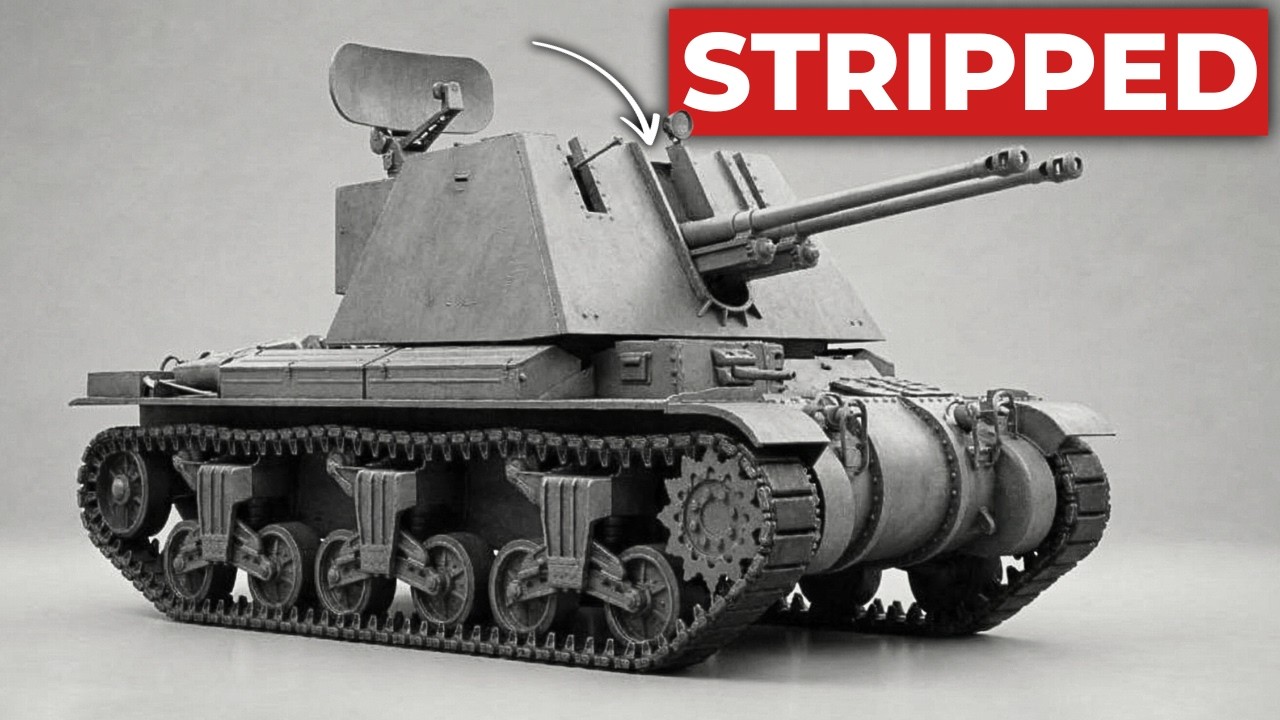
The crew kept the gun manned regardless. The following day, the famous Crusader AA Mark III, nicknamed Al A Kiefak, Arabic for how are you, from the 22nd Armored Brigade Headquarters of the 7th Armored Division, rolled off a landing ship onto Gold Beach. The Imperial War Museum’s captured it in photograph B5129 by Sergeant Laing.
Each British armored regiment carried an anti-aircraft troop of six to eight Crusader AA tanks in its headquarters squadron. The 1944 armored division establishment included approximately 27 Crusader SP anti-aircraft guns and 25 AA tanks total. Known operators included the 7th Armored Division, the 11th Armored Division, the Guards Armored Division, the 1st Polish Armored Division, and the 2nd Canadian Armored Brigade.
The irony was immediate and total. Allied air supremacy over Normandy meant there were almost no Luftwaffe aircraft to engage. A wireless operator and gun loader on a Crusader AA captured the frustration in his account. His troop waited with headquarters squadron, wondering if they would ever get moving.
There was not an enemy aircraft to be seen. The only air action they witnessed came from low-flying friendly American fighter planes attacking their own column. His troop turned in their Crusaders within a week, received Cromwells, and became an operational tank troop. According to the 80th Anti-Aircraft Brigade’s operational reports, their units expended 1,097 light anti-aircraft rounds for every aircraft destroyed during June 1944.
The anti-aircraft troops attached to headquarters squadrons were generally disbanded by the end of August 1944. Crews were desperately needed for gun tanks. The 120th Light Anti-Aircraft Regiment replaced its unreliable Crusader SP guns with towed Bofors, but the Crusader AA’s most significant combat came against targets on the ground.
During the Battle of the Falaise Pocket in August 1944, the first Polish armored division turned their Crusader AA weapons horizontal against German forces fleeing the encirclement. Twin 20-mm Oerlikons proved lethal against soft-skinned vehicles, troops, and horse-drawn transport. The Poles destroyed 55 enemy tanks and nearly 250 other vehicles during the Falaise battles, with Crusader AA fire contributing to the carnage against unarmored targets.
Cruising Churchill tank units also discovered that twin 20-mm guns were effective against infantry sheltering behind hedgerows in the Normandy bocage. One operational limitation was that Oerlikon rounds lacked self-destructing fuses, meaning they could only be safely fired into areas confirmed clear of friendly forces.
So, how did this compare to what the Germans and Americans fielded? The German Wirbelwind mounted four 20-mm Flak 38 cannons on a Panzer IV hull, delivering roughly double the volume of fire at 800 rounds per minute practical versus the Crusader’s 500. The Flak 38 also had superior muzzle velocity at 900 m per second.
However, the Wirbelwind used 20-round box magazines that ran dry far faster than the Crusader’s 60-round drums. The Wirbelwind’s open-topped nine-sided turret, nicknamed Keksdose, meaning biscuit tin, left crews exposed to shrapnel and air burst. The Crusader’s enclosed turret protected from all angles, including overhead.
The Wirbelwind’s Panzer IV hull offered 80 mm of front armor versus the Crusader’s 49. But, only 87 to 122 Wirbelwinds were ever built, entering service in July 1944, 2 years after the British began Crusader AA development. The German Ostwind replaced the Wirbelwind’s four 20-mm guns with a single 37-mm Flak 43 in a proper rotating turret.
It fired a heavier shell, but at only 180 rounds per minute. According to German production records, only 43 to 44 Ostwinds were completed from December 1944, far too late and far too few. The American M16 Multiple Gun Motor Carriage, nicknamed the Meat Chopper, took a different approach entirely. Its quad .
50 caliber Brownings delivered the highest volume of fire at 2,000 rounds per minute combined, but the weakest caliber. .50 caliber rounds lacked the explosive content to structurally damage aircraft the way 20-mm or 40-mm shells could. The M16’s half-track body offered only 12 mm of armor. Over 3,500 were built, but they were fundamentally different vehicles, cheaper, faster on roads, and intended for a lighter role.
The timeline tells the real story. Britain began Crusader AA development in September 1941. Germany did not start serious Flakpanzer work until 1943. The British identified the problem 2 full years earlier because they had been on the receiving end of Stuka attacks across North Africa while the Luftwaffe still owned the skies.
By the time Germany felt the same urgency under Allied air superiority, they could never build enough vehicles to matter. Most Crusader AA tanks were scrapped in the post-war drawdown. The chassis had always been a known liability. By late 1944, surviving vehicles were being stripped of their anti-aircraft mountings, which went on to trucks while the worn-out hulls were abandoned.
The 93rd Light Anti-Aircraft Regiment defended the Orne and Caen canal bridges near Pegasus Bridge, then moved to guard crossings captured during Operation Market Garden before their Crusader chassis finally gave out. The most remarkable post-war story belonged to Egypt.
According to surviving inventory records, one battalion of Crusader AA tanks served with the Egyptian army from 1944 until the late 1960s, seeing action during the 1956 Suez Crisis. Egypt remains the only nation to have used the Crusader AA in its intended anti-aircraft role during actual combat against hostile aircraft.
The concept of mounting anti-aircraft weapons on obsolete tank hulls became standard practice in the Cold War. The Marksman turret system, developed by Marconi starting in 1983, embodied the identical philosophy. A twin 35-mm Oerlikon KDA auto cannon turret with integrated radar, designed to fit any available obsolete main battle tank chassis.
Tested on Chieftain, Centurion, Leopard, and T-55 hulls, it achieved a documented 52.44% hit rate. The British army, continuing its tradition of developing superb anti-aircraft systems and then not buying them, never adopted it. September 1941. A staff officer signs a requirement to rip the gun out of a perfectly good tank and bolt anti-aircraft cannons onto the hull.
Three years later, those converted tanks roll off landing ships onto Gold Beach. The weapon works. The engineering is sound. The enclosed turret is unique in the entire war. The problem is that the enemy has already lost the sky. British engineers solved what others had not even recognized as a problem, built the only fully enclosed self-propelled anti-aircraft turret of World War II, and delivered it to the battlefield 2 years ahead of every rival.
That the Luftwaffe was already beaten when it arrived does not diminish the achievement. It confirms it. Britain built the answer before anyone else had even finished asking the question.