Why This ‘Boring’ American Truck Is The Reason The M1 Abrams Can Ever Reach A War D
1991, the port of Ad Dammam, Eastern Saudi Arabia. A 68-ton machine, wider than a two-lane road, is being driven off a ship’s ramp and onto a concrete dock in the Persian Gulf heat. Steel tracks grind against steel plate. The engine screams. The dock shudders. The M1 Abrams main battle tank, the most powerful ground weapon in the United States military, has just arrived in theater, and it cannot go anywhere.
Not under its own power. Not along the 600 miles of desert highway separating it from the attack positions where it needs to be in less than 6 months. If the army tries to drive every one of those tanks to the front, it will burn through their engines, strip their tracks to bare metal, split apart every paved road between the port and the Kuwaiti border, and arrive with a force of exhausted machines too worn out to fight the most advanced tank on Earth, and it cannot move itself to the battle that will define its legend. The army’s solution was already waiting. Not on a dock. Not in a hangar. Not in the news. It was on a highway. A truck. A colossal, unglamorous 18-wheel truck rolling through the Saudi heat, pulling a flatbed trailer so wide it required a police escort to move. 30 m long from cab to ramp. 40 wheels beneath the trailer alone. Capable of hauling 70 tons across desert and broken road at 45 mph, keeping the Abrams off the ground it would otherwise destroy. Every main
battle tank that fought Desert Storm traveled to its attack position on the back of one of these trucks. Every tank that drove into Baghdad in 2003 was first carried to within striking distance of the city. Every armor deployment the United States has run since the early 1990s has depended on this vehicle to make it possible.
It has never been on the cover of a magazine. No film has been made about it. Its crews are never interviewed. Its role is never mentioned in the news. Its designation is the M1070 Heavy Equipment Transporter, and without it, the most powerful army in the world cannot move. To understand why this vehicle exists, you need to understand the problem the United States Army spent most of the Cold War ignoring.
The M1 Abrams main battle tank weighs 68 tons in its M1A1 configuration. Combat loaded with ammunition, fuel, crew equipment, and reactive armor packages, it exceeds 70 tons. Its gas turbine engine, the Lycoming Textron AGT1500, consumes between 1.5 and 3 gallons of fuel per mile of road travel. Its tracks, the steel links that carry across terrain no wheeled vehicle can cross, constitute the second largest consumable expense in the entire United States Army budget, behind only field rations.
A full set of Abrams track can cost up to $100,000 and last anywhere from a few hundred to roughly 2,000 miles of road use. The tank itself has an engineering service life of 6,000 miles, beyond which its running gear, suspension, and drivetrain require depot level overhaul. Every mile the Abrams drives under its own power is a mile subtracted from its fighting life. The solution was not new.
Since the Second World War, every serious armored force had understood that tank transporters preserve tank combat readiness. The American M25 Dragon Wagon had moved armor across Europe in 1944 and 1945. The principle was sound. The problem was that by the 1980s, the transport fleet the United States Army actually owned was built around the wrong tank.
The M911 commercial heavy equipment transporter had been designed to carry the M60 Patton. The M60 weighed about 52 tons. The M911 was an 8×6 truck pulling an M747 trailer rated to carry 60 tons. It was adequate, barely, for the Patton. It was not adequate for the Abrams. When Operation Desert Shield began in August 1990, the United States Army discovered the scale of its problem with brutal clarity.
Lieutenant General William Pagonis, who commanded the entire logistics operation that would sustain 700,000 allied troops in Saudi Arabia, later described what he found. He had 112 heavy equipment transporter systems in theater. He needed closer to 1,400. He rented the difference, negotiating use of coalition allies transporters from Saudi Arabia, Egypt, Germany, and Czechoslovakia, and securing additional 2,200 flatbed trucks and 450 lowboys from civilian contractors.
The American Army, the most powerful ground force in the world, moved its tanks to the line of departure on road trucks. The M911 fleet compounded the crisis further. Multiple transporters failed under loads exceeding 60 tons as M1A1s were placed on trailers not built to carry them. Durability was poor.
Breakdowns multiplied along main supply routes. The Army had known a replacement was needed before the Gulf War. Oshkosh Defense, based in Oshkosh, Wisconsin, had been awarded an initial production contract in 1992 for 1,044 M1070 tractors with options for more. Production began in July 1992. The vehicle entered service in 1993.
It had been designed from its first engineering requirement to carry a combat loaded Abrams. The M1070 is an 8×8 tractor truck. All eight wheels are driven. The engine in the original production model was a Detroit Diesel 8V-92, a 12-liter V8 two-stroke diesel developing 500 horsepower at 2,100 revolutions per minute and nearly 1,500 foot-pounds of torque.
Power was routed through an Allison CLT 754 five-speed automatic transmission and a two-speed transfer case turning all four axle sets simultaneously. The cab was fully enclosed and pressurized, designed to operate in environments where nuclear, biological, or chemical contamination was possible. It seated the driver and one additional crew member in the front with four further seats in the rear, enough to carry the entire four-man crew of the Abrams it was transporting while their tank rode behind them on the trailer. For long hauls, the rear seats folded into two sleeping berths, two hydraulic winches, each rated at 55,000 lb of pull were mounted to the rear of the tractor. Either winch could be used to drag a disabled Abrams aboard the trailer if the tank could not move under its own power. The truck could, in theory, recover and transport a completely dead 68-ton vehicle from a combat zone. The trailer behind it was an engineering achievement in its own right. The M1000 semi-trailer was developed privately by Southwest Mobile Systems, a company that would later be absorbed into the defense
electronics giant DRS Technologies, now a subsidiary of Leonardo. A production order for 1,066 units was placed in 1989. The trailer sat on five axle lines carrying a total of 40 wheels. Every tire was a low-profile commercial unit sized to spread the Abrams weight across the widest possible footprint and reduce ground pressure on roads and bridges.
What made the M1000 remarkable was its steering system. Axle lines two through five did not simply follow the tractor. Each line steered automatically responding to the angle between tractor and trailer and calculating the precise steering input required to maintain Ackermann geometry through every turn.
The driver made no additional inputs. The trailer simply followed. Its 40 wheels tracing the correct arc through intersections as narrow as 30 ft without tire scrub or curb contact. The hydraulically supported gooseneck adjusted its angle automatically to equalize weight across the fifth wheel coupling.
Loading was controlled from a handheld fingertip pendant. The driver activated the hydraulic deck control which lowered the entire trailer bed and inclined it rearward into a loading ramp. The Abrams was then driven on, its tracks climbing the angled deck as the trailer bore the full weight of the tank with no tipping, no sway, and no structural overstress.
The deck was then raised, leveled, and locked. Chains and shackles secured the tank for road movement. The whole process from stopped trailer to loaded and road ready took trained crews less than 15 minutes. Combined payload capacity was 70 tons. Combined weight of the complete loaded system, tractor plus trailer plus M1A1, approached 235,000 lbs.
Now, before the record is examined in detail, if this kind of deep look at the machines that actually run a modern army is something you find valuable, hit subscribe. It costs nothing. It takes 1 second, and it keeps this channel making content like this. The M1070 entered operational service just as the army was absorbing the lessons of the Gulf War.
Its first sustained combat theater deployments came in the Balkans, where it moved American armor through the broken roads and soft ground of Bosnia and Kosovo during peacekeeping operations in the mid and late 1990s. The terrain was demanding. The M1070 handled it. The true operational test came in March and April 2003, when the 3rd Infantry Division crossed from Kuwait into Iraq on the night of March 19th.
It moved along routes its heavy equipment transporters had already been working for months. Camp Arifjan in Kuwait served as the primary staging base for the 296th Transportation Company, an Army Reserve unit out of Brookhaven, Mississippi, whose crews drove M107s continuously throughout the preparation phase and the invasion itself.
Their job was to move armor from assembly areas and forward staging points to the positions where tank commanders needed it, and to do it fast enough that the advancing ground force never ran short. Staff Sergeant Kenneth Hannah, one of the company’s lead drivers, described the particular challenge of operating the system in urban and near urban environments.
The M1A1’s low profile on the trailer created massive blind spots around the cab and trailer sides that required constant mirror work and ground guides in confined spaces. The weight and length of the system demanded that drivers think three intersections ahead when navigating roads not built for vehicles of this size.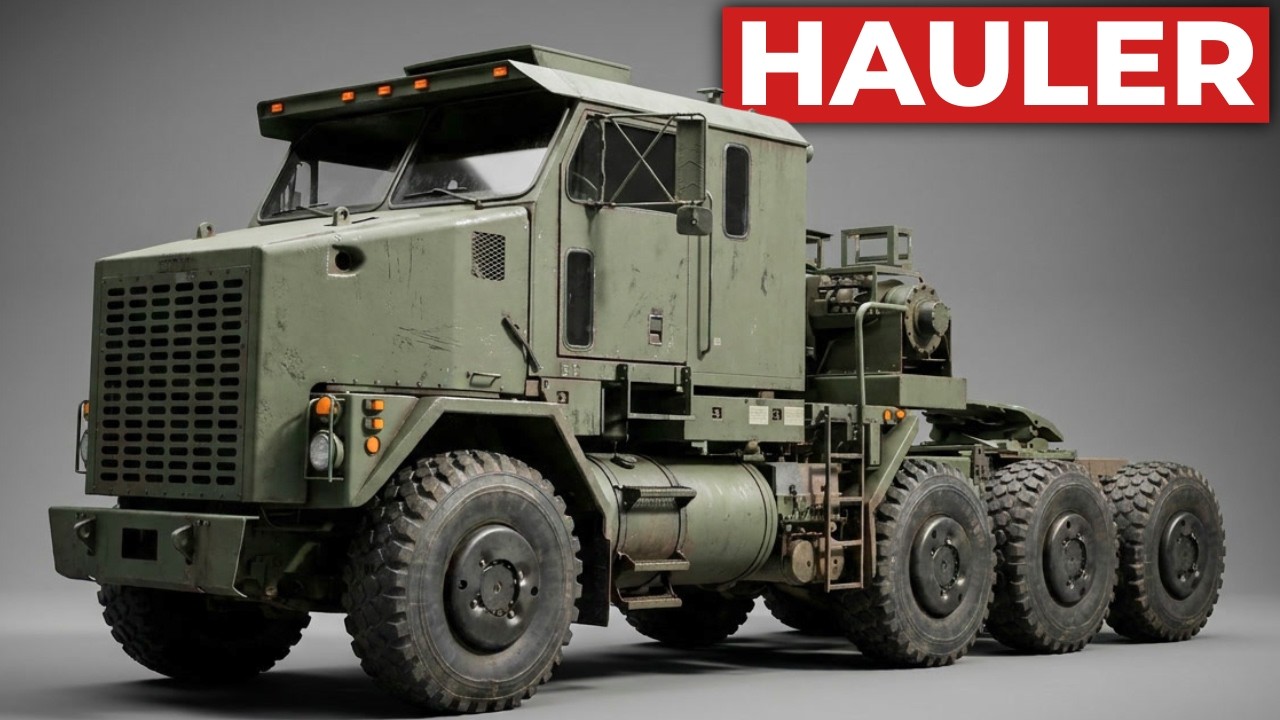
Hannah noted that the M1070 handled more like a large car than a conventional semi-truck, responsive and predictable, but that the trailer’s geometry required complete familiarity before a driver could be trusted with it at speed. Lieutenant Colonel Robert Dixon, who commanded the 260th Combat Sustainment Support Battalion during this period, summarized the operating philosophy his transporter crews lived by.
The mission was to move equipment safely and quickly, and those two demands were never in contradiction. His guidance was direct. Slow is smooth, and smooth is fast. The utility of the system went beyond simple point-to-point movement. Abrams tanks were disabled by mechanical failure, mine damage, or combat action, M107s moved in to recover them.
The twin winches on the tractor and the M1000’s hydraulic loading system meant that a tank with dead tracks, a seized drivetrain, or a destroyed running gear could be winched aboard and evacuated before the enemy could exploit it, or before its crew was left exposed. One episode from the occupation period illustrated the system’s reach in a different way.
American forces discovered a buried Iraqi MiG-25 jet aircraft concealed in the desert sand outside Al Taqaddum Airbase. The aircraft, a 20-ton interceptor, was excavated and transported out of the desert on an M1070 with an M1000 trailer. A vehicle built to carry tanks was carrying interceptor jets. The insurgency period from 2003 to 2011 placed the M1070 under a different kind of pressure.
Transporter convoys moving armor along main supply routes in Anbar province and Diyala were subjected to improvised explosive devices, rocket-propelled grenades, and ambushes. The original M1070 cab had been designed for Cold War mechanized warfare, not for a sustained insurgency targeting logistics routes.
Armor Holdings delivered protective cab upgrade kits across the fleet. Fire suppressant blankets were fitted around the external fuel tanks. Later, the HUSKY program, the Heavy Equipment Transporter Urban Survivability Kit, brought energy-attenuating seats, blast-resistant floor systems, and automatic fire extinguishing to the cab interior.
The upgraded vehicle, according to the United States Army Transportation Museum, proved to be one of the safest vehicles operating in Iraq. In 2008, the Army contracted for an upgraded variant that addressed the one genuine performance limitation of the original. The M1A2 system enhancement package and its successors had grown heavier than the original service estimates assumed.
The M88 Hercules armored recovery vehicle, which crews often needed to haul alongside Abrams units, weighed over 70 tons combat loaded. The M1000’s rated capacity was exactly at its design limit. The M1070A1 addressed the tractor. The 500 horsepower Detroit diesel was replaced by a Caterpillar C18, an 18-liter 6-cylinder turbo diesel developing 700 horsepower.
The transmission was upgraded to an Allison 4800 SP 7-speed automatic. Anti-lock braking and traction control were added. The cab was redesigned to accept armor upgrade kits under the long-term armor strategy framework. 1,591A1 tractors were delivered before production concluded in August 2014. The trailer problem required a different answer entirely.
In September 2022, the Army awarded Oshkosh Defense a contract valued at $263 million for a new semi-trailer designated the enhanced heavy equipment transporter system. The trailer, built around a design from the Dutch firm Broshuis, was rated to carry payloads of up to 90 tons. The initial delivery order covered 68 production trailers alongside five test units with the full requirement running to approximately 466 vehicles.
The first deliveries began entering service from 2023. The companion to the M1070 throughout its service life, across every theater and every generation, was the German Faun SLT 50 Elephant. Where the American system was built around 8×8 all-wheel drive and genuine cross-country capability, the Elephant was optimized for Germany’s superb road network.
Its trailer carried 50 tons in the base configuration, a meaningful margin below the Abrams. The later SLT 56 Franziska closed part of the gap, rating to 56 tons, but the M1070 70-ton capacity and its cross-country mobility on unprepared ground remained a genuine operational distinction. The British variant, designated the 1070F and operated under a private finance contract by civilian crews under military oversight, used the same Caterpillar C18 engine and a seven-axle Broshuis trailer and moved the 72-ton Challenger 2 at highway speeds across both Afghanistan and Europe. Russia’s equivalent, the KZKT-7428 Rusik, entered service in 1990 and matched the M1070 in payload capacity. Its YaMZ-8401 V12 diesel produced 650 horsepower. It could operate at extremes of temperature the American system was not designed to
endure. What it lacked was the M1000 trailer’s self-steering sophistication and the United States Army’s depth of integrated logistics doctrine behind every transporter in the fleet. 1992, a factory floor in Oshkosh, Wisconsin, a truck rolls off the production line. Eight wheels across each axle, a deep green cab no different in outline from thousands of commercial heavy haulers on American highways.
There is nothing in its appearance to suggest what it will carry, where it will go, or how much of the modern American way of war will depend on it. It was not fast. It was not armored. It carried no weapons. Its crew of two would never fire a shot in anger. Its name would appear in no citation, and no citation would be written in its honor.
The press would never follow it down a highway in Kuwait. The documentaries would not film it loading in the dark outside Fallujah at 3:00 in the morning. In the deserts of Saudi Arabia and Iraq. In the mountain roads of Bosnia. In the European preposition stocks waiting for a war that has not come.
It performed a function without which the most powerful tank the United States has ever built cannot reach the battlefield. It preserved 6,000 mile service lives one convoy at a time. It saved $100,000 track sets mile by mile. It carried disabled machines out of ambushes and delivered fresh ones to commanders who needed them within the hour.
22 nations have bought it or its variants. Over 4,000 systems are in service worldwide. The enhanced heavy equipment transporter trailer now extends the system’s reach to 90 tons. As the next generation of Abrams grows heavier still, the Abrams gets the history. The M1070 gets the Abrams there. That is not coincidence.
That is the difference between a weapon and the machine that makes the weapon possible.