Why This ‘Crude’ British Car Company Built The Gun Truck The Luftwaffe Feared Most British War Machine D
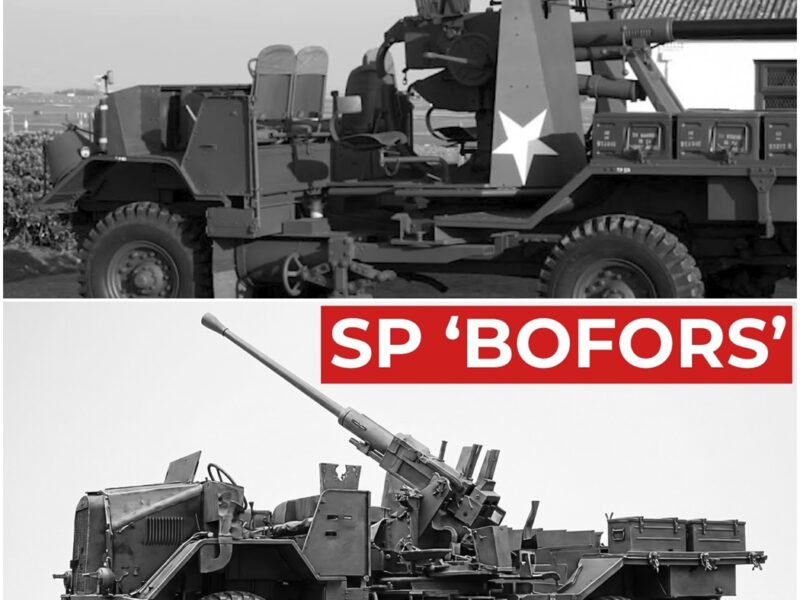
June 1944, Sword Beach, Normandy. A column of flat-topped trucks rolls off a landing craft into chest-deep surf. Each one carrying a long-barreled 40-mm cannon pointed at the sky. They look crude. No armor, no doors, no windscreen. The driver sits completely exposed beside three gunners on an open platform that resembles a builder’s lorry more than a weapon of war.
A watching infantry sergeant later recalled thinking they were some kind of mobile workshop. They were not. Within 48 hours, those six trucks and their crews would shoot down 17 German aircraft over Pegasus Bridge, breaking the Luftwaffe’s attempt to destroy the most important river crossing in Normandy.
The vehicle was the Morris C9B. The company that built it made delivery vans and London taxi cabs. And the gun it carried would go on to become the most successful anti-aircraft weapon in history. To understand why Morris Commercial Cars ended up building a weapon the Luftwaffe feared, you need to understand the problem Britain faced in 1940.
When war began, London’s first anti-aircraft division possessed exactly one Bofors gun, one 3-in gun, and 52 light machine guns to defend the entire capital against low-flying attack. Even by June 1940, the city had only 19 Bofors. The standard arrangement was towing a Bofors behind a truck. When enemy fighters screamed in to strafe a convoy, the crew had to stop, unlimber the gun, deploy it, and set up before returning fire.
Trained crews needed 25 seconds to a minute. Against a Stuka diving at over 400 mph, that meant the attack was over before the gun was ready. British convoys were sitting targets during the critical transition from halt to firing. The army needed a vehicle that could shoot back immediately while still moving or within seconds of stopping.
Nobody in the War Office had commissioned one. Morris Commercial Cars Limited had been founded in February 1924 when William Morris purchased a bankrupt engineering works at Soho, Birmingham. Before the war, the company built everything from quarter-ton delivery vans to double-decker buses, London taxi cabs, ambulances, and fire engines.
By 1932, they offered 15 different vehicle types from a new factory at Adderley Park, Birmingham. Their military work had already begun. The CS8 1500-weight truck became the most numerous light truck in the British Army with over 21,000 built. The company also produced the famous C8 Quad, the beetle-backed artillery tractor that towed 25-pounder guns across every theater.
Approximately 10,200 quads were manufactured between 1939 and 1945. Morris Commercial was part of the broader Nuffield organization, which also produced Crusader tanks, Liberty tank engines, and critically, manufactured over half of Britain’s Bofors guns at a plant in Coventry. In 1941, a three-man engineering team led by Percy Rose at the Adderley Park factory began work on a solution.
This was a private venture, not a War Office contract. A speculative gamble that the army would want a vehicle with a Bofors permanently mounted and ready to fire. Rose’s team took the proven C8 quad chassis, lengthened it, stripped away all cab protection for 360° gun traverse, and mounted the Bofors on a Mark V mounting with four heavy scissor jacks to stabilize the platform for sustained fire.
The steering wheel was hinged to fold down out of the gun’s line of fire. A unique dual-feed carburetor system bypassed the float chamber to prevent gun vibrations from interrupting fuel supply. That single detail reveals how well the designers understood what their vehicle would actually face in combat.
The first prototype was completed in late 1942. According to production records, the War Office approved it, and 1,680 vehicles were built between 1943 and 1944. Its official military designation was carrier, 30-cwt SP 4×4 40-mm AA Bofors. Crews called it the SP Bofors. The vehicle ran on the same Morris EH inline four-cylinder petrol engine as the quad, with 3,519 cubic centimeters of displacement, producing 70 brake horsepower at 3,000 revolutions per minute.
A five-speed gearbox with permanent four-wheel drive gave it a top road speed of 50 mph. The body was completely open, seating four crew abreast. No doors, no roof, no armor of any kind beyond the gun shield. Flat platforms behind the gun held 40-mm ammunition boxes over each rear wheel. It measured roughly 20 ft 2 in long by 7 ft 4 in wide.
The gun itself was the Bofors 40-mm L/60, designed by AB Bofors in Sweden beginning in 1928. It fired a 900-g high explosive shell at a muzzle velocity of 881 m/s. That is faster than a rifle bullet, and each shell carried roughly the destructive force of a hand grenade. The cyclic rate was 120 rounds per minute, with a practical rate of 80 to 90 due to hand-fed four-round clips.
It could traverse a full 360° and elevate from -5° to +90°. Britain acquired the design through a licensing deal struck in 1937, and according to Imperial War Museums records, British, Canadian, and Australian factories eventually produced over 19,000 Bofors guns during the war. Now, before we see how this performed in combat, if you are enjoying this deep dive into British engineering, hit subscribe.
It takes a second, costs nothing, and helps the channel grow. Right, let us get into the combat record. The C9B’s baptism of fire came on the beaches of Normandy. F Troop of the 92nd Loyals Light Anti-Aircraft Regiment was the only divisional light AA unit to land at Sword Beach on June the 6th, 1944 itself, bringing six SP Bofors guns.
By dawn the following day, F Troop had deployed around the vital Caen Canal and Orne River bridges, known as Pegasus Bridge and Horsa Bridge, with two guns at each bridge and two in between. On D+2, according to regimental records, Bénouville became the hottest spot in the beachhead for anti-aircraft action, with up to 45 German aircraft attacking with cannon and machine guns.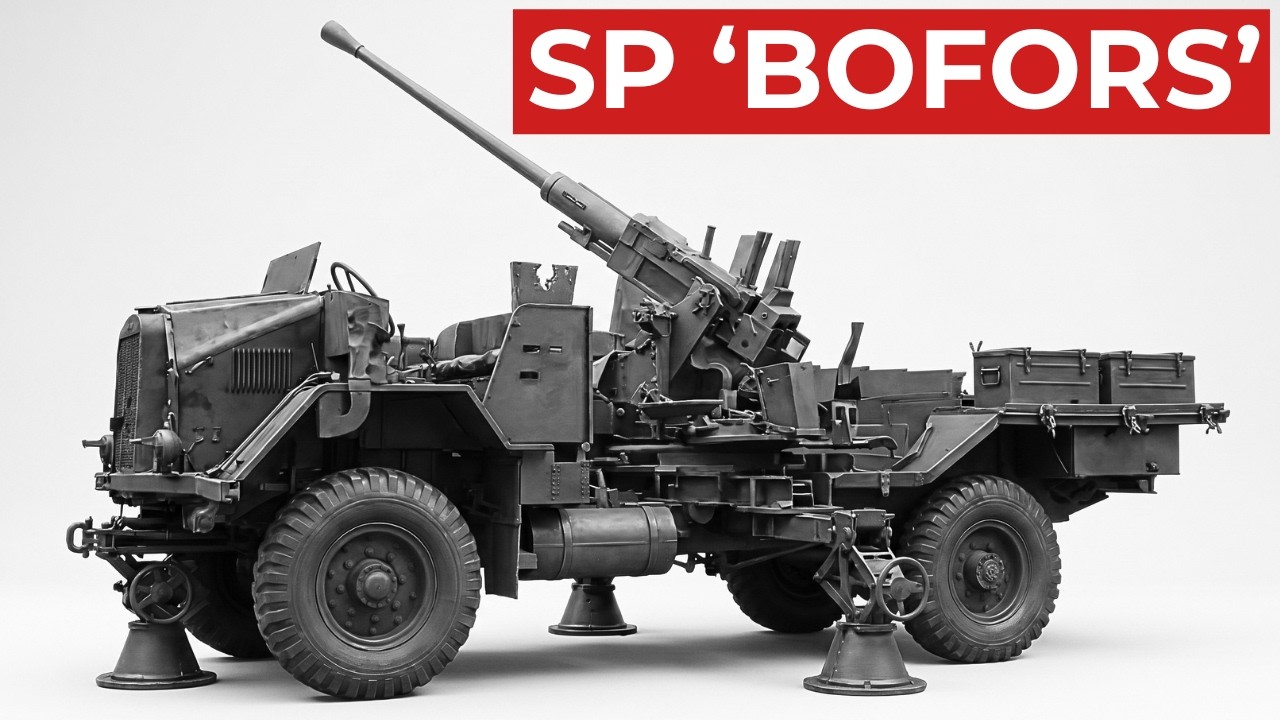
F Troop shot down three Focke-Wulf Fw 190s that day alone. On D+3, waves of 50 aircraft struck the position. Nine more fell. Over four days, the six guns fired 5,000 rounds and accounted for 17 confirmed German aircraft destroyed. Veteran James Holdervale later recalled that the Germans simply could not sustain such losses and abandoned low-level bombing of the bridges entirely.
The 15th Isle of Man Light Anti-Aircraft Regiment, known as the Manx Regiment, claims the distinction of being the most successful Allied anti-aircraft unit of World War II, with over 300 confirmed aircraft destroyed. Equipped with C9Bs from early 1944, the regiment’s war took it from defending Liverpool during the Blitz to the Suez Canal, East Africa, Crete, El Alamein with the 7th Armoured Division, through Sicily and Italy, then back to England for D-Day, and finally across France, Belgium, Holland, and into Hamburg. The Bofors also played roles its designers never intended. At the Second Battle of El Alamein in October 1942, Bofors guns fired tracer horizontally to mark safe paths through German minefields for advancing troops at night. During the Rhine crossing in March 1945, mast Bofors delivered devastating ground fire against enemy positions. The 92nd Light Anti-Aircraft Regiment alone fired
approximately 32,000 rounds during that single operation. Marine Tom Buckingham of the 45th Royal Marine Commando remembered that finding the way across was easy because the Royal Artillery had Bofors guns firing lines of red tracers to mark the route. One of the war’s most remarkable single kills belongs to a Bofors crew.
On November 28th, 1944, a gun of 2875 Squadron RAF Regiment at Helmond Airfield near Eindhoven achieved what is widely considered the first ground-to-air destruction of a jet combat aircraft, downing a Messerschmitt Me 262 A-2a Sturmvogel. A weapon designed in 1928 had just killed the most advanced aircraft in the world.
Now, consider what the Germans and Americans fielded in comparison. Germany’s answer to mobile anti-aircraft defense evolved into the Flakpanzer series, purpose-built armored vehicles on Panzer IV tank chassis. The Wirbelwind mounted quad 20-mm guns in a rotating turret. It offered hull armor of up to 80 mm, meaning it could survive ground fire that would shred a C9B, but only 87 to 105 Wirbelwinds were ever built.
The Ostwind carried a more powerful 3.7-cm Flak 43 gun, but just 44 left the factory before the war ended. Total Flakpanzer IV production of all types reached roughly 400 vehicles, too few to matter strategically. America fielded the M16 MGMC, known as the Meat Chopper. Four .50-calibre Browning machine guns in an electrically powered quad mount on an M3 half-track.
Combined rate of fire exceeded 2,000 rounds per minute, devastating at close range, but each .50-calibre projectile weighed only 45 g. Against the Bofors 900-g shell, the American weapon lacked both range and per-hit killing power. The M16’s effective ceiling reached roughly 1,000 to 1,500 m. The Bofors reached 3,800.
About 3,550 M16s were built. The C9B’s advantage was its firepower-to-cost ratio. It delivered the war’s finest light anti-aircraft gun on the cheapest possible platform. Its weakness was that same cheapness. No armor, several minutes on jacks for stable sustained fire, and limited cross-country capability on wheels.
The German Flakpanzers were theoretically superior in protection, but existed in numbers too small to influence the air war. The American M16 was operationally common, but effective only at close range. Britain built 1,680 C9Bs. Germany built 400 Flakpanzers of all types. The British fielded four times as many mobile anti-aircraft platforms, each carrying a gun with 20 times the shell weight of the Whirlwind’s individual 20 mm rounds.
Legend has it that on Malta during the illustrious Blitz of January 1941, ammunition grew so scarce that Bofors crews were ordered not to fire when a lone Messerschmitt Bf 109 buzzed Luca Airfield at low altitude. One crew fired a single round and destroyed the aircraft instantly, then swapped out their barrel to hide the evidence when headquarters called to ask who had been shooting.
Whether true or not, the story spread through every Bofors battery in the Mediterranean. The Morris C9B continued in British service after 1945, seeing use in the Korean War before being phased out in the 1950s. Very few survive today. Morris Commercial Cars itself was absorbed into the British Motor Corporation in 1952, and the brand effectively died in 1968.
The Adderley Park factory closed in 1971. The Bofors 40 mm proved immortal. Used by 77 countries across 12 major conflicts, the gun saw combat from Korea to the Falklands to the Gulf War. Bofors developed the improved L70 variant in 1947, which became NATO standard in 1953. The Swedish CV90 infantry fighting vehicle carries a Bofors 40 mm as its main armament today.
The latest descendant, the Bofors 40 Mark 4, fires programmable air burst ammunition and is currently being deployed to Ukraine as a counter-drone weapon. The Bofors 40 mm family has been in continuous production for approximately 94 years, making it one of the longest-serving artillery designs in human history.
A Birmingham car company that built delivery vans and taxi cabs designed a truck with no armor, no protection, and no war office contract. It mounted the best anti-aircraft gun in the world on a platform so crude it looked like a mistake. 1,680 were built, arriving just in time for D-Day. Its crews fought with nothing between them and the enemy except their aim, and they broke the Luftwaffe over Pegasus Bridge, over the Rhine, and over every convoy route from Normandy to Hamburg.
The Morris C9B was not elegant. It was not sophisticated. It was British engineering in its most practical, solving a lethal problem with what was available and proving that the right gun on the right platform crewed by the right men did not need armor to win.