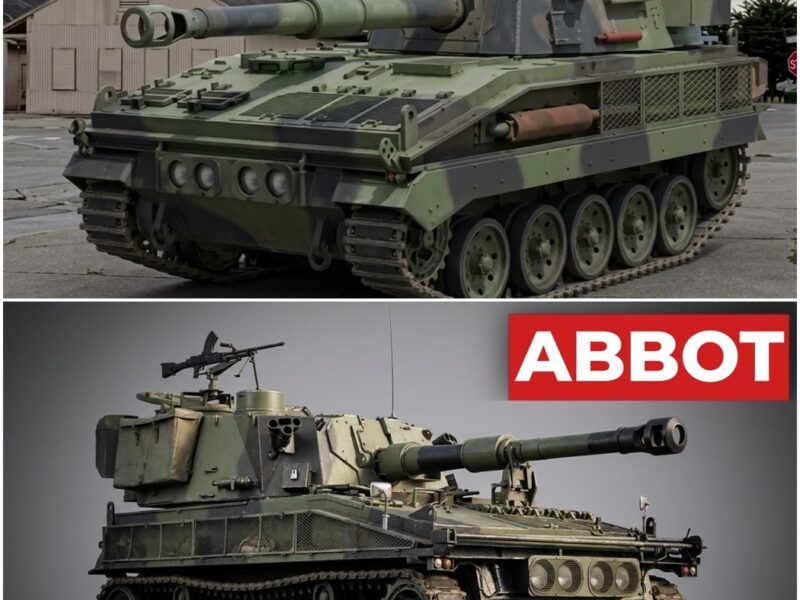
Why This ‘Forgotten’ British Gun Was Built To Fire And Flee Before The Soviets Struck Back D
1965, the Vickers-Armstrong’s works at Elswick, Newcastle upon Tyne. A tracked vehicle rolls through the factory gates and into the cold northern light. It is small by the standards of the machines built in this yard, compact, low to the ground. Its turret sits forward on the hull, stubby and purposeful.
A short barrel angled toward the gray sky. 16 and a half tons of steel and aluminum painted olive drab with the stenciled letters of the British Army across its flank. The men who watch it pass do not cheer. Some of them have built Centurion tanks. They’re not easily impressed. And this vehicle, at first glance, does not impress. It looks small.
It looks modest. It looks, in the blunt language of soldiers who have seen too many weapons come and go, like something designed by a committee of accountants. They were wrong. Over the next three decades, this machine would stand on the most dangerous military frontier in European history. It would arm a second nation 10,000 km away.
It would give an entire generation of Royal Artillery officers the doctrine they carried into the 21st century. And the ammunition fired is still fired today from a different gun on a different battlefield by British soldiers who do not know its name. Its designation was F433. Its name was the Abbot. And it was Britain’s answer to the question that kept every NATO artillery commander awake at night.
To understand why the Abbot existed, you need to understand the problem Britain faced in 1958. The British Army of the Rhine, holding the central sector of NATO’s defensive line on the North German plain, was outnumbered. Soviet and Warsaw Pact ground forces facing British Corps could field tank and motor rifle divisions in numbers that NATO’s smaller formations could not match man for man or gun for gun.
The plan was not to stop them at the border. It was to absorb the blow, delay, punish, and hold long enough for reinforcements to arrive. Artillery was the arm that made that plan viable. Massed, accurate, responsive fire could savage Soviet approach columns and break up assault formations before they reach the armored regiments holding the delay lines.
For that role, the Royal Artillery needed something modern. What it had was anything but. The Sexton, a Canadian-built 25-pounder on a Sherman derivative hull, was still in the order of battle. It was open-topped, unprotected against nuclear and chemical weapons, and firing a caliber that NATO standardization had already passed by.
Before it, the Bishop, a 25-pounder bolted into a fixed box on a Valentine tank hull, had been a wartime desert expedient. The American Priest had come and gone. None of these machines could survive the environment now being planned for on the Rhine. The Soviet threat was not simply the tanks. It was what the tanks brought with them.
Soviet artillery doctrine placed enormous emphasis on finding and destroying enemy guns. Their answer was a network of artillery locating radars, the SNAR series, mounted on tracked vehicles capable of detecting shell bursts at ranges of tens of kilometers and back plotting the trajectory to the firing position within minutes.
Once a battery fired, Soviet counter-battery doctrine demanded a response before those guns could displace. The arithmetic was brutal. Fire and stay, die. Fire and move, survive. That was the requirement handed to the Fighting Vehicles Research and Development Establishment at Chertsey, Surrey in 1958. Build a gun that can fire and run.
Design work was assigned to Vickers Armstrongs at Elswick. The engineers made a practical decision early. Rather than engineer an entirely new chassis, the gun would share its suspension, running gear, and engine with the FV432 armored personnel carrier already entering service. 12 prototypes were delivered by 1961.
Full production began at Elswick in 1964. The first vehicles reached the 3rd Regiment Royal Horse Artillery in 1965. The gun was named for a head of a monastery. This was deliberate. Britain had long named its self-propelled artillery after church titles, the Bishop, the Priest, the Sexton. The Abbot continued that tradition and would be the last vehicle ever to carry it.
The Abbot weighed 16 and 1/2 tons, small enough to move quickly, light enough to cross bridges that heavier vehicles could not. Its Rolls-Royce K60 engine produced 240 brake horsepower and could run on petrol, diesel, or kerosene in an emergency, simplifying logistics on a battlefield where supply lines would be under pressure.
On road, it reached 47 km/h. Its operational range was 480 km. The gun itself was the Royal Ordnance Factory’s 105-mm L13A1, a rifled piece mounted in a fully rotating turret, 360° of traverse powered, with no hull repositioning needed between fire missions. The gun elevated from -5° to +70°. At maximum range, it threw a shell nearly 17 and 1/2 km.
The crew of four could sustain six to eight rounds per minute. 40 rounds were stowed inside the vehicle. The armor was thin, 12 mm at the front, 10 mm on the sides, enough to stop small arms and splinters, and nothing heavier. That was deliberate. The Abbot was not built to take a hit. It was built to not be there when the hit arrived.
One further detail set the Abbot apart from everything that came before it. It was fully amphibious. A collapsible flotation screen deployed around the hull allowed it to swim rivers under its own power, driven by the tracks alone, at roughly 5 and 1/2 km/h. On the expected battlefields of the North German Plain, cut by the Weser, the Elbe, and a hundred smaller waterways, that capability was not a luxury.
It was survival. Now, before we get into how the Abbot actually fought and how it stood against its rivals, if you are enjoying this deep dive into Cold War British engineering, hit subscribe. It takes a second, costs nothing, and helps the channel grow. The Abbot never fired a shot in anger in British service.
That sentence sounds like a failure. It was not. For nearly 30 years, the gun did exactly what it was built to do. It stood on the forward edge of the most dangerous standoff in history and made the arithmetic of a Soviet breakthrough look worse with every exercise, every NATO drill, and every season spent in the pine forests and open plains of West Germany.
The field regiments of first British Corps, each equipped with 24 Abbots in three batteries of eight guns, were the fire support backbone of the armored brigades holding the delay lines. The third regiment Royal Horse Artillery, first to convert in 1965, was followed by regiment after regiment through the late 1960s and into the ’70s until the Abbot was the standard close support gun across the British Rhine Army.
The regiments exercised at home and on the Soltau-Lüneburg training area, running the same fire mission sequence in every major NATO exercise. The forward observation officer, riding forward with a Chieftain tank regiment in an armored FV432, would identify a target and pass it back. The data moved to the battery command post, ran through the field artillery computer equipment, and transmitted digitally to each gun through the artillery weapon data transmission system.
A regimental fire mission, all 24 guns firing on one point, could be delivered within minutes of the observation call. Then every gun moved. That movement was the entire point. Once British shell bursts appeared on a Soviet SNAR radar screen, the back plot began. NATO planners credited Soviet counter-battery teams with a sensor-to-shooter window of somewhere between 5 and 15 minutes.
The Abbot’s job was to make that window useless. Fire the mission, collapse the gun, drive, be somewhere else before the return rounds arrived. Former Royal Artillery officers interviewed by the Center for Historical Analysis and Conflict Research described batteries taking 24 to 36 hours to dig a fully concealed and prepared fire position in West Germany.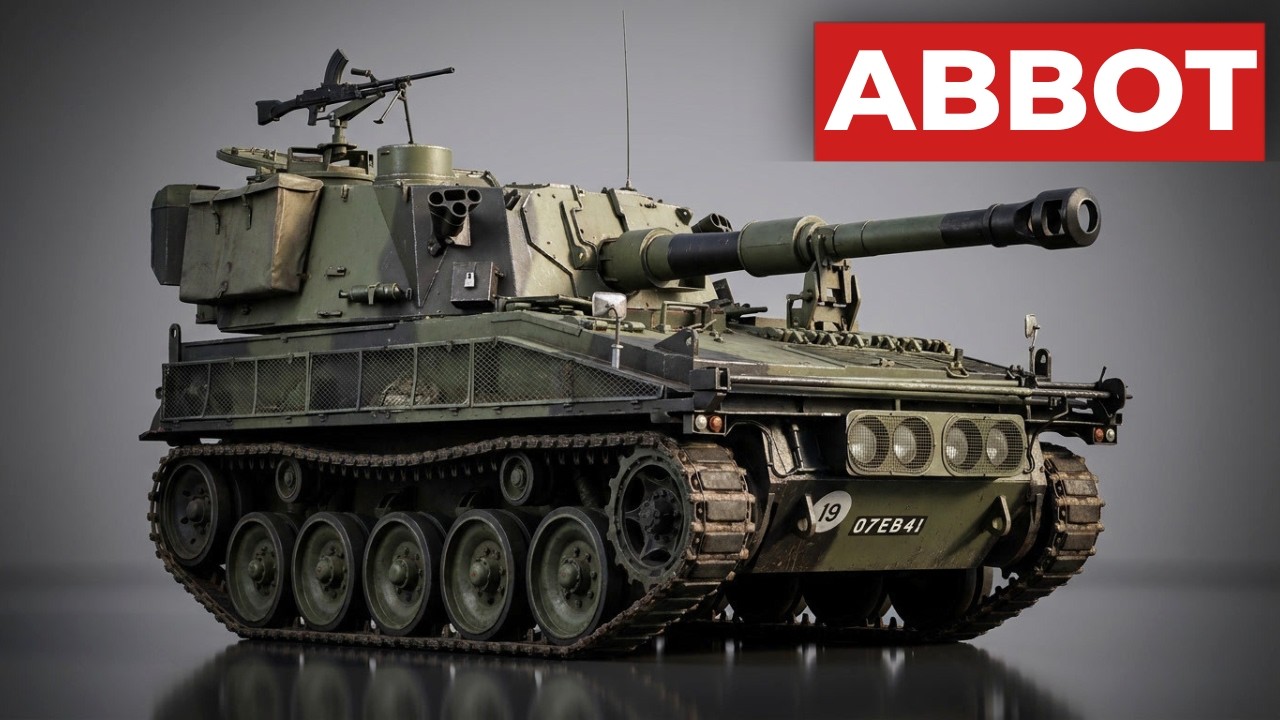
In a real battle, that time would not always exist. The machine that moved fastest survived. Everything about the Abbot, its 360-degree turret that needed no hull realignment, its multi-fuel engine, its amphibious capability was engineered for that single imperative. In 1982, the Falklands War broke out 8,000 miles from the North German Plain.
The Abbot did not go. The terrain of East Falkland and the logistics of an amphibious campaign had no place for a 16-ton tracked howitzer. Britain’s artillery in the South Atlantic was the towed 105-mm L118 light gun, carried ashore by helicopter, man-packed across the peat. It fired the same 105-mm ammunition family that the Abbot used.
Every round that broke Argentine positions on Two Sisters and Longdon owed something to the ammunition engineering done for the Abbot two decades earlier. In 1991, when 1st British Armoured Division deployed to the Gulf for Operation Granby, the Abbot again did not go. The open desert demanded range and shell weight that 105-mm could not deliver.
Britain’s artillery in Iraq took the 155-mm M109 and the M270 rocket launcher. The verdict on the Abbot’s caliber had been building for years. The Gulf confirmed it in a single campaign. The one operator who did put the Abbot to sustained use across decades was India. In the late 1960s, the Indian Army received 68 simplified variants built at Elswick with the flotation screen, the full nuclear and chemical protection, the powered traverse, and much of the advanced communications equipment removed to reduce cost. The Indian Army’s Regiment of Artillery operated up to 80 of the type in armored and mechanized formations for four decades. They were finally replaced from 2014 onward by the Korean-designed K9 Vajra T, a 155-mm self-propelled howitzer. The Abbot had served India longer than it served Britain. The Abbot’s rivals tell the story of a caliber debate that Britain eventually lost and ultimately had to concede. The American M109 entered
United States service in 1963, two years before the Abbot. It mounted a 155-mm howitzer on a vehicle weighing up to 28 tons. Britain bought roughly 140 of them and ran them alongside the Abbot throughout the Cold War. The M109 in the medium regiments, the Abbot in the close support field regiments.
On paper, the American gun dominated. It delivered roughly three times the explosive payload per round. In practice, the Abbot was lighter, faster into and out of action, and better integrated with the armored brigades it was designed to support. The argument that Britain should have standardized on the M109 alone was made at the time and has been made repeatedly since.
It was implicitly conceded when the replacement program finally began. The direct Soviet counterpart was the 2S1 Gvozdika, meaning carnation, entering Soviet service in 1971 and first publicly identified in Polish service in 1974. The Gvozdika mounted a 122-mm howitzer on a tracked infantry carrier chassis and weighed approximately 16 tons.
It was amphibious, nuclear and chemical protected, crewed by four, and carried a 360-degree turret. In almost every dimension, the two vehicles were mirror images of each other, designed to solve the same problem from opposite sides of the same frontier. The Soviet gun threw a heavier shell and reached a longer range.
The Abbot, once the artillery weapon data transmission system was integrated, had more sophisticated digital fire control. The Gvozdika was built in vastly greater numbers, more than 10,000 vehicles in total. It is still in active combat service today. The Abbot numbers around 234 vehicles across all variants and customers.
History is rarely fair to the lesser produced machine, but the Gvozdika’s dominance in production reflects not a better gun, but a different empire’s priorities. The French equivalent, the AMX-61, mounted a 105-mm howitzer on a light tank chassis and used a fixed casemate with only roughly 20 degrees of traverse to either side, meaning the crew had to reposition the entire hull for any significant change of target bearing.
Against the Abbot’s powered 360° turret, it was a generation behind. Shoot and scoot demanded a gun that could point anywhere instantly without turning the hull. The Abbot could, the French gun could not. The replacement for the Abbot was the AS90, designed by Vickers Shipbuilding and Engineering as a private venture and contracted by the British government in 1989.
It mounted a 155 mm gun capable of firing three rounds in under 10 seconds with a maximum range of nearly 25 km. The first regiment Royal Horse Artillery began converting from Abbots in October 1993. By 1995, the last British Abbot had left frontline service. The argument about caliber was over.
Surviving Abbots are held today at the Imperial War Museum, the Tank Museum at Bovington, Eden Camp Museum in Yorkshire, and in private collections and tank driving experience operations across Britain and the United States. Several are kept in full running condition. The Littlefield collection in California sold one through auction.
For a gun that served quietly, was never fired in combat by the nation that built it, and was replaced by a bigger weapon with a heavier shell, the Abbot has accumulated a following that its understated character seems designed to resist. 1965. The Vickers-Armstrong’s works at Elswick, Newcastle upon Tyne. The vehicle that rolled through those gates was 16 and 1/2 tons of compromise.
Its gun could not match the Americans 155 mm shell. Its armor stopped only splinters. Its 40 round stowage was barely adequate for a sustained engagement. In a full nuclear and chemical environment, it would have been fighting the moment it left the vehicle’s protection. And against a Soviet counter-battery radar and a 5-minute sensor to shoot a window, it had to move almost immediately every single time it fired. And yet it worked.
It worked across 30 years of exercises on the North German plain, season after season, regiment after regiment. It worked in the armored formations of the Indian Army for four decades across an entirely different strategic theater, it brought the Royal Artillery into the age of computerized fire control and digital data links.
It fired an ammunition family that still equips British guns in the field today, and it made two nations gunners think differently about the relationship between a gun, a firing position, and time. The Abbot was not powerful. It was not the longest ranged, or the most feared, or the most produced gun in any army’s inventory. It was British.
It was practical, and it was designed from its first drawing board at Chertsey to be somewhere else before the shells arrived. That is not a compromise. That is doctrine.