Why This ‘Reject’ French Personnel Carrier Outsold Every Tracked Rival On Three Continents D
1971, the Panhard factory, Avenue de Ivry, Paris. A squat slab-sided steel box rolls off the production line on four rubber tires. It weighs 6 tons. Its armor is 8 mm thick, roughly the width of a pencil. Its engine produces 90 horsepower, less than a family sedan. It carries no cannon, no missile launcher, no sophisticated electronics.
It looks like a delivery van someone welded steel plates onto and forgot to paint. It looked cheap. It looked disposable. Every officer who examined it against the tracked carriers already in NATO inventories dismissed it as a compromise vehicle for armies that could not afford anything better. They were half right.
It was cheap. It was a compromise. And it would go on to equip more than 30 nations across Africa, the Middle East, and Latin America, out-selling heavier, better armed, better protected tracked rivals on three continents, remaining in front-line military service for more than 50 years, and proving that in the wars that actually get fought in the developing world, logistics will always beat specifications.
Its designation was the Panhard M3, and it was the most quietly successful armored personnel carrier France ever built, a vehicle the French army itself refused to use. To understand why the M3 existed, you need to understand the problem France’s defense industry faced in the late 1960s.
Decolonization had reshaped the global arms market. Dozens of newly independent nations across Africa and the Middle East needed mechanized forces, but lacked the budgets, the infrastructure, and the trained technicians to operate complex Western equipment. France had already answered part of that demand. The Panhard AML armored car, a compact 4×4 reconnaissance vehicle mounting a 90 mm gun, had become one of the most successful armored exports of the Cold War.
By 1967, more than 40 nations operated the AML. Spare parts flowed along established supply chains from Dakar to Riyadh. Mechanics in Chad and Ivory Coast could strip and rebuild its air-cooled flat-four engine blindfolded. What those same nations lacked was a troop carrier. Their infantry rode in unarmed trucks, exposed to ambush, mine blast, and small arms fire.
They needed an armored personnel carrier, but every Western option on the market, the American M113, the British FV432, the French AMX-VCI, was tracked, heavy, mechanically demanding, and expensive to maintain in austere conditions. In 1959, the French Defense Directorate had studied the idea of building an amphibious troop carrier on the AML chassis.
The French army rejected it. The concept sat dormant for eight years. Then, in 1967, Panhard restarted the project as a private venture, a commercial gamble funded entirely by the manufacturer. The logic was elegant and ruthless. If a nation already operated the AML, it could adopt the M3 without retraining a single mechanic, without restocking a single warehouse, without learning a single new maintenance procedure.
95% of the automotive components were identical. Same engine, same gearbox, same axles, same suspension, same filters, gaskets, and bearings. The first prototype was completed in August 1969. Serial production began in April 1971. The vehicle itself was a masterpiece of calculated adequacy. The hull was all-welded steel, 8 mm on the sides and rear, 12 mm on the front glacis.
That stopped rifle rounds and shell fragments. It stopped nothing else. The engine was the same Panhard Model 4 HT air-cooled flat-four petrol unit as the AML, displacing 2 L and producing 90 horsepower at 4,700 revolutions per minute. It ran on low octane gasoline, tolerated extreme heat and dust without a liquid cooling system to fail, and was rated for 26,000 km between major overhauls.
Top speed on roads was 90 km/h. Operational range was 600 km on 165 L of fuel. The M3 was fully amphibious without preparation, propelling itself through water at 4 km/h using the rotation of its wheels. Crew consisted of a driver and a commander who doubled as gunner. The rear compartment carried 10 fully equipped infantry who entered and exited through two rear doors or a pair of top hatches. Armament was modular.
The basic configuration mounted a single 7.62 mm machine gun on a ring mount. But Panhard offered more than a dozen weapon fits, from twin machine gun turrets to a 20-mm auto cannon, a 60-mm gun mortar, a quad HOT anti-tank missile launcher, and even a twin 20-mm anti-aircraft turret with optional radar.
A single chassis could be configured as a troop carrier, an ambulance carrying four stretchers, a command vehicle with radios and map tables, an armored workshop, a combat engineer with a hydraulic dozer blade, or a mortar carrier. One logistics chain, one parts catalog, an entire battalion’s worth of roles. The price in 1986 was approximately $166,000 per vehicle.
An M113 cost nearly three times as much once lifetime track replacement and depot level maintenance were factored in. Now, before we get into where the M3 actually fought, if you are enjoying this deep dive into Cold War arms export strategy, hit subscribe. It takes a second, costs nothing, and helps this channel grow.
The M3’s combat record is written not in headlines, but in footnotes. It rarely starred in named battles. It served in wars where the historical record is fragmentary, where unit-level documentation was lost or never created, and where the vehicles that mattered most were often the ones nobody photographed.
But the M3 was present, and it bled. Lebanon is the clearest theater. The Lebanese army received at least 60 M3s in the early 1970s. When the civil war shattered the army in January 1976, those vehicles scattered across the militia ecosystem. Sunni, Christian, Druze, and Palestinian factions all operated, captured, or defected M3s through 15 years of urban warfare.
The most documented episode came during the Battle of the Hotels in late October 1975, when armored vehicles, including M3s, helped evacuate more than 200 trapped civilians and staff from the Holiday Inn in downtown Beirut under sustained fire. The vehicle designed for open desert patrol found itself grinding through rubble-choked streets, absorbing small arms impacts its thin armor was never intended to resist.
The Irish Army deployed 14 M3s into the United Nations Interim Force in Lebanon beginning in April 1978. Irish crews reported the vehicles were underpowered on Lebanon’s mountain roads and acoustically conspicuous at night, their air-cooled engines announcing every patrol to anyone within half a kilometer.
In Chad, the M3 served alongside the AML during the long war against Libyan intervention, but the vehicle that won the Toyota War was not the M3. At the Battle of Fada in January 1987, Chadian forces under Commander Hassan Djamous destroyed 92 Libyan T-55s and killed nearly 800 Libyan soldiers. The killing was done by AML-90 armored cars and Toyota technicals mounting Milan missiles.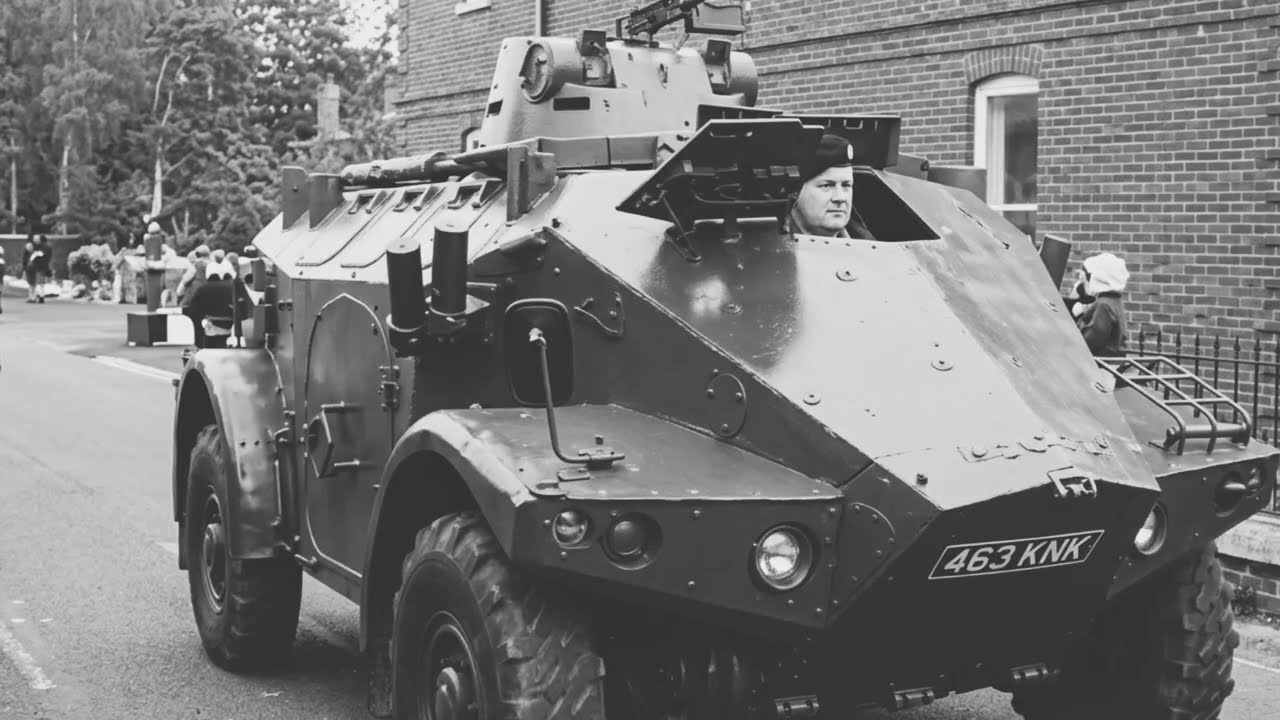
The M3s carried the infantry forward and brought the ammunition back. They were the supply line, not the spearhead. At Wadi Doum in March 1987, the pattern repeated. The M3 hauled troops across hundreds of kilometers of open desert to the objective. Other vehicles did the fighting. Morocco deployed roughly 50 M3s in the Western Sahara against Polisario guerrillas.
Mauritania operated 12. Both forces suffered in the hit-and-run war of the late 1970s, where lightly armored wheeled columns proved vulnerable to ambush. At Lem Side in January 1979, two Moroccan motorized columns were shattered. Polisario captured the five M3s it ever operated from Moroccan forces and never integrated them into its own logistics chain.
Iraq was the largest single combat operator. 244 M3s served in escort and mechanized infantry roles throughout the Iran-Iraq War of 1980 to 1988 and the 1991 Gulf War. Iraqi reconnaissance battalions paired the M3 with AML-90s using the armored car as the striking element and the personnel carrier as the dismount platform.
It was the combination Panhard had designed for and Iraq bought it wholesale, but the wars ground the fleet down. By 2012, only 44 of those 244 vehicles remained operational. Some of those survivors were pressed back into service during the Iraqi Civil War against the Islamic State between 2014 and 2017, half a century after the design was first drawn.
Across sub-Saharan Africa, M3s served in conflicts in the Democratic Republic of Congo, Rwanda, Angola, Burkina Faso, Niger, and Senegal. Rwanda’s armed forces operated about 12 French-supplied M3s during the civil war of 1990 to 1994 when the Rwandan Patriotic Front took Kigali.
Those vehicles retreated with the defeated government forces into Zaire. In none of these theaters did the M3 achieve individual distinction. It was always the vehicle behind the vehicle that mattered. On paper, the M3’s rivals looked superior. The American M113 offered 38 mm of aluminum armor, roughly equivalent to 12 mm of steel, carried 12 troops in a larger hull, was fully tracked for superior cross-country mobility, and had been produced in quantities exceeding 80,000 units.
The Soviet BTR-60PB was an 8×8 design carrying 14 troops with water jet propulsion for genuine river-crossing capability. France’s own véhicule de l’avant blindé, the VAB, selected by the French Army in 1974, weighed 13 to 15 tons, carried better armor, had a range of 1,000 km, and was produced in numbers exceeding 5,000.
In practice, the M3 offered something none of them could match in its target market. A nation operating the AML could absorb the M3 overnight. No new training programs, no new spare parts contracts, no new depot tooling. The air-cooled engine eliminated the radiator failures that plagued liquid cooled rivals in Saharan heat.
Wheels eliminated the track pad replacements that consumed maintenance hours on M113s operating on abrasive laterite roads. The vehicle could self-deploy 600 km on its own fuel without a tank transporter. And French export financing came without the end use restrictions that Washington attached to American equipment, opening markets in Iraq, Saudi Arabia, and apartheid era South Africa that the M113 could not legally enter.
The American Cadillac Gage V-150 Commando was a closer competitor. A 4×4 wheeled carrier with a 200 horsepower V8 engine and better armor. It out-sold the M3 in the Gulf, but the V-150 shared no parts with any existing vehicle in African or Middle Eastern inventories. The M3 did and that single fact decided more procurement competitions than any power comparison ever could.
There is an irony buried in the M3 success that deserves attention. The French army never adopted it. Not a single M3 ever wore the tricolor roundel. France chose the heavier, better protected VAB, which entered service in 1976 and the M3 remained a product built exclusively for export. Yet the vehicle France rejected went on to serve in more countries than the vehicle France chose.
The VAB equipped fewer than 15 nations. The M3 equipped 30. The largest customer was the United Arab Emirates, which acquired 246 vehicles. Saudi Arabia took 150, later re-engineering the entire fleet with turbo diesel power plants. Ireland purchased 44, retiring them between 1996 and 2001.
Production ended in 1986 after approximately 1200 vehicles had been built, replaced on Panhard’s line by the Buffalo, a longer wheelbase derivative that achieved only modest additional sales. In In the M3 remains on the books of at least 23 of its original operators. Saudi Arabia’s fleet is the most thoroughly modernized.
Iraqi examples survive in diminished numbers. Across the Sahel, from Niger to Burkina Faso to Chad, M3s still patrol roads that no tracked vehicle could sustain itself on without a logistics tail three times the vehicle’s own weight. 1971, the Panhard factory, Avenue d’Ivry, Paris, a steel box on four wheels rolls out into a market that did not ask for it. It was underpowered.
It was under armored. It carried no weapon that could threaten a serious adversary. It lacked night vision, nuclear biological chemical protection, and the kind of survivability that any Western army would demand. And yet it worked. It worked in the Saharan dust of Chad, in the rubble-filled streets of Beirut, in the mountain passes of Lebanon, in the flat deserts of Iraq, in the bush tracks of Central Africa.
The Panhard M3 did not win wars. It moved men to where wars were being fought, and it did so cheaply enough and reliably enough that 13 nations chose it over every tracked alternative on the market. It was not powerful. It was not protected. It was compatible. And in the arms export market of the Cold War, compatibility was worth more than armor. That is not luck.
That is French industrial logic. And it outlasted everything the competition could offer.