Why This ‘Ridiculous’ British Trailer Hauled Crashed Spitfires Through The Blitz To Fly Again D
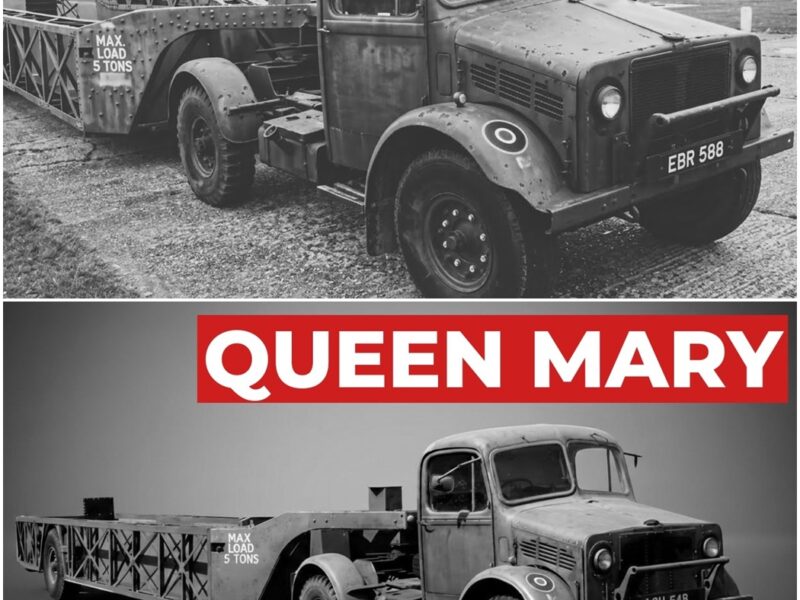
July 1940, the Waterloo Iron Works, Andover, in the county of Hampshire. A flat steel monster rolls out of the workshop doors, 50 ft from coupling to tail, 8 ft wide, 12 in off the ground. A single axle bears the entire weight of the deck. It looked enormous. It looked absurd.
Drivers said it could not be turned around in any village in England. And yet, over the next 5 years, trailers exactly like this one would crawl through bombed streets and blacked out country lanes, recover the broken bones of 79,000 aircraft from fields across Britain, feed the greatest aircraft repair operation of the war, and stay in active military service for more than half a century.
Its official designation was the Tasker 5-ton long low-loading semi-trailer. The men who drove it gave it a different name. They called it the Queen Mary, and it was the trailer that kept Fighter Command alive. To understand why the Queen Mary existed, you need to understand the problem Britain faced in 1938. War was coming.
The Royal Air Force was racing to expand. Spitfires and Hurricanes were rolling off production lines in numbers that would have seemed impossible 5 years earlier. But every fighter that crashed in a field, struck a tree, or belly-landed on a beach was a fighter taken out of the war.
Pre-war recovery still relied on flatbed lorries, hand disassembly, and rail freight. Some salvage parties still used horses. The Air Ministry knew that if war came in the air, those methods would fail in a single afternoon. In 1938, the Air Ministry issued a tender. They wanted a low-loading semi-trailer capable of carrying a complete fighter aircraft, wings dismounted, recovered from anywhere in Britain.
The firm that answered was Taskers of Andover, working out of the Waterloo Iron Works in Hampshire. According to the RAF Museum, Taskers responded in sight 10 days. They submitted a costed proposal and a full-size working prototype, both delivered to Whitehall together. Popular memory often credits Cranes of Dereham in Norfolk as the manufacturer.
That attribution is not supported by the records. Every authoritative source, the RAF Museum, the Imperial War Museum, and Bruce Robertson in Wheels of the RAF, names Taskers of Andover as the designer and primary builder. The vehicle itself was a study in industrial honesty. 50 ft long when coupled to its tractor, 8 ft wide, the deck sat just 12 in off the ground.
That clearance meant a broken Spitfire could be winched aboard at field level without ramps, without lifting frames, sometimes with nothing more than tackle and willing hands. The frame was steel girder. The deck was timber. High side rails ran the length of the bed so that aircraft wings could be carried vertically, resting on their leading edges.
Loaded weight could exceed 8 tons. That weight ruled out most existing army tractors. The recovery teams used the Bedford OXC, the Commer Q2, and from October 1943, the Crossley was QL8, a 4×4 prime mover that drivers nicknamed the donkey. Together, the tractor and trailer formed an articulated combination over 50 ft long that, in some configurations, carried a danger sign on the rear marked 60 ft.
That number became the Queen Mary’s myth. The bed was never The warning was for everyone behind it. Production reached roughly 3,800 units across two main patterns, the 3-ton 1939 version and the larger 5-ton 1943 version. The nickname came from the largest of all British ocean liners.
The RMS Queen Mary was the largest passenger ship of her age. The trailer that carried the largest aircraft of the RAF took her name. Now, before getting into where these trailers actually fought, if this kind of forgotten British engineering is what you came here for, hit subscribe. It takes a second, costs nothing, and helps the channel grow.
In May 1940, when France was falling and the German bomber fleets turned toward Britain, the new Minister of Aircraft Production, Lord Beaverbrook, took control of the salvage system. He did not invent it. The civilian repair organization had been set up at the Morris Motors Works at Cowley, Oxford, on the 11th of September, 1939, under William Morris, Lord Nuffield.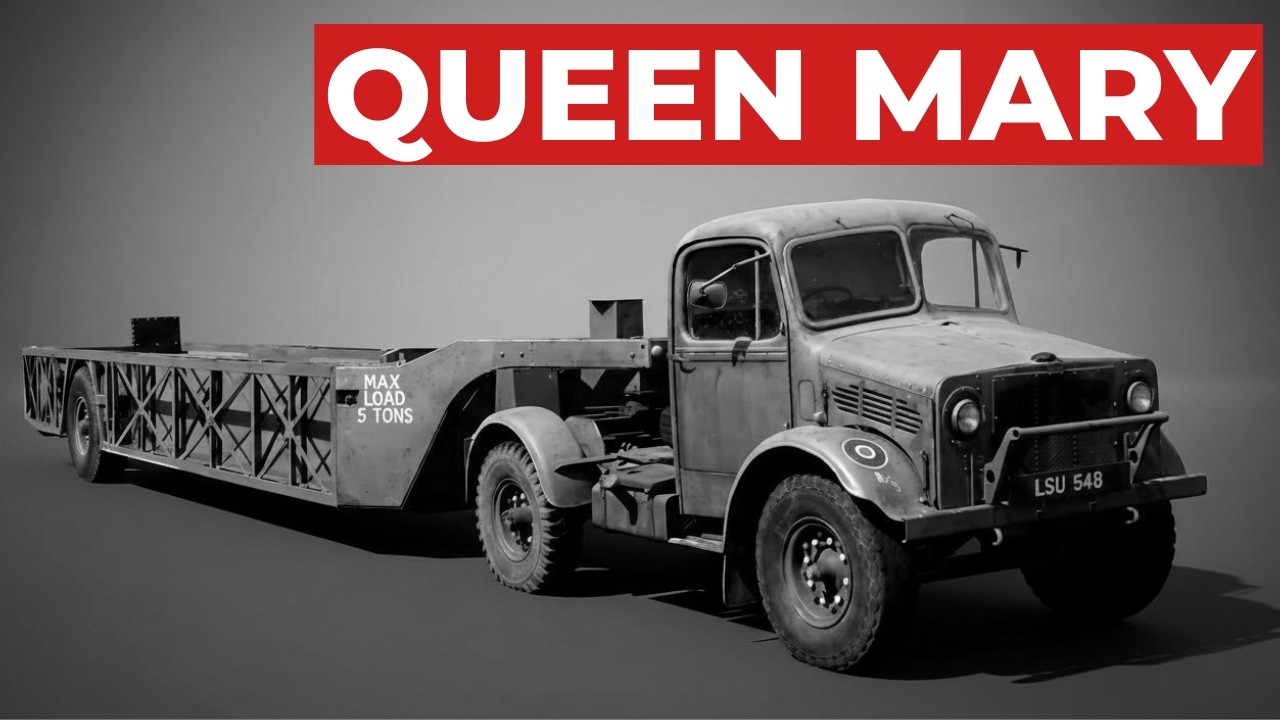
What Beaverbrook did was throw the Queen Mary trailers at it without restraint. Within weeks, repaired aircraft output rose by 186%. Repaired engine output rose by 159%. In his postwar dispatch in the London Gazette, Air Chief Marshal Hugh Dowding wrote that the effect of Beaverbrook’s appointment could be described as magical.
The heavy aircraft wastage that would otherwise have crippled Fighter Command in the Battle of Britain ceased, in his words, to be a primary danger. The trailers themselves were first to feel the storm. On the 16th of August, 1940, a Stuka raid hit RAF Tangmere on the Sussex coast. Two RAF drivers were killed.
Three Commer low-loaders, a Coles crane, and a Bedford 3-tonner were destroyed. The fleet that recovered wrecked fighters was, that afternoon, the wreckage being recovered. The work fell to a string of maintenance units. Number 49 MU at Faygate, near Horsham, covered the south coast. Number 50 MU at Cowley covered the Midlands.
Faygate worked alongside civilian hauliers, especially AV Nichols and Company of 100 North Road, Brighton. Two of their men, Jack Austin and Bob Sawyers, carried out roughly 80 separate aircraft recoveries between September 1940 and March 1941. The work was lethal in ways the public never saw.
On the 24th of September, 1940, recovering a Heinkel He 111 at the Gordon Boys’ School in Chobham, Sawyers’ cutting torch ignited live German rifle ammunition still inside the wreck. The next day at Studland in Dorset, on another He 111, two RAF airmen of a maintenance unit were electrocuted when the jib of their Coles crane brushed an overhead power line.
On the 3rd of November, in Wansunt Road, Bexley, a stick of bombs fell on the Nichols gang as they slept beside a Dornier Do 17. One of the Dornier’s Bramo engines was thrown out of the wreck and into the cab of their Leyland lorry. But the story the trailers will be remembered for is one Spitfire.
On the 25th of October, 1940, near Hastings, Pilot Officer Ludwik Martel of 603 Squadron was hit by cannon fire from a Messerschmitt Bf 109. Polish, 20 years old, he force-landed his Spitfire Mark 2A, serial P7350, with the wheels up. He was wounded in the leg. He sat trapped in the cockpit for half an hour until the Home Guard reached him.
The aircraft was graded category B, not a write-off, repairable in workshop. On the 31st of October, 1940, a Queen Mary trailer collected what was left of P7350 and hauled it through Sussex and across southern England to Number 1 Civilian Repair Unit at Cowley. There, the Morris Motors workshop straightened the airframe, replaced the panels, and recertified the engine.
On the 7th of December, 1940, this same Spitfire flew again. That aircraft is still flying today. P7350 is the only Battle of Britain Spitfire still in the air. It belongs to the RAF’s Battle of Britain Memorial Flight. Every time it passes overhead at a national service of remembrance, the public is watching a fighter that was hauled back to life on a Queen Mary.
By the end of the war, the Civilian Repair Organization had returned roughly 79,000 aircraft to combat. According to the Battle of Britain Network, 61% of all aircraft crossed off squadron lists because they could not be repaired locally were brought back into the fight.
Hamble alone, run by Air Service Training, repaired 3,507 Spitfires across the war. Hucknall, Rolls-Royce’s own factory, used Queen Marys to bring in over 100 Hurricanes that left the workshop as up-gunned Mark IIs. The Armstrong Whitworth Albemarle bomber was actually designed from the start to break down into Queen Mary shippable subsections.
The trailer shaped the aircraft. To remove a single damaged Lancaster from RAF Swinderby took a convoy of six Queen Mary trailers. The Luftwaffe never built a true equivalent. German aircraft salvage was handled by Berge Bataillon, salvage battalions. But for shipping wrecked airframes, the Germans relied on Reichsbahn rail flat cars.
Captured Allied aircraft worth flying went straight to evaluation units. The Americans operating in Britain had no British-style transport either. The Eighth Air Force Service Command used Diamond T tractors, paired with 25-ton Fruehauf flatbeds, and frequently broke up wrecks where they fell rather than recover them whole.
On paper, those vehicles looked superior. In practice, the Queen Mary offered something neither could match. It carried a fighter back to a workshop and let that fighter fly again. One single Queen Mary tells the comparison better than any specification. The Imperial War Museum surviving trailer was dispatched to France in the spring of 1940.
When France fell, the Germans captured it and used it themselves. In 1944, British forces recaptured it. One trailer served both air forces of the war. The Queen Mary outlasted almost everything that towed it. The RAF kept Queen Marys in service through the 1950s. The Fleet Air Arm kept them into the 1960s.
The Royal New Zealand Air Force kept theirs in active frontline service until the early 1990s. That is more than 50 years of unbroken military use. After that, civilian operators bought them. A Queen Mary carried a de Havilland Comet airliner fuselage in 1956. Silver City Airways used them at coastal airfields.
Today, a small handful survive at the RAF Museum in Hendon. A Bedford OXC tractor coupled to a Queen Mary trailer has carried the fuselage of Avro Anson W2068 in the Bomber Hall since April 1996. The Imperial War Museum holds the France and Luftwaffe survivor. The Lincolnshire Aviation Heritage Centre at East Kirkby keeps a running Bedford OX tractor and Queen Mary on the airfield for visitors.
There is a working pairing at Hangar 42, Blackpool. The Air Force Museum of New Zealand at Wigram has held one under restoration since 2020. Generations of British schoolchildren built the Queen Mary in plastic. The Airfix RAF Recovery Set has been continuously available in one form or another since the 1960s.
Oxford Diecast still produces it in 1943 Tunisia markings. July 1940, the Waterloo Iron Works, Andover. A trailer rolls out of the workshop, 50 ft long, 8 ft wide, 12 in off the ground. A single axle. Almost no protection for the men who drove it. It was unwieldy. It was unstable at speed.
Its low ground clearance was punishing on cratered roads. Its crews worked in the open under enemy guns. A single damaged Lancaster needed a convoy of six Queen Marys to recover. A Wellington needed three. Drivers were killed at Tangmere. Other men were electrocuted on Coles cranes. Live ammunition cooked off in cutting torches.
The trailer made the work possible. It did not make the work safe. And yet, it worked. It worked in Sussex stubble fields and Kent orchards. It worked on cratered London streets and unlit country lanes. It worked through the Battle of Britain, through the Blitz, through five years of European war.
Roughly 79,000 aircraft were carried back into combat on its bed. The Queen Mary was not elegant. It was not fast. It was British. And it worked when it mattered most. That is the difference between a fighter command that loses aircraft and a fighter command that gets them back.