Why This ‘Simple’ South African Truck Survives Landmine Blasts That Destroy Every Other Vehicle D
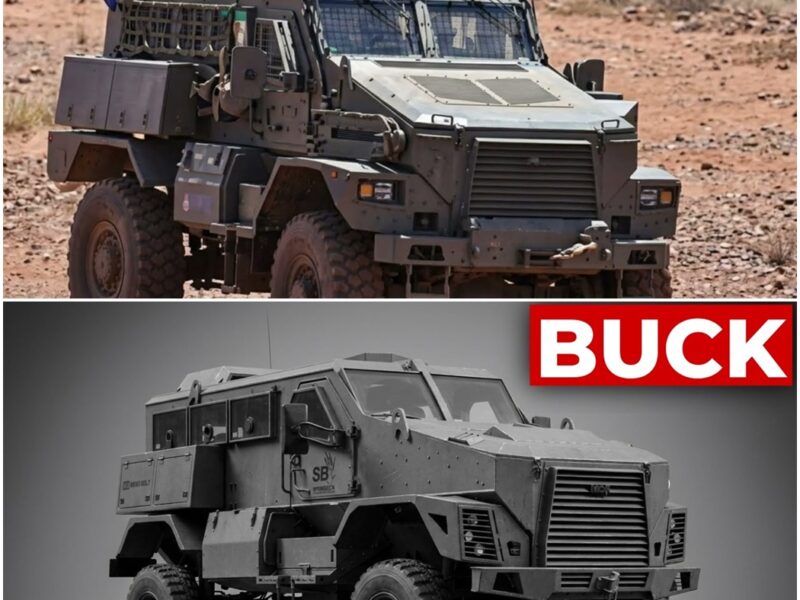
2024 General Service Unit Headquarters, Ruaka, Nairobi, Kenya. Eight armored vehicles rolled through the compound gates in a single file. They are not elegant. They are not fast. They do not carry cannon or missile or any of the sleek systems that draw crowds at international defense shows. They are boxy. They sit high on oversized tires.
Their V-shaped steel hulls look almost agricultural, as if someone had simply folded a sheet of armor plate into a wedge and bolted a cab on top. Cabinet Secretary Kithure Kindiki walked the No ribbon, no speech about revolutionary capability. The official language was practical.
These vehicles would be sent immediately to the North Rift Valley, to the northeastern border region, to the Boni enclave in Lamu County, where al-Shabaab fighters cross from Somalia carrying improvised explosive devices packed with anti-tank mine charges. What the ceremony did not say was this. Kenya had already been operating these vehicles for 4 years before that day.
In those 4 years, three of them had driven directly improvised explosive devices powerful enough to destroy any standard military truck. Two were repaired in the field and returned to patrol within days. A third was repaired and put back into service weeks later. No crew members were killed in any of those three blasts.
The vehicle was the Springbok armored personnel carrier, built by DCD Protected Mobility in Boksburg, South Africa. And it is one of the most quietly effective pieces of military engineering produced anywhere on the African continent in the last 30 years. It is not famous. It has never been featured in a war film. No superpower operates it.
It has no glamorous combat record against a named enemy force. What it has is a verified track record of keeping soldiers alive on the most dangerous roads in Africa. Eight nations operate it. Hundreds are in service, and the philosophy behind its design is so brutally simple that most Western engineers would dismiss it on first inspection. They would be wrong.
To understand why the Springbok exists, you need to understand the problem Southern Africa faced in 1994. That year, production of the Casspir, the vehicle widely credited as the father of all mine protected armored personnel carriers, effectively came to an end. The Casspir had been developed by the South African Council for scientific and industrial research in the early 1980s.
Born from the hard experience of the South African Border War and Rhodesia’s Bush War, two conflicts where land mines laid by insurgent forces had been killing soldiers in flat-bottomed vehicles since the 1960s. Casspir’s answer to the mine problem was the V-shaped hull. Blast energy from a detonation beneath a flat-bottomed vehicle travels straight up into the floor of the crew compartment, coupling directly into the human body.
A V-shaped hull redirects that same energy outward and away from the crew, deflecting the pressure wave to the sides. Combined with a raised ground clearance, sacrificial suspension components designed to break away rather than transmit energy, and blast attenuating seats that absorb residual shock, the geometry transformed what had been a lethal event into a survivable one. The Casspir proved it.
More than 2,500 were built. They absorbed mine blasts that would have killed everyone aboard a conventional vehicle, repeatedly, across Angola, Namibia, and the operational zones of the Border War. But by 1994, the political and economic conditions that sustained Casspir production had changed.
A gap appeared in the market. A small engineering company called Drakensberg Truck Manufacturers, operating from a plot outside Pretoria, saw that gap in 2001 and began designing a replacement. Not a direct Casspir copy, a clean sheet vehicle built on the same principles, but adapted to a different customer base.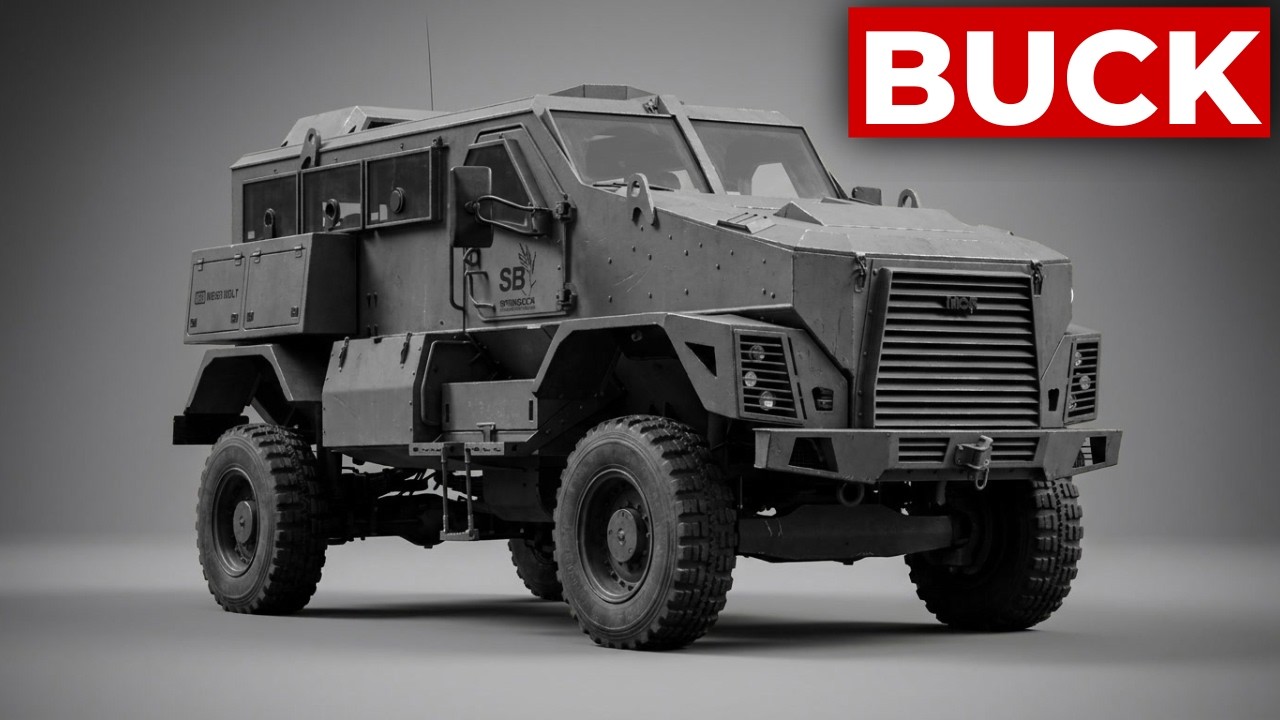
The armies and police forces of sub-Saharan Africa operating in the 21st century on budgets that ruled out expensive European or American mine resistant vehicles, on roads that required reliability over sophistication, and in environments where a vehicle that could not be repaired in the field with locally available tools was worse than no vehicle at all.
The result was the Springbuck DCD protected mobility acquired the design from Drakensberg Truck Manufacturers at the Africa Aerospace and Defense Show in 2012 and expanded the range into three variants. The standard duty, the heavy duty, and the extra duty. Each shares the same fundamental architecture.
A welded all steel armored hull formed into a V shape mounted on a 4×4 commercial drivetrain using components sourced from internationally available suppliers with a crew compartment rated to stop 7.62 mm ball ammunition and a hull geometry rated to defeat landmine blast that would destroy a conventional truck entirely. The standard duty variant weighs 9,000 kg empty.
It carries a driver, a commander, and nine soldiers. 11 personnel in a vehicle roughly the size of a heavy commercial lorry. The engine is a six-cylinder turbocharged diesel producing 194 horsepower driving through an Allison five-speed automatic transmission. Ground clearance under the axle is 385 mm, more than enough to place critical running gear above the immediate blast radius of most buried devices. Top speed is 110 km/h.
Operational range on a single tank is 600 km. Every one of those specifications was chosen for a reason. The commercial Allison gearbox means that mechanics in Lagos or Nairobi or Mogadishu can service and repair it without specialist tools or factory technicians. The 385 mm of clearance is not arbitrary.
It reflects the maximum safe standoff distance between the underside of the hull and the ground calibrated against the blast profile of the devices most commonly encountered in African operational theaters. The 600 km range was set because forward logistics in African peacekeeping operations frequently fail and a vehicle that runs out of fuel on a mine threat road is a vehicle whose crew is stranded.
The blast certification is the engineering centerpiece. According to DCD’s published technical documentation, the standard duty and heavy duty Springbuck hulls are designed to withstand a single TM-57 anti-tank mine detonated directly beneath the hull or two TM-57 mines detonated beneath any single wheel.
The TM-57 is a Soviet-designed anti-tank blast mine containing 6.3 kg of high explosive equivalent to roughly 6.3 kg of TNT. That is the charge that has been destroying vehicles in African conflict since it was first exported in the 1960s. The Springbuck standard duty hull is rated to absorb that blast and keep the crew alive.
The flagship extra duty variant goes further. Its independently certified blast protection meets STANAG 4569 level 4 alpha, which requires survival of a 10 kg TNT equivalent detonation beneath any wheel, and level 3 bravo, which requires survival of 8 kg beneath the center of the hull. The extra duty achieves this while still using the same commercial drivetrain philosophy. A Cummins 6.
7 L engine producing 360 horsepower and an Allison six-speed automatic paired with double wishbone independent suspension giving 350 mm of wheel travel, exceptional by armored vehicle standards, and a payload of 3,500 kg. It can be transported one vehicle per C-130 Hercules aircraft. That single fact defines its strategic usefulness across a continent where road infrastructure cannot always be trusted to deliver heavy equipment where it is needed.
Now, before we get into the combat record and exactly what those Kenyan border patrols revealed, if you are finding this deep dive into African military engineering valuable, hit subscribe. It costs nothing and it helps this channel grow. The combat record of the Springbuck begins not in Kenya, but in Nigeria. The Nigerian Police Force took delivery of the first Springbucks in 2006, becoming the type’s first operational customer.
By 2009, a follow-on order for 48 vehicles had been placed with deliveries running through to 2014. By 2013, according to reports from Army Technology, more than 40 Springbucks were deployed across all 34 Nigerian states operating in counter-insurgency roles against Boko Haram activity in the northeast and providing protected transport for security forces in areas of persistent armed criminal violence.
The Nigerian deployment validated the core design philosophy under real operational conditions in the north of the country where improvised explosive devices had become the dominant threat to security force mobility. The Springbuck’s mine protected hull kept crews alive through blast events that destroyed or disabled the flat bottom trucks it replaced.
DCD and the Nigerian government subsequently partnered with a local manufacturer, Mechelec, to develop a domestically built derivative called the Ikkri based on the Springbuck’s architecture and intended for local production at reduced cost. The principle that had made the Casspir viable in Southern Africa in the 1980s was reproducing itself across West Africa 30 years later.
Burundi brought the Springbuck into its most intense multilateral deployment in November 2018. The Burundian contingent of the African Union Mission in Somalia received 10 Springbuck heavy-duty vehicles ahead of frontline deployment in Mogadishu and the surrounding operational zones. Three of the 10 were fitted with GEW technologies radio-controlled improvised explosive device jamming systems, electronic countermeasure packages designed to defeat the remotely det- nated that Al-Shabaab had been deploying with increasing sophistication against the African Union Mission since its establishment in 2007. The operational environment those vehicles entered was among the most mine and improvised explosive device dense in the world. Between 2007 and 2018, more than 383 African Union Mission personnel were killed by improvised explosive device attacks in Somalia alone accounting for approximately 20% of all mission fatalities. Conventional trucks had been burning on Mogadishu’s
roads for years before Burundi fielded its Springbok fleet. The Burundian contingent chose the South African vehicle precisely because no African Union troop contributing country could absorb the financial or human cost of replacing crews that conventional protection could not keep alive. Kenya’s deployment is the most operationally documented and the most revealing of what the Springbok actually delivers under fire.
The Kenyan security forces, specifically the National Police Service and elements of the Kenya Defense Forces, had been operating Springboks without public acknowledgement for at least four years before Cabinet Secretary Kindiki’s commissioning ceremony in March 2024. During those four years, along the Somali border and in the northern counties where al-Shabaab cross-border infiltration routes converge with traditional cattle raiding territory, three Springboks detonated improvised explosive devices.
DefenseWeb, the principal defense reporting publication covering the African continent, documented what happened. Two of the three vehicles were repaired in the field and returned to operational service within days. The third required more extensive work, but was returned to service shortly afterward.
In all three incidents, the crew survived. The details that matter are not the dramatic ones. They are the mundane ones. Repaired in the field, returned to service, crew alive. The Kenyan government was not publicizing these incidents while they occurred. The first official acknowledgement came only with the formal commissioning ceremony, at which Interior Cabinet Secretary Kindiki announced that the police equipment modernization program would spend 7.
6 billion Kenyan shillings on security force equipment in the following 6 months and a further 29.4 billion over the following 3 years. The Springbok was the centerpiece of the armored vehicle element of that program. A second batch was commissioned on the 6th of March 2025 by Kindiki’s successor, Cabinet Secretary Anesimus Kipchumba Murkomen.
Murkomen attributed a 70% reduction in banditry in northern Kenya to the overall modernization program. The Springbok had been operating in the Kerio Valley in Meru and Isiolo and Marsabit counties and in the Boni Enclave throughout this period alongside the Somali border on roads where the threat was not theoretical. The Springbok’s competitors in the African market reveal the precise gap it fills.
The Casspir, the elder statesman of the mine protected vehicle class, offers superior blast protection. In its Mark II and Mark III configurations, the Casspir is rated to withstand the detonation of four stacked TM-57 mines, a blast level that the Springbok standard duty cannot match. A famous test of the Casspir’s design involved exactly that, four stacked mines detonated beneath a vehicle with crew aboard with the worst injury being a broken ankle.
The Casspir’s hull geometry and mass distribution are the product of decades of refinement through actual combat experience, but the Casspir weighs 12,500 kg empty and costs substantially more than the Springbok. African armies buying vehicles for United Nations peacekeeping missions at their own government’s expense, that cost differential is not an abstraction.
It determines how many vehicles can be fielded, how many crews can be protected, and whether a procurement program completes at all. The RG-31 Nyala, built by BAE Systems from South African origins, offers protection broadly comparable to the Springbok standard duty and heavy duty and has been certified to United States military MRAP category one standards following its extensive deployment in Iraq and Afghanistan.
More than 2,400 RG-31s were built for American and allied forces. On paper, it competes directly with the Springbok XD in the same protection bracket. In practice, its price point and the complexity of its maintenance requirements place it beyond the reach of most African military procurement budgets without external funding.
The Springbok fills the space between the disposable and the unaffordable. It costs less than either the Casspir or the RG-31. Its drivetrain uses commercial components available from Allison and Cummins distributors in most African capitals. Its armor is welded steel, not composite or laminated ceramic tile systems that require factory replacement after blast events.
When a Springbuck absorbs a mine strike, the primary damage is to the suspension, the tires, and the lower hull, all components that a trained military mechanic with basic tools can replace in the field. That is not a minor advantage. In the operating environments where Springbuck serve, the distance to the nearest qualified armored vehicle maintenance depot can be measured in hundreds of kilometers across roads that are themselves mine threatened.
A vehicle that can be repaired on the roadside by the crew that drives it is, for African peacekeeping and counterterrorism operations, a fundamentally different class of equipment from one that must be recovered to a specialist facility before it can return to service. DCD has continued evolving the platform. At the Africa Aerospace and Defense Show in 2024, the company unveiled a Springbuck multi-purpose armored vehicle variant fitted with an Aselsan Alkar 120-mm automated mortar with a maximum range of 8,000 m and blast protection meeting STANAG and 3 bravo. The same basic hull that carries nine soldiers to a patrol checkpoint can now deliver indirect fire support. The same V-shaped steel floor that deflects an anti-tank mine can absorb the sustained recoil of a weapon system that would shake apart a conventional vehicle mounting in sustained fire. 2024 General Service Unit Headquarters, Embakasi, Nairobi.
Those eight vehicles that rolled through the compound gates were not new. Kenya had been operating the type in silence for 4 years. Three vehicles had already been tested not in a controlled demonstration or a laboratory blast trial, but on actual roads against actual devices planted by actual fighters with actual intent to kill.
The Springbuck does not have night vision systems. It does not have active protection against anti-tank missiles. It carries no guided weapons and generates no electronic intelligence. It is not fast enough to avoid contact and not heavy enough to stop a shaped charge warhead. Compared to the armored vehicles that first world military’s field for similar missions, it is stripped bare.
And yet, in Nigeria, it kept police alive through years of counterinsurgency operations that burned through conventional vehicles. In Burundi’s Somali deployment, it gave African Union soldiers a platform that could survive the device that had been killing peacekeepers for a decade. In Kenya, three vehicles absorbed mine blasts that would have ended those patrols permanently, and two of them were back on the road within days.
In the desert scrub of the North Rift Valley, in the alley approaches of Mogadishu, in the track roads of the Boni enclave, where the border is a line on a map and the threat is buried in the soil beneath the wheels. Eight nations bought it. Several are still buying more. That is not marketing.
That is what happens when an engineer builds a vehicle for the problem that actually exists, not the problem that looks impressive on a specification sheet. The Springbuck was built for Africa, and in Africa, it works when it matters.