Why This ‘Small’ British Command Tank Ran Entire Armoured Operations From A Tiny Aluminum Hull D
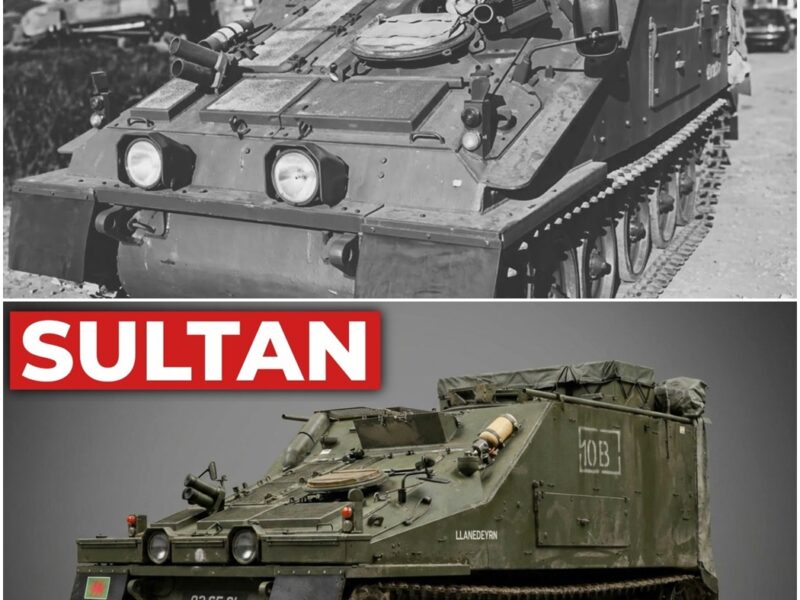
1967, the Alvis factory, Holyhead Road, Coventry, England. Inside the production floor, a vehicle takes shape. It does not look like a weapon. It does not look like a tank. It is boxy, low, squat, built from welded aluminum sheets rather than the thick rolled steel of a real fighting machine.
It has no turret, no gun barrel reaching forward. One machine gun on a pintle mount is the entirety of its armament. A man of average height can barely stand upright inside it. Its working compartment is roughly the size of a garden shed. The engine under its nose comes from a Jaguar road car. Officers seeing it for the first time called it cramped.
Veterans called it a box. Critics pointed out that the armor protecting its crew was barely thicker than a grown man’s thumb. And yet this vehicle, this unremarkable aluminum rectangle on tracks, would go on to run British armored operations across four continents, command reconnaissance regiments through the coldest years of the Cold War in Germany, direct entire armored formations through the deserts of Kuwait and Iraq, coordinate operations across the mountain roads of Bosnia, and keep soldiers alive through the bloodiest years of the war in Afghanistan. It would deploy with every major British military operation for nearly half a century. Foreign armies in more than 20 nations would buy it. Some are still using it today. Its designation was FV105 Sultan, and it was the brain of every British armored reconnaissance regiment that ever went to war. To understand why the Sultan existed, you need to understand the problem Britain faced in the 1960s. By the middle of that decade, the vehicles performing reconnaissance for the British Army were showing their
age. The wheeled Alvis Saladin armored car was powerful but heavy. The Daimler Ferret scout car was nimble but underpowered. Neither could keep pace with the armored spearheads of a modern Warsaw Pact offensive. The Soviet Army was fielding the BMP-1 infantry combat vehicle, capable of crossing rivers without preparation, carrying a full infantry section at speed, and mounting an anti-tank guided weapon.
Britain’s reconnaissance fleet had no answer. In 1966, a formal requirement was issued for a new family of air-portable armored fighting vehicles. The Fighting Vehicles Research and Development Establishment at Chobham in Surrey conducted the initial studies. The specification demanded vehicles light enough to be carried in pairs inside a Lockheed C-130 Hercules transport aircraft, fast enough to outrun anything they could not destroy, and capable of operating across the waterlogged lowlands of the North German Plain without sinking into the soft ground that would swallow heavier vehicles’ hole. In September 1967, the contract was awarded to Alvis Limited of Coventry. The result was the Combat Vehicle Reconnaissance Tracked Family, comprising seven distinct variants sharing a single common hull. The fire support Scorpion, the anti-tank Striker, the personnel carrier Spartan, the ambulance Samaritan, the recovery vehicle Samson, and at the center of it all, the command vehicle the Sultan. Every vehicle in the family shared the
same bones, welded aluminum armor offering protection against heavy machine gun fire and artillery splinters. A torsion bar suspension running five road wheels per side, generating ground pressure so low it was comparable to a soldier on foot, meaning the vehicle could cross ground that would stop a main battle tank outright.
And a Jaguar 4.2 L six-cylinder petrol engine, militarized and detuned to run on low-grade military fuel, producing 195 brake horsepower and pushing the vehicle to road speeds of over 80 km/h. That engine detail matters. Jaguar made road cars. Quiet, refined road cars. Cramming one into an armored fighting vehicle was the kind of lateral thinking that defined British military engineering at its best.
The Scorpion variant, using the same engine, would later set the Guinness World Record for the fastest production tank on Earth at 82.23 km/h, recorded at the Chertsey test track on 26 January 2002. The Sultan itself weighed approximately 8,346 kg in its original configuration. Its hull measured 4.82 m long and 2.28 m wide.
At that size, it was smaller than many civilian delivery vans. What separated it from the Spartan personnel carrier was its raised fixed roof superstructure, a taller boxier fighting compartment that crews universally called the office. Inside the office, a large vertical map board ran the length of one wall. A bench seat for three personnel faced it.
Forward of that, the radio operator managed a fit of four Clansman radio sets simultaneously, monitoring the higher command net, the lower net, two flanking nets, calling in artillery, passing aircraft requests, relaying casualty reports, all at once. Mounted at the rear of the vehicle was its most vital piece of equipment, and it was not electronic, and it was not armored. It was a canvas tent.
Crews called it the penthouse. A collapsible steel tube frame could be erected from the vehicle’s rear within minutes, dramatically expanding the available planning space. Multiple Sultans could park in formation with their penthouses joined, creating a mobile command complex large enough to support a full regimental headquarters.
An auxiliary generator powered the radios and lighting without running the main engine, keeping the vehicle’s thermal and acoustic signature low. The commanding officer could brief a full orders group without anyone crouching on the track guards in the rain. For protection, the crew had smoke grenade dischargers on the hull front and one 7.
62 mm general purpose machine gun on the commander’s mount. The armor would stop a heavy machine gun round at range. It would not stop much else. That was not an accident. The Sultan was designed to think, not to fight. Its survival came from speed, low ground pressure, camouflage, and discipline. The first production vehicles entered British Army service in 1977.
291 were built for the British Army alone. Before this vehicle goes to war, if you are enjoying this deep dive into British armored engineering and military history, hit subscribe now. It takes 1 second. it costs nothing, and it helps the channel grow. The first operational environment the Sultan was designed for was West Germany.
Through the 1970s and 1980s, Sultans equipped the headquarters of every British armored reconnaissance regiment serving with the British Army of the Rhine. Regiments including the Household Cavalry, the Blues and Royals, the 1st Queen’s Dragoon Guards, the 9th and 12th Royal Lancers, and the Light Dragoons kept Sultans at their squadron and regimental headquarters.
The aluminum offices tucked into forest hide positions across Westphalia and Lower Saxony, while Scorpion and Scimitar troops probed forward watching the border. In the event of a Soviet armored assault, those Sultans would have been the places where British commanders received the first reports of contact, plotted advancing enemy formations across their map boards, coordinated artillery and close air support, and issued the orders that would either blunt the offensive or buy time for a counterattack. The reconnaissance regiment was the eyes of the armored division. The Sultan was the brain behind those eyes. The major exercise Lionheart in 1984, the largest NATO exercise of the Cold War decade, placed Sultan-equipped regimental headquarters under sustained pressure for weeks, running continuous operations around the clock, 24 hours a day, every day. The Cold War ended without the scenario it was built for. The first major combat deployment came instead in the desert in 1991, when Britain sent the 1st United Kingdom Armoured Division to Saudi Arabia for the liberation of Kuwait under Operation
Granby. The 1st Queen’s Dragoon Guards deployed as the divisional reconnaissance regiment. Their Sultans crossed the Saudi border into Iraq when the ground war began on 24 February 1991. The 100-hour campaign drove deep into Iraqi-held territory, and reconnaissance regiment headquarters needed to keep pace with the fastest-moving elements of the divisional advance.
Sultans crossed the desert at high speed, penthouse tents rising and collapsing as headquarters leapfrogged forward position after forward position. One vehicle, hull number 92 KB20, was issued to 33 Engineer Regiment for explosive ordnance disposal coordination. Its cramped office managing the tasking of bomb disposal teams clearing the enormous quantities of Iraqi ordnance abandoned by the retreating army.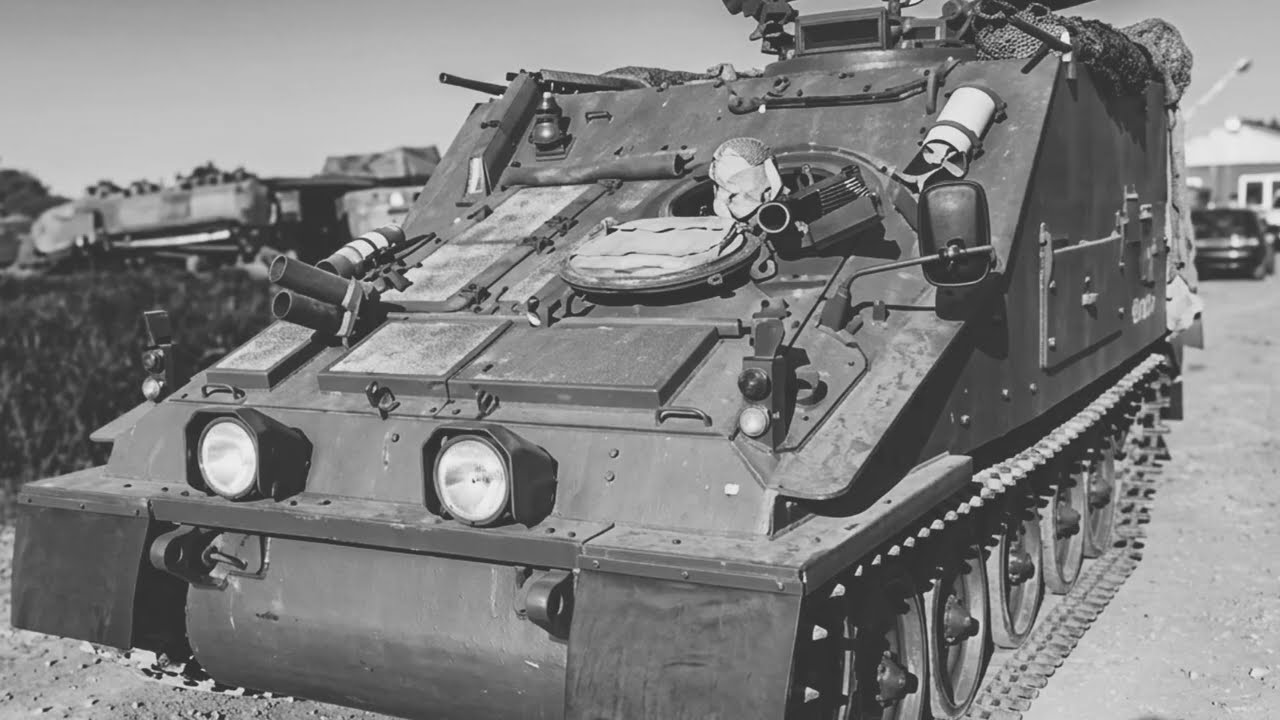
A vehicle the size of a London cab was coordinating an effort on the scale of a department store warehouse. Bosnia came next. From 1993 onward, British formations rotated through the former Yugoslavia as part of United Nations and NATO operations. Squadron level headquarters from the Household Cavalry Regiment, the 9th and 12th Lancers, and other formations deployed Sultans as mobile command posts patrolling the inter-entity boundary line through mountain villages and frozen valleys that would have been impassable for heavier vehicles. In Bosnia, the Sultan’s low ground pressure and high road speed proved as valuable as they had ever been in Germany. The terrain demanded them, but in Bosnia, a problem surfaced that would eventually reshape the vehicle entirely. Serbian forces were reportedly capable of listening in on the unencrypted Clansman radio transmissions coming out of British headquarters vehicles. The brain was exposed. That lesson drove the eventual replacement of the Clansman family with the encrypted Bowman digital communication system, which entered
service with CVR T formations in the mid-2000s. Iraq in 2003 was the third act in the Sultan’s operational career. When the 1st United Kingdom Armoured Division crossed into southern Iraq on 20 March 2003 under Major General Robin Brims, CVR T equipped reconnaissance units pushed ahead of the main advance.
D Squadron of the Household Cavalry Regiment screened forward of the British axis, their Scimitars probing the approaches to Basra, while Sultans accompanied the squadron headquarters through the urban assault and into the long occupation that followed. It was during this period that the Sultan’s original design assumptions were most severely tested.
The emerging insurgency demanded protection against rocket-propelled grenades and improvised explosive devices threats the original aluminum hull had never been designed to survive. Crew bolted on Permali applique armor plates. Engineers welded bar armor cages over the sides and rear. Mine blast protection kits were fitted under the hulls.
A Sultan that had weighed 8 and 1/2 tons at factory acceptance was now approaching 11 tons in full operational configuration. The running gear groaned, but the vehicles kept moving. Afghanistan was the final and most severe test. From 2006 when Britain took responsibility for Helmand province under Operation Herrick, Household Cavalry squadrons rotated through with CVR(T) equipped reconnaissance troops and Sultans sat at the heart of these deployments as squadron headquarters vehicles. The up-armored vehicles performed well against the threats they faced. Multiple vehicles survived improvised explosive device strikes that would have destroyed lighter platforms. Crew operated in temperatures exceeding 50° C in terrain that coated everything in fine talc-like dust where every road and every culvert was a potential ambush site. The Sultan’s engine, by this point the Cummins 5.9 L diesel fitted during the life extension program, proved more reliable in Afghan conditions than the original Jaguar petrol unit it replaced and significantly safer removing the
risk of igniting hundreds of liters of petrol inside an aluminum hull if the vehicle struck a mine. Through four decades of operations from the frozen exercise areas of Westphalia to the dust of Helmand, the Sultan never fired a shot that changed the outcome of a battle. It did not need to.
Every shot that mattered was called from it. The Americans had their own answer to the problem of mobile armored command. The M577 command post carrier was a variant of the M113 armored personnel carrier fitted with a raised rear roof and a working compartment capable of carrying up to eight personnel and five radio sets.
Production ran to several thousand vehicles across multiple variants. The M577 was substantially larger than the Sultan weighing around 14.4 tons more than 1 and 1/2 times the Sultan’s combat weight, it offered more internal volume, more radio capacity, and a tent extension that could connect four vehicles simultaneously in a cross formation. On paper, it looked superior.
In practice, the Sultan offered something the American vehicle could not match. It weighed half as much. It moved 25% faster on roads. It could cross ground that would defeat an M113 without preparation. Two of them fitted inside a single C-130 Hercules. For a British Army that built its reconnaissance regiments around the doctrine of move fast, stay hidden, and avoid decisive engagement, the Sultan’s lightness was not a limitation.
It was the entire point. The Soviets took a different approach entirely. Their BMP-1 command variant carried a 10-m telescoping antenna mast and multiple radio sets, but weighed 13 tons and was optimized for a centralized top-down command style, coordinating the massive fire and maneuver of a Soviet combined arms army.
The Sultan was designed for a command style built on initiative, where a British regimental commanding officer in the field made decisions without waiting for permission from above. Two vehicles, two entirely different conceptions of how armies should think. 291 Sultans were built for the British Army.
A further substantial number went to export customers. Belgium fielded a significant fleet with its mounted rifles regiments until 2004. Brunei purchased two vehicles in 1976 and operates them to this day. Oman, Venezuela, Nigeria, Honduras, Thailand, and the Philippines all fielded Sultans in their own reconnaissance roles.
Latvia received ex-British vehicles in a major transfer beginning in 2014. Ukraine received donated Sultans from British stocks following the Russian invasion of 2022. Replacement came slowly and not cleanly. In 2003, the Ministry of Defense awarded a 166 million pound contract for 401 Panther command and liaison vehicles.
The first Panthers entered service in 2008. They were lighter and faster on roads, but too small to carry the full Bowman radio system and an effective planning team at the same time. In 2018, the entire fleet of 395 Panthers was advertised for disposal. The true conceptual successor to the Sultan, a dedicated armored command variant on a modern hull with full digital integration, is the Ajax Athena, still entering British Army service at the time of writing.
Sultan survived today in museums and private collections across Britain, Belgium, and the Philippines. The example at the Norfolk Tank Museum, hull number 92 KB20, still runs under its own power. It is the vehicle that served in the Gulf War with 33 Engineer Regiment for Explosive Ordnance Disposal.
1967, the Alvis factory, Holyhead Road, Coventry. A boxy aluminum rectangle on tracks rolls off the production line. No gun, no turret, one machine gun, and a canvas tent. It was underpowered by the standards of its era. Its armor would not stop a heavy machine gun at close range.
Its working compartment was barely large enough for a map board and three officers. It had no night vision when it entered service. Its original petrol engine was a fire risk that took two decades to correct. The penthouse tent leaked in heavy rain, and yet it worked. It worked in the frozen exercises of the North German plain.
It worked in the desert sand of Kuwait and southern Iraq. It worked on the mountain roads of Bosnia and the dust tracks of Helmand. It worked for nearly half a century across four continents and more than 20 nations. Inside an aluminum shell no bigger than a transit van, British officers directed artillery, coordinated close air support, managed casualty evacuation, planned night attacks, and gave orders that determined whether men lived or died. The weapon was never the vehicle.
The weapon was always the mind inside it. That is not luck. That is British operational thinking distilled into 291 aluminum boxes.