Why This ‘Strange’ British Missile Carrier Killed Soviet Tanks From Behind A Hill At 4kmD
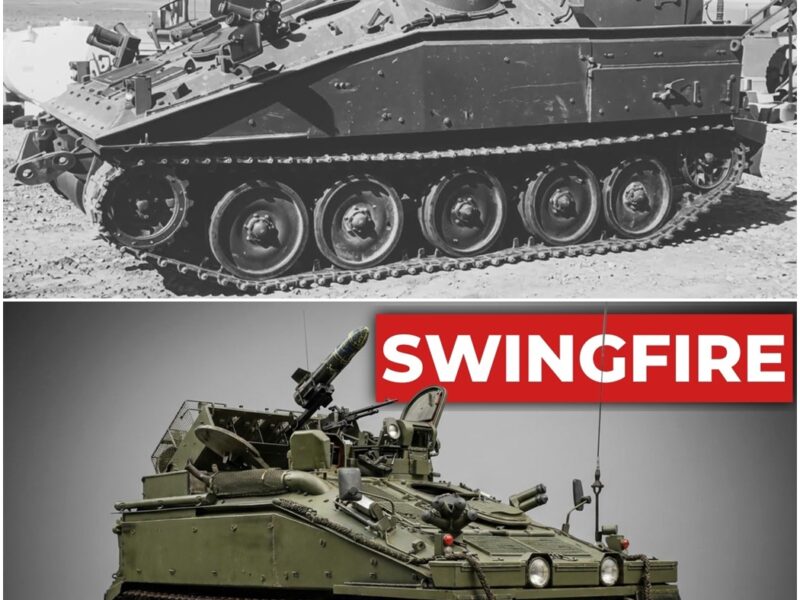
1976, the Bovington Proving Ground, Dorset, Southern England. A small tracked vehicle crawls across the testing range. 8 tons of welded aluminum, three crew, a boxy angular hull lower than a man’s chest. On the rear deck sits something that makes the whole machine look wrong, an elevating launcher box that rises into the air exposing five missile tubes pointed at the sky. It looked strange.
It looked unfinished. It looked like somebody had bolted a luggage rack onto a baby tank and called it a weapon. Foreign observers studying photo graphs of it during the Cold War were puzzled. The aluminum hull was thinner than the armor on a Soviet armored personnel carrier. The crew compartment had no turret.
The gunner station faced sideways. And the missile tubes themselves were not even hinged in the direction of any sensible enemy. But this strange little vehicle would deploy across the inner German border for nearly 30 years. It would lead the British armored advance through Iraqi minefields in 1991.
It would fire on Iraqi tanks in the marshes of southern Iraq in 2003. And it would be the only western armored vehicle of its generation that could destroy main battle tank from behind a hill with its gunner not even sitting inside it. Its designation was the FV102 Striker. And it was the strangest anti-tank vehicle the British Army ever fielded.
To understand why the Striker existed, you need to understand the problem NATO faced in the 1960s. The Soviet plan for a Third World War in Europe was simple, mass armor. The Group of Soviet Forces Germany held thousands of T-62s, T-64s, and the new T-72s, all positioned to pour across the inner German border in waves.
Against them, the British First Corps was assigned to hold a line from the Dutch border to the Harz Mountains. The arithmetic was brutal. NATO planners assumed they would be outnumbered three to one in armor, and possibly worse. Existing weapons could not solve this problem. Conventional anti-tank guns could only engage what they could see.
The older Malkara missile was outdated. American TOW-style designs had range limits. And anything that could see a Soviet tank could be seen by the Soviet tank. Britain needed a different idea, a weapon that could shoot what it could not see. The development began at Fairey Engineering in 1959. The British Aircraft Corporation Guided Weapons Division at Stevenage joined in 1960.
Together with the Royal Armament Research and Development Establishment at Chertsey, they began work on a missile that did something nobody else had ever built. The Swingfire missile was wire guided, 1.07 m long, 170 mm in diameter, 27 kg in weight. It 7 kg heat warhead capable of penetrating up to 800 mm of rolled homogeneous armor, sufficient to defeat any Soviet tank in service.
Its maximum range was 4,000 m, longer than the American TOW, longer than the Soviet Sagger, longer than the early French HOT, but range was not the genius of Swingfire. The genius was a thrust vectoring nozzle in the missile’s tail called the jettison. It could deflect the rocket exhaust to swing the missile up to 90° in the first moments after launch, then 45° in azimuth, 20 in elevation throughout the rest of flight.
This meant the missile could be fired in one direction and flown in another. Then there was the cable, the remote sight unit, a long cord that let the gunner sit 100 m away from the vehicle, up to 20 m higher or lower, in a foxhole, in a hedgerow, in the upper window of a German farmhouse.
The vehicle to carry this missile was developed in parallel. General Staff Operational Requirement 3301 issued in 1964 called for a family of small air portable reconnaissance vehicles. Alvis Limited at Coventry, the company that had built the Saladin and the Saracen, won the prime contract in September 1967.
Every variant in the family received a name beginning with the letter S. Scorpion, Scimitar, Spartan, Samaritan, Sultan, Striker. The Striker shared its hull with the Spartan armored personnel carrier, 8.13 tons combat loaded, welded aluminum armor 12.7 mm thick at its strongest point, proof against rifle fire, proof against shell fragments, nothing more.
The engine was a Jaguar J60, the same 4.2 L straight-6 found in luxury Jaguar saloon cars, derated from 265 to 195 horsepower, so it could run on military diesel and last in service. Top speed exceeded 80 km/h on roads. The Scorpion variant of the same family holds the Guinness record for fastest production tank ever built.
The crew was three, driver in the front left, commander behind him with a 7.62 mm general purpose machine gun in a small cupola, and the gunner on the right side controlling the missile launcher, equipped with the combined sight with the option of dismounting up to 100 m away on the end of the guidance cable.
Five Swingfire missiles sat ready in the elevating launcher box on the rear deck. Five reloads stowed inside the hull. Total ammunition load, 10 missiles. Service entry came in August 1974. The first production Striker rolled off the Alvis line in June 1975. By 1976, the type was operational with British units in Germany.
89 were built for the British Army, 43 more for Belgium. That was the entire fleet, the whole bet against Soviet armor. Now, before we get into whether Striker actually fought and the strange single combat kill that proved everything its designers promised, if you are enjoying this deep dive into British Cold War engineering, hit subscribe.
It takes a second, costs nothing, and helps the channel grow. For most of its service life, the Striker fought a war that never came. Through the 1980s, the British Army of the Rhine fielded two armored reconnaissance regiments, each with four medium reconnaissance squadrons. Every squadron contained an integral guided weapons troop of four Strikers.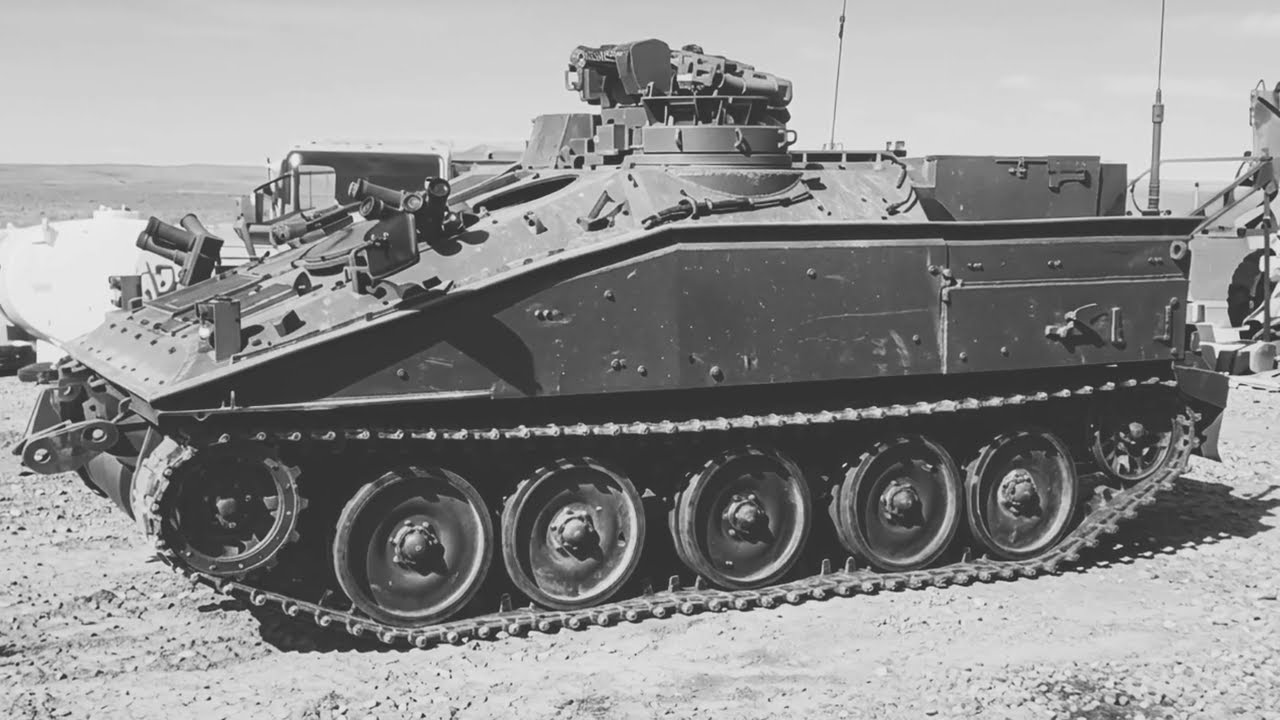
A formation reconnaissance regiment typically counted 48 Scimitar scout cars and 16 Strikers. The missile carriers handled long-range overwatch. The cannon-armed Scimitars handled the close work. The doctrine was elegant. Dig the Striker into a hull-down hide on a reverse slope. Push the gunner forward to a foxhole or a farmhouse window with 100 m of cable.
Engage the leading T-72s in a Soviet motor rifle battalion at 4 km before the Soviet gunners even realized where the missiles were coming from. Collapse to the next ambush position before counterbattery fire arrived, then do it again and again until the Soviet armored thrust bled out across the North German plain. The 16th/5th, the Queen’s Royal Lancers, based at Herford Barracks in Herford, claimed to be the first regiment to deploy anti-tank guided missiles operationally.
The Household Cavalry Regiment, the 9th/12th Royal Lancers, the Light Dragoons, the 1st Queen’s Dragoon Guards, they all rotated through the Striker role. Exercise Lionheart 84 was the largest British Army field exercise since the Second World War. 131,565 personnel deployed across the First Corps area in Germany.
Strikers practiced their ambushes. Live firings took place at Hohne in northern Germany and at Castlemartin in Pembrokeshire, Wales. Then the Cold War ended. In 1991, the British 1st Armoured Division was sent to Saudi Arabia for Operation Granby. Major General Rupert Smith took command. The Divisional Reconnaissance Regiment, the 16th/5th Lancers, fielded 36 Scimitars, 16 Strikers, 12 Spartans, and a tail of Sultan command vehicles and Samaritan ambulances.
On February 25th, 1991, they led the divisional advance through the breach in the Iraqi minefield. They fought direct fire engagements supporting 7 Armoured Brigade across the desert. No published combat kill by a Striker survives from this campaign. Regimental forums carry recollections of a swing fire engagement against an Iraqi armored vehicle, but the named individuals do not appear in authoritative records, and the claim remains anecdotal.
12 years later, the Striker finally had its day, March 2003. Operation Telic, 3 Commando Brigade was tasked with seizing the Al-Faw Peninsula at the southernmost tip of Iraq, the strategic gateway to the Persian Gulf, the place where every drop of Iraqi oil exited the country. The terrain was flat marsh cut by canals and pipelines.
Iraqi forces had dug T-55s and bunker positions into the ground around the oil terminals. C Squadron of the 1st Queen’s Dragoon Guards was attached to the Brigade. They brought their Strykers. On March 24th, 2003, a Stryker of C Squadron engaged an Iraqi T-55 with a Swingfire missile. The missile flew.
The missile turned. The missile hit. The Iraqi tank was destroyed. It was the first and only confirmed main battle tank kill in the entire history of the FV102 Stryker. Over the following days, additional Swingfire firings against Iraqi bunker positions were photographed by the British press pool.
One French agency caption misidentified the missile as a Sidewinder air-to-air weapon. The C Squadron Association later wrote that they had been in constant contact with the enemy for 20 days. Three Commando Brigade presented the regiment with the Commando Dagger, a rare honor for a non-Royal Marine unit.
27 years of Cold War doctrine, 27 years of training in Germany, 27 years of dug-in ambush positions waiting for tanks that never came, and it all came down to one missile fired at one tank in one Iraqi marsh at the edge of the Persian Gulf. The strange thing was, it worked exactly as advertised.
On paper, the Stryker had rivals everywhere. The American M901 Improved TOW Vehicle, built on the M113 chassis, fired the TOW missile out to 3,750 m. The West German Jaguar 1 fired the HOT missile out to 4,000 m with up to 1,250 mm of armor penetration on the later HOT 3 round. The French wheeled VAB Mephisto carried four ready HOT missiles and reloads.
The Soviet BRDM-2 carrier with the Sagger reached 3,000 m and the later Konkurs version stretched out to 4,000. All of them shared one limitation. The launcher had to see the target. The American TOW required the gunner to keep his sight steady on the target throughout the entire missile flight. So did the German HOT.
So did the Soviet Sagger. So did the Konkurs. If the launcher could see the tank, the tank could see the launcher. Only Swingfire combined a 4-km reach with a separable sight. A thrust-vectored missile that could turn the corner and a gunner who could be 100 m from his vehicle in a position the enemy could not even shoot at.
In practice, the Striker offered something nobody else gave their crews: permission to hide. Replacement came quietly. By the mid-2000s, the British Army’s center of gravity had shifted. The Cold War was over. Expeditionary infantry warfare was the new doctrine. Manual missile guidance skills were expensive to maintain.
The HOT 3 round and the TOW 2A had eclipsed Swingfire’s penetration figures. Even the Swingfire improved guidance program, completed in 1996, only kept the system viable for another decade. In mid-2005, the Striker was withdrawn from British service. The Lockheed Martin Raytheon Javelin missile, fired from a soldier’s shoulder, took over its role.
There was no direct vehicle replacement. There never would be. A capability gap opened that day. It has now lasted over 20 years. The British Army’s mounted close combat Overwatch program, intended to replace the Striker’s defilade firing capability, remains in development. Survivors of the 89 vehicles built are scarce.
The Tank Museum at Bovington holds one. Imperial War Museum Duxford holds one. Eden Camp Modern History Museum in North Yorkshire preserves the original prototype, vehicle P28, from the 1972 trials. The Belgian Museum Kapellen at Leopoldsburg holds a Belgian Striker. At least one runs in private hands in Switzerland. Egyptian production of the missile continued long after the British launchers were parked for the last time.
Arab British Dynamics, under the Arab Organization for Industrialization, manufactured over 1,000 Swingfire missiles under license. The missile, in a way, outlived the vehicle that carried it. 1976. The Bovington testing range. The strange little tracked vehicle on the dirt. The aluminum hull.
The five missile tubes elevated and pointed at nothing in particular. The Striker was underpowered. Its armor stopped only small arms and shell fragments. Its missile crawled across the sky at 185 m per second. Its reload procedure required a crewman to climb out of the hull and onto the rear deck exposed to fire. Its crew of three was small.
Its production run of 89 vehicles for the British Army was tiny by armored vehicle standards, and yet it worked. It worked on the inner-German border for 30 years. It worked through Exercise Lionheart 84. It worked at the breach in 1991. And on March 24, 2003 in the marshes of southern Iraq, it worked exactly as a young engineer at Stevenage had drawn it on paper 44 years earlier.
A missile that could turn 90° after launch. A gunner who could fire from behind a hill. A tank killer that never had to show itself to the tanks it was hunting. That is not luck. That is British operational engineering doing exactly what it was built to do.